If you have ever stood alone on a tennis court with a racquet and a basket of balls and nobody to hit with, you already understand the problem PongBot was built to solve. Finding a reliable practice partner is hard, private coaching is expensive, and the old-school ball machine at your club fires the same predictable shot to the same spot until you are bored of it. PongBot takes a different approach. It is a sports-robotics brand that builds AI-assisted training robots for tennis, table tennis, and now pickleball and padel — machines that track where you are standing, wait for you to recover, adapt their shot patterns to your level, and run hundreds of drills from a smartphone app. With a lineup that runs from a roughly $300 table tennis robot to a flagship Pace S Pro tennis machine that picked up multiple CES 2026 awards, backing from Qualcomm's venture arm, two Kickstarter campaigns that each raised well over $2.5 million, and a global community of coaches in dozens of countries, PongBot has quickly become one of the most talked-about names in solo sports training: what if practice felt more like playing a real opponent?
For busy professionals who can only train early or late, parents building a home practice setup for the family, club coaches running group sessions, and competitive juniors or league players who want more quality repetitions per hour, the pitch is compelling. This 2026 review walks through PongBot's full ecosystem — the Pace S and Pace S Pro tennis machines, the new multi-sport Aura, the Nova, Omni, and Halo table tennis robots, the app and AI features, current pricing, head-to-head comparisons, honest limitations, and exactly who should (and shouldn't) buy.
PongBot Review 2026: The AI Training Robots That Turn Solo Practice Into Match-Ready Tennis, Table Tennis, Pickleball, and Padel Sessions
Overview and Background
PongBot is a sports-technology company that designs smart ball-feeding robots and sells them direct to consumers through its official store, alongside retail channels. The company was founded around 2018–2019 by a team with roots in table tennis training technology — founder Fred Zhang previously led AI training-robot research connected to China's national table tennis team — and it has since received strategic investment from Qualcomm's venture arm. That origin explains the brand's DNA: PongBot started with table tennis robots, then carried the same thinking about spin, placement, and drill design onto the much larger tennis court.
The breakout moment came with the Pace S series. Its 2024 Kickstarter campaign raised about $2.7 million from more than 2,500 backers, and the Pace S Pro went on to collect a string of CES 2026 recognitions, including CES Highlight and several “Best of CES” picks from tech publications. In 2026 the company launched Aura, a single machine that reconfigures itself for tennis, pickleball, and padel; its Kickstarter drew more than $2.5 million from over 3,000 backers within its first weeks. Today PongBot ships free across the US, Europe, the UK, and Australia, runs service warehouses and repair centers in California and Germany, and reports a community of coaches and clubs spread across dozens of countries.
There is one thing every buyer needs to understand before going further, and it is the most common source of confusion on the product pages. PongBot's “AI” is not a magic camera that watches you play. On the Pace S Pro, the smart features rely on a small sensor system that ships in the box — two P Station S units placed on the court and a P Tag S tracker worn by the player — which together measure your position so the machine can react. The cheaper Pace S shares the same launch hardware but does not include this tracking system or the four AI training modes, even though its marketing copy leans on similar language.
Why PongBot Stands Out in 2026
Movement tracking that changes how a drill feels: Most ball machines fire on a fixed timer, so you either rush back to the center or stand around waiting. The Pace S Pro samples your position at 100Hz with sub-10cm accuracy and, in Recovery Trigger mode, only launches the next ball once you have returned to your recovery position. Independent reviewers consistently single this out as the feature that makes the machine feel less like a cannon and more like a patient hitting partner who punishes lazy footwork.
Pro-level ball delivery: The Pace machines reach speeds of up to 80 mph (about 130 km/h), generate up to 60 revolutions per second of spin, can switch spin in around 1.5 seconds, and throw lobs as high as 8.1 meters. PongBot also claims genuine full-court coverage, feeding deep baseline balls, drop shots, and lobs across the court rather than confining you to one half.
A deep, growing drill library: The Pace S Pro ships with 564+ preset drills (396 on the Pace S), and the app lets you build your own sequences with control over speed, spin, depth, and placement, then share them with a global community. Some community drills are better than others, as reviewers note, but the sheer range means you rarely run out of fresh sessions. Over-the-air updates keep adding features to both the app and the machine.
Match simulation calibrated to your level: Match Challenge draws on data from 10,000+ real matches to produce varied, rally-like sequences, and it scales difficulty to your NTRP level from 1.0 through 7.0. That makes the same machine useful for a beginner learning to rally and a strong club player preparing for league matches.
Battery life that outlasts your legs: With a 7,800 mAh battery rated for about 8 hours, a 150-ball hopper, and both a physical remote and app control, the Pace S Pro is built for long sessions. Owners report that a two-hour session barely dents the charge, which matters for coaches who run back-to-back lessons.
One brand across four racket sports: Few competitors cover tennis, table tennis, pickleball, and padel under one roof. PongBot's table tennis range spans a compact tabletop robot to a floor-standing club model, and the new Aura uses a patented adaptive wheel track that physically adjusts for balls from 40mm to 80mm — a genuinely novel engineering idea for multi-sport households.
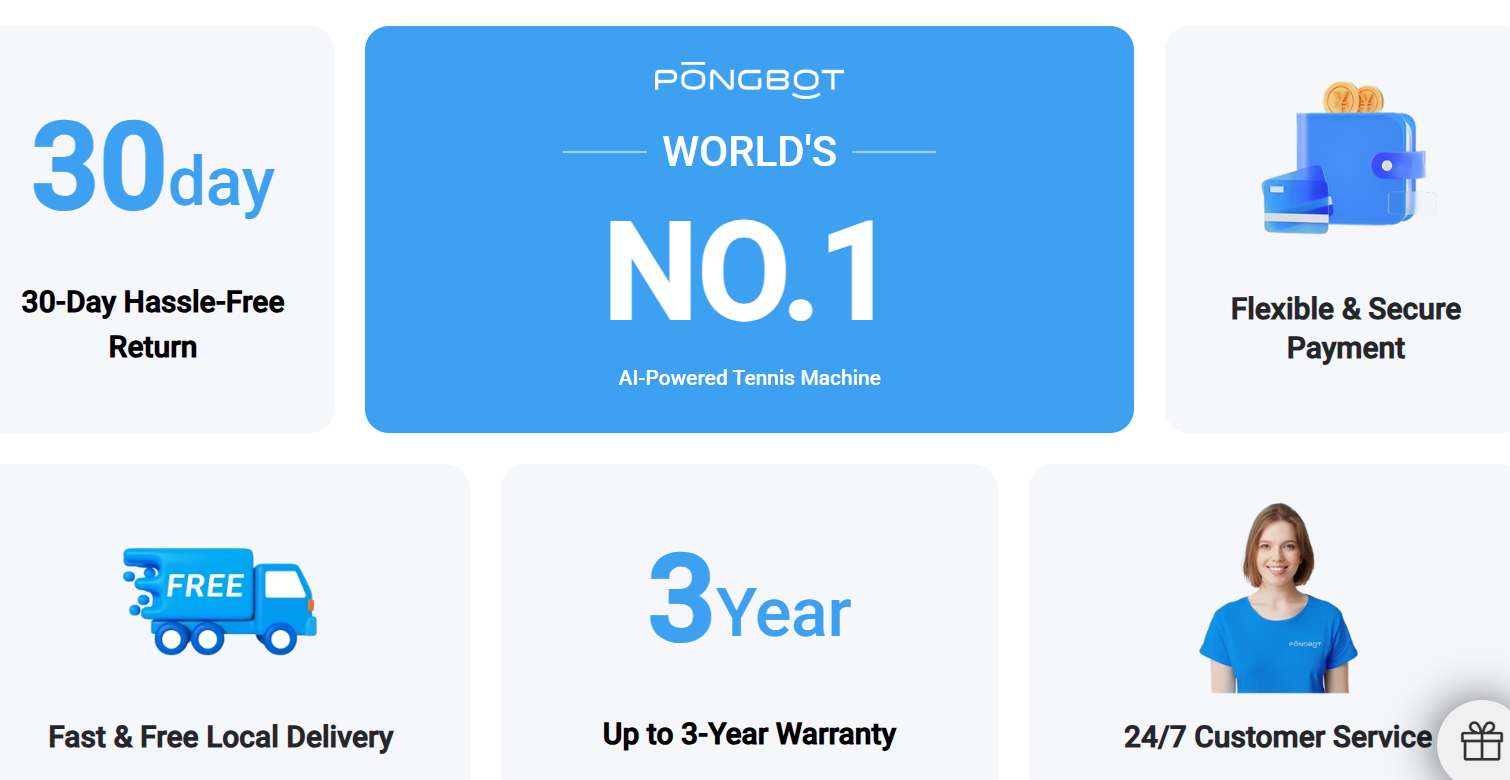
Buyer-friendly store policies: PongBot offers free delivery in its core markets (typically 3–7 business days in the US and EU), a 30-day return window, up to a 3-year warranty on core components, installment payments at checkout, and ongoing customer support by email. For a four-figure purchase, those safety nets matter.
Key Features and Technology
PongBot's lineup splits into three families: the Pace tennis machines, the Aura multi-sport robot, and the S-series table tennis robots. Here is what each brings to the court or table.
Pace S Pro: The AI Flagship
The Pace S Pro is PongBot's headline product and the one most reviewers test. On top of the core ball-delivery engine, it adds four smart modes. Recovery Trigger waits until you return to position before feeding. Adaptive Rally tracks your movement in real time and adjusts shots to where you are, simulating the move-recover-hit rhythm of a real rally. Match Challenge uses an AI model to set intensity based on your hitting and running, pitched at your NTRP level. Arena of Dash combines running and hitting into a dynamic challenge and ranks your results on a leaderboard, which adds a surprisingly motivating competitive layer to solo training.
In the box you get the machine with one battery installed, two P Station S sensors, one P Tag S wearable, a remote control, an adapter, and a cable. The machine measures 700 × 370 × 560 mm, weighs 22 kg, and works on hard, clay, artificial grass, and natural grass courts. It has also been optimized for padel, with custom drills available now and built-in padel drills promised in future updates.
Pace S: The Value Tennis Machine
The Pace S uses the same chassis, the same 15–80 mph speed range, the same 60 rps spin, the same 150-ball capacity, and the same 8-hour battery as the Pro. What it drops is the tracking hardware and the four AI modes, and its preset library is smaller at 396 drills. It still supports full custom drill building in the app and optional accessories like the T Serve S, a serve-trigger sensor that detects your serve and automatically feeds the next ball for serve-and-return practice. For players who mainly want a powerful, programmable feeder, this is where the value sits.
Aura and Aura S: One Machine for Tennis, Pickleball, and Padel
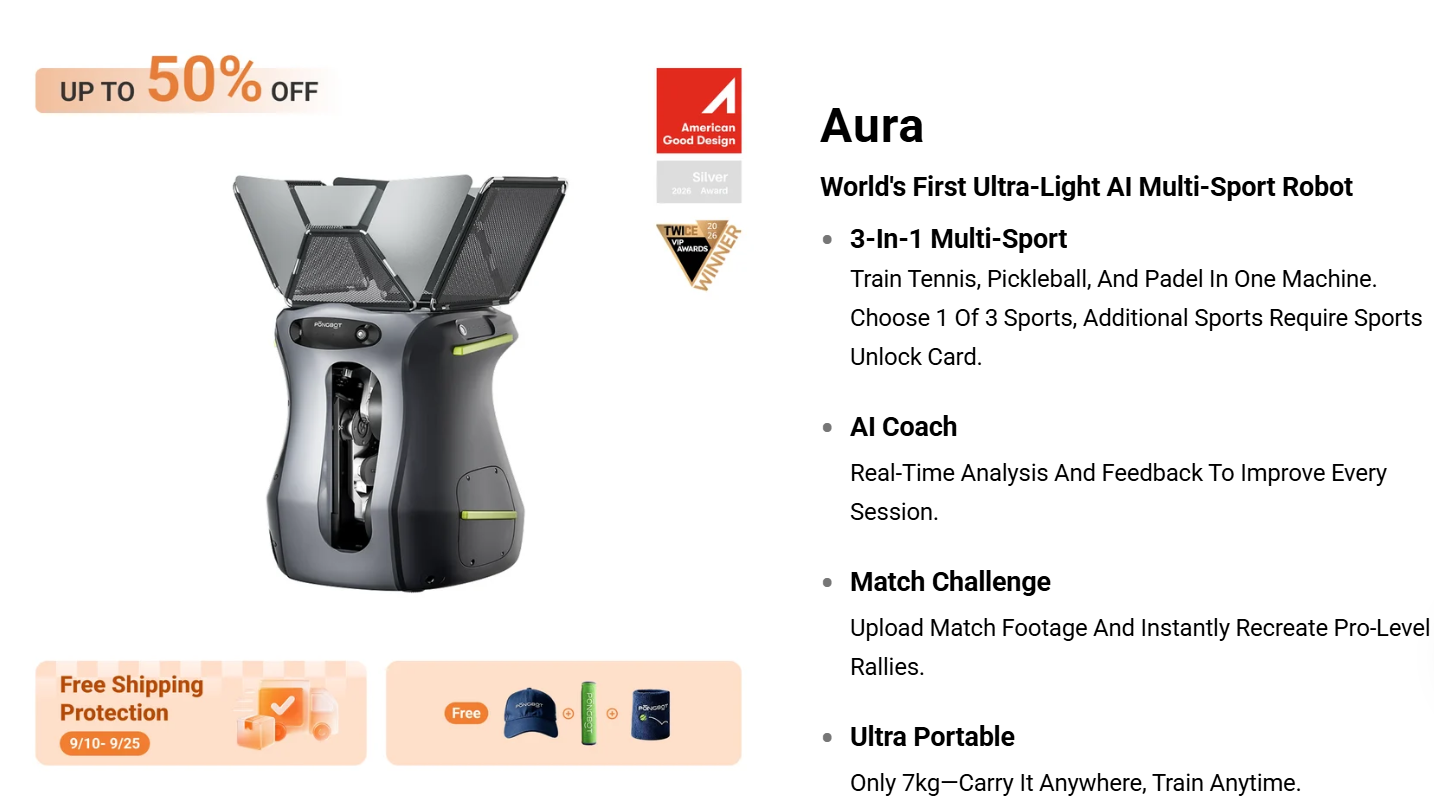
Aura is PongBot's newest and most ambitious product. Its adaptive wheel track physically reconfigures for tennis balls, pickleballs, and padel balls, with modes tuned for each sport — full-court topspin and slice in tennis, dinks and kitchen placement in pickleball, and simulated side-wall and back-wall rebounds in padel. It weighs around 7 kg, holds about 120 tennis or padel balls or 100 pickleballs, and runs up to roughly 5 hours on a 4,500 mAh battery. The Aura S adds a detachable dual-camera Spotter module that analyzes your shots, logs landing points, and can double as an automated line-calling referee near the net. By default, one sport is activated at no extra cost, so check how additional sports are unlocked before you buy.
Nova S Pro, Omni S Series, and Halo S Pro: Table Tennis Robots
PongBot's table tennis range is where the company started, and it scales neatly by player level. The Nova S Pro is the compact, tabletop entry model at around 4 kg with a roughly 150-ball capacity, app control, and topspin and backspin drills — independent reviewers praise its build and value, though some note its heaviest backspin is still easier to loop than a strong opponent's. The Omni S Series (Omni S Plus and Omni S Pro) steps up with a head that moves and rotates to produce a fuller range of spins including sidespin and combinations, more granular placement, and a library of over 500 drills. The Halo S Pro is the floor-standing flagship at about 11 kg with a roughly 250-ball capacity, built for clubs, coaches, and serious home setups.
The App and Community Ecosystem
Across every product, the app is the control center. You browse preset drills, build and save your own routines, download drills shared by other players and coaches, and review training history. PongBot also runs an active Facebook community and partners with clubs and coaches internationally. Reviewers agree the app is capable and generally easy to connect over Bluetooth, though some find the interface busy at first and wish for small quality-of-life touches like favorites and better language selection.
Pricing, Plans, and Package Structure
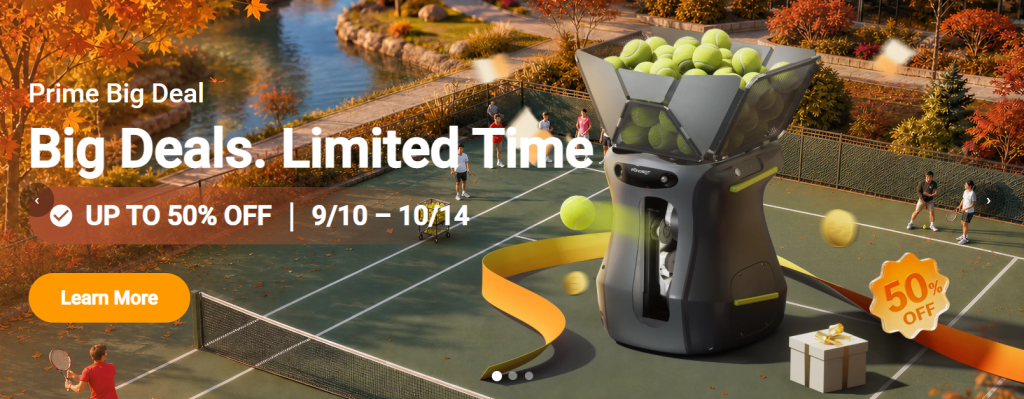
PongBot sells hardware outright — there is no subscription required to use a machine or its drill library. Prices below reflect PongBot's Fall Prime Time sale (running September 10 to October 14, 2026, with up to 50% off list prices); PongBot discounts heavily and frequently, so the “regular” list price is rarely what you actually pay. Treat these figures as approximate and confirm the live price and bundle contents at checkout.
| Product | Approx. Sale Price | Approx. List Price | What You Get | Best For |
|---|---|---|---|---|
| Nova S Pro | ~$299 | ~$399 | Compact tabletop table tennis robot, app control, topspin/backspin drills | Beginners and home table tennis players |
| Omni S Plus | ~$749 | ~$1,199 | Multi-spin table tennis robot with moving head | Improving club players on a budget |
| Omni S Pro | ~$1,099 | ~$1,599 | Full-spin table tennis robot, 500+ drills, advanced placement | Competitive club and rated players |
| Halo S Pro | ~$1,499 | ~$1,999 | Floor-standing table tennis robot, ~250-ball capacity | Clubs, coaches, and dedicated home setups |
| Aura S (pre-order) | ~$799 | ~$1,699 | Multi-sport robot for tennis, pickleball, padel with Spotter AI camera | Multi-sport households and early adopters |
| Pace S | ~$999 | ~$1,699 | Full-power tennis ball machine, 396 drills, custom drill builder | Players who want power and programmability without AI |
| Pace S Pro | ~$1,219 | ~$1,999 | AI tennis machine with tracking kit, 564+ drills, four smart modes | Serious solo players, coaches, and competitors |
| Pace S Pro bundles | ~$1,319–$1,509 | ~$2,139–$2,499 | Adds T Serve S, extra balls, dust cover, or a spare battery | Heavy users and coaches running long sessions |
Accessories are modestly priced: the Court Essentials Kit runs about $40 and a Pace dust cover about $32 on sale. Checkout supports major cards, PayPal, Apple Pay, and Google Pay, plus interest-free installment plans. During the current promotion, PongBot is also bundling a free Court Essentials Kit with Pace S Pro and Aura purchases, 50 free tennis balls for the first 300 Pace S Pro buyers, and free shipping protection on select robots for part of the sale window.
How PongBot Compares to Alternatives
| Factor | PongBot Pace S Pro | Tenniix | Tennibot Partner | Slinger Bag / Traditional Feeder |
|---|---|---|---|---|
| Approx. price | ~$1,219 on sale (~$1,999 list) | ~$849–$899 (Basic) | ~$2,245 (Partner V2) | ~$749 (Slinger); ~$1,079–$2,999 (Lobster Elite range) |
| Player tracking | Yes — wearable tag and court sensors | Yes — AI features | Camera-guided feeding | No |
| Top speed / spin | Up to 80 mph, 60 rps | Competitive | Competitive | Varies; lower on budget models |
| Drill library | 564+ presets plus community drills | App-based drills | App-based drills | Limited; remote or dial control |
| Portability | 22 kg, rolls like a suitcase | Lightweight (~18.7 lbs) | Heavier, autonomous unit | Slinger rolls as a bag; Lobster is heavy |
| Multi-sport | Tennis and padel | Tennis-focused | Tennis and padel | Tennis-focused |
| Best for | Smart solo training and coaching | Budget AI buyers who value portability | Autonomous feeding and ball pickup | Simplicity and proven track record |
vs. Tenniix: Tenniix is the closest rival in the newer AI-powered category and undercuts the Pace S Pro on price while weighing far less, which makes it easier to carry to public courts. PongBot counters with a larger drill library, the Recovery Trigger system that reviewers rate highly, and a more established community of shared drills. If portability and price are decisive, Tenniix deserves a look; if training depth matters most, PongBot has the edge.
vs. Tennibot Partner: Tennibot's machine moves autonomously and can pair with automated ball collection, which is a genuine advantage for coaches tired of picking up balls, and it maps court geometry for padel. It also costs meaningfully more. The Pace S Pro is stationary but delivers similar smart feeding at a lower sale price, so it wins on value unless autonomous movement is a must-have.
vs. Slinger Bag, Lobster, and traditional feeders: The Slinger Bag remains the budget, grab-and-go option for beginners, and Lobster machines offer decades of reliability and simple controls that many clubs still prefer. Neither can wait for your recovery, adapt to your position, or run hundreds of app-built drills. You pay more for PongBot, and you trade some long-term track record, but the training experience is in a different category. On the table tennis side, the Omni S Pro has been listed hundreds of dollars below premium rivals like the Power Pong Omega and Butterfly Amicus Prime, though those 3-wheel flagships still lead for truly lifelike combination spin.
Pros and Cons
What Players Love
Training that feels like a real opponent: Owners and reviewers repeatedly describe the Recovery Trigger and Adaptive Rally modes as the reason they bought the Pace S Pro. Being forced to recover properly before the next ball arrives translates directly into better match footwork.
Outstanding battery life: Multiple owners report running two long sessions in a day without using half the battery. You will run out of energy long before the machine does.
Endless variety: Hundreds of preset drills, a flexible drill builder, and community sharing mean sessions stay fresh for months. Coaches especially value building custom routines for individual students.
Quick setup and solid build: Reviewers report going from box to court-ready in under 15 minutes, with sturdy construction that survives the occasional hit from a stray shot.
Strong value during sales: With frequent discounts that take roughly 35–50% off list prices, PongBot's machines often land below comparable smart feeders — and the Nova S Pro brings app-controlled table tennis training within reach of casual players.
Responsive support: Several owners mention quick replies from customer service on shipping and technical questions, backed by repair centers in the US and Germany.
Limitations Worth Knowing
Heavy and awkward to carry: At 22 kg, the Pace machines roll like a suitcase but have no easy way to lift up stairs or into a car trunk. Reviewers flag this as the main practical drawback.
Top speed is not always usable: At least one owner notes that maximum speed tends to send balls long unless the machine sits well behind the baseline, because it cannot add enough topspin to bring max-speed balls down into the court. Others say ball height cannot be adjusted fully independently.
App learning curve: The app is powerful but busy. Expect to spend some time learning drill settings, and a few default shot types may need tweaking before they feel realistic.
Return costs outside the US and EU: Returns for non-faulty reasons are at your expense, and customers outside the US and Europe must ship returns back to China — a real cost on a 25 kg package.
Newer products carry more risk: Aura is a pre-order product with less real-world history, and multi-sport machines inevitably involve compromises compared with a single-sport specialist. PongBot's tennis reliability record does not automatically transfer to pickleball and padel.
Entry table tennis robot has limits: The Nova S Pro is excellent for the money, but advanced players may find its heaviest backspin lighter than competitive opponents produce and will eventually want an Omni or Halo.
Who Should Use PongBot
Busy professionals who train alone: If your schedule only allows early mornings or late evenings, a machine that is always available removes the biggest barrier to consistent practice. The Pace S Pro gives you structured, match-like sessions without coordinating with anyone.
Competitive juniors and league players: Players preparing for tournaments get the most from Match Challenge and Adaptive Rally, which build decision-making and recovery under pressure. The Pace S Pro with the T Serve S bundle is the natural choice.
Coaches and clubs: Custom drill building, shareable routines, long battery life, and a big hopper make PongBot a strong assistant coach. For tennis, choose the Pace S Pro; for table tennis programs, the Halo S Pro is built for heavy group use.
Families and multi-sport households: If your household splits time between tennis, pickleball, and padel, the Aura S offers one machine for all three at a lower combined cost — provided you are comfortable with a pre-order timeline.
Table tennis players at every level: Beginners and home players should start with the Nova S Pro; improving club players will appreciate the Omni S Plus or Omni S Pro; serious players and coaches should look at the Halo S Pro.
Who should skip it: Absolute beginners on a tight budget who only want a simple feeder may be better served by a basic machine, and anyone who needs to carry a machine up stairs regularly should weigh the 22 kg Pace against lighter rivals.
Getting Started: Step by Step
- Choose your sport and level. Match the machine to how you actually play — Pace S Pro for AI tennis training, Pace S for a value feeder, Aura for multi-sport, or the Nova, Omni, or Halo for table tennis.
- Check the current promotion. Visit the official store, look for active sale pricing and discount codes, and confirm shipping, bundle contents, and return terms for your country.
- Unbox and assemble. Remove the packaging, attach the ball basket, and charge the battery. Most owners are court-ready in under 15 minutes.
- Download the app and pair. Install the PongBot app and connect over Bluetooth. You can also run basic sessions straight from the included remote.
- Load the right balls. Use pressureless tennis balls for daily training; avoid low-compression balls, which can cause jams and inconsistent feeds.
- Start with presets, then build your own. Work through beginner drills to learn the settings, then create custom routines targeting your weaknesses.
- Unlock the smart modes. On the Pace S Pro, place the P Station S sensors, wear the P Tag S, and try Recovery Trigger and Match Challenge once you are comfortable with the basics.
Tips for Getting Maximum Value
Never pay list price — PongBot runs major promotions several times a year, and sale periods routinely cut 35–50% off, often with free accessories on top, so time your purchase around a sale and stack any available discount code. Buy the Pace S Pro rather than the Pace S if there is any chance you will want the AI modes later, because the tracking features cannot be added to the cheaper model. Invest in a good supply of pressureless balls, since a 150-ball hopper is only as good as the balls you feed it and pressurized balls lose bounce quickly under machine use. Explore the community drill library but curate it, saving the routines that work for you and ignoring poorly built ones. Check your club or public court rules before buying, as some facilities restrict ball machines to off-peak hours. Finally, if you live outside the US, EU, UK, or Australia, confirm shipping costs and the return process before ordering, since returns may need to go back to China.
Future Outlook and Final Assessment
The tailwinds are strong. Pickleball and padel are among the fastest-growing racket sports worldwide, tennis participation remains healthy, and players increasingly expect their training tools to be as smart as their phones and watches. PongBot's bet on sensor tracking, AI-calibrated match simulation, over-the-air updates, and a shared drill community positions it well in a market that is moving away from dumb feeders toward genuine training partners. Aura's camera-based Spotter module hints at where the category is heading next: shot analysis, automated line calling, and personalized feedback built into the machine itself.
The honest caveats remain. The Pace machines are heavy, the app rewards patience, return logistics are less friendly outside core markets, and the newest products still need to prove themselves in long-term, real-world use. But within those boundaries, PongBot delivers one of the most complete, feature-rich, and genuinely effective solo training ecosystems available in 2026, at sale prices that consistently undercut comparable smart machines.
Conclusion
PongBot has built something rare in sports equipment: a coherent family of training robots that meets players where they are, from a compact table tennis robot on the kitchen table to an AI-assisted tennis machine that waits for you to recover and plays to your level. It is powerful, versatile, backed by a real community and credible investors, and priced aggressively during its frequent sales. Pick the model that matches your sport and ambition, confirm the live price and shipping terms, and PongBot turns every solo session into purposeful, match-ready practice — the kind of smart tool that helps you make everything easy on the path to your best game.
Ready to train smarter with an AI practice partner that never cancels?
Explore more honest reviews, tutorials and tool comparisons to find the right tech for the way you work and live — at AI Solutes, where we make everything easy.
👉 Get Started: https://ai-solutes.com/pongbot
👉 Our YouTube Channel: youtube.com/@ai-solutes
👉 Our Facebook Fanpage: Facebook
👉 Our X (Twitter): @AISolutes
- Can Pipedrive Successfully Centralize Your Customer Communication Across Email, Web Forms, and Live Chat? Testing the CRM
- Will Bitdefender Secure the Future of Connected Devices? A Deeper Look at Its Behavioral Monitoring Tools
- Hume AI 2026 Guide: Build Empathic Voice Assistants with Emotion AI, EVI, and TADA TTS
- What If You Could Delegate Daily Tasks to a Dedicated AI Team? Inside Sintra AI’s Automation Suite
- Tripo 3D AI