For most of the AI boom, frontier-class intelligence has meant frontier-class prices — and a short list of Western labs deciding who gets access and at what cost. Z.ai is one of the boldest challenges to that status quo. It’s the international brand of Zhipu AI, a Beijing research lab spun out of Tsinghua University that builds the GLM family of large language models, and it has spent 2026 doing something unusual: shipping models that trade blows with the best on coding and reasoning benchmarks, releasing many of them as free, open-weight downloads, and pricing its paid tiers at a fraction of what OpenAI or Anthropic charge. The scale of the bet is real. In January 2026, Zhipu became the first large-language-model company in the world to go public, listing in Hong Kong at a valuation of roughly $6.6 billion, on the back of 2025 revenue that grew about 132% year over year and a backer list that includes Alibaba, Tencent, Xiaomi, and Saudi Aramco’s investment arm.
The result, at z.ai, is a genuinely capable AI platform: a free chatbot and agent anyone can use in the browser, a developer coding plan that undercuts every Western subscription, and open weights you can self-host — all powered by GLM-5.2, a model with a one-million-token context window built for long-horizon, agentic work. It’s not without trade-offs, and some of them matter a great deal depending on who you are and what data you handle. This review walks through what Z.ai actually is and who builds it, the GLM technology and features, the real (and frequently-shifting) pricing, honest comparisons with the Western giants, genuine limitations worth knowing, and exactly who should — and shouldn’t — put it to work.
Z.ai Review 2026: Frontier-Class AI at a Fraction of the Price, With Open Weights and Honest Caveats
Overview and Background
Z.ai is the global-facing brand of Zhipu AI, one of China’s leading AI labs and a member of the group often nicknamed the country’s “AI tigers.” The company was founded in 2019 as a commercial spin-out of Tsinghua University’s Knowledge Engineering Group by professors Tang Jie and Li Juanzi, and is led by CEO Zhang Peng. That academic DNA runs through everything it ships: the GLM (“General Language Model”) architecture, the open ChatGLM dialogue models that made it well known in 2023, and a steady stream of research on agents, vision, and video. In July 2025, the lab rebranded internationally from Zhipu AI to Z.ai — a signal that it was done being a China-only product and was coming after the global developer market directly.
Crucially, Z.ai is a model lab, not primarily a chat-app company. It monetizes its GLM models across three distinct surfaces: a free chat interface at chat.z.ai (use GLM models in the browser at no cost, much like a free ChatGPT account); a pay-as-you-go API through its open platform; and the GLM Coding Plan, a subscription that gives developers metered access to its top models inside coding tools. The model cadence has been relentless — GLM-4.5 (July 2025), GLM-4.6 (September 2025), GLM-4.7 (December 2025), GLM-5 (February 2026), GLM-5.1 (April 2026), and the current flagship GLM-5.2 (June 2026) — with the company’s slogan for this generation being a shift “from vibe coding to agentic engineering.”
The corporate milestone that defined its year was going public. On January 8, 2026, Zhipu listed on the Hong Kong Stock Exchange (ticker 2513.HK), billed as the world’s first listing by an LLM company, raising roughly $558 million at a valuation near $6.6 billion, with about 70% of proceeds earmarked for model R&D through 2028. Before listing it had raised around $1.5 billion from an unusually broad set of investors — Alibaba, Tencent, Ant Group, Meituan, Xiaomi, Hillhouse, and Saudi Aramco’s Prosperity7 Ventures among them. The stock has been volatile since (it briefly spiked to a valuation over $100 billion in May 2026 before falling back), and the company has approved a plan for a secondary listing on Shanghai’s STAR Market.
Why Z.ai Stands Out in 2026
Frontier-class capability at a fraction of the cost: This is the headline. On Z.ai’s own testing, GLM-5.2 lands within a few points of the very best Western models on coding and reasoning benchmarks while its standalone API costs roughly a sixth of what comparable frontier models charge. Even accounting for the caveat that those benchmarks are vendor-reported, developers who’ve tested GLM against their real codebases keep reaching the same verdict: for many tasks it’s not a downgrade — it’s the same work, far cheaper.
A genuinely free chatbot for everyone: Anyone can go to chat.z.ai and use GLM models in the browser at no cost — for writing, research, coding help, or building slide decks — the same way you’d use a free ChatGPT account. For casual users, students, marketers, and content creators who just want a capable assistant without a subscription, that free tier alone makes Z.ai worth bookmarking.
Open weights under a permissive license: Unlike the closed flagships from OpenAI and Anthropic, Z.ai releases its top models — including GLM-5.2 — as open weights under the MIT license, free to download, modify, fine-tune, and self-host for commercial use. That’s a rare combination of frontier capability and genuine ownership, and it’s the cleanest answer to both vendor lock-in and data-sovereignty concerns.
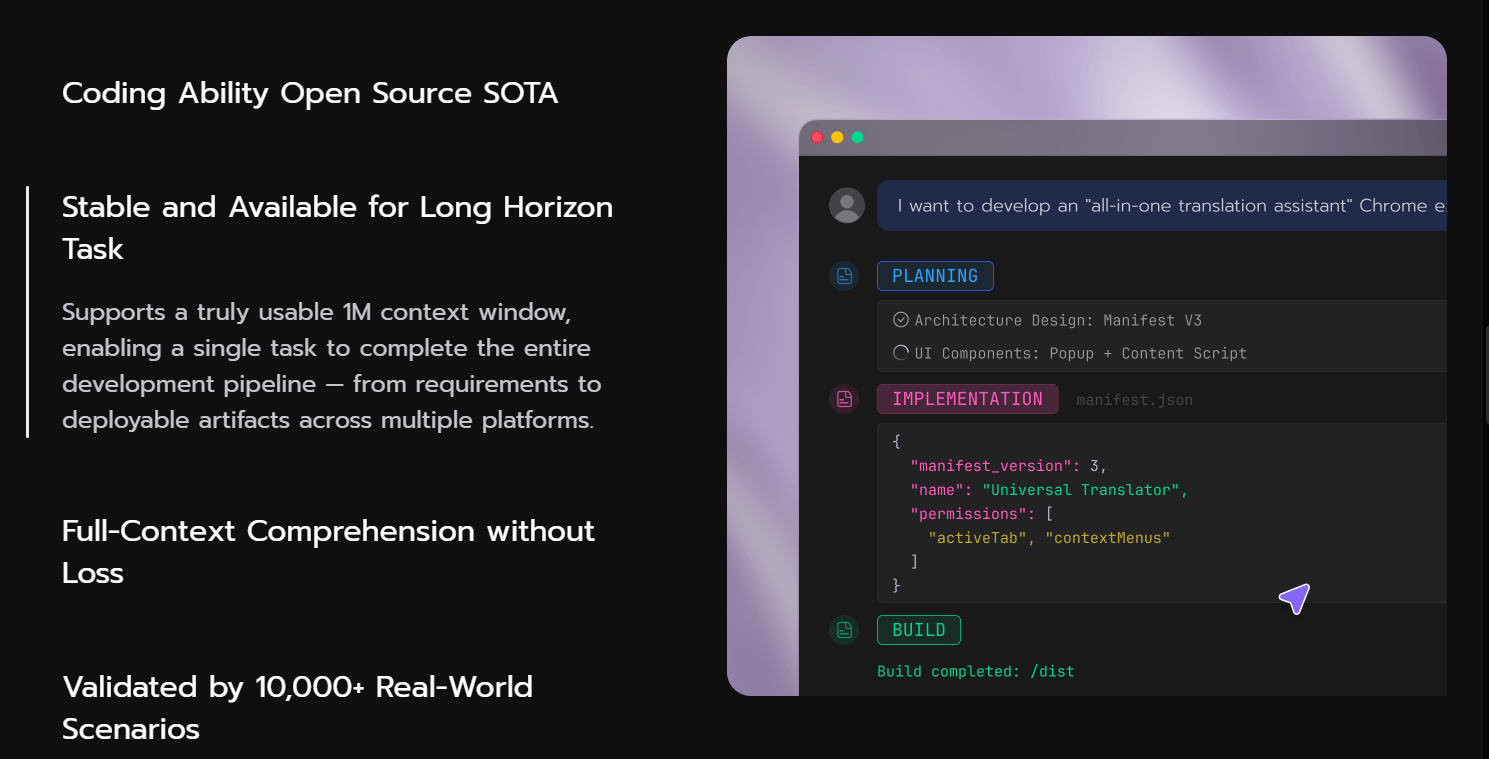
A one-million-token context window: GLM-5.2 ships with a usable 1M-token context — roughly a fivefold jump over its predecessor — enough to hold an entire mid-sized code repository or a large document set in memory at once, with output up to 131,072 tokens for multi-file rewrites in a single pass. For repository-scale coding and long-document work, that headroom is a real, practical advantage.
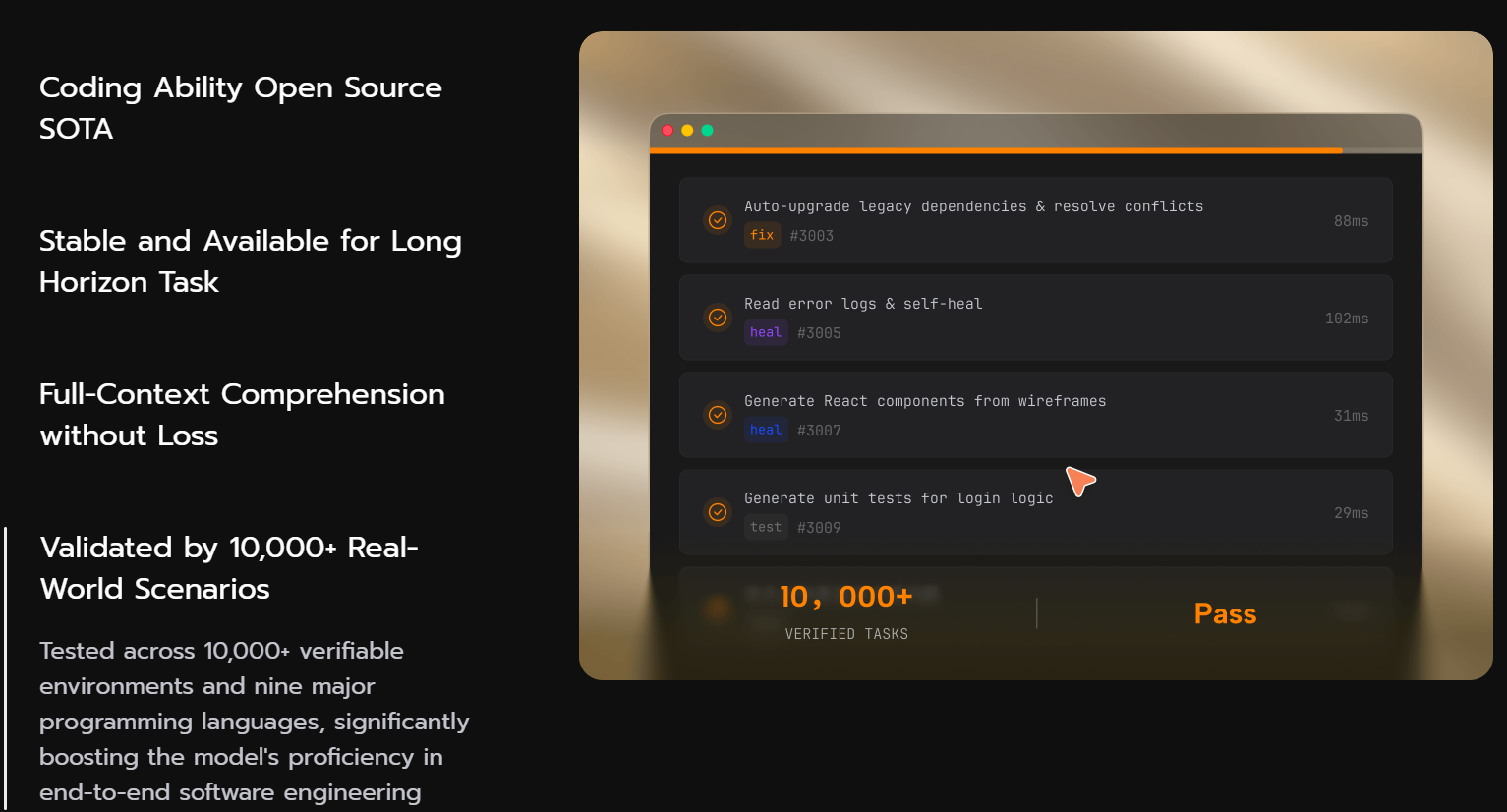
Built for agents, not just chat: The GLM-5 series is explicitly tuned for long-horizon software engineering and autonomous agent work rather than one-off prompts. Z.ai markets GLM-5.1 as able to sustain autonomous work for hours across hundreds of iterations, and GLM-5.2 doubles down with first-class function calling and multi-turn tool use. If you’re building agents or automating multi-step workflows, it reads like it was designed for exactly that.
A drop-in backend for the tools you already use: The GLM Coding Plan exposes an Anthropic-compatible endpoint, which makes it a practical drop-in backend for Claude Code, plus it works with Cline, Cursor, Continue.dev, Roo Code, OpenCode, and any tool that speaks the OpenAI or Anthropic API format. You can often keep your existing workflow and simply swap the model underneath it.
Serious backing and a relentless release pace: As the first LLM company to IPO, backed by China’s biggest tech names and pouring most of its proceeds into R&D, Z.ai has both the resources and the demonstrated cadence to keep improving fast — six major model releases in a year is not a company resting on its lead.
Key Features and Technology
Z.ai spans a free consumer assistant, a family of frontier models, a developer coding plan, and a full multimodal toolkit. Here’s how the pieces fit together.
The Free Z.ai Chatbot and Agent
At chat.z.ai you get a capable, free AI assistant that goes beyond Q&A: it can build websites, write and debug code, run deep-research tasks, generate presentation slide decks, and handle long-horizon jobs — the kind of agentic execution that used to require a paid tier elsewhere. It’s the easiest on-ramp, and for many non-developers it’s all they’ll ever need from the platform.
The GLM-5 Model Family
The engine underneath is the GLM-5 series. The current flagship, GLM-5.2 (released June 13, 2026), is a large Mixture-of-Experts model — roughly 753 billion total parameters with about 40 billion active per token — paired with a 1M-token context and two selectable reasoning modes (High and Max). On Z.ai’s own benchmarks it posts strong numbers (around 62.1 on SWE-bench Pro and 81.0 on Terminal-Bench 2.1, edging past GPT-5.5 on some coding tasks), though those figures are vendor-reported and still awaiting broad independent verification, and it trails the very top models such as Claude Opus 4.8 on the hardest long-horizon engineering tasks. Lighter and faster variants (Flash and Turbo models) round out the lineup for simpler work.
GLM Coding Plan and Developer Tools
For developers, the GLM Coding Plan is the main paid product — a subscription that meters usage by prompts within rolling five-hour and weekly windows rather than monthly credits, so heavy users can cycle through multiple windows a day. It plugs into more than twenty mainstream coding tools (Claude Code, Cline, Cursor, Roo Code, OpenCode, and others) thanks to OpenAI- and Anthropic-compatible endpoints, letting you slot GLM into an existing agentic-coding setup with minimal friction.
Multimodal: Vision, Image, Video, and OCR
Beyond text, Zhipu’s open platform (bigmodel.cn) offers the wider GLM ecosystem: vision-reasoning models (the GLM-V line) for image, video, and GUI-agent tasks, image generation via CogView, video generation via CogVideoX, and a dedicated GLM-OCR model for extracting text from documents and images. It adds up to a one-stop toolkit for building multimodal applications, not just chatting.
Open Weights and Self-Hosting
GLM-5.2’s weights are published under the MIT license on Hugging Face (under the zai-org organization) and run through serving frameworks like vLLM, SGLang, Ollama, and LM Studio. Self-hosting keeps all your data on your own infrastructure — the strongest answer to sovereignty concerns — but at this scale it’s demanding: a 700B-class model needs hundreds of gigabytes of memory even quantized, so it’s a multi-GPU or big-unified-memory undertaking, not something a single laptop can run.
Pricing, Plans, and Package Structure
Z.ai’s pricing spans three routes: a free chat interface, a pay-as-you-go API, and the tiered GLM Coding Plan. The Coding Plan is billed by prompt quota (with discounts of roughly 10% for monthly, 20% for quarterly, and 30% for yearly commitments), and it applies a peak-hours multiplier that can burn quota faster at busy times. Be warned that these numbers move often — Zhipu has restructured pricing several times, and different sources report different figures — so treat the table below as approximate signposts and confirm the live plan on z.ai before you buy.
| Plan | Approx. Price | What You Get | Best For |
|---|---|---|---|
| Free Chat | $0 | Full GLM chatbot and agent at chat.z.ai — writing, research, coding help, AI slides | Everyone: casual users, writers, marketers, students |
| Free API (Flash) | $0 | GLM Flash models via API for simple tasks (formatting, completions, lookups) | Developers testing or running light automation |
| Coding Plan — Lite | ~$10–18 / month* | Entry prompt quota, access to GLM-5.2 and others, works in Claude Code / Cline / Cursor | Hobbyists and light coding experimentation |
| Coding Plan — Pro | ~$30–72 / month* | Higher quota, full model lineup, agentic multi-step workflows | Solo devs and small teams (the usual sweet spot) |
| Coding Plan — Max | ~$80–160 / month* | Highest quota for long, multi-hour autonomous agent sessions | Power users running heavy agent workloads |
| Standalone API | ~$1.40 in / $4.40 out per 1M tokens* | Pay-as-you-go GLM-5.2 access (~1/6 the cost of top Western APIs) | App builders and metered/production usage |
How Z.ai Compares to Alternatives
| Factor | Z.ai (GLM) | Claude (Anthropic) | ChatGPT (OpenAI) | DeepSeek |
|---|---|---|---|---|
| Open weights | Yes (MIT license) | No (closed) | No (closed) | Yes (open weights) |
| Free tier | Yes (free chat + Flash API) | Yes (limited free chat) | Yes (limited free chat) | Yes (free chat) |
| Relative API cost | Very low (~1/6 of top Western) | Premium | Premium | Very low |
| Context window | 1M tokens (GLM-5.2) | Large (200K+) | Large | Large |
| Data hosting | China (or self-host) | US / Western | US / Western | China (or self-host) |
| Best-known strength | Cheap agentic coding, huge context | Top-tier coding and reasoning | Broadest ecosystem and polish | Low-cost reasoning models |
vs. Claude and ChatGPT: The Western flagships still lead on the hardest long-horizon engineering tasks, polish, ecosystem depth, and enterprise trust, and they host your data in the US or other Western jurisdictions. What Z.ai offers instead is comparable capability for a great many everyday tasks at a fraction of the price, plus open weights you can own. For mission-critical work where every last point of reliability and Western data hosting matter, Claude or ChatGPT remain the safer picks; for cost-sensitive building where GLM is “good enough” (and it very often is), Z.ai is compelling.
vs. DeepSeek: DeepSeek is Z.ai’s closest analogue — another Chinese lab shipping cheap, open-weight models that pressure Western pricing. On independent composite indices the two trade places depending on the task, with DeepSeek often strong on general reasoning and GLM sharpened specifically for agentic, repository-scale coding and boasting a larger context window. If your focus is long-horizon coding agents, GLM’s specialization is the differentiator; if you want a broad low-cost reasoning model, both deserve a look, and many teams keep an eye on both.
Pros and Cons
What Users Love
Extraordinary value: The recurring theme across developer reviews is that GLM delivers most of the capability of frontier models at roughly a sixth of the API cost — and its coding subscription undercuts every Western equivalent. For budget-conscious builders, the price-to-performance is the whole appeal, and it’s genuinely hard to beat.
A capable free tier anyone can use: The browser chatbot at chat.z.ai is free and surprisingly full-featured — coding, research, slides, agentic tasks — making Z.ai instantly useful to non-developers with zero commitment. It’s one of the strongest free AI assistants available.
True ownership through open weights: MIT-licensed weights mean you can download, fine-tune, and self-host GLM-5.2 with no vendor lock-in and no data leaving your infrastructure. Few frontier-class models offer that freedom, and for the right team it’s a decisive advantage.
Massive context and agent-first design: A usable one-million-token window plus tooling built for long-horizon, multi-step agent work makes GLM-5.2 excellent for repository-scale coding and sustained autonomous tasks — areas where many general assistants struggle.
Drops into your existing tools: Anthropic- and OpenAI-compatible endpoints let you use GLM inside Claude Code, Cursor, Cline, and other popular agents with minimal rewiring, so trying it rarely means abandoning your workflow.
Limitations Worth Knowing
Data sovereignty and regulatory risk: The hosted service routes data through Chinese infrastructure, Zhipu is on the US Entity List, and the models align with PRC content rules. For regulated, government, or sensitive-data workloads, that’s a real barrier — self-hosting or a Western provider is often the safer route, and Western enterprises have historically been slow to trust Beijing-based labs regardless of benchmarks.
Benchmarks are vendor-reported: Z.ai’s most impressive “beats GPT-5.5 / rivals Opus” claims come from its own testing and haven’t had broad independent verification; independent indices tend to place its models a notch lower on the hardest general tasks. The models are strong, but the marketing numbers deserve healthy skepticism until you test them yourself.
Coding-first, not a polished all-rounder: The GLM-5 series is deliberately optimized for software engineering and agents, with general chat treated almost as a side effect. For pure writing, nuanced conversation, or general-assistant polish, the leading Western models can still feel more refined.
Confusing, shifting pricing: Prompt-based quotas, five-hour windows, peak-versus-off-peak multipliers, promo expiries, and repeated price restructures make the true cost genuinely hard to predict — your effective spend depends heavily on when you work and which model you pick. And the budget gap over Western rivals has narrowed as newer GLM models raised prices.
Self-hosting is heavy, and hallucinations remain: Running the open weights yourself demands serious multi-GPU infrastructure that most individuals and small businesses don’t have, so many will fall back to the hosted API anyway. And like all large models, GLM can hallucinate — especially near the upper end of its very large context window.
Who Should Use Z.ai
Budget-conscious developers and indie hackers: If you’re paying premium API bills or a pricey coding subscription and your work isn’t sensitive, Z.ai’s GLM Coding Plan can slash costs dramatically — start on Lite to test your workflow, then settle on Pro, which suits most daily users.
Startups and small teams building with AI: Aggressive pricing plus a huge context window and agent-first models make Z.ai a strong backbone for cost-controlled products — especially agentic tools and anything that needs to reason over large codebases or document sets.
Writers, marketers, students, and casual users: If you just want a capable free assistant for drafting, research, coding help, or slide decks, the free chat at chat.z.ai delivers a lot without a subscription — an easy addition to your toolkit alongside whatever else you use.
Teams that want vendor independence: Organizations wary of lock-in — or that need to keep data fully in-house — can download the MIT-licensed weights and self-host, gaining a frontier-class model they control end to end, provided they have the GPU infrastructure to run it.
Who should be cautious: If you handle regulated, government, healthcare, or otherwise sensitive data, the hosted service’s China-based infrastructure and Entity List status are serious considerations — lean toward self-hosting the open weights or a Western-hosted provider, and involve your compliance team before adopting it for anything confidential.
Getting Started: Step by Step
- Try the free chat first. Head to chat.z.ai and start using GLM in the browser at no cost — ask it to write, research, code, or build a slide deck. It’s the fastest way to gauge whether the models fit your needs before spending anything.
- Decide sensitive vs. non-sensitive. Before going further, be honest about your data. For confidential or regulated work, plan to self-host the open weights or use a Western provider; for general and hobby work, the hosted service is fine.
- Developers: grab a free API key. Sign up on Z.ai’s platform and test the free Flash models via the API for simple tasks, confirming the integration works with your tooling before you pay for anything.
- Plug GLM into your coding tool. Using the Anthropic- or OpenAI-compatible endpoint, point Claude Code, Cursor, or Cline at GLM and run a real task on your own codebase to feel the quality and speed firsthand.
- Pick the right Coding Plan tier. If the free options aren’t enough, start with Lite, then move to Pro (the usual sweet spot) — and schedule heavy agent runs for off-peak hours to stretch your quota under the multiplier system.
- Verify pricing and benchmarks against reality. Confirm the current plan and any active promotions on z.ai before committing to a billing cycle, and test GLM’s output on your actual workload rather than trusting the vendor benchmark table.
Tips for Getting Maximum Value
Get the most from Z.ai by starting free and matching the tool to the task. The browser chat and Flash API cost nothing, so prove value there before paying — and for coding, resist over-buying: most people are well served by the Pro tier, and Lite is enough for light experimentation. Because the Coding Plan meters by prompts in rolling windows with a peak-hours multiplier, schedule your heaviest agent sessions for off-peak times and watch for promotional off-peak rates, which can meaningfully lower effective cost but expire on set dates. Always test GLM against your own workload rather than the vendor benchmark table, since the standout numbers are self-reported. Keep a clear line between sensitive and non-sensitive data: route confidential work to self-hosted weights or a Western provider, and reserve the hosted service for general use. If you build agents, lean into GLM’s strengths — its huge context and long-horizon design shine on repository-scale coding — and pair it with a more polished general model for tasks like nuanced writing where the Western flagships still edge ahead. And before any renewal, re-check z.ai’s live pricing, because with this company the numbers change often.
Future Outlook and Final Assessment
Z.ai sits at the center of one of 2026’s defining trends: cheap, open-weight, frontier-class models from Chinese labs putting relentless pricing pressure on the entire market — a dynamic that benefits developers everywhere, whichever tool they ultimately choose. As the first LLM company to go public, with most of its IPO proceeds funneled into R&D, a secondary listing planned, and a release cadence few rivals match, Zhipu has both the resources and the momentum to keep pushing. Its explicit focus on “agentic engineering” is well-aimed for a world moving toward autonomous, long-horizon AI agents, and its open-weight strategy gives independent builders a serious alternative to closed models.
The honest caveats are significant: the data-sovereignty and Entity List realities are dealbreakers for some organizations, the headline benchmarks are vendor-reported and still trail the very best on the hardest tasks, the pricing is confusing and has crept upward, and self-hosting is demanding. But for the many use cases where GLM is genuinely “good enough” — and for anyone who values a capable free assistant or a low-cost coding backend — Z.ai in 2026 is one of the most interesting and disruptive options in AI. Try it free, test it on your own work, and let the results decide.
Conclusion
Z.ai has done something genuinely disruptive: taken frontier-class AI — capable chat, repository-scale coding, long-horizon agents, and a full multimodal toolkit — and made it available for free in the browser, cheap through an API, and fully ownable as open weights. It’s fast-moving, remarkably affordable, and squarely built for the agentic future, even if it comes with real trade-offs around data sovereignty, unverified benchmarks, and shifting prices that every user should weigh honestly. For developers, startups, and everyday users who fit its profile, few tools deliver more capability per dollar — and by putting powerful models within reach of far more people, Z.ai does a lot to make everything easy. Start with the free chat, test it against your own work, keep your sensitive data in mind, and let Z.ai show you just how much frontier AI you can get without the frontier price tag.
Ready to get frontier-class AI without the frontier price?
Explore more honest reviews, tutorials and tool comparisons to find the right tech for the way you work and live — at AI Solutes, where we make everything easy.
👉 Start for Free: https://ai-solutes.com/z.ai
👉 Our YouTube Channel: youtube.com/@ai-solutes
👉 Our Facebook Fanpage: Facebook
👉 Our X (Twitter): @AISolutes
- Does Prezi Transform Presentation Design? Reviewing the Prezi Zooming Presentation Technology
- Soulkyn
- Maximize Rakuten Rewards in 2026: Earn More Cash Back and Stack Amex MR + Bilt Points
- Galaxy – Social Media Management Tool
- Accelerate Enterprise Transformation with IBM watsonx: Hybrid Cloud, Lakehouse Data, and Agentic AI Automation