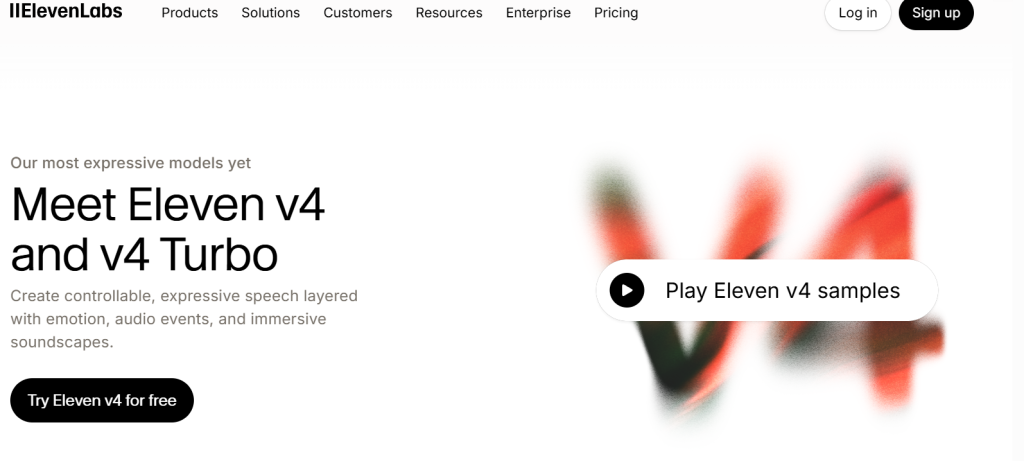
There is a moment every content creator hits. You have the script, the edit is locked, and the only thing standing between you and publishing is a voice. Hiring a voice actor means a day of back and forth and a bill in the hundreds. Recording it yourself means your accent, your room noise, your fourth take at midnight. ElevenLabs built a company on removing that moment entirely, and in 2026 it is the clear benchmark for AI audio. The platform now spans text to speech in more than 90 languages, voice cloning that most listeners cannot distinguish from a real recording, dubbing, music generation, studio grade transcription, and a full production platform for voice agents that answer phones and resolve support tickets. In February 2026 the company raised $500 million at an $11 billion valuation, and the month after that it pledged $1 billion worth of free voice restoration technology to a million people living with permanent voice loss. Pricing starts at a free tier and climbs from roughly $6 to $990 per month.
For YouTubers, podcasters, course creators, marketers, agencies and developers building voice into a product, the question is no longer whether the output is good enough. It is whether the pricing works for your volume, which plan unlocks the feature you actually need, and whether the credit system holds any nasty surprises. This 2026 review walks through the full model lineup including the new Eleven v4 family, the creative and agent products, every pricing tier with the licensing detail that catches most buyers out, honest comparisons against Murf and PlayAI, the real complaints from paying users, and who should and should not subscribe.
ElevenLabs Review 2026: The AI Voice Platform That Set the Standard, and What It Really Costs to Run
Overview and Background
ElevenLabs is an AI audio company founded in 2022 by Mati Staniszewski and Piotr Dąbkowski. The origin story is unusually specific: the founders grew up in Poland watching foreign films flattened by single voice dubbing, where one narrator reads every character in a monotone over the original audio. That frustration became a company built on the idea that synthetic speech should carry emotion and timing, not just pronounce words correctly.
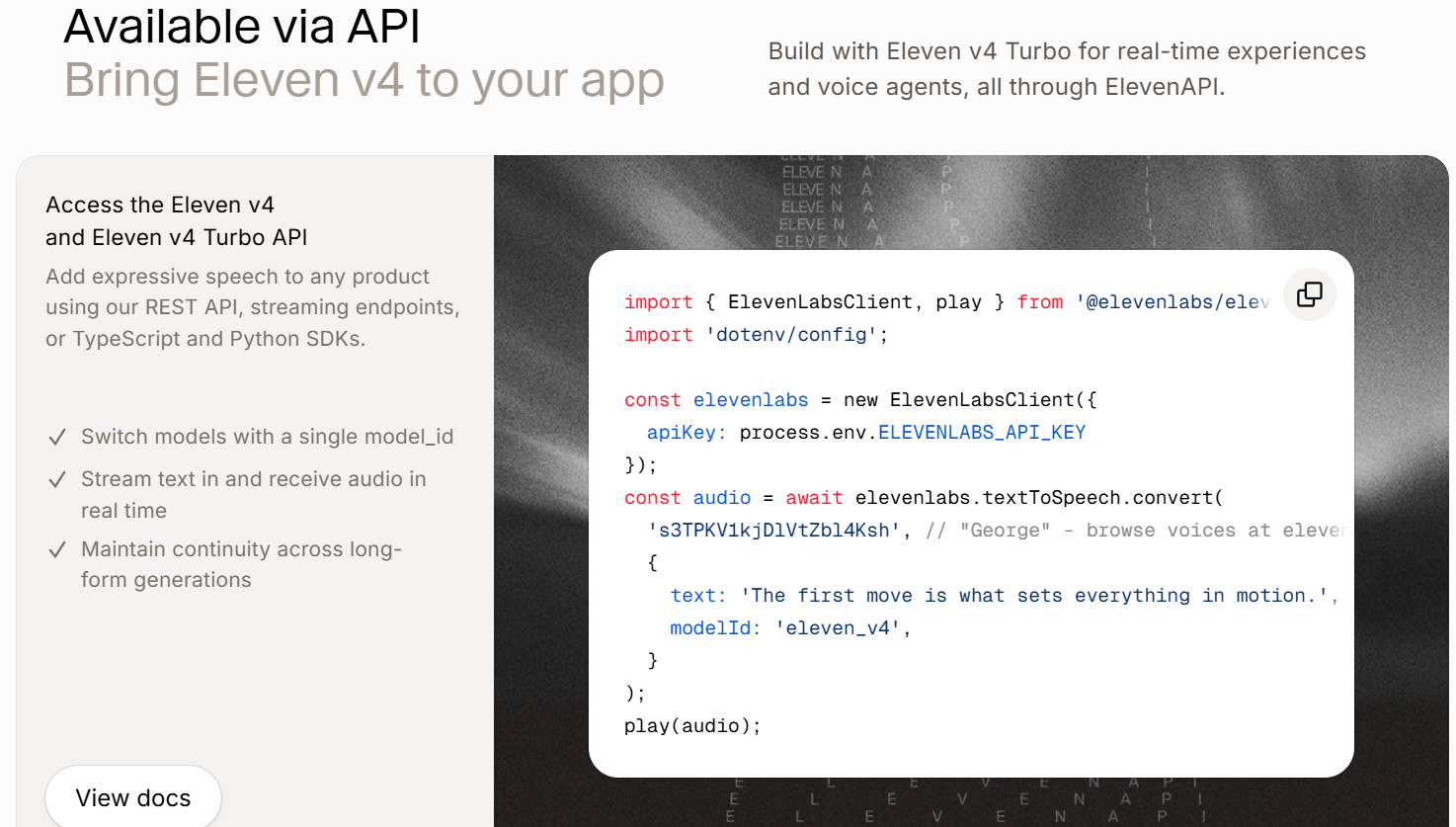
Four years on, the product is no longer a text to speech box. ElevenLabs now organises itself into four surfaces. ElevenCreative is the no code web studio where creators and editors generate voiceovers, music, dubs and full projects in a browser. ElevenAgents is the production platform for conversational voice agents, with a visual builder for non technical users and full programmatic control for developers. ElevenAPI exposes every capability through REST with official Python and TypeScript SDKs. There is also Reception.ai, aimed at front desk and inbound call handling. Underneath sit capabilities most competitors ship separately: dubbing, sound effects, voice changer, voice isolation, forced alignment, avatars and an ads engine.
The commercial trajectory matches the product sprawl. The February 2026 round of $500 million at an $11 billion valuation put ElevenLabs among the most valuable private AI companies, and the voice restoration pledge in March signalled a company thinking about reputation as much as revenue. That matters for a buyer, because the thing you are really subscribing to is not a single model. It is a platform that ships new flagship models every few months, and the voice you build your channel around today needs to still be there in two years.
Why ElevenLabs Stands Out in 2026
The output quality is still the benchmark everyone else is measured against: independent comparisons across the category keep arriving at the same conclusion, that ElevenLabs sits at the top for realism and emotional range. Reviewers on G2 and Capterra repeatedly describe the voice cloning as the standout feature, and competitors’ own marketing pages tend to compete on price or workflow rather than claiming better audio.
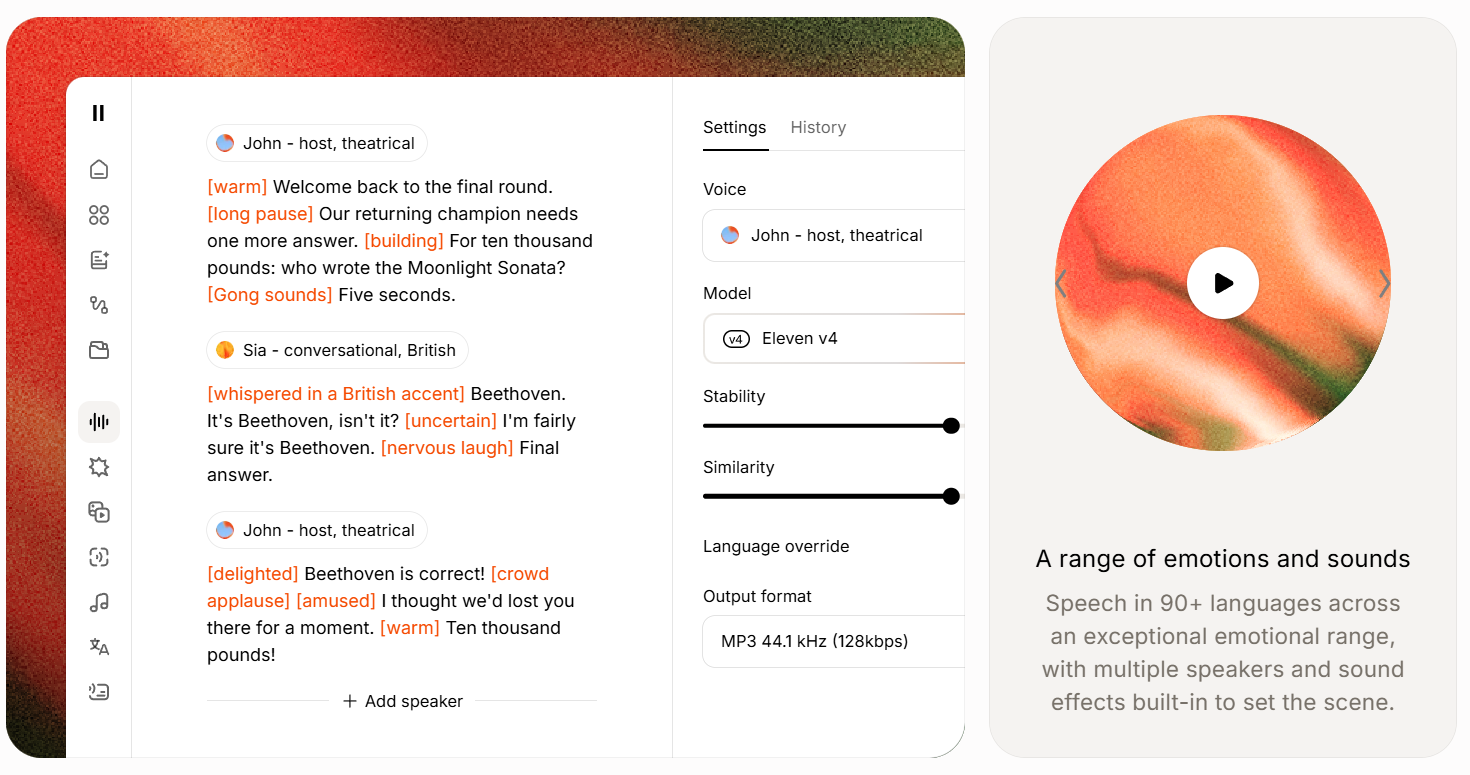
Eleven v4 raised the ceiling again: the current flagship supports more than 90 languages, handles 10,000 characters in a single request for roughly ten minutes of audio, preserves a cloned speaker reliably across long generations, and natively produces multi speaker dialogue. For audiobook narration and character work, the practical benefit is consistency. The voice does not quietly drift halfway through a chapter.
Audio tags let you direct the performance, not just the words: inline markers such as [whispers], [laughs] and [excited] tell the model how to deliver a line, which is the difference between a read and a performance. Combined with Text to Dialogue, you can script a two person exchange and generate it in one call with the pacing intact.
Real time latency is now low enough for live conversation: Eleven v4 Turbo delivers a median inference latency of about 100 milliseconds, and Flash v2.5 goes down to roughly 75 milliseconds across 32 languages at half the per character API price. On the input side, Scribe v2 Realtime transcribes in more than 90 languages at about 150 milliseconds. Those three numbers are what make a voice agent feel like a phone call instead of a walkie talkie.
Language coverage is genuinely global: the v4 family covers 90 plus languages including Vietnamese, Tagalog, Swahili, Welsh and Sorani Kurdish, and Scribe handles 90 plus on transcription. For anyone localising content into markets the big cloud vendors cover thinly, the breadth is a real competitive moat rather than a marketing number.
One vendor covers the whole audio pipeline: script to voice, voice to another language, background music, sound effects, transcription with speaker separation, and a live agent that talks back. Most teams assembling this from parts end up with three subscriptions and a glue layer. Here it is one account, one API key and one bill.
Enterprise plumbing exists where it counts: SSO with Microsoft Entra and Okta, SCIM provisioning, audit logs, model approvals, workspace billing groups, configurable data residency, private deployments, and a HIPAA eligible medical transcription model with a zero retention mode. That list is why regulated buyers can get this past a procurement team at all.
Key Features and Technology
The platform is wide enough that most people only ever use a quarter of it. Here is what actually sits inside, grouped by the job you are trying to do.
The Text to Speech Model Family
Five models matter in practice. Eleven v4 is the quality flagship, 90 plus languages, 10,000 character limit, strongest cloning fidelity, built for narration, audiobooks and character work. Eleven v4 Turbo is the same expressiveness tuned for real time at around 100 milliseconds, and it is what you point a live agent at. Eleven v3 and v3 Conversational are the previous generation, still excellent, 70 plus languages with a 5,000 character limit. Multilingual v2 covers 29 languages and remains the most stable choice for very long single generations. Flash v2.5 is the budget and speed option, roughly 75 milliseconds, 32 languages, a 40,000 character limit and half the per character API cost. Choosing correctly is a real decision, because the wrong pick costs you either audio quality or money.
Voice Cloning, Voice Design and the Library
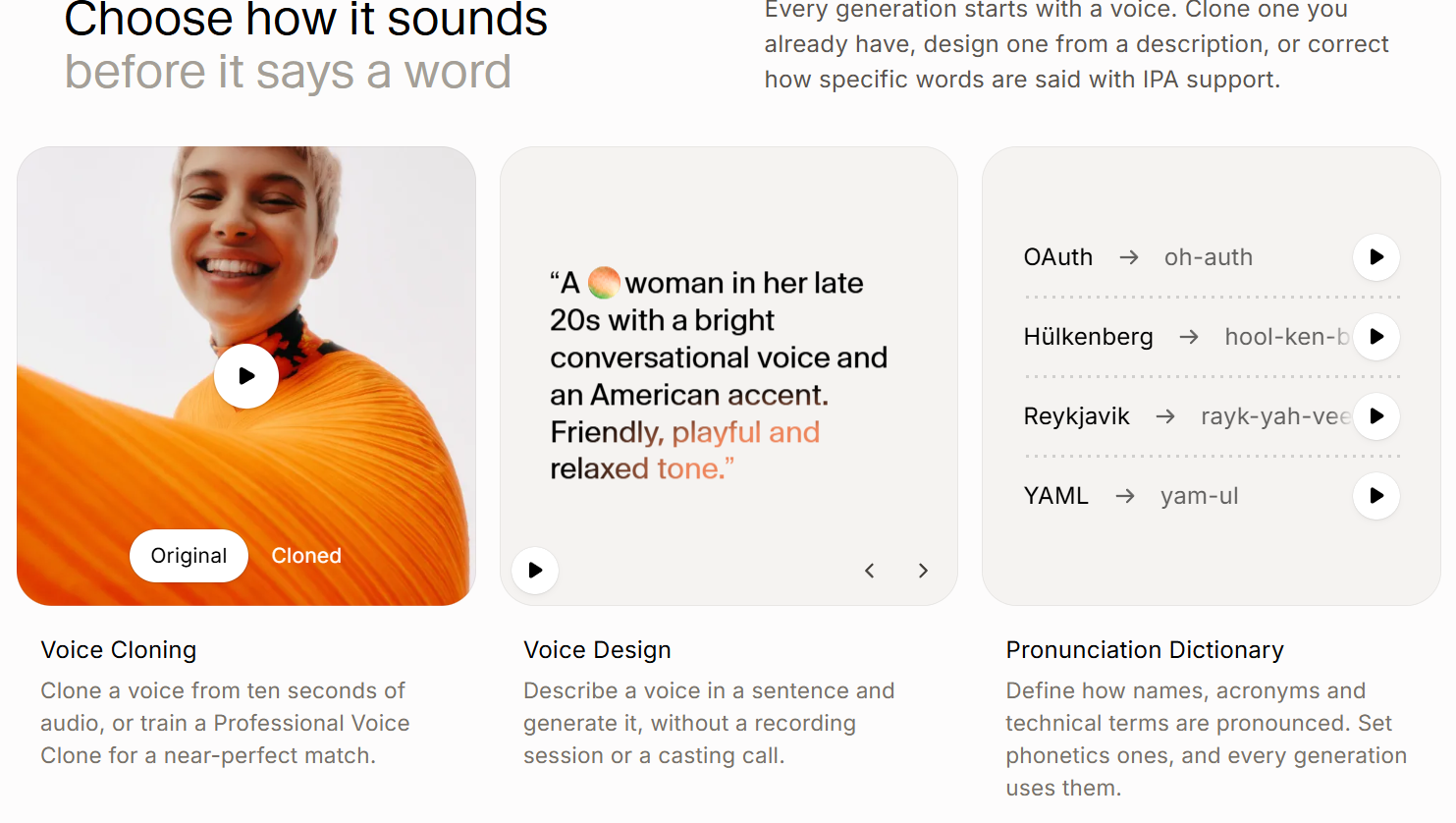
There are three ways to get a voice. The shared Voice Library holds thousands of community and professional voices you can use immediately. Voice Design generates a brand new voice from a text description, useful when you want something nobody else has and want to sidestep consent questions entirely. Voice Cloning comes in two grades: Instant Voice Cloning works from a short sample and starts on Starter, while Professional Voice Cloning trains on a longer recording for noticeably better fidelity and starts on Creator with one slot. Voice Remixing and the Voice Changer round it out, the latter letting you perform a line yourself and re render it in a different voice while keeping your timing.
Scribe, Dubbing and Eleven Music
Scribe v2 is a serious transcription engine in its own right, with word level timestamps, speaker diarisation for up to 32 speakers, entity detection across 65 types, keyterm prompting for up to 1,000 domain terms, and transcript editing by natural language instruction. Scribe v2 Realtime handles live transcription at roughly 150 milliseconds, and Scribe v2 Medical cuts errors on clinical audio by about 35 percent at the same price. Dubbing translates video into another language while preserving the original speaker’s voice. Eleven Music v2.5 generates studio grade tracks from a prompt, with control over genre, structure and vocals, plus section level editing of sound and lyrics.
ElevenAgents and the Developer Layer
ElevenAgents stitches speech recognition, a language model of your choice, text to speech and turn taking into a deployable voice agent. Agents can call tools mid conversation through APIs and MCP, so they look up a record, book an appointment or trigger a workflow rather than just talking. There is a visual builder, a CLI for managing agents as code, SDKs for React, JavaScript, React Native and Swift, and a Speech Engine that wraps an existing text chat agent into a voice one. Concurrency is plan dependent, which is the detail developers most often discover late: Creator allows 5 simultaneous Multilingual v2 requests and 10 on Flash, Pro doubles that, and Scale and Business go higher again.
Pricing, Plans, and Package Structure
ElevenLabs sells monthly subscriptions measured in credits, where roughly 1,000 credits equals about a minute of speech on the standard models. Annual billing is advertised as paying for ten months instead of twelve, bringing Creator down to around $18.33 and Pro to around $82.50. Extra usage beyond your allowance is billed per minute at a rate that falls as you move up the tiers, from roughly $0.36 on Free to about $0.17 on Pro and above. Voice agent minutes run on a second, separate ladder with their own concurrency caps, so a plan that looks generous for narration can be tight for a live phone agent.
| Plan | Approx. Price | Credits / Approx. Minutes | What You Get | Best For |
|---|---|---|---|---|
| Free | $0 | 10,000 / about 10 min | Full model access and Voice Design, but no commercial licence and attribution required. No voice cloning. | Testing the voices before you commit |
| Starter | ~$6/mo | 30,000 / about 30 min | Commercial licence, Instant Voice Cloning, dubbing, higher quality audio, API access | Occasional paid voiceovers and first client work |
| Creator (most popular) | ~$22/mo, often ~$11 first month | 121,000 / about 121 min | Professional Voice Cloning with 1 slot, 192 kbps audio, usage based billing for overage, higher concurrency | Regular YouTubers, podcasters and solo creators |
| Pro | ~$99/mo | 600,000 / about 600 min | 44.1 kHz PCM output via API, double the concurrency of Creator, everything above | High volume creators, small studios, API projects |
| Scale | ~$299/mo | About 1,800 min | 3 seats, higher concurrency and music limits, team workspace features | Small agencies and production teams |
| Business | ~$990/mo | About 6,000 min | 10 seats, low latency priority, full workspace administration | Localisation teams and product companies at volume |
| Enterprise | Custom quote | Negotiated volume | Elevated concurrency, SSO and SCIM, audit logs, data residency, private deployment, HIPAA with a signed agreement | Regulated industries and large scale deployments |
How ElevenLabs Compares to Alternatives
| Factor | ElevenLabs | Murf AI | PlayAI (Play.ht) | Voice actor or free TTS |
|---|---|---|---|---|
| Voice realism | Category benchmark | Very good, cleaner and less emotive | Good, close but a step behind | Perfect with a human, poor with free tools |
| Voice cloning | Instant from ~$6, professional from ~$22 | Largely enterprise gated | Instant cloning on paid tiers | Not applicable |
| Languages | 90+ on the v4 family | About 20+ | 140+ advertised | One per actor hired |
| Entry paid price | ~$6/mo, ~$22 for pro cloning | ~$19 to $29/mo | ~$31 to $39/mo | $100 to $500+ per project, or $0 |
| Billing model | Credits, expire on cancel or downgrade | Hours of generation per year | Characters, with unlimited personal tiers | Per project or free |
| Real time voice agents | Full platform, ~100 ms models | Limited | Yes, agent focused | No |
| Best for | Peak quality, cloning, multilingual, agents | Team studio workflow and e learning | Long form volume and cloning breadth | Flagship brand work, or zero budget |
vs. Murf AI: Murf wins on workspace. Its studio interface is widely considered the best in the category for teams producing corporate training, e learning and presentation voiceovers, with word level timing controls and video sync built around a production workflow rather than a text box. It also bills in hours of generation per year, which some teams find easier to forecast than credits. The trade offs are real: fewer languages, less emotional range, and voice cloning that is effectively reserved for enterprise agreements. If nobody on your team needs a cloned voice and the work is corporate narration, Murf is a legitimate choice at a similar price.
vs. PlayAI, formerly Play.ht: PlayAI competes on breadth and volume with 900 plus voices across more than 140 languages, instant cloning on paid plans, and unlimited style tiers that suit anyone narrating very long content such as blog archives or full audiobooks. Quality on cloned voices has closed much of the gap but most side by side testing still puts ElevenLabs ahead on realism. Entry pricing is higher, roughly $31 to $39 per month against $6, so PlayAI makes most sense when sheer character volume is the constraint rather than the last ten percent of audio quality.
vs. hiring a voice actor or using free TTS: a professional human still wins for flagship brand work where a specific performance and a specific person matter, and it is honest to say so. But a single narrated explainer can cost $100 to $500 and takes days, while the same script on Creator costs a few dollars of credits and twenty seconds. At the other end, free tools built into editors such as CapCut produce usable audio for casual content, and on a small unmonetised channel that may be enough. ElevenLabs earns its subscription in the middle ground, where you publish often, the audio represents a business, and amateur narration is costing you watch time.
Pros and Cons
What Creators Love
Audio that passes as human: this is the compliment that appears in almost every verified review. The voices carry intonation, pacing and breath in a way that lets you publish without apologising for the narration, and cloned voices are repeatedly described as unrivalled.
A genuinely low entry price: around $6 a month buys a commercial licence and instant voice cloning. No other platform at the top of the quality rankings opens that door for the price of a coffee, and the frequent $11 first month on Creator makes a serious trial cheap.
Setup takes minutes, not an afternoon: reviewers consistently call the voiceover process simple. Paste a script, pick a voice, generate, download. The complexity only arrives if you go looking for it in the API or the agent builder.
One platform replaces several subscriptions: voiceover, dubbing, background music, sound effects and transcription in one account removes the usual tangle of tools, exports and format conversions between them.
Shipping pace and a serious API: new flagship models arrive every few months, the documentation is thorough, the SDKs are maintained, and a well regarded startup grant programme gives early stage companies elevated limits. For developers this is a dependable foundation rather than a bet.
Limitations Worth Knowing
Credits vanish when you cancel or downgrade: this is the single most repeated complaint in public reviews, and it is a genuine one. Unused credits you have already paid for can disappear when you change or end a plan. Spend your balance before you touch the subscription, and treat any large credit purchase as use it or lose it.
Credits burn faster than the headline minutes suggest: every regeneration costs full price, higher quality models cost more per character, and a failed take you would never publish still spends the allowance. Reviewers describe running out far sooner than the advertised figures implied.
Support is chatbot first and slow on billing: the gap between strong G2 and Capterra scores and a weaker Trustpilot average is driven almost entirely by billing and cancellation experiences rather than product failures. Several users report multi day waits to reach a human on charge disputes, though others report fast refunds, so experiences vary widely.
The free plan cannot be used commercially: 10,000 monthly credits sounds generous until you read the licence. No commercial use, and attribution required. Anyone monetising content needs to pay, which is reasonable but catches people out after they have already produced an episode.
Occasional pronunciation and consistency glitches: unusual names, technical terms and acronyms sometimes come out wrong, and tone can vary subtly between sessions on the same voice. Editing controls for pace and pauses are lighter than some competitors offer, so fixes often mean regenerating, which costs credits again.
Costs climb steeply at production scale: the jump from Pro at around $99 to Scale at $299 to Business at $990 is steep, and voice agent deployments add a separate minute ladder plus concurrency limits. At real volume this becomes one of the more expensive options per million characters in the category.
Voice cloning carries a consent obligation: you may only clone a voice you own or have explicit permission to use. That is both a platform rule and, in a growing number of jurisdictions, a legal one. Treat a cloned voice like a signature rather than a sound effect.
Who Should Use ElevenLabs
YouTubers and faceless channel operators: if you publish several videos a week and narration quality is affecting retention, this is the clearest case in the whole category. Creator at around $22 gives you about two hours of monthly audio plus a professional clone of your own voice.
Podcasters and audiobook producers: Eleven v4 holds a voice consistently across long form, and the 10,000 character limit means fewer seams to stitch. Start on Creator and move to Pro once you are producing more than two hours a month.
Marketers and course creators: ad variations, product demos and lesson modules all benefit from being able to change a line without rebooking a studio. Starter at around $6 is often enough to begin, since marketing scripts are short.
Agencies and localisation teams: dubbing combined with 90 plus languages turns one asset into a dozen market versions without recasting. Scale at around $299 brings the three seats and concurrency that client work needs.
Developers and product teams building voice features: the API, SDKs, agent platform and sub 100 millisecond models make this the default choice for voice in an application. Budget on Pro or above and check the concurrency table against your expected load before you commit.
Who should look elsewhere: very occasional users who would let credits sit unused, teams whose main need is a collaborative studio interface rather than peak realism, and anyone generating millions of characters a month where cheaper providers win on cost alone.
Getting Started: Step by Step
- Test on the free plan first. Sign up and spend the 10,000 monthly credits on a real script from your own content, not a demo sentence. Remember the output is not licensed for commercial use at this stage.
- Audition voices properly. Browse the Voice Library, and try Voice Design to generate an original voice from a description if you want something nobody else is using. Shortlist two or three before you commit to one.
- Pick the right model for the job. Eleven v4 for narration and quality, v4 Turbo or Flash v2.5 for anything real time, Multilingual v2 for very long single generations or scripts heavy with numbers and dates.
- Choose the plan that matches the feature you need. Starter for a commercial licence and instant cloning, Creator if you want a professional clone of your own voice, Pro or above if you are running an API integration or a voice agent.
- Clone your voice with a clean sample. Record in a quiet room with consistent tone and pacing. Garbage in, garbage out applies more here than almost anywhere else, and only clone a voice you own or have written permission to use.
- Polish the script before you generate. Fix pronunciation of names and acronyms with phonetic spellings, add audio tags where you want emotion, and read it aloud once. Every regeneration costs credits at full rate.
- Watch your usage for a month, then adjust. Check the analytics dashboard against your plan, and spend any banked credits before you downgrade or cancel, because they do not survive the change.
Tips for Getting Maximum Value
The biggest saving available is discipline with your script, since every retake costs the same as the original. Lock the words before you touch the generate button, generate in sections rather than whole episodes so a single bad line does not cost you the full render, and keep a working document of phonetic spellings for names and jargon your voice keeps mispronouncing. Use Flash v2.5 for drafts and previews where quality barely matters, then switch to v4 for the final pass, since Flash costs roughly half as much per character through the API. Watch for the discounted first month on Creator, which is often around $11 and is the cheapest way to properly evaluate professional voice cloning. Take the annual billing saving of about two months only once your monthly usage has settled, and never cancel or downgrade while you still hold credits you paid for, because they disappear with the plan. Finally, if you are building an agent, test the number heavy paths such as confirmation codes and dates before launch, and check your plan’s concurrency ceiling against realistic peak traffic rather than average traffic.
Future Outlook and Final Assessment
ElevenLabs is in an unusually strong position. The $11 billion valuation and $500 million raised in early 2026 fund a model cadence competitors are struggling to match, voice is becoming the default interface for AI products rather than a nice addition, and and the company has quietly built the enterprise scaffolding, from SSO and audit logs to data residency and private deployment, that turns a creator tool into infrastructure. The voice restoration pledge also hints at a company trying to define the responsible end of a technology with obvious potential for misuse, which matters in a market where regulation on synthetic voices is tightening.
The caveats are concentrated in one place, and it is not the product. Billing is where this company frustrates people: credits that expire on cancellation, consumption that outpaces the advertised minutes, and support that leans on automation before it reaches a human. None of that undermines the audio, which remains the best available, but it does mean you should go in with a clear plan for how many minutes you need and a habit of spending your balance before changing anything. Do that, and the value is straightforward. Professional narration for a few dollars a month, in your own voice, in 90 languages, available at two in the morning when the edit is finally done.
Conclusion
ElevenLabs is the rare tool that genuinely deserves its reputation. It turned synthetic speech from something you tolerate into something you can publish, then kept going until it covered dubbing, music, transcription and live voice agents under one subscription. It is not perfect. The credit system needs more transparency, support needs more humans, and heavy users will feel the price at scale. But for creators, marketers, educators, agencies and developers who need professional audio without a studio, a budget or a booking, nothing else in 2026 combines this quality, this language coverage and this low a barrier to entry. Start free to hear it for yourself, pick the tier that matches the feature you actually need, and let a voice stop being the thing that holds your publishing schedule hostage. That is exactly the kind of leverage we look for at AI Solutes, where our job is to help you make everything easy.
Ready to give your content a voice people actually want to listen to?
Explore more honest reviews, tutorials and tool comparisons to find the right tech for the way you work and live, at AI Solutes, where we make everything easy.
👉 Open Free Account: https://ai-solutes.com/elevenlabs
👉 Our Website: https://ai-solutes.com/
👉 Our YouTube Channel: youtube.com/@ai-solutes
👉 Our Facebook Fanpage: Facebook
👉 Our X (Twitter): @AISolutes
- Unlock Epic Israel and Jordan Adventures with Bein Harim Tours 2026 Guide
- BHuman AI
- Discover the Future of Smart Mirrors: AI-Powered Mirrors vs Traditional Smart Mirrors 2025 – Innovation, Health, and Privacy Insights
- Why Is Consensus Becoming the Ultimate Search Engine for Modern Researchers and Scientists?
- Mentimeter