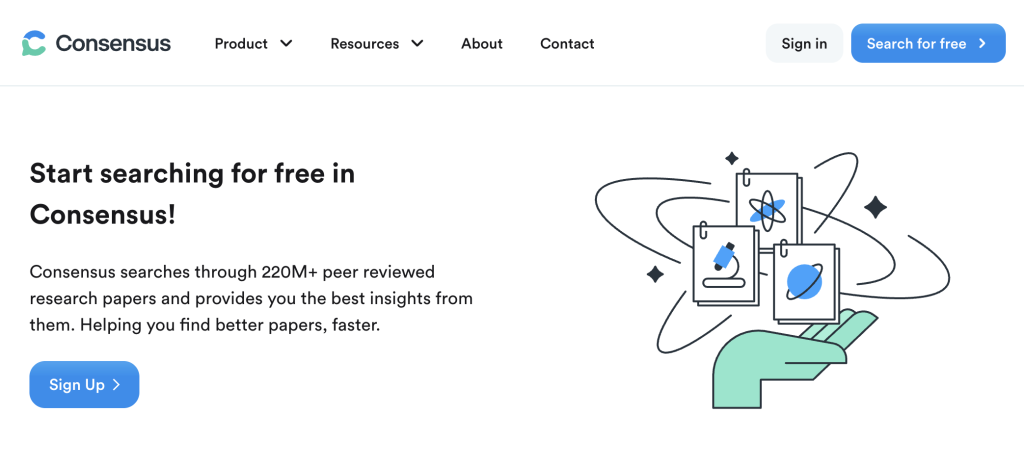
If you have ever typed a research question into ChatGPT, gotten a confident answer, and then discovered the “study” it cited does not actually exist, you already understand the problem Consensus was built to solve. Consensus is an AI-powered academic search engine that does not write answers from memory — it reads the literature first. Every query runs against a corpus of 200 million-plus peer-reviewed papers, retrieves the most relevant studies, and only then uses language models to synthesize what the research actually says, with a clickable citation behind every claim. It is the difference between a polished guess and a sourced answer.
That distinction has made Consensus one of the fastest-growing tools in the research world. Founded in 2021 by two Northwestern University classmates, it now serves millions of researchers, students, and clinicians every month, partners with more than 170 university libraries — including Yale, the University of Virginia, and Oklahoma State — and recently raised a $30M round to expand from search into a full “AI operating system for research.” This 2026 review walks through exactly what Consensus is, how the Consensus Meter and Deep Search work under the hood, current pricing for every plan (including the student and clinician discounts), an honest field-by-field quality verdict, how it stacks up against Elicit, Scite, Semantic Scholar, and Perplexity, and the three real limitations you need to know before you rely on it.
Consensus Review 2026: The Citation-Backed AI Search Engine That Turns Hundreds of Papers Into a Sourced Answer in Seconds
Overview and Background
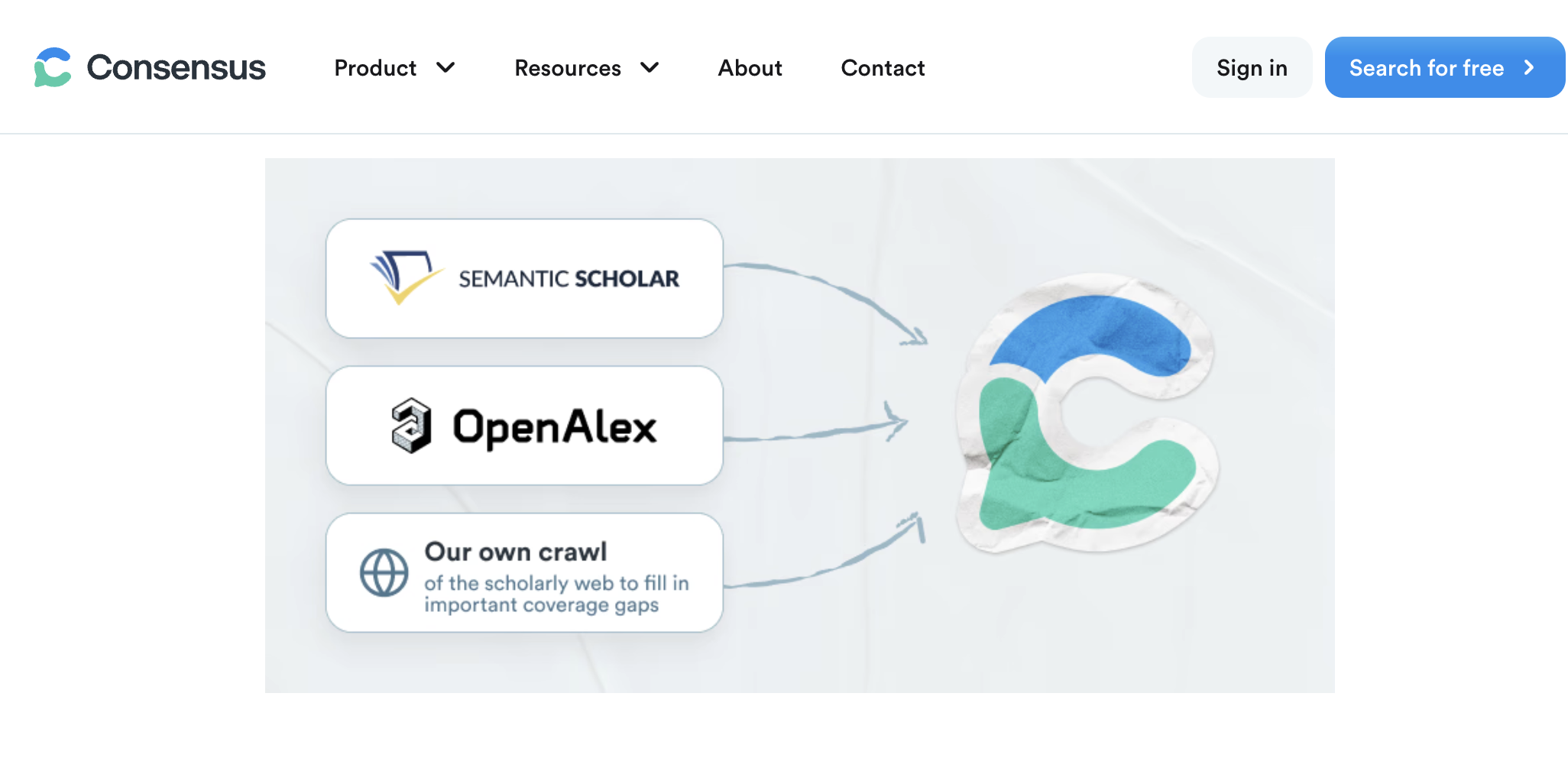
Consensus (the company is registered as Consensus NLP, Inc.) is an AI search engine purpose-built for scientific and academic research. Instead of returning a list of blue links the way Google Scholar does, or generating fluent text the way a general chatbot does, it sits in between: it finds real, relevant, peer-reviewed papers and then writes a clear synthesis of their findings — with inline citations so you can trace every insight back to its source. The corpus spans every domain of science, built by aggregating Semantic Scholar, OpenAlex, the company’s own crawl of the scholarly web, and full-text partnerships with major publishers (it reports relationships with 6 of the 12 largest, including Wiley, Taylor & Francis, Sage, and APA), giving it near-complete coverage of the highest-impact journals and the entirety of PubMed.
The origin story matters because it explains the product’s personality. Co-founders Eric Olson (CEO) and Christian Salem (CPO) describe themselves as “consumer technologists who are the children of academics” — Division I athlete teammates from Northwestern who deeply valued research but never had the patience to comb through papers themselves. After Salem started experimenting with GPT-3 in 2020, the two became convinced that consumer-grade AI could make rigorous science genuinely accessible to non-experts. That consumer-first instinct is why Consensus feels less like a clunky library database and more like a modern app: you ask a plain-English question and get a readable, sourced answer.
Traction has followed. The company reports over 200 million indexed documents, more than 170 university library partnerships, and millions of monthly users across academia, healthcare, biosciences, finance, journalism, and everyday consumers fact-checking health claims. After an early partnership with OpenAI that gave it some of the first customized GPT-4 API access, Consensus has continued shipping rapidly — adding Deep Search, Medical Mode, Study Snapshots, an “Ask Paper” chat, citation-manager integrations, and an agentic research layer. In 2026 it raised roughly $30M (bringing total funding to around $45M from Union Square Ventures, GreatPoint Ventures, Nat Friedman, Daniel Gross, Draper Associates, and others) to push beyond search toward a complete research workflow.
Why Consensus Stands Out in 2026
It searches papers, not the open web: The single biggest reason researchers trust Consensus over a general chatbot is that it retrieves real peer-reviewed literature before it writes anything. Because it pulls from an indexed corpus rather than generating citations from a model’s memory, it does not hallucinate paper titles or invent DOIs — the chronic failure mode that has burned countless people using ChatGPT for academic work.
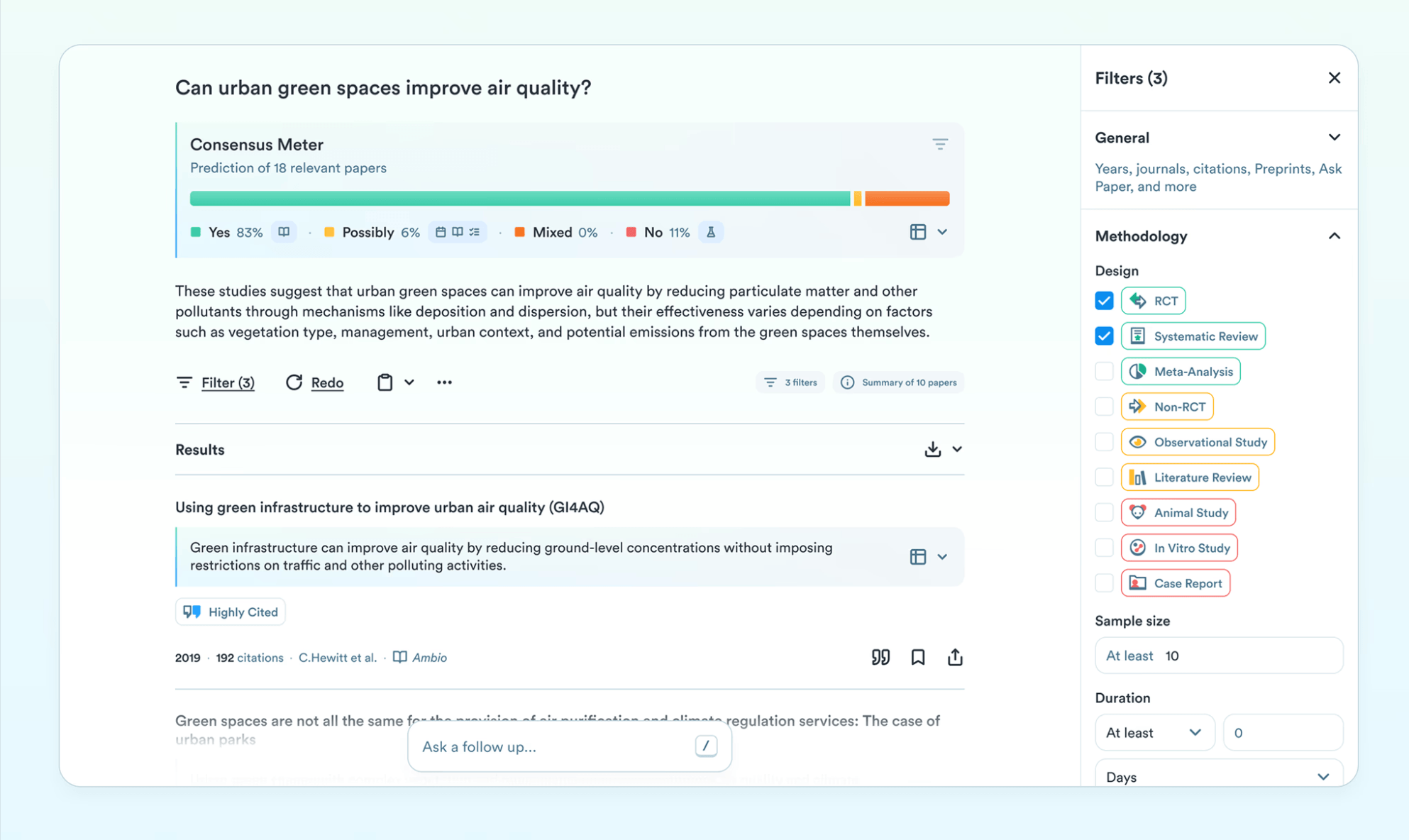
The Consensus Meter is genuinely novel: For yes/no research questions, Consensus classifies the top papers by which side of the question they support and renders a simple visual breakdown — what percentage of analyzed studies say yes, no, or possibly. No other mainstream tool reduces a sprawling body of literature to an at-a-glance read on where the evidence leans. It is not a substitute for judgment, but as a starting orientation it is uniquely fast.
Deep Search compresses days of literature review into minutes: Beyond quick answers, Deep Search builds a full search strategy on your behalf — expanding key terms, surfacing conflicting arguments, and exploring the citation graph across roughly 50 papers — then returns a structured report with a summary, an overview of research gaps, an indication of where the field agrees and disagrees, and clickable links to every source. It is the closest thing to an automated scoping review in the category.
Quality filters most rivals do not match: Consensus lets you constrain a search by study design (meta-analysis, systematic review, RCT, observational), journal ranking (Q1–Q4), citation threshold, publication year, open-access status, and preprint exclusion — and you can specify populations, timeframes, and study types directly in the prompt. For evidence-quality control, that level of input granularity is a real edge over tools that only do semantic retrieval.
Study Snapshots strip a paper to its essentials: Click the table icon on any result and Consensus auto-extracts the methodology, sample size, study duration, population, and key outcomes — so you can triage which papers deserve a full read without opening twenty PDFs. For literature triage, this is one of the most time-saving features in the product.
A built-in Medical Mode for clinical rigor: Clinicians can narrow results to the highest-quality medical sources — a curated set of tens of thousands of clinical guidelines and millions of articles from the top medical journals — for fast, trusted answers to point-of-care-adjacent questions, with the same citation-backed transparency.
It fits the tools professionals already use: Consensus integrates with Zotero and EndNote, exports references in standard formats, and through LibKey can connect institutional users to paywalled full text their library already licenses. You can also chat directly with a paper’s full text or your own uploaded PDFs via “Ask Paper,” and the company states it does not train its models on your data and keeps searches private and anonymized.
Key Features and Technology
Understanding how Consensus works under the hood helps you know when to trust the output and when to dig into the sources yourself. The pipeline runs in three stages, and the headline features layer on top of it.
The Three-Stage Pipeline — Retrieve, Re-rank, Synthesize
When you type a question, Consensus runs a hybrid search across its corpus: a semantic search using AI embeddings (which capture meaning beyond literal keywords) combined with traditional matching, so you do not need exact Boolean phrasing. It then re-ranks the candidates using signals like citation counts, study design, and journal reputation, surfacing the strongest evidence first. Finally, a language model synthesizes the top results into a cohesive answer with inline citations. The key thing to internalize is that the sources are real and retrieved, but the summary is generated — which is exactly why you should always click through on anything that matters.
Pro Search, Deep Search, and the Consensus Meter
The product is organized around escalating depth. A standard Papers search (formerly “Quick search”) returns relevant studies fast. A Pro message generates an AI-synthesized analysis across roughly the top papers from your search. Deep Search (also called Deep review) is the heavyweight: a more intensive, slightly slower pass across about 50 papers that produces a genuine mini literature review. The Consensus Meter renders automatically on yes/no questions, and Study Snapshots can be opened on any individual paper. There is a real, well-understood tradeoff here: the fast modes are great for orientation, but the deeper, slower modes are where the higher-quality answers live.
Ask Paper, Libraries, and the Agentic Layer
Beyond search, Consensus is building toward a workflow hub. “Ask Paper” lets you interrogate the full text of a study or your own uploaded PDF — useful for pinning down a specific methodology detail or finding the one paper in your library that makes a particular claim. Newer additions include Threads for organizing ongoing research, a Scholar Agent that handles more complex multi-step queries, and a forthcoming Search API for teams that want to build Consensus retrieval into their own pipelines. The direction is clear: from answer engine to end-to-end research operating system.
Pricing, Plans, and Package Structure
Consensus is 100% subscription-based — no ads, and the company states it does not sell user data. It is free to start, and the paid tiers are recurring subscriptions (monthly or discounted annual). The main lever between plans is how many Deep Searches you get; unlimited “Pro messages” unlock at the Pro tier. The figures below reflect the official pricing at the time of writing — always confirm the live numbers, since third-party roundups frequently quote outdated tiers.
| Plan | Approx. Price | What You Get | Best For |
|---|---|---|---|
| Free | $0 | Unlimited paper searches, 15 Pro messages/mo, 3 Deep reviews/mo, 10 Study Snapshots/mo | Students and occasional researchers testing the tool |
| Pro (most popular) | $15/mo, or $120/yr (≈$10/mo) | Unlimited Pro messages, unlimited Study Snapshots, 15 Deep reviews/mo | Routine, regular evidence-based research |
| Deep | $65/mo, or $540/yr (≈$45/mo) | Everything in Pro plus 200 Deep reviews/mo | Power users running frequent literature reviews |
| Teams | Custom (per seat) | All Pro features, 50 Deep reviews/mo per user, centralized billing, up to 200 seats | Research groups, labs, and academic departments |
| Enterprise | Custom quote | All Team features, library integrations, training, 200+ users | Universities and large organizations |
How Consensus Compares to Alternatives
| Factor | Consensus | Elicit | Scite | Google Scholar |
|---|---|---|---|---|
| Core job | Fast evidence-backed answers + synthesis | Systematic review & data extraction | Citation verification | Paper discovery (link list) |
| Signature feature | Consensus Meter (yes/no/maybe) | Extraction tables across many papers | Smart Citations (support/contrast) | Massive free index |
| AI synthesis | Yes, citation-backed | Yes, structured | Limited | None |
| Entry price | Free; Pro ≈$10–15/mo | Free; paid from ~$10–49/mo | Paid from ~$12/mo | Free |
| Best for | Quick, sourced answers & scoping | Formal reviews at scale | Checking if a finding holds up | Free, broad searching |
vs. Elicit: Elicit and Consensus are the two heavyweights, and they pull in opposite directions. Elicit is a systematic-review and extraction engine — it can screen thousands of papers per report and pour their data into structured, spreadsheet-style tables with a full audit trail, which is what you want for a rigorous, reproducible review. Consensus is built for speed and orientation: it answers a specific question with sourced evidence in seconds, and it actually offers more granular input filters (methodology, citation thresholds, preprint exclusion). The honest rule of thumb: use Consensus to scope a topic and get fast answers, then move to Elicit when you need formal, large-scale screening and extraction.
vs. Scite and Semantic Scholar: These solve adjacent problems rather than competing head-on. Scite’s Smart Citations tell you not just that a paper was cited but how — whether later work supported, contradicted, or merely mentioned it — which is invaluable before you build an argument on a single study. Semantic Scholar is the best free discovery engine, with AI TLDRs and citation-graph visualization across a comparable 200M+ index. Many serious researchers run all three: Semantic Scholar to discover, Consensus to synthesize, Scite to verify.
vs. Perplexity and general chatbots: Perplexity is faster and more versatile because it searches the open web, but that breadth is also its weakness for academic work — it mixes high- and low-quality sources and is less constrained than a paper-grounded tool. General chatbots like ChatGPT, Claude, and Gemini are excellent for brainstorming and turning verified findings into readable prose, but they carry a higher risk of fabricated citations and should never be your retrieval layer. For anything that has to stay tied to peer-reviewed literature, a grounded tool like Consensus comes first; the general model comes after the sources are verified.
Pros and Cons
What Researchers Love
Real sources, every time: Because it retrieves before it writes, Consensus does not invent papers. The constant complaint about general chatbots — hallucinated citations — largely disappears, and that reliability is the feature users praise most.
Genuinely fast and readable: Plain-English questions return clear, synthesized, cited answers in seconds. For clinicians, journalists, and anyone who needs to know what the evidence says without running a full review, it is a dramatic time-saver — users routinely report saving hours a week.
The Consensus Meter and Study Snapshots: The Meter gives an instant read on where evidence leans, and Snapshots let you triage papers by methodology and sample size without opening each one. Together they turn a daunting pile of literature into something scannable.
A generous, refreshing free tier: Unlimited basic searches plus monthly Pro messages, Deep reviews, and Snapshots — and the limits reset every month rather than being one-time credits. Few competitors are this usable for free.
Excellent value, especially for students: With the 40% academic discount bringing Pro to around $6/month, it is arguably the best-priced serious research tool available, and it integrates cleanly with Zotero, EndNote, and university library systems.
Limitations Worth Knowing
The summary can still misread a paper: While it won’t fabricate titles, the AI synthesis can misinterpret or misrepresent a real study’s findings. This is the most important caveat: always click through and verify any claim you intend to cite or act on.
Not a substitute for a systematic library search: In at least one librarian’s test, Consensus missed a large majority of the relevant resources a traditional database search surfaced. It is a complement to library databases, not a replacement — using it as your only tool for a formal systematic review will leave gaps reviewers will catch.
No automatic retraction filtering, English-dominant corpus: Consensus does not currently flag or exclude retracted papers automatically, and roughly 95% of its indexed literature is English. If your field publishes heavily in another language or you need watertight retraction screening, plan for extra manual checks.
Weaker for deep extraction than Elicit: If your task is extracting structured data across hundreds of papers, Elicit’s tables and screening workflow are purpose-built and Consensus will feel thin by comparison. Deep Searches are also capped (15/month on Pro), which matters for heavy reviewers.
Privacy and academic-integrity caveats: The company states it does not train on your data and keeps searches private, but it is sensible to treat anything you upload as potentially retained. And most universities require you to disclose AI tool use in your methodology or acknowledgments — never paste Consensus output verbatim into a thesis.
Who Should Use Consensus
Graduate students and early-career researchers: If you are scoping a new topic, catching up on a fast-moving field, or hunting for seminal papers, Consensus accelerates the discovery and orientation phase enormously. Start on the Free tier, and upgrade to Pro with the 40% student discount once you hit the Deep Search limit.
Clinicians and healthcare professionals: Medical Mode plus citation-backed answers make Consensus a strong tool for evidence-based questions at the bench or in research contexts — paired with the clinician discount. Remember it is a research tool, not a point-of-care clinical decision-support system; for treatment recommendations, lean on guideline-grounded clinical tools instead.
Journalists, analysts, and content creators: Anyone who needs to fact-check a scientific claim or ground an article in real research will find Consensus far safer than a general chatbot. The Free or Pro tier covers most of this work comfortably.
Research teams, labs, and universities: For groups, the Teams plan adds centralized billing, individual logins, and a higher per-user Deep Search allowance; institutions with 200+ users should look at Enterprise for library integrations and training. If your lab runs frequent, heavy literature reviews, the individual Deep plan is the one that removes the search ceiling.
Getting Started: Step by Step
- Create a free account. Go to consensus.app and sign up with email or your Google account. You can search immediately, but an account unlocks Pro messages, Deep reviews, and Study Snapshots. If you have a .edu or .ac email, use it — it qualifies you for the academic discount later.
- Ask a clear, direct question. Consensus works best with focused, natural-language questions — for example, “Does intermittent fasting improve cardiovascular health?” You can add context like population, timeframe, or study design directly in the prompt.
- Read the synthesis, then the Meter. Review the cited summary, and on yes/no questions check the Consensus Meter to see how the analyzed studies break down. Treat it as a starting orientation, not a verdict.
- Apply filters to raise quality. Narrow by study design (RCT, meta-analysis, systematic review), journal ranking (Q1–Q4), citation count, publication year, or open access to surface the strongest evidence.
- Open Study Snapshots and Ask Paper. Click the table icon to extract a paper’s methodology and sample size, and use Ask Paper to interrogate a full text or your own uploaded PDF for specific details.
- Run a Deep Search for big topics. When you need a real overview, switch on Deep mode to generate a structured report across ~50 papers, complete with research gaps and a consensus summary.
- Verify and export. Click through to the original sources to confirm key claims, then export citations to Zotero or EndNote — and disclose your AI tool use per your institution’s policy.
Tips for Getting Maximum Value
Spend a few sessions on the Free tier before paying — it is generous enough to tell you whether Consensus fits your workflow, and you’ll learn whether you actually hit the Deep Search ceiling. When you do upgrade, take the annual Pro plan and stack the 40% student or 25% clinician discount if you qualify; that combination makes it one of the cheapest serious tools in the category, and the $45/month Deep plan only pays off if you are running literature reviews almost daily. Phrase questions tightly and lean on the methodology and journal-quality filters rather than accepting the first broad answer — narrowing to Q1 journals and meta-analyses dramatically improves output. Reserve Deep Search for genuinely complex topics so you do not burn your monthly allowance on simple lookups. Above all, treat Consensus as the fast first 80% of the job: let it find and summarize, but always read the original papers before you cite them, cross-check anything clinical or high-stakes against a traditional library database, and remember that the tool is there to take the tedious work off your plate — not to replace your judgment.
Future Outlook and Final Assessment
The tailwinds are strongly in Consensus’s favor. The volume of published research keeps growing faster than any human can read, AI literacy among researchers is rising, and the company has just raised a fresh round explicitly to expand from a search engine into a full “AI operating system for research” — with an agentic Scholar Agent, a forthcoming Search API, and deeper team and enterprise features on the roadmap. With 170+ university partnerships and millions of monthly users, it has the distribution and the corpus to keep compounding, and its consumer-grade polish remains a genuine differentiator in a category full of clunky tools.
The honest caveats remain, and they are worth restating: the AI summary can misread a real paper, retracted studies are not filtered automatically, the corpus is English-dominant, and it is a complement to — never a replacement for — a rigorous library-database search and your own reading. But within those boundaries, Consensus is the cleanest, fastest, best-value tool available for getting evidence-backed answers from real scientific literature in 2026, and for most researchers that makes it an easy addition to the toolkit.
Conclusion
Consensus has built something the research world genuinely needed: a tool that brings the speed and ease of consumer AI to scientific literature without sacrificing the one thing that matters most — real, citable sources. It will not write your systematic review or replace your critical reading, and it shouldn’t try to. What it does is take the tedious, time-eating front end of research — finding the right papers and seeing what they collectively say — and compress it from days into minutes. Pick the tier that matches how often you search, keep a healthy habit of verifying the originals, and Consensus turns one of the most daunting parts of academic and professional work into something genuinely manageable — making everything easy, one sourced answer at a time.
Ready to get answers backed by real research, not guesses?
Explore more honest reviews, tutorials and tool comparisons to find the right tech for the way you work and live — at AI Solutes, where we make everything easy.
👉 Open Free Account: https://consensus.app/
👉 Our YouTube Channel: youtube.com/@ai-solutes
👉 Our Facebook Fanpage: Facebook
👉 Our X (Twitter): @AISolutes