Landing in a new country and realizing your phone has no signal is one of modern travel’s small, universal panics. For most of the last decade, the fix meant hunting for an airport SIM kiosk, arguing in broken English about which plan you needed, and juggling a tiny piece of plastic you’d inevitably lose by the next flight. Nomad eSIM was built to erase that entire ritual. It’s a digital SIM marketplace that lets you buy, install, and activate mobile data from your phone before you even board — no physical card, no counter, no contract. With eSIM plans in over 200 destinations, prices starting around $3–5 for a short trip, and a 4.3–4.8 star reputation across app stores and Trustpilot from tens of thousands of reviewers, Nomad has become one of the go-to names for travelers who want connectivity handled before they land.
For remote workers, backpackers, business travelers, and anyone who’s tired of paying their home carrier’s roaming rates, the appeal is obvious. This 2026 review walks through how Nomad eSIM actually works, its full plan lineup and pricing, how it stacks up against Airalo and Holafly, honest user feedback on the parts that don’t always go smoothly, and exactly who should — and shouldn’t — rely on it for their next trip.
Nomad eSIM Review 2026: The Travel Data Marketplace That Skips the Airport SIM Counter
Overview and Background
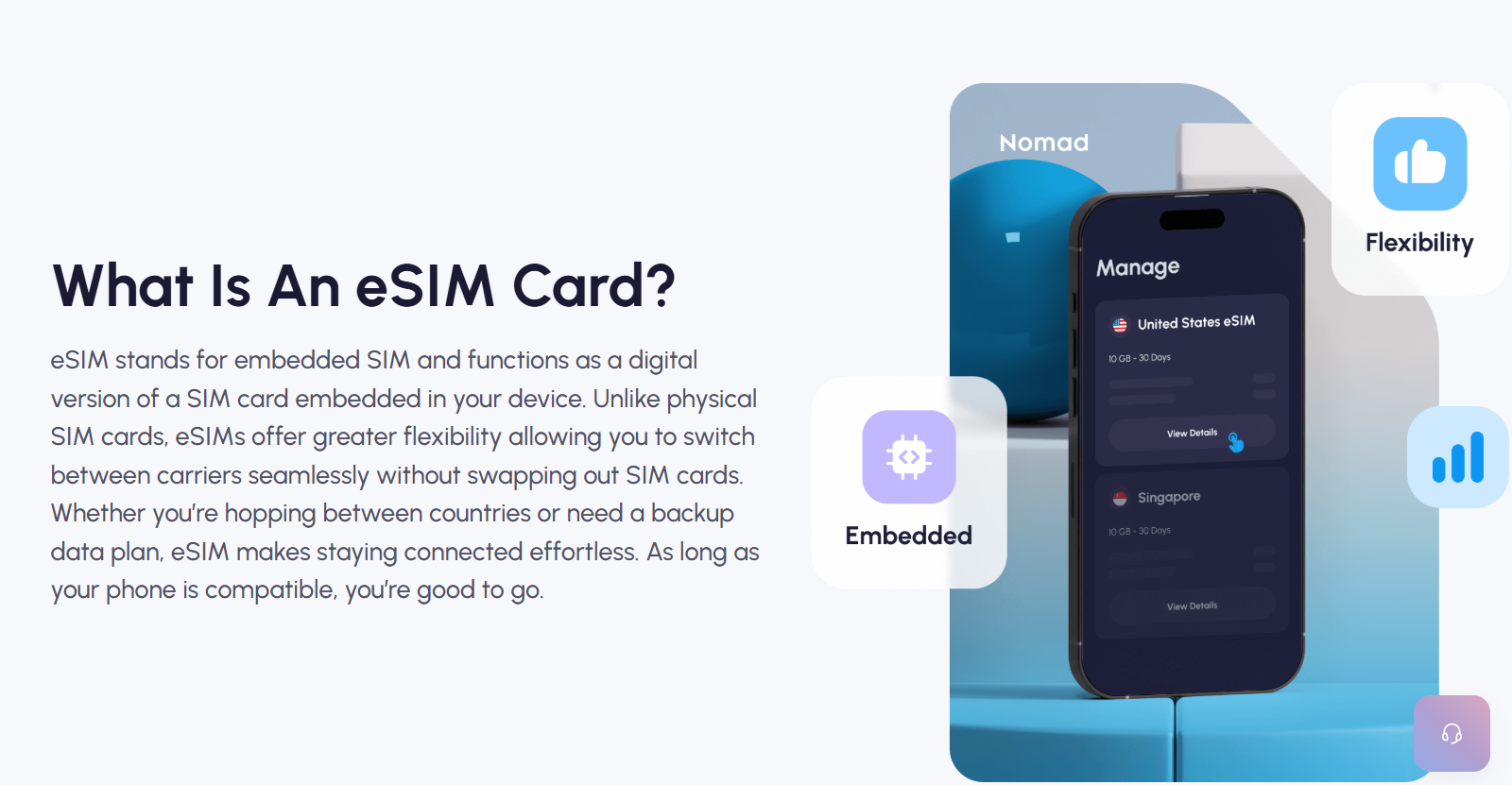
Nomad eSIM is a connectivity marketplace launched in 2020 as a business line of LotusFlare, a telecommunications software company founded by former Microsoft engineers and headquartered in Santa Clara, California. Rather than operating its own cell towers, Nomad partners with local network providers in each destination — often more than one per country — and packages their data into simple, prepaid eSIM plans sold through its app and website. Travelers buy a plan, scan a QR code or tap to install, and connect to 4G/5G the moment they land, all without touching their existing SIM card or phone number.
The company has scaled into one of the more visible names in the eSIM space, with coverage in 200+ destinations, a claimed 20–40% price advantage over some competitors, and features in The New York Times, CNBC, TechRadar, Lonely Planet, and PCWorld. It holds roughly 4.8/5 on the App Store, 4.7/5 on Google Play, and a mixed-but-generally-strong 4.3/5 on Trustpilot from over 40,000 reviews.
Why Nomad eSIM Stands Out in 2026
Genuinely broad destination coverage: with plans in over 200 countries and regions, Nomad covers not just the usual tourist hotspots but plenty of less-common destinations, giving frequent international travelers one app instead of juggling several providers.
Multi-network redundancy: Nomad partners with more than one local carrier in most countries and lets your eSIM automatically switch networks if signal in one is weak — a meaningful edge over single-network competitors when you’re moving through rural areas or between cities.
Buy now, activate later: Nomad eSIMs can be purchased and installed up to 60 days before your trip, with the plan only starting to count down once you actually connect at your destination — useful for last-minute booking anxiety or unpredictable travel dates.
Flexible plan types across the board: unlike providers that only sell fixed-data or only unlimited plans, Nomad offers both — fixed GB packages for budget travelers and unlimited short-burst plans for heavier data users, letting you match the plan to your actual trip instead of overpaying for a one-size-fits-all option.
Nomad Pass subscription: a low-cost monthly membership (around $3/month for Europe) that bundles a small recurring data allowance with a 15% discount on all add-on data purchases — a smart layer for people who travel to the same region repeatedly.
Hotspot and tethering support: nearly all Nomad plans allow tethering, so a single eSIM can keep a laptop connected alongside a phone — a genuine requirement for remote workers, not just tourists checking maps.
Long-term Global-EX plans: for true frequent flyers, Nomad’s Global-EX tier offers up to year-long coverage across 54–82 destinations, positioning it as one of the few eSIM providers with a genuine long-haul option rather than only short-trip packages.
Key Features and Technology
Nomad’s product spans four practical areas: getting connected, staying connected, topping up, and managing everything from your phone.
Setup and Activation
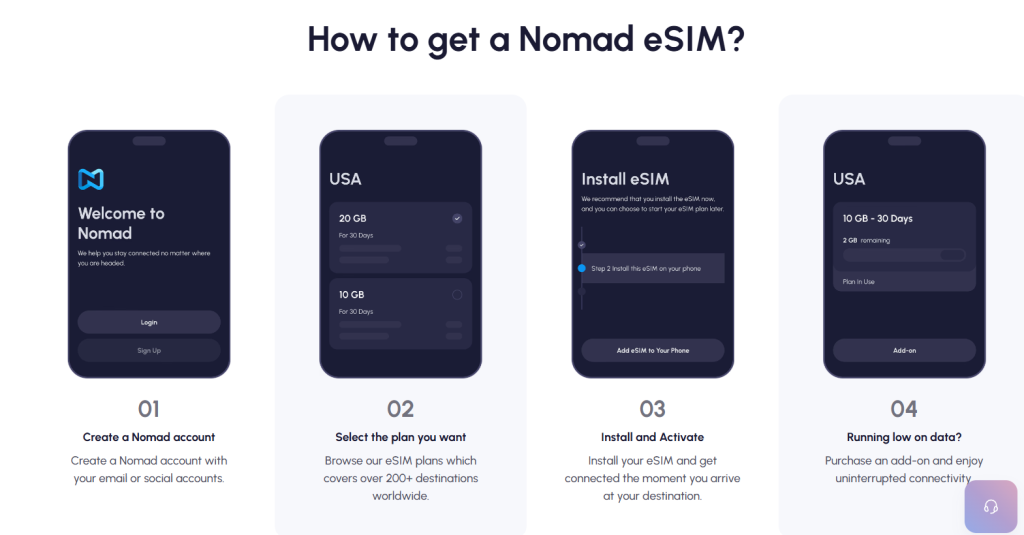
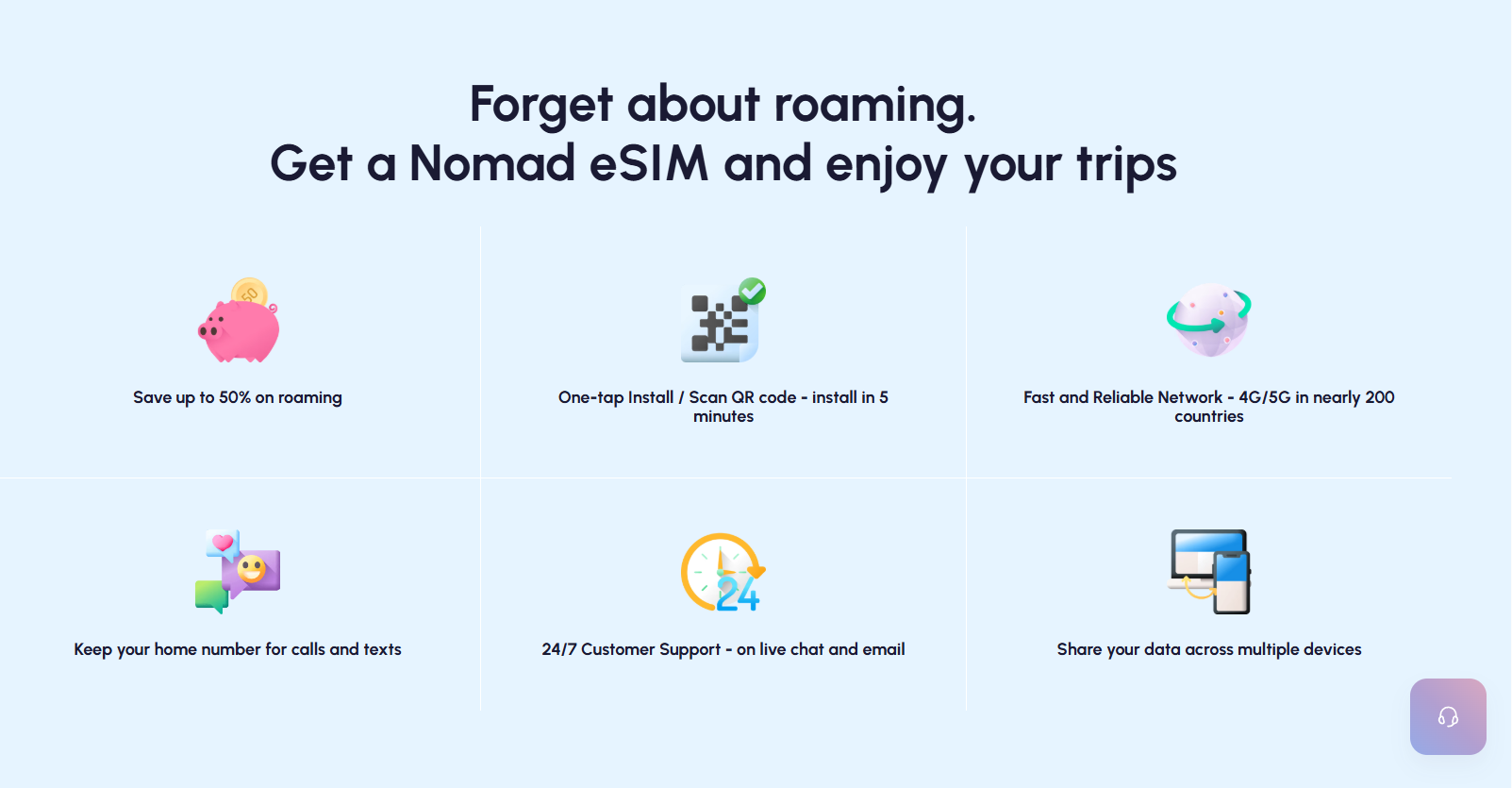
Install via QR code scan or one-tap in-app installation, both taking about five minutes. Nomad supports most eSIM-capable iPhones, Google Pixels, and Samsung Galaxy devices — always confirm compatibility on Nomad’s device list before purchasing, since older or region-locked phones sometimes lack eSIM support.
Coverage and Network Switching
Each plan lists its available local carrier partners; the eSIM automatically finds and connects to the strongest available network at your destination. For regional and multi-country plans, the eSIM switches carriers automatically as you cross borders, without needing to reinstall anything.
Data Management
The app sends notifications as your data runs low or your plan nears expiry. Add-on top-ups apply directly to the existing eSIM — no need to install a second one. Nomad’s Data Calculator tool asks about your typical app usage and destination to recommend an appropriately sized plan, which is a genuinely useful way to avoid over- or under-buying.
Account and Rewards
The app manages up to 10 eSIMs at once, supports multi-currency payments and 13 languages, and includes a loyalty points program plus a referral scheme that gives both parties $5 off future purchases.
Pricing, Plans, and Package Structure
Nomad prices vary by destination, but the structure is consistent everywhere: fixed-data plans priced by GB and validity period, unlimited short-burst plans for heavy users, and the optional Nomad Pass subscription for frequent travelers to a specific region. Prices below use the Europe eSIM as a representative example — always check the destination-specific page for exact current pricing, since rates and promotions shift regularly.
| Plan Type | Data | Validity | Approx. Price (Europe) |
|---|---|---|---|
| Fixed data (small) | 1 GB | 7 days | ~$5.50 |
| Fixed data (medium) | 10 GB | 30 days | ~$23 |
| Fixed data (large) | 50 GB | 30 days | ~$35 (on sale) |
| Unlimited (short) | Unlimited | 5 days | ~$19 |
| Unlimited (extended) | Unlimited | 10 days | ~$34 |
| Nomad Pass (subscription) | 1 GB / month | Auto-renews, cancel anytime | ~$3/month + 15% off add-ons |
First-time users can redeem a free 1GB trial eSIM before ever paying, and Nomad periodically runs promo codes (such as discounts on multi-eSIM purchases) worth checking for before checkout. Long-haul travelers should look at the Global-EX plans separately, since year-long multi-country coverage is priced and structured differently from the short-trip packages above.
How Nomad eSIM Compares to Alternatives
| Provider | Plan Style | Coverage | Standout Strength |
|---|---|---|---|
| Nomad eSIM | Fixed + unlimited hybrid | 200+ destinations | Multi-network redundancy, tethering on nearly all plans |
| Airalo | Mostly fixed data | 200+ destinations | Largest brand recognition, calls/SMS add-ons in select markets |
| Holafly | Unlimited only | 160+ destinations | Simple unlimited pricing, no usage math required |
| Airport physical SIM | Varies by kiosk | Single country | No app needed, but queues, cost, and lost-SIM risk |
vs. Airalo: Airalo is the biggest name in the category with the widest brand recognition and the most third-party comparison coverage, and it offers calls and SMS add-ons in more destinations than Nomad. But independent testing shows Airalo’s unlimited plans have gotten notably more expensive in 2026 — a Japan 7-day unlimited plan roughly doubled in price — while Nomad’s mixed fixed/unlimited lineup keeps more budget-friendly fixed options in place for travelers who don’t need truly unlimited data.
vs. Holafly: Holafly sells exclusively unlimited plans, which is simple but pricier for short trips — often the most expensive option in head-to-head country comparisons. Nomad’s ability to sell a small fixed-data plan for a quick weekend trip, rather than forcing every traveler into an unlimited package, generally makes it the cheaper choice for anyone who isn’t streaming video or on video calls all day.
vs. an airport physical SIM: a local SIM kiosk can sometimes undercut any eSIM on raw price, but it costs queue time, requires ID in some countries, and risks the classic lost-SIM problem when switching phones or trips. Nomad’s install-before-you-fly workflow trades a small price premium for landing already connected.
Pros and Cons
What Travelers Love
Reliable coverage across many destinations: repeated Trustpilot reviews describe flawless connectivity across multi-country Europe trips, Southeast Asia, and even China — a market where connectivity is notoriously tricky for foreign SIMs.
Genuinely fast setup: most users report installing and activating within minutes, skipping the airport SIM counter entirely.
Competitive pricing on fixed-data plans: several long-time users specifically cite Nomad’s prices as lower than competitors they’d previously used.
Responsive support in many cases: multiple reviewers describe fast, full refunds after reporting genuine technical problems, sometimes issued the same day.
Limitations Worth Knowing
Refund policy tightens after activation: the most consistent complaint pattern in reviews involves refund refusals — either for unused eSIMs in destinations travelers ultimately didn’t visit, or for connectivity problems that support disputed. Nomad’s official position is that unactivated eSIMs are refundable within 30 days, but activated plans require proof of a technical failure.
No phone support: customer service runs through an AI chatbot and email/in-app ticketing only. The bot handles routine questions reasonably well, but travelers with an urgent connectivity problem mid-trip don’t have a phone line to call.
Occasional installation friction: a handful of reviewers describe needing to delete and reinstall the eSIM, or struggling with the initial activation, particularly right after landing with limited Wi-Fi access to troubleshoot.
Speed can vary by city and local partner network: a small number of reviews mention unexpectedly slow speeds in specific cities even on “unlimited” plans — a reminder that Nomad depends entirely on local partner network quality, which it doesn’t fully control.
Who Should Use Nomad eSIM
Short-trip tourists and business travelers who need reliable maps, messaging, and email for a week or two will get strong value from a mid-size fixed-data plan without paying for data they won’t use.
Remote workers and digital nomads who need to tether a laptop will appreciate that hotspot support is standard across nearly all plans, rather than a premium add-on — a Global-EX plan is worth evaluating for anyone spending months on the road across multiple countries.
Multi-country Europe travelers are a particularly good fit given the regional plan’s automatic network switching across 35+ countries and the low-cost Nomad Pass for repeat visitors.
Budget-conscious travelers comparing raw price will generally find Nomad’s fixed-data plans undercut Holafly’s unlimited-only pricing for anyone whose actual usage is moderate rather than heavy.
Travelers who value phone support or need airtight refund guarantees for unpredictable itineraries should weigh Nomad’s chat-only support model and stricter post-activation refund policy against their own risk tolerance before committing to a longer or pricier plan.
Getting Started: Step by Step
- Check device compatibility — confirm your phone supports eSIM and is carrier-unlocked using Nomad’s device compatibility list before purchasing anything.
- Download the Nomad app or visit the website — both let you browse plans by country or region.
- Use the Data Calculator (optional) — answer a few questions about your typical usage and destination to get a plan-size recommendation.
- Purchase and install before you fly — buy the plan up to 60 days in advance and install it over Wi-Fi at home; it won’t start counting down until you activate it.
- Turn on Data Roaming and select the Nomad eSIM — once you land, enable your cellular line, ensure Data Roaming is toggled on, and set the Nomad eSIM as your data line.
- Monitor usage in the app — the app notifies you as your data runs low or your plan nears expiry.
- Buy an add-on if needed — purchase a top-up directly from the app; it applies automatically to your existing eSIM without a reinstall.
Tips for Getting Maximum Value
Redeem the free 1GB trial eSIM before your first paid purchase to confirm your device connects properly with Nomad’s local network partners in your specific destination — this sidesteps most of the installation-friction complaints reviewers describe. Install your eSIM at home over stable Wi-Fi rather than waiting until you land, since a shaky airport connection is the most common trigger for setup problems. Keep the eSIM installed and don’t delete it if something goes wrong mid-trip; contact support first, since removing the eSIM can make a technical fault impossible to verify for a refund. If you’re a frequent visitor to one region, run the numbers on Nomad Pass versus buying individual plans each trip — the 15% discount on add-ons adds up quickly for repeat travelers. And for genuinely heavy data users doing video calls or streaming daily, compare Nomad’s unlimited short-burst plans against Holafly’s unlimited pricing directly for your specific destination, since the cheaper option flips depending on trip length.
Future Outlook and Final Assessment
The eSIM travel market is growing fast as more phones ship eSIM-only or eSIM-first, and as travelers increasingly expect to land already connected rather than hunting for a SIM kiosk. Nomad’s mixed fixed/unlimited catalog, multi-network redundancy, and steadily expanding destination list position it well against both Airalo’s broader brand reach and Holafly’s unlimited-only simplicity. The honest caveats are real, though: the post-activation refund policy and chat-only support model mean travelers with a mid-trip emergency have fewer options than they might expect, and it’s worth going in with that expectation set correctly.
Conclusion
Nomad eSIM earns its place among the better-known travel eSIM providers in 2026 — the destination coverage, network redundancy, and flexible fixed-or-unlimited plan structure genuinely solve the airport-SIM-counter problem for most travelers. It isn’t flawless: the refund policy tightens noticeably after activation, and support is chat-only rather than phone-based, so it pays to read the fine print and install your eSIM before you actually need it rather than in a rush at the gate. For short-trip tourists, remote workers who need tethering, and frequent Europe travelers in particular, Nomad delivers real convenience and generally fair pricing. That’s the whole idea behind AI Solutes, too — we dig through the pricing pages, the fine print, and the real user reviews so you don’t have to, because we believe in helping you make everything easy.
Ready to land already connected on your next trip?
Explore more honest reviews, tutorials and tool comparisons to find the right tech for the way you work and live — at AI Solutes, where we make everything easy.
👉 Get Your eSIM: https://ai-solutes.com/nomad.esim
👉 Our YouTube Channel: youtube.com/@ai-solutes
👉 Our Facebook Fanpage: Facebook
- Will Cutout.pro Eliminate Tedious Photoshop Editing? Analyzing the Cutout.pro Automated Masking Engine
- Transform Retail Success with Increff: AI-Powered Inventory Optimization and Predictive Analytics
- Master Krisp AI in 2026: Boost Call Clarity with Noise Cancellation, Meeting Assistant, and Call Center AI
- Master LearnWorlds 2026: AI Course Creation Review, Pricing Breakdown & Setup Tutorial
- CSM.AI