Something seismic is happening underneath your traffic dashboards. ChatGPT now serves roughly 900 million weekly active users, Google’s AI Overviews reach well over a billion people a month, and independent analysis suggests around 93% of AI search sessions end without a single click to a website. Your customers are still asking the same questions they always asked — what’s the best CRM, which agency should I hire — but they’re increasingly getting an answer instead of ten blue links. And in that answer, either your brand is named, or your competitor is. Rank Prompt is one of the most complete platforms built to solve exactly that problem: it monitors how six major AI engines talk about your brand, shows which sources they cite, and gives you the content, audit and outreach tools to change the outcome. Pricing starts at roughly $39/month billed annually (about $49 month-to-month), every plan includes a 7-day free trial with 50 free prompts, and the platform covers ChatGPT, Perplexity, Google AI Mode, Claude, Gemini, and Grok in a single dashboard.
For SaaS marketers, content teams, SEO professionals, e-commerce brands, local and multi-location businesses, and agencies selling AI visibility as a service, this is one of the few tools in a very new category that does more than hand you a number. This 2026 review walks through the full platform — monitoring, Content Studio, citation outreach, Agent Mode, the developer API and MCP server, and the new Agency Plus suite — plus current pricing, honest limitations, head-to-head comparisons, and exactly who should (and shouldn’t) subscribe.
Rank Prompt Review 2026: The All-in-One GEO Platform That Tracks — and Actually Fixes — Your Brand’s Visibility Across Six AI Engines
Overview and Background
Rank Prompt is an AI search visibility platform — the category known as GEO (Generative Engine Optimization) or AEO (Answer Engine Optimization). It queries six AI assistants with prompts tailored to your brand, industry and customer search patterns, analyzes whether and how your brand appears, and turns that into a visibility score, a competitor leaderboard, a citation map and a prioritized list of fixes.
The origin story tells you a lot about the product. Rank Prompt began as an internal tool inside a marketing agency, built because clients kept asking a question nobody could answer: does AI recommend our brand? That agency DNA explains why the platform is unusually strong on client reporting, white-labeling and multi-brand management — things pure-play analytics startups tend to bolt on late. The company is headquartered in Miami, Florida, run by four founding partners and a founding engineer.
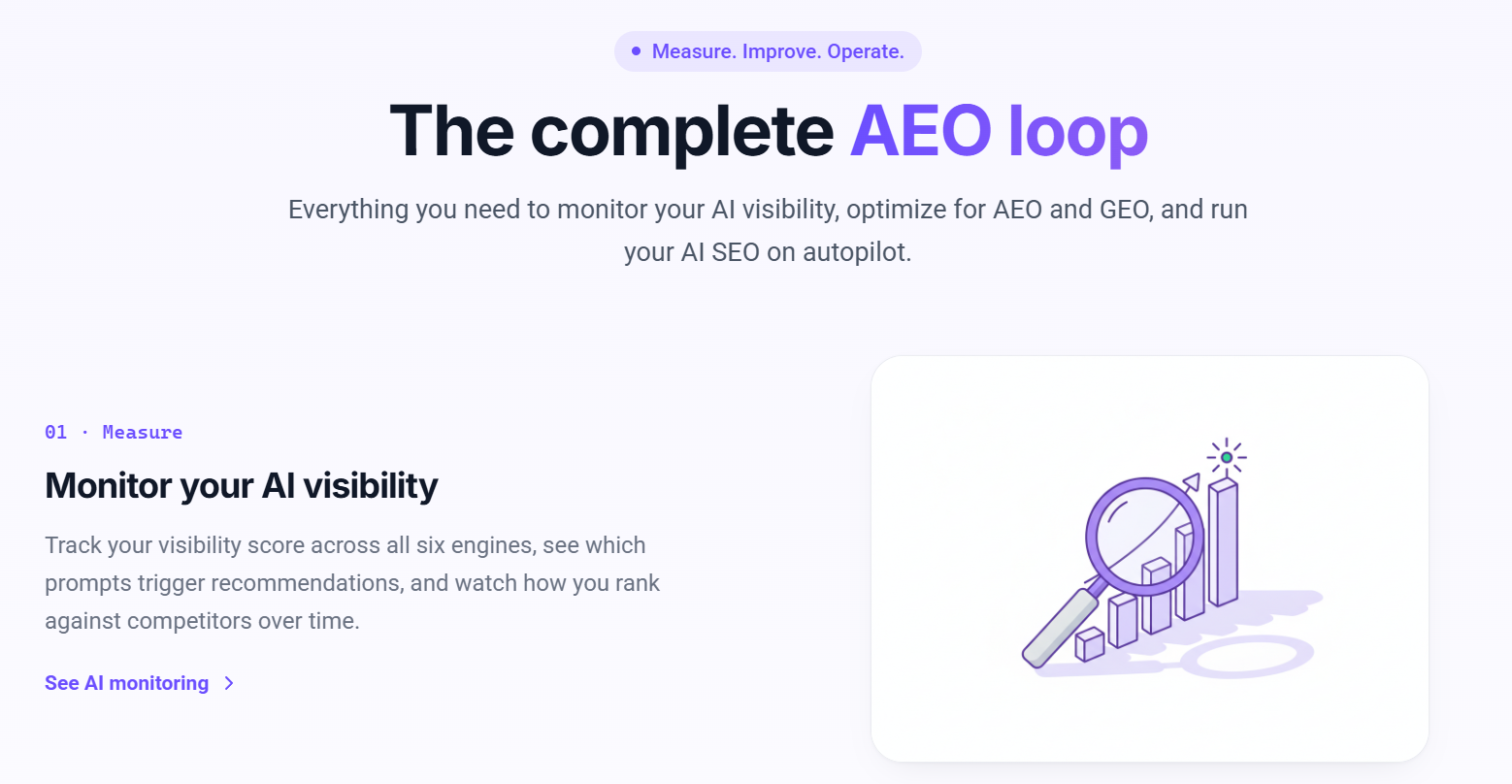
What separates Rank Prompt from the dozens of trackers launched in the last eighteen months is scope. Most competitors measure. Rank Prompt measures, then hands you an AI Content Studio, technical and Lighthouse SEO audits, a citation-outreach and email campaign system, Google Business Profile management, an autonomous agent with 50+ tools, a public REST API, and an MCP server that plugs visibility data straight into Claude Code, Cursor or ChatGPT. Its own framing — measure, improve, operate — is accurate.
Why Rank Prompt Stands Out in 2026
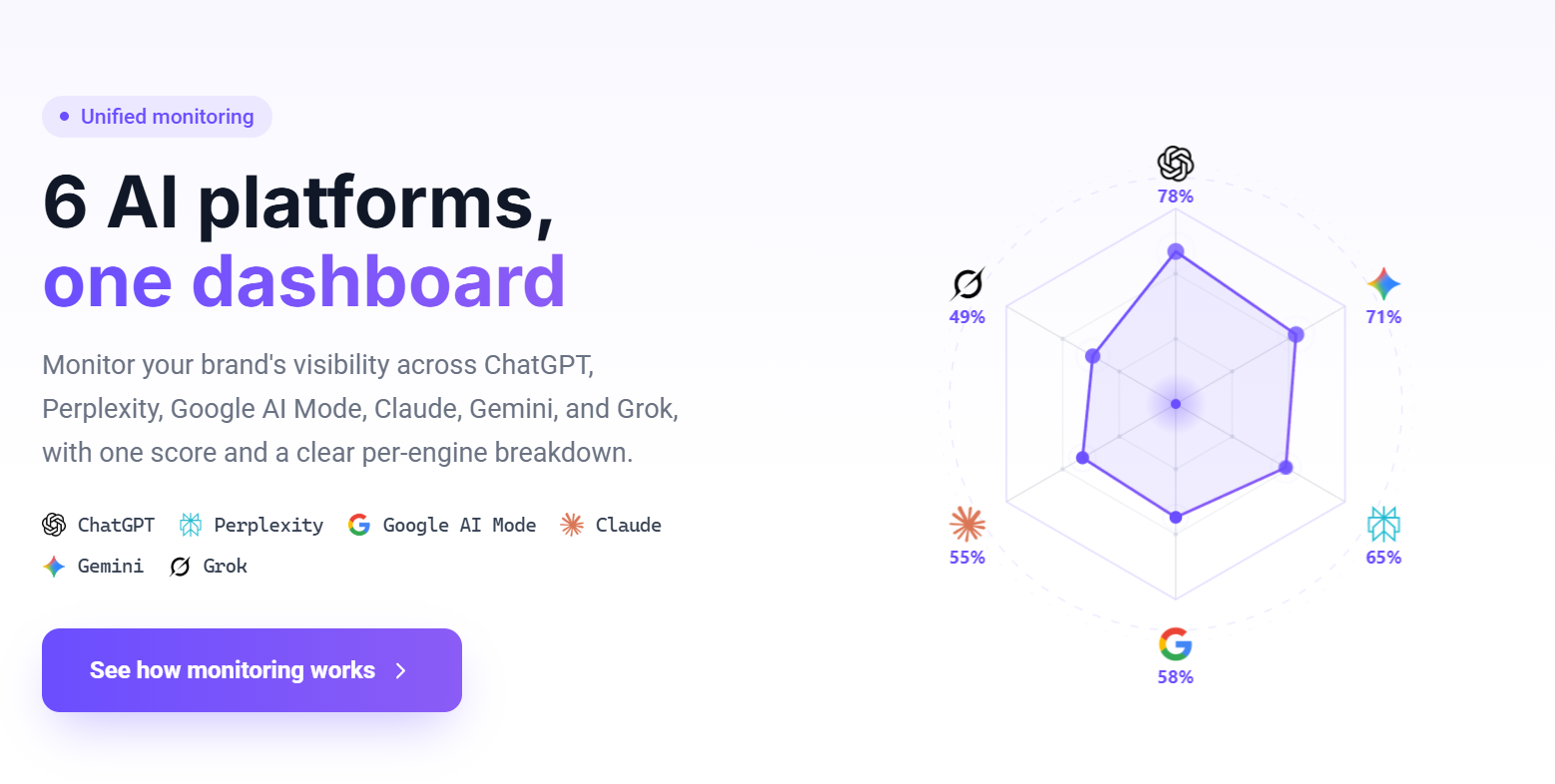
Six AI engines in one dashboard — and that number matters more than it used to: Rank Prompt tracks ChatGPT, Perplexity, Google AI Mode (AI Overviews), Claude, Gemini, and Grok, with a blended visibility score plus a per-engine breakdown. This is no longer a vanity spec. Independent 2026 panel research found ChatGPT’s share of measurable B2B AI referral traffic had fallen to roughly 63%, with Claude near 18%, Gemini 11% and Perplexity 7%. Different engines surface different brands for identical prompts, so a tool watching only ChatGPT now measures less than two-thirds of the picture — and several well-known competitors cap you at three or four engines, or charge per-engine add-ons.
It closes the loop instead of stopping at the scoreboard: The common complaint about this category is that these tools tell you your score is 14% and then leave you alone with it. Rank Prompt ships the whole workflow: monitoring, competitor tracking, brand perception audits, citation analysis, a Content Studio generating six content types with schema markup, technical and Lighthouse audits, outreach campaigns, and auto-generated tasks telling you what to fix next. One subscription replaces what would otherwise be three or four point tools.
The most affordable serious entry point in the category: Industry pricing round-ups in mid-2026 put credible multi-engine tracking at roughly $200–$500/month, with enterprise platforms quoted into the thousands. Rank Prompt’s Starter plan lands near $39/month billed annually and covers all six engines with no per-engine surcharge. For founders and small businesses discovering GEO for the first time, that’s the lowest-friction credible way in — and the single strongest argument in the product’s favor.
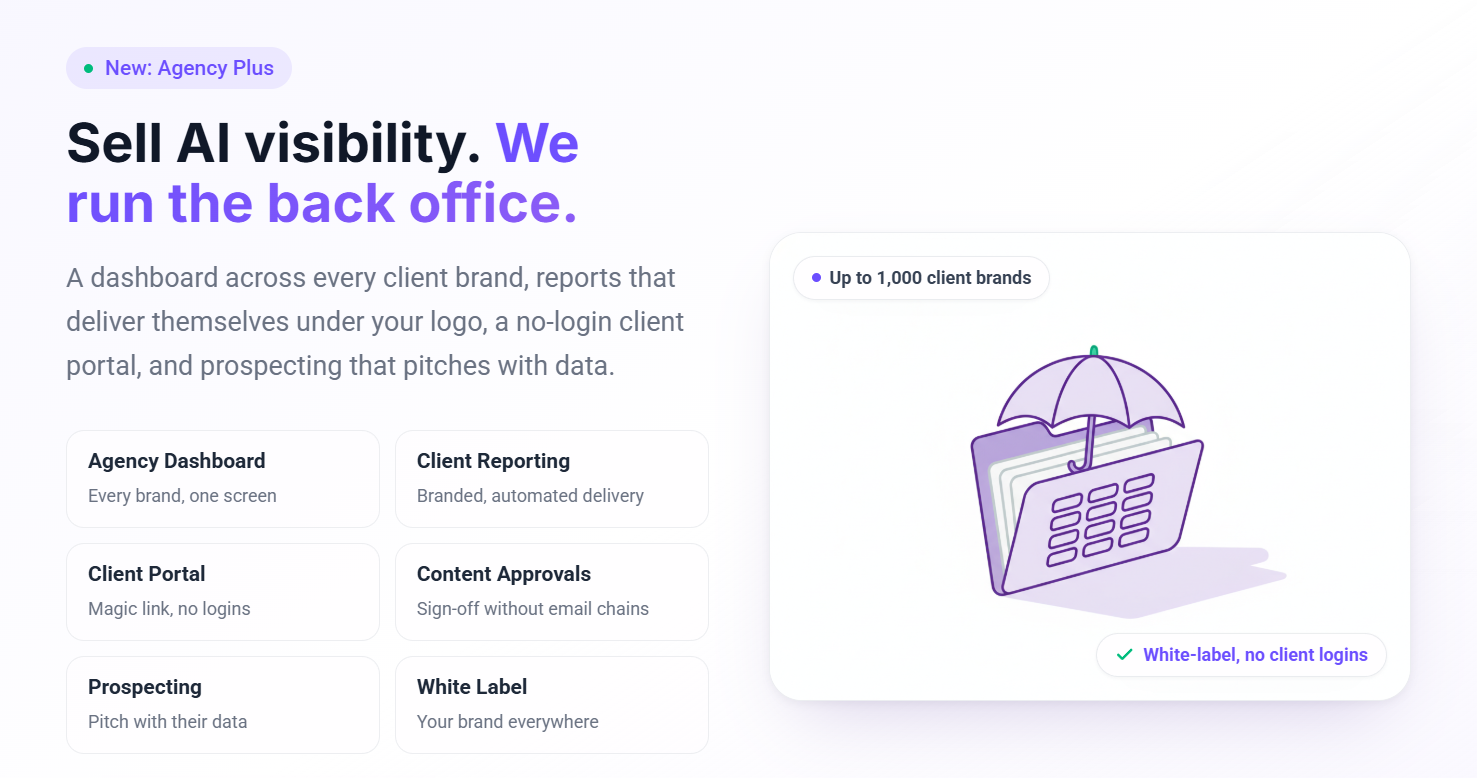
Agency Plus is a reseller business in a box: Shipped in June 2026, Agency Plus adds a real operations layer rather than a white-label PDF: a cross-brand dashboard with visibility scores, portfolio trends, a brand-by-platform heatmap and needs-attention alerts; automated client report delivery under your branding with open tracking; a magic-link client portal requiring no client logins; article reviews with anchored comments; cold prospecting with branded pitch reports; and an agency-wide AI copilot — across up to 1,000 client brands.
A real developer platform, not a marketing bullet: Every paid tier includes public REST API access documented against OpenAPI 3.1 — 10,000 requests/month on Starter up to 100,000 on Agency Plus — plus webhooks. More interesting for AI-native teams: an MCP server you connect in one line, letting Claude Code, Cursor, ChatGPT or Codex query your real visibility data in plain English. Telling your coding assistant to “pull my latest report and fix the top three issues” is a workflow almost nobody else offers.
Agent Mode grew up: What started as a chat box is now a persistent dock with 50+ tools, live article canvas editing, memory across sessions, confirmation flows with an audit trail, and bring-your-own-key support. Ask why visibility dropped this week, have it draft outreach to domains citing competitors but not you, or run a report and summarize what changed — without touching a dashboard.
Local and multi-location coverage that most competitors skip: Rank Prompt tracks hyper-local visibility across 50+ countries and 500+ cities, with location configs carrying their own country, language and prompt sets. The April 2026 release added Google Business Profile management: connect one or many locations, AI-optimize descriptions and categories, publish posts, reply to reviews in bulk, and map local pack rank with Geo Grid heatmaps. For franchises, this is a category of its own.
Six genuinely free tools, no account needed: The free AI Readiness Checker, AI Visibility Checker, GEO Prompt Generator, Robots.txt AI Checker, GEO ROI Calculator and LLMs.txt Generator work without signing up. If you’re not sure GEO is a real problem for your business yet, these let you find out before spending anything.
Key Features and Technology
Rank Prompt organizes into three layers — monitor, optimize, automate — plus agency and developer layers on top.
AI Visibility Monitoring and Competitor Tracking
The core engine generates prompts tailored to your brand and industry, runs them across all six platforms, and scores visibility from 0–100%. Independent hands-on testing notes that Rank Prompt uses browser-based front-end capture rather than relying purely on API calls — observing closer to what a real user sees, a meaningful difference in a category where API responses and consumer-facing answers diverge. Competitor detection is automatic: the platform identifies which brands AI names alongside (or instead of) you, categorizes them as direct or indirect competitors, publishers, AI platforms or brand aliases, and shows the prompts where they appear and you don’t.
Citations, Brand Audit, and AI Traffic Analytics
Citation tracking is arguably the most actionable module here. AI engines cite sources when they recommend brands, and 2026 research consistently shows brands are several times more likely to be cited through third-party sources than through their own domain. Rank Prompt shows which domains AI cites in your category, enriched with titles and preview images, and flags which are ready for outreach. The Brand Perception Audit goes further, analyzing not just whether AI mentions you but how it characterizes you. AI Traffic Analytics connects to GA4 and Search Console so you can tie visibility movements to real sessions and clicks.
Content Studio and SEO Audits
Content Studio generates six content types built to be cited: comparison articles, ranked lists, location pages, case studies, product deep-dives and FAQ articles, each with schema markup and AI-generated images. Since leaving beta it supports inline AI editing, undo from the AI panel, and direct publishing to WordPress or a hosted subdomain blog. Alongside it sit two audit systems: a free technical SEO audit covering indexability, robots.txt, sitemaps, meta tags and AI bot access, and a credit-consuming Lighthouse audit for Core Web Vitals.
Citation Outreach and Email Campaigns
This is where measurement turns into action. Rank Prompt identifies the sites LLMs cite most in your category, extracts contact names, emails and roles behind those sources, and runs multi-step sequences with automated follow-ups, merge tags, open and reply tracking, CSV import and blacklist management. Email campaigns are Pro-and-above; basic outreach tooling starts at Starter.
Agent Mode, Smart Tasks, and Scheduled Reports
Smart Tasks auto-generate action items from sentiment audits, AI analysis, Lighthouse checks and technical scans — “add schema markup to product pages,” “create a comparison article vs Competitor X” — filterable by priority, with due dates and a Kanban board. Scheduled reports deliver themselves on your cadence. Agent Mode sits across all of it as a copilot that executes rather than just advises.
Developer API, MCP Server, and Integrations
The public REST /v1 API is documented with OpenAPI 3.1 and available on every paid tier at rising request ceilings, webhooks push events to your stack, and the MCP server connects your assistant to live data in one command. Native integrations cover GA4, Search Console, WordPress and Google Business Profile.
Pricing, Plans, and Package Structure
Rank Prompt is a recurring subscription with four self-serve tiers plus a custom enterprise option. Annual billing saves roughly 20%, and all four paid plans include the same six-engine coverage — what changes is credits, brand limits, seats, API quota and the agency feature set. Figures below are approximate list prices at the time of writing.
| Plan | Approx. Price | Credits & Limits | Best For |
|---|---|---|---|
| Starter | ~$39/mo annual (~$470/yr) or ~$49/mo monthly | 150 credits/mo, up to 10 brands, $5 Agent Mode budget, 10k API requests, all 6 engines | Solo founders, side projects, first-time GEO buyers |
| Pro (most popular) | ~$71/mo annual (~$855/yr) or ~$89/mo monthly | 500 credits/mo, up to 100 brands, 2 seats, $10 Agent budget, email campaigns, priority support, 25k API | In-house marketers and growing content teams |
| Agency | ~$119/mo annual (~$1,430/yr) or ~$149/mo monthly | 1,000 credits/mo, up to 500 brands, 10 seats, white-label reports, $15 Agent budget, 50k API | Agencies delivering branded reports to clients |
| Agency Plus (new) | ~$239/mo annual (~$2,870/yr) or ~$299/mo monthly | 2,000 credits/mo, up to 1,000 brands, 25 seats, full agency suite, client portal, prospecting, $25 Agent budget, 100k API | Agencies running GEO as a productized service at scale |
| Enterprise | Custom quote | 100+ brands or locations, custom cadences, network-level executive summaries, volume credit pricing, dedicated onboarding | Franchises, multi-location networks, large brand portfolios |
| Credit top-ups | ~$18 / $35 / $65 | 50 / 100 / 200 one-time credits — never expire, stack with monthly allocation | Anyone hitting a temporary crunch without wanting to upgrade |
How Rank Prompt Compares to Alternatives
The market has crowded fast, splitting into three groups: specialist monitors, enterprise analytics suites, and traditional SEO tools adding AI features. Here’s roughly where Rank Prompt sits. Competitor figures are approximate public list prices and shift frequently.
| Option | Approx. Entry Price | Engine Coverage | Execution Tools | Best Fit |
|---|---|---|---|---|
| Rank Prompt | ~$39–49/mo | 6 engines on every plan, no add-ons | Content Studio, SEO audits, outreach, agent, API, MCP | SMBs and agencies wanting measurement and execution in one bill |
| Peec AI | ~$95/mo (agency tiers ~$245+) | Typically 3 engines per tier; some models gated to higher plans | Analytics-focused; little content or outreach tooling | Teams who want clean, well-funded monitoring and nothing else |
| Profound | ~$399–499+/mo realistic entry | Deep, but engine and region limits at lower tiers | Crawler analytics and attribution depth; limited content generation | Enterprise teams needing SOC 2, SSO, and dedicated CSMs |
| Semrush / Ahrefs | ~$129–139/mo | AI tracking added on top of classic SEO; limited prompt-level control | Enormous traditional SEO toolset; AI features still maturing | Teams whose primary job is still classic SEO and backlinks |
| DIY manual prompting | $0 plus your time | Whatever you can open in a browser tab | None — no history, no scoring, no competitor baseline | A one-off sanity check, not an ongoing program |
vs. Peec AI: Peec is a well-built, well-capitalized monitoring platform with a clean interface and strong support, consistently praised for data density. But it is fundamentally an analytics product: it tells you where you stand, then hands the problem back. It also typically caps engine coverage per tier, with some models reserved for higher plans. Rank Prompt starts at well under half the price, includes all six engines from the entry tier, and adds the content, audit and outreach layer Peec doesn’t attempt. If your team already handles content and outreach and just wants the cleanest dashboard, Peec is a legitimate choice; if you want one tool that measures and fixes, Rank Prompt wins on scope and cost.
vs. Profound: Profound is the enterprise benchmark, with deeper AI crawler analytics, revenue attribution, and the compliance apparatus — SOC 2, SSO, dedicated customer success — large organizations require. It’s also roughly ten times the entry cost, with practical starting points reported around $399–$499/month and lower tiers carrying engine, region and history limits. For a Fortune 500 brand that premium is justified; for everyone else, Rank Prompt delivers most of the decision-useful signal at a fraction of the spend, with self-serve signup instead of a sales call.
vs. Semrush and Ahrefs: These aren’t really competitors so much as different jobs. If your primary work is keyword research, backlink analysis and technical crawls at scale, keep them — their AI visibility modules exist but offer less prompt-level control and narrower engine coverage than a purpose-built GEO platform. The realistic 2026 setup is a traditional SEO suite plus a GEO tool, and Rank Prompt is priced to be the affordable half of that pairing.
Pros and Cons
What Marketers and Agencies Love
Unmatched breadth for the money: Monitoring, content, audits, outreach, tasks, agent, API and agency tooling in one subscription starting under $50/month.
All six engines on every plan: No per-engine upsells and no tier gating on the thing you’re actually buying.
It tells you what to do next: Smart Tasks, ready-to-contact citation targets, and prompts where competitors beat you turn a score into a work queue.
A serious agency business model: White-label reports, a no-login client portal, automated delivery, approvals and prospecting make reselling GEO practical rather than aspirational.
Developer and AI-native friendly: OpenAPI 3.1 REST access, webhooks and an MCP server on every paid tier is rare here at any price.
Real local and multi-location depth: 50+ countries, 500+ cities, per-location prompt configs, Geo Grid heatmaps and GBP management.
A visible, fast shipping cadence: A public changelog showing six substantial releases, the latest adding an entire agency operating layer.
Limitations Worth Knowing
No permanent free plan, and mixed messaging on the trial: Every tier is paid after seven days, and the site contradicts itself on whether a card is required. Third-party listing sites muddy things further by describing a “free tier” that doesn’t appear on official pricing. Verify at signup and diarize the trial end date.
Credits are the real constraint, and they don’t roll over: Brand limits are generous — 10 on Starter — but 150 credits won’t meaningfully monitor ten brands, and unused credits expire at the billing date. Plan prompt sets and article generation deliberately, or budget for top-ups.
Agent Mode is metered separately in dollars: The included AI budget is $5/month on Starter — a small allowance for a 50-tool agent, so heavy users will top up, upgrade, or bring their own key.
Breadth comes at some cost to depth: Specialists go further in specific directions — Profound on crawler analytics and attribution, others on sentiment and narrative mapping. If one dimension is your entire use case, a focused tool may serve you better.
All AI visibility measurement is sampling, not truth: A category-wide caveat, not a Rank Prompt flaw. No tool sees every prompt, and AI answers vary by user, session, location and model version. Treat visibility scores as a directional trend line, not a precise share-of-voice figure.
A very young, very fast-moving category: Features, pricing and even the engines tracked change quarter to quarter. That cuts both ways: rapid improvement, but the product you evaluate in July may look different by autumn.
AI-generated content still needs a human editor: Content Studio produces well-structured, schema-marked drafts, but publishing unreviewed is a reputational risk. Budget editing time; the tool accelerates the work, it doesn’t remove it.
Who Should Use Rank Prompt
Solo founders and bootstrapped SaaS: If organic traffic is softening and you suspect AI summaries are eating your top-of-funnel, this is the cheapest credible way to find out whether you’re being recommended. Start with Starter on annual billing, track 20–30 commercial prompts, and upgrade only when credits become the bottleneck.
In-house marketers and content teams: You need a trend line for the monthly deck plus a work queue writers can execute against, and the GA4 and Search Console integrations connect visibility movement to real sessions. Pro is the right tier — where the second seat and email campaigns unlock.
Agencies and consultants selling GEO: The strongest use case in the product. Client work needs white-label reports, multi-brand dashboards, approvals and automated delivery, and Rank Prompt ships all of it. Agency at ~$119/month annual covers branded reporting for a growing book; Agency Plus at ~$239/month adds the client portal, prospecting and cross-brand operations that turn GEO into a productized service.
Local, franchise and multi-location businesses: When someone asks an assistant for “the best dentist near me,” location-level visibility is the whole game, and the 500+ city coverage, per-location prompt configs, Geo Grid heatmaps and Google Business Profile management make this a differentiated fit. Pro for a handful of locations; Enterprise past 100.
E-commerce and DTC brands: AI-driven referral traffic to retail surged through the 2025 holiday season and converts unusually well, so knowing whether assistants name your product in category questions has direct revenue consequences. Pro, paired with disciplined product schema work flagged by the technical audits.
Who should probably look elsewhere: Large enterprises with hard SOC 2, SSO or procurement requirements will find Profound or a comparable vendor a smoother fit. And if you want only a dashboard with no execution layer, a specialist monitor may suit you better.
Getting Started: Step by Step
- Run the free checkers first. Before creating an account, use the free AI Visibility Checker and AI Readiness Checker to see whether AI engines mention you and whether your site is crawlable by AI bots. If robots.txt is blocking them, fix that before paying for anything.
- Start the 7-day trial and add your first brand. Enter your domain, industry and key competitors. The platform generates a prompt set automatically — review it, because auto-generated prompts skew informational when you want commercial intent.
- Spend your 50 trial prompts on real buying questions. Not “what is Rank Prompt” but “best AI visibility tool for agencies” — the questions where a recommendation converts. This is the highest-leverage decision in your evaluation.
- Connect GA4, Search Console and WordPress. These take minutes and make everything downstream more useful: real traffic attribution, prompt suggestions informed by your query data, and one-click publishing from Content Studio.
- Run the free technical SEO audit and review your citation map. The technical audit costs no credits, so run it immediately. Then look at which domains AI cites in your category — that list is your outreach target list, and usually more valuable than the visibility score itself.
- Work the Smart Tasks queue, not the dashboard. Schema fixes, comparison articles, citation outreach: pick the top-priority items and ship them. Visibility moves because of published work, not refreshed reports.
- Schedule weekly reports and set your cadence. Automate delivery to yourself or your client, then check monthly on the trend rather than daily on the noise. AI answers fluctuate; only the trend line means anything.
Tips for Getting Maximum Value
Commit to annual billing once you’re convinced — the roughly 20% discount is the easiest saving available, and it’s the difference between Pro at about $89 and about $71 a month. Treat credits, not the price tag, as your real budget: an article costs ten credits and a brand audit ten more, so decide up front whether this month is a monitoring month or a production month. When you hit a crunch, one-time top-ups usually beat a permanent upgrade because they never expire. Resist tracking every brand your plan permits — ten brands on 150 credits produces ten meaningless samples, while one brand tracked properly produces a signal you can act on. Focus effort off-site: 2026 research consistently shows brands get cited through third-party sources far more often than their own domains, which makes citation outreach, not the content generator, the highest-ROI module for most users. Agencies should lead sales conversations with a free AI Visibility Checker result on the prospect’s own brand — nothing sells a GEO retainer faster than showing a founder that ChatGPT recommends three competitors and never mentions them. Developers should wire up the MCP server early. And always export your baseline in week one; in a category this new, showing a client where they started six months ago is worth more than any single report.
Future Outlook and Final Assessment
The tailwinds behind this category are about as strong as tailwinds get. AI Overviews now appear in roughly a quarter of Google searches, up sharply year over year, and zero-click behavior dominates AI sessions. AI referral traffic is still small as a share of total traffic but growing steadily, and it converts well above average because arrivals have been pre-qualified by a recommendation. The engine mix also keeps shifting — Claude and Gemini both grew referral share sharply through 2026 — which strengthens the case for multi-engine tracking over ChatGPT-only tools. GEO is following the adoption curve SEO followed twenty years ago: dismissed, then debated, then a line item in every budget.
The honest caveats stand. There’s no free plan, credits expire monthly, the Agent Mode allowance on Starter is thin, and specialists go deeper on specific dimensions. The measurement is sampled rather than absolute — true of every tool here, and worth saying plainly to any client you report to. But the trajectory is impressive: six major releases, an entire agency operating layer shipped in one quarter, a real developer platform, and pricing that has stayed at the accessible end of a market drifting steadily upmarket.
Conclusion
Rank Prompt has done something unusual in a category defined by expensive dashboards: it built the whole loop, and priced it so a solo founder and a fifty-client agency can both start on the same day. Six engines on every plan, a content and outreach layer that turns scores into published work, an agency suite that makes GEO genuinely resellable, and a developer platform that lets your AI assistant do the reporting — that’s a lot of product for a subscription starting under $50 a month. It isn’t the deepest tool in every dimension, and the credit system deserves attention before you buy. But if you want to know whether AI recommends your brand and then actually do something about it, this is the most complete answer available without a procurement process. Run the free checker, take the trial, point it at the questions your customers really ask — and let Rank Prompt make everything easy about a channel that only gets more important from here.
Ready to find out whether AI recommends your brand — or your competitor?
Explore more honest reviews, tutorials and tool comparisons to find the right tech for the way you work and live — at AI Solutes, where we make everything easy.
👉 Start Your Free Trial: https://ai-solutes.com/rankprompt
👉 Our YouTube Channel: youtube.com/@ai-solutes
👉 Our Facebook Fanpage: Facebook
👉 Our X (Twitter): @AISolutes
- Accelerate Enterprise Workflow Automation with TextCortex AI Agents: GDPR-Compliant and Integrates with 30,000 Apps
- Discover Inergy’s 2026 Innovations in Semiconductors and Portable Solar Technology for a Clean Energy Future
- How Can Apollo Accelerate Your Sales Pipeline? Inside the Smart Prospecting Tool
- StudyMonkey AI
- Recover Lost Files Fast: EaseUS Data Recovery Wizard Review, Features and 2026 Guide