If you’ve ever priced out a proxy subscription for scraping, sneaker copping, ad verification, or just keeping five social accounts alive without triggering a ban wave, you already know the category has a premium problem: the “enterprise-grade” providers quote numbers built for agencies with six-figure data budgets, not solo operators and small teams. Proxy-Cheap built its entire brand around the opposite promise. Since 2018, this Cyprus-based provider has sold datacenter, static residential (ISP), rotating residential, and mobile proxies at some of the lowest headline prices in the industry — datacenter IPv6 from roughly $0.15/month, static residential (ISP) IPv4 from about $1.99 for a 7-day trial, and a 4.5/5 rating across hundreds of G2 and Trustpilot reviews from more than 45,000 clients. The pitch is simple: you don’t need to overpay to get a working proxy.
For freelance scrapers, small e-commerce operators, SEO consultants, sneaker and ticket resellers, and digital-native professionals who need proxies as a tool rather than as a core infrastructure investment, that budget-first pitch is genuinely appealing. This 2026 review walks through everything Proxy-Cheap actually offers — the full proxy lineup, real current pricing across every product line, how it stacks up against Bright Data and IPRoyal, honest complaints pulled straight from Trustpilot and G2, and exactly who should (and shouldn’t) buy in.
Proxy-Cheap Review 2026: Budget-Friendly Residential, Datacenter, ISP, and Mobile Proxies Worth Shortlisting
Overview and Background
Proxy-Cheap is a proxy and server infrastructure provider offering residential, static residential (ISP), datacenter, and mobile proxies, built around one central positioning: affordability without a sales call. The company markets itself directly on price — its own homepage claims the title “#1 in Pricing” among proxy vendors — and backs that up with a self-serve dashboard where you can buy a single proxy or a bulk plan with a credit card, PayPal, Alipay, or crypto, no minimum spend and no long-term contract required on most product lines.
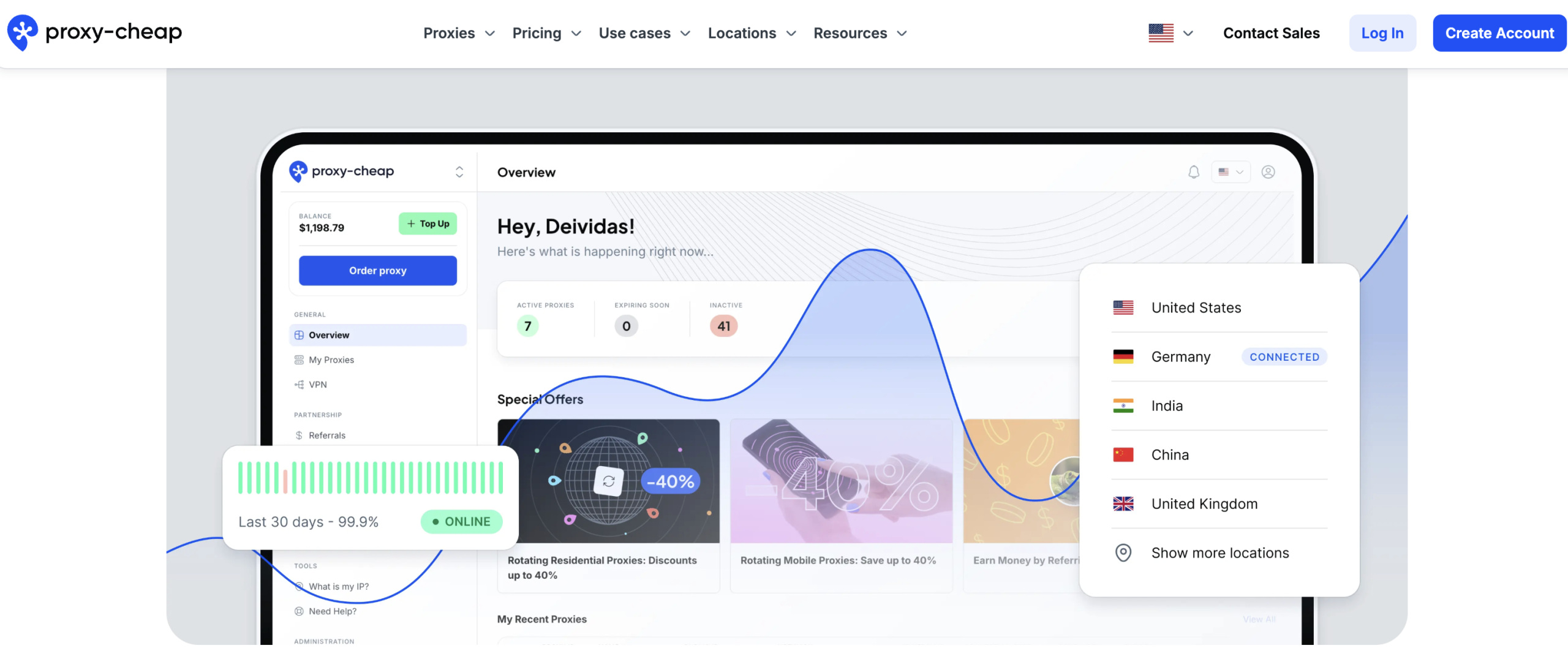
The product catalog covers the four proxy types most professionals actually need: datacenter IPv4/IPv6 (private, unlimited bandwidth, priced per proxy), static residential/ISP proxies (a dedicated IP that doesn’t rotate, good for account management), rotating residential proxies (a large pool of real household IPs billed by bandwidth), and static/rotating mobile proxies (real 3G/4G/5G carrier IPs). All product lines support HTTP, HTTPS, and SOCKS5 protocols with either IP or username/password authentication, and Proxy-Cheap layers in a browser proxy manager (Chrome extension and Firefox add-on), a usage-analytics dashboard, cURL-based network testing, and a referral program paying up to 25% commission.
Why Proxy-Cheap Stands Out in 2026
Genuinely low entry prices across every proxy category: This is the whole reason the brand exists. Datacenter IPv4 proxies run from roughly $1.18–$1.75 per proxy per month with unlimited bandwidth, datacenter IPv6 drops as low as $0.15–$0.20, and static residential (ISP) proxies start around $1.99–$2.29. Even rotating residential — normally the most expensive proxy category — has shown promotional pricing under $1/GB, well below the $3–$8/GB industry range most competitors charge.
A full proxy ladder in one account: Rather than forcing you to pick one specialty (like some boutique providers do), Proxy-Cheap sells datacenter, static residential, rotating residential, and mobile proxies from a single dashboard. That means a scraper who starts on cheap datacenter IPs can graduate to residential or mobile proxies for tougher targets without switching providers or re-learning a new API.
Unlimited bandwidth on datacenter plans: Most datacenter proxies are sold per-IP with no bandwidth cap, which is a meaningfully better deal than bandwidth-metered plans if you’re running heavy, repetitive automation against unprotected or lightly protected targets.
Broad, near-global coverage: Depending on the proxy type, Proxy-Cheap advertises coverage spanning 125+ to nearly 200 countries and territories, with dedicated location pages for high-demand markets like the US, UK, Germany, Brazil, Singapore, and Turkey. For anyone doing geo-targeted price monitoring, ad verification, or region-locked content access, that breadth matters more than raw IP-pool size.
Flexible, low-friction payments: Visa, Mastercard, Amex, Maestro, PayPal, Alipay, and crypto via Coingate are all supported. For freelancers and small operators in regions where corporate cards or wire transfers are impractical, that flexibility is a real convenience — though crypto deposits reportedly take up to 45 minutes to credit while the network confirms.
Pay-as-you-go, no forced monthly commitment: Several plans, particularly rotating residential and datacenter, let you top up and use credit on your own schedule instead of locking into a recurring subscription — useful for bursty, seasonal, or one-off projects like a quarterly catalog scrape or a single sneaker drop.
Built-in browser tooling: The Chrome extension and Firefox add-on let you switch proxies and manage settings without touching your OS network configuration — a small but genuinely useful convenience for non-developers doing manual account management or ad checks.
Key Features and Technology
Proxy-Cheap’s catalog splits cleanly into four product families, each aimed at a different job. Here’s how they break down.
Residential and ISP Proxies — Static and Rotating
Static Residential (ISP) proxies give you a dedicated IP tied to a real internet service provider, with country and ISP-level targeting, unlimited bandwidth, 100+ threads, and 100+ Mbps throughput — well suited to social media account management, long-lived logins, and tasks where an IP that doesn’t rotate is an advantage. Rotating Residential proxies instead draw from a much larger, dynamically changing pool of real household IPs, sourced through a P2P-style network — reports put the pool anywhere from roughly 7 million to over 80 million addresses depending on the source and proxy tier, so treat any single figure as approximate. Rotating residential is billed per GB and is the right choice for scraping targets with aggressive bot and fraud-score detection.
Datacenter Proxies — IPv4 and IPv6, Unlimited Bandwidth
Datacenter proxies are Proxy-Cheap’s clearest value story: private (not shared) IPv4 and IPv6 addresses, sold per proxy with no bandwidth cap, drawn from a pool the company puts at roughly 900,000+ addresses across every populated continent. They’re the cheapest, fastest option (rated around 4 Gbit/s), and the obvious pick for tasks that don’t need to disguise themselves as residential traffic — internal tooling, geo-unblocking, bulk API calls against your own infrastructure, or lightly-protected scraping targets.
Mobile Proxies — Real 3G/4G/5G Carrier IPs
Static and rotating mobile proxies route through actual mobile carrier networks across 47+ locations, which makes them the highest-trust (and highest-priced) option in the lineup. They’re aimed squarely at social media management, app testing, and ad verification, where mobile IPs are far less likely to get flagged than datacenter or even residential ones — carriers share IPs across huge numbers of real phones, so a single flagged address rarely stays flagged for long.
Dashboard, Extensions, and Protocol Support
Every proxy type supports HTTP, HTTPS, and SOCKS5, with your choice of IP whitelisting or username/password authentication. The dashboard centralizes proxy generation, port and subnet management, a usage-analytics view for tracking consumption, and a one-click cURL test to confirm a proxy is live before you build it into a workflow. For non-technical buyers, the Chrome and Firefox extensions handle the whole setup without touching system-level network settings.
Pricing, Plans, and Package Structure
Proxy-Cheap doesn’t offer a permanently free plan, and it doesn’t run a truly free trial either — instead, most product lines offer a very low-cost paid trial period (as little as $1.99 for 7 days on static residential) so you can test quality before committing to a monthly or annual plan. Pricing below reflects publicly listed rates at the time of writing; proxy pricing shifts frequently with promotions, so treat every figure as an approximate range and confirm the live price on Proxy-Cheap’s order page before purchasing.
| Proxy Type | Approx. Starting Price | Billing Basis | Best For |
|---|---|---|---|
| Static Residential (ISP) IPv4 | ~$1.99–$2.29/mo | Per proxy, unlimited bandwidth | Account management, long-lived sessions |
| Static Residential IPv6 | ~$0.15–$0.70/mo | Per proxy | High-volume, cost-sensitive tasks |
| Rotating Residential | ~$0.78–$4.99/GB | Per GB, pay-as-you-go | Scraping defended, bot-sensitive sites |
| Datacenter IPv4 | ~$1.18–$1.75/mo | Per proxy, unlimited bandwidth | General automation, light scraping |
| Datacenter IPv6 | ~$0.15–$0.20/mo | Per proxy, unlimited bandwidth | Bulk, budget-first tasks |
| Static Mobile | ~$7.00–$11.61/proxy | Per proxy/month | App testing, social media, ad verification |
| Rotating Mobile | ~$4.00+/GB | Per GB | Highest-trust, hardest targets |
How Proxy-Cheap Compares to Alternatives
| Feature | Proxy-Cheap | Bright Data | IPRoyal | Free/DIY Public Proxies |
|---|---|---|---|---|
| Positioning | Budget, self-serve | Premium enterprise | Budget, PAYG specialist | No vendor, no support |
| Residential from | ~$0.78–$4.99/GB (promo-dependent) | ~$3.53–$5.88/GB | ~$1.75–$7.00/GB | “Free” — high risk, no reliability |
| Datacenter from | ~$1.18/proxy, unlimited BW | ~$0.90/IP | ~$1.39/proxy | N/A |
| Traffic expiry | Plan-dependent | Expires monthly | Non-expiring | N/A |
| Enterprise unlock/API tools | No | Yes — SERP, Unlocker, Crawl API | No | No |
| Support quality (reported) | Mixed — fast for some, slow for others | Strong, dedicated account management | Generally solid | None |
vs. Bright Data: Bright Data is the enterprise standard — a larger, better-vetted IP pool, dedicated unlocker and SERP APIs, and stronger compliance tooling — but it’s priced for teams with real scraping budgets, often 2–5x Proxy-Cheap’s per-GB cost outside of promotions. If you’re running mission-critical, high-value data pipelines, Bright Data’s reliability is worth the premium. If you’re testing an idea, running a side project, or need proxies for account management rather than industrial-scale extraction, Proxy-Cheap covers the same core use cases for a fraction of the spend.
vs. IPRoyal: IPRoyal’s headline advantage is non-expiring residential traffic, which genuinely helps bursty, irregular workloads avoid wasting prepaid bandwidth. Proxy-Cheap counters with broader unlimited-bandwidth datacenter options and, during active promotions, lower sub-$1/GB residential pricing — though IPRoyal’s baseline pricing without promos is often more predictable. Both are legitimate budget picks; the right choice usually comes down to whether your workload is steady (favor Proxy-Cheap’s flat monthly plans) or bursty (favor IPRoyal’s non-expiring credit).
vs. free/DIY public proxy lists: Free public proxy lists are tempting but rarely worth the risk — they’re frequently dead, overused to the point of being instantly blocked, and in some cases actively logging or manipulating your traffic since someone has to pay for the infrastructure. Even Proxy-Cheap’s cheapest paid tier is a meaningfully safer, more reliable choice than anything advertised as free.
Pros and Cons
What Users Love
Some of the lowest entry prices in the category: Across every proxy type, users consistently cite price as the reason they chose Proxy-Cheap over larger, better-known providers.
Genuinely easy setup for non-coders: G2 and Trustpilot reviewers repeatedly mention getting proxies configured in a browser within minutes, even without technical background.
Stable enough for the price point: Multiple reviewers, including small business owners running local-market audits, describe the residential IP pool as clean, with low captcha and block rates for everyday research and monitoring use.
Technical support can go deep when it engages: At least one reviewer reported support staff reviewing an actual Python/BeautifulSoup scraper snippet and giving specific header-configuration advice — a level of hands-on help budget providers don’t always offer.
Flexible payment and no forced long-term contract: Card, PayPal, and crypto support plus pay-as-you-go options on several product lines make it easy to start small and scale only if the service proves out.
Limitations Worth Knowing
No permanent free plan or true free trial: The cheapest way to test the service is a low-cost paid trial (from about $1.99 for 7 days) — there’s no free tier to poke around in first.
Occasional proxy-type mislabeling reported: A number of Trustpilot and independent reviews describe orders labeled “residential” or “ISP” behaving like datacenter IPs on inspection — not the norm, but common enough to warrant checking any batch before relying on it.
Customer support quality is inconsistent: Alongside the positive support stories, other users report slow response times, bot-driven chat that auto-closes tickets, and difficulty getting refunds approved.
Geolocation accuracy isn’t always precise: Some reviewers report IP locations that don’t perfectly match the advertised city or region, which matters if your use case depends on tight geo-targeting.
Pricing pages don’t always agree: Headline prices on service pages, blog content, and live order forms can differ, so the number that first catches your eye isn’t guaranteed to be the number you’ll actually pay.
Not built for mission-critical, high-value scraping: For enterprise workloads where a failed request has real cost — large-scale price intelligence, ad-fraud detection at scale — the fraud-score variability on budget residential pools makes a premium provider a safer bet.
Who Should Use Proxy-Cheap
Freelancers and solo scrapers testing a new project or client engagement will appreciate the low commitment and pay-as-you-go options — start on Datacenter IPv4 for unprotected targets and upgrade to Rotating Residential only once you hit real blocking.
Small e-commerce and local-marketing operators doing competitor price checks, Google Business Profile audits, or geo-specific ad verification are well served by the Static Residential (ISP) plan, which gives a stable per-region IP without the overhead of a rotating pool.
Sneaker and ticket resellers on a budget can use Datacenter or Static Mobile proxies for drop automation, though high-stakes, high-volume cop crews may eventually want to compare against dedicated sneaker-proxy specialists for the fastest, most retailer-tolerant subnets.
Developers prototyping a scraping or automation product can validate an MVP cheaply here before committing to enterprise pricing elsewhere once the product proves out and scale demands it.
Enterprise teams running compliance-sensitive or mission-critical pipelines should look elsewhere first — Bright Data or a comparable premium provider will offer more consistent IP quality and stronger support SLAs for workloads where downtime or bad data carries real cost.
Getting Started: Step by Step
- Create your account at proxy-cheap.com using email or a Google sign-in — no sales call or lengthy KYC form required for standard plans.
- Pick your proxy type based on your task: Datacenter for unprotected targets and unlimited bandwidth, Static Residential (ISP) for stable long-term sessions, Rotating Residential for defended sites, or Mobile for the highest-trust use cases.
- Compare the live plan cards on the order page rather than trusting the first headline price you see, since promotions and billing periods shift the effective cost.
- Complete checkout with your preferred payment method — card, PayPal, Alipay, or crypto — and note that crypto deposits can take up to 45 minutes to confirm on-chain.
- Generate your credentials from the dashboard, choosing IP whitelisting or username/password authentication depending on your setup.
- Test the connection with the built-in cURL checker or the Chrome/Firefox extension before wiring the proxy into a production script or bot.
- Monitor usage in the analytics dashboard and set a calendar reminder near your trial or billing renewal date to confirm the plan still fits your needs.
Tips for Getting Maximum Value
Start on the cheapest tier that could plausibly work — Datacenter IPv4 or IPv6 — before paying for residential or mobile bandwidth you might not need; plenty of tasks (internal tooling, unblocking your own region-locked services, light API automation) never actually require the higher trust tiers. If you do need residential or rotating proxies, watch for the promotional pricing that periodically drops rotating residential well under $1/GB, since the non-promo rate can run several times higher. Run a quick IP-type verification check on any freshly purchased batch, particularly for static residential or ISP orders, given the mislabeling complaints noted above. Favor the 12-month plan over monthly billing wherever the annual rate matches the monthly rate — several Proxy-Cheap tiers offer this, which means longer commitment costs you nothing extra once you’ve confirmed quality. Finally, keep your crypto or PayPal receipts and screenshot your plan terms at purchase time, since refund and support experiences are reported as inconsistent — having documentation in hand makes any dispute faster to resolve.
Future Outlook and Final Assessment
The proxy market is only growing more competitive, driven by expanding e-commerce data collection, AI-training data pipelines, ad-fraud verification demand, and the ongoing arms race between bot-detection systems and automation tools. Budget providers like Proxy-Cheap benefit directly from this trend, since a growing share of buyers — indie developers, small agencies, solo researchers — need proxies as an occasional tool rather than a core infrastructure line item, and simply can’t justify enterprise pricing. Proxy-Cheap’s broad product ladder and self-serve model position it well to keep serving that segment, provided it keeps investing in pool quality and support consistency to close the gap with pricier rivals.
The honest caveats are worth restating plainly: pricing pages that don’t always match each other, occasional proxy mislabeling, and support experiences that swing from genuinely excellent to frustratingly slow depending on who you reach. None of these are dealbreakers for casual or moderate use, but they’re real enough that mission-critical, revenue-dependent workflows should weigh a premium alternative first.
Conclusion
Proxy-Cheap won’t out-muscle Bright Data on enterprise reliability, and it isn’t trying to. What it offers instead is a genuinely low-cost, self-serve way to get datacenter, residential, ISP, and mobile proxies working in minutes, with enough flexibility in payment and billing to fit almost any budget. For the freelancers, small business owners, and digital-native professionals AI Solutes readers tend to be, that’s exactly the right trade-off — as long as you go in with realistic expectations about support consistency and take the extra minute to verify what you’re buying. At AI Solutes, our goal is always to point you toward tools that make everything easy, and for anyone who needs proxies without the enterprise price tag, Proxy-Cheap earns its place on the shortlist.
Ready to try budget-friendly proxies that actually work?
Explore more honest reviews, tutorials and tool comparisons to find the right tech for the way you work and live — at AI Solutes, where we make everything easy.
👉 Start Your Trial: https://ai-solutes.com/proxycheap
👉 Our YouTube Channel: youtube.com/@ai-solutes
👉 Our Facebook Fanpage: Facebook
👉 Our X (Twitter): @AISolutes
- Does Legal Templates Simplify Contract Creation? Evaluating the Legal Templates Document Automation Suite
- Transform Your Identity with FaceApp AI: Aging Filter, Makeup Editor, and Viral Photo Trends Revealed
- Does LiveChat Accelerate Customer Support? Reviewing the LiveChat Real-Time Chat Technology
- Unlock Puma’s 2026 Brand Strategy: Transformation, Innovations, and McLaren Racing Partnership Revealed
- Unlock the Top Impact Trends Redefining Tech, Sustainability, and Global Growth in 2025