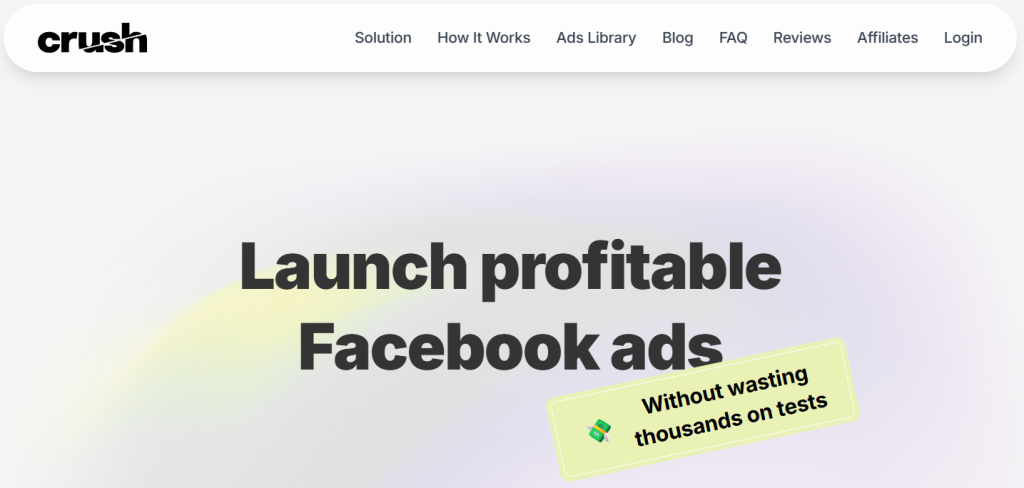
Running Facebook ads as a small business usually means choosing between two bad deals. Do it yourself and you inherit a second job: learning Ads Manager, briefing creatives, writing hooks, building test structures, then checking your phone at midnight to see whether today's budget bought anything. Hire an agency and you hand over $2,000 to $10,000 a month — or 10–20% of your spend — before a single dollar reaches Meta. Crush AI (trycrush.ai) sells a third answer: an AI media buyer that plugs into your Meta ad account and runs the entire loop itself, generating creatives and copy, launching structured tests, killing losers, scaling winners, and shifting budget around the clock. It lists at roughly $80 a month, its models are trained on a claimed $100 million-plus in ad spend, and it ships with a searchable library of over 1.7 million real Facebook ads that costs nothing and doesn't even ask you to sign up.
The timing is hard to argue with. Meta is forecast to overtake Google as the world's largest digital advertising seller in 2026, with roughly $243 billion in global ad revenue against Google's $239 billion — meaning more competition and less room for guesswork than ever. But Crush AI also asks something significant of you: autonomous, spend-level access to your ad account, granted to a company barely a year into public trading. This 2026 review walks through what Crush AI automates, the real cost including the ad budget most reviews omit, how it compares to Madgicx and Bïrch, the failure modes that recur in customer reviews, and exactly who should — and shouldn't — hand it the keys.
Crush AI Review 2026: The ~$80/Month AI Media Buyer Built to Replace Your Facebook Ads Agency
Overview and Background
Crush AI is a Lithuania-based advertising platform trading as trycrush.ai. It describes itself plainly: AI that runs Facebook ads end to end — it builds the ads, launches them, and moves budget toward whatever sells, monitoring campaigns around the clock. The company is small enough that its co-founder, Albertas (who signs his public replies as Albert), personally answers customer reviews, issues refunds by name, and offers to walk frustrated users through setup himself. He came to it from roughly eight years of buying media for clients, with more than $50 million in combined Facebook and TikTok spend behind him, and built Crush AI out of the internal tools he wrote to automate his own work.
That origin explains the product's shape. Crush AI is not another AI creative generator with a nice landing page. Creative generators stop at the asset — you get images and copy, then still do all the hard media buying yourself. Crush AI crosses the line most tools won't: it pushes campaigns into your live Meta account, watches conversion data against a target you set, pauses ads that fail the benchmark, and moves budget toward the ones clearing it.
Its quietly impressive asset is data. Crush AI maintains its own index of Facebook ads drawn from Meta's Ad Library — over 1.75 million unique ads at last public count, more than 440,000 currently live, plus retained records of ads advertisers have since pulled. It uses ad longevity as its primary success signal, on the logic that a creative running for months is almost certainly profitable. The library is free, searchable and sits outside the signup wall — the easiest way to judge the company's data quality before spending anything.
Why Crush AI Stands Out in 2026
There is no shortage of Meta ad tools. What separates Crush AI is where it draws the line between advising you and acting for you.
It actually buys media, not just creative: Tools like AdCreative.ai and Creatify produce assets you export and launch yourself. Madgicx and Bïrch optimize campaigns you already built. Crush AI does both halves — generating creative and copy, then launching, testing, cutting and scaling inside your account without you touching Ads Manager. Very few affordable tools cross that boundary.
Flat, published pricing in a category that hides it: Most Meta automation platforms tier their price to your ad spend, and several won't show a number until you sign in and connect an account — Madgicx's flagship plan is gated behind “see price inside the app.” Crush AI publishes one figure and charges it whether you spend $500 a month or $50,000. For a growing store, that is the difference between a predictable line item and a bill that doubles when you scale.
A competitor ad index with longevity data: Plenty of tools scrape the Meta Ad Library. Crush AI keeps records of ads since taken down and ranks by how long a creative has run — a far better profitability proxy than impressions or engagement. You get the angles that survived, not just the ones live today.
Genuinely fast setup when it works: Reviewers who clear the connection step report being live in ten to fifteen minutes — a two-click Meta and Pixel connection, a short intake, then a first batch. Against the multi-day onboarding of most agency relationships, that is a different category of speed.
Multilingual and multi-currency by default: Crush AI generates creative and copy in any language and works in any currency. If you sell across several markets — common for ecommerce operators outside the US — that removes the usual workaround of a separate tool or translator per geography.
It tells you when the problem isn't the ad: Weak-funnel detection examines your offer, pricing and landing page and flags where conversion is leaking. Most tools default to blaming the creative, because creative is what they sell. For a beginner, being told the page is the bottleneck is often the single most valuable output.
Founder-level accountability: The co-founder replies personally to complaints, admits fault in writing, refunds publicly and offers to run setup calls himself; Trustpilot records a 100% reply rate on negative reviews. That does not undo a bad experience, but it signals how disputes get resolved here.
Key Features and Technology
Crush AI is best understood as four connected systems: a research engine, a creative engine, a launch layer and an optimization loop. Each feeds the next.
Competitor Research and the Free Ad Library
Search by keyword or competitor domain and Crush AI returns live and historical Facebook ads ranked by longevity — you see how many days a creative has run, the closest public proxy for whether it makes money. No account is required, so you can stress-test the data on your niche in five minutes. As a free tool it competes with paid ad-spy subscriptions.
Product URL Scan and AI Creative Generation
You paste your product or landing page URL and Crush AI reads it — pricing, positioning, imagery, key selling points — then shapes output from that context. It generates image and video creative in batches, patterned on proven layouts rather than free-form design. Independent testers rate the quality solid for testing: good enough to validate an angle fast, usually worth a small tweak before it is brand-ready. The copy engine writes headlines, primary text and calls to action in any language.
Campaign Launch and Meta Integration
Once you approve a set, Crush AI pushes the campaign into your connected Meta account directly — no exporting, no rebuilding in Ads Manager. This is also, as the review record makes clear, where things break. Meta's own setup chain (Pixel, Business Manager permissions, account and domain verification) is complicated, and a hold or missing permission on Meta's side stops campaigns publishing no matter how good the software is.
Autonomous Testing, Kill Switches and Scaling
This is the media-buyer layer. Crush AI builds structured tests, reads performance against the ROAS or CPA target you set at intake, and pauses ads that fail the benchmark — kill switches that protect budget while you sleep. Winners get fresh variations to fight creative fatigue, and budget shifts toward them. The scaling logic is deliberately simple: broad targeting and vertical budget increases rather than elaborate cost caps and audience stacking. Experienced buyers may find that limiting; beginners will find it hard to break.
Weak Funnel Detection
Crush AI analyses your offer, price point and landing page and points at the weakest link. If your page converts at half the category norm, no amount of creative testing fixes it — the automation just burns budget faster. That diagnosis, delivered before you scale, is worth more than most of the creative output.
Pricing, Plans, and Package Structure
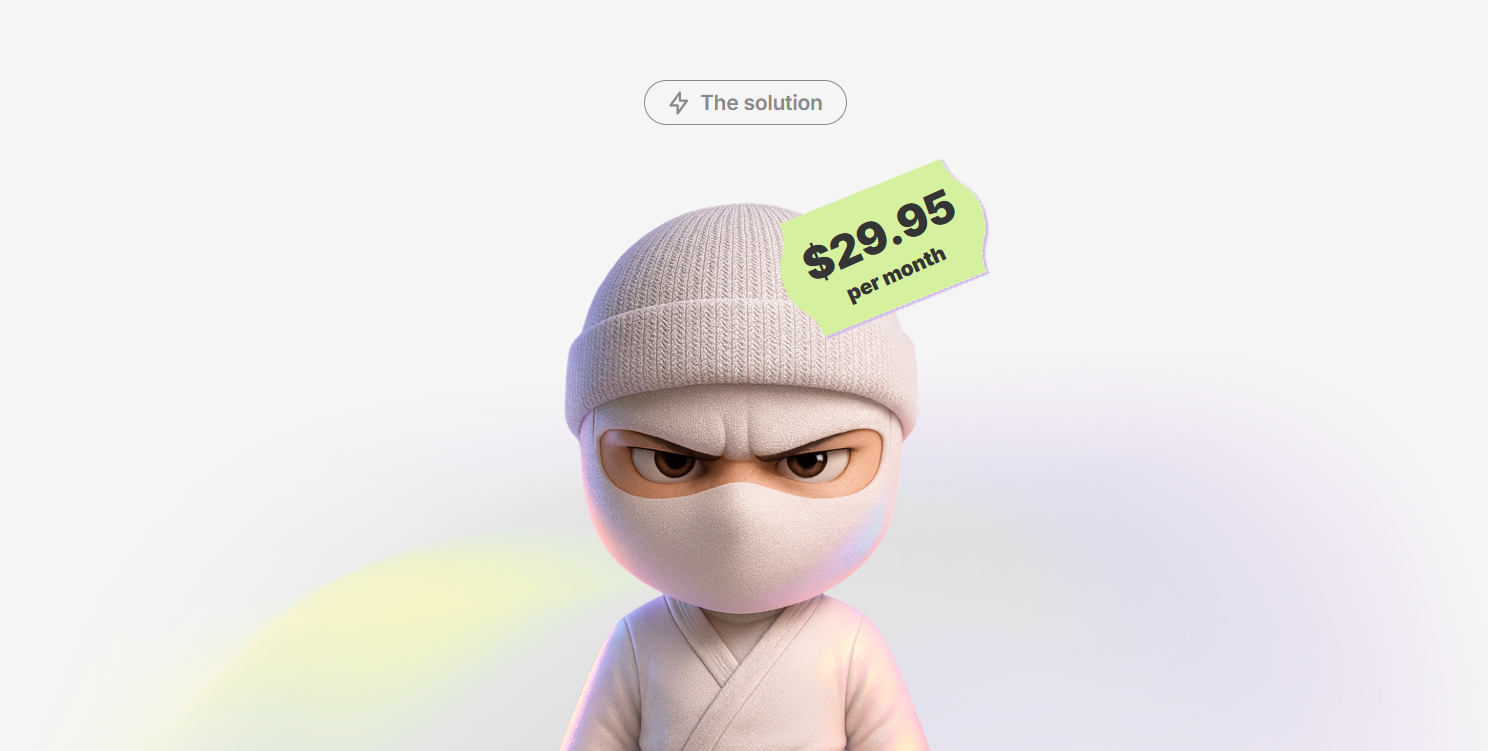
Crush AI keeps this simple: one subscription, one price, no spend tiers, no seat maths. The caveat is that the number moved during 2026 — the company's own affiliate documentation currently references $79.95 a month, several independent reviews published mid-year list $99, and promotional multi-week plans surface periodically. Treat the figures below as an approximate range and confirm the live price before you commit. The second thing to understand is that the subscription is not your total cost: your ad budget is separate and goes straight to Meta.
| Cost Component | Approximate Price | What It Covers |
|---|---|---|
| Crush AI subscription | ~$79.95–$99 / month | Full platform: AI media buying, image and video creative generation, ad copy in any language, competitor research, campaign launch, autonomous testing, kill switches, budget scaling |
| Ad budget (separate) | From ~$200 / month | Paid directly to Meta, not to Crush AI. This is the company's recommended minimum so the AI gathers enough conversion data to learn from |
| Realistic month-one total | ~$280–$300+ | Subscription plus minimum test budget. Below this, the learning phase stretches out and results are hard to read |
| Free ad library | $0, no signup | Searchable index of 1.7M+ Facebook ads with longevity data, including creatives that have since been taken down |
| Money-back guarantee | 14 days | Full refund if it doesn't beat your manual results; per company terms you keep the ads and data generated |
| Agency equivalent | $2,000–$10,000 / month | Typical flat retainer, or 10–20% of ad spend, before any budget reaches Meta |
How Crush AI Compares to Alternatives
Crush AI's closest competitors mostly do a different job — some generate creative and stop, some optimize campaigns you built yourself. Very few do both ends.
| Crush AI | Madgicx | Bïrch (ex-Revealbot) | Hiring an agency | |
|---|---|---|---|---|
| Core job | Autonomous AI media buying plus creative | AI optimization and analytics layer | Rule-based automation engine | Human strategy and execution |
| Generates creative | Yes, image and video, any language | Static ad generator; creative analytics | No | Yes, human-made |
| Launches campaigns for you | Yes, end to end | Partly; you build the structure | No; automates existing campaigns | Yes |
| Competitor ad research | 1.7M+ ad index with longevity data | Limited; own-account creative analysis | No | Manual, varies by team |
| Channels | Meta (Facebook, Instagram) | Meta only for optimization | Meta, Google, TikTok, Snap | Whatever you pay for |
| Approximate entry price | ~$80–$99 / month flat | ~$44–$99+ / month, spend-tiered; flagship price gated in-app | From ~$49 / month, spend-tiered | $2,000–$10,000 / month or 10–20% of spend |
| Price scales with your ad spend | No | Yes | Yes | Usually yes |
| Best for | Hands-off buying on a clean offer | Established accounts at $5K+ monthly spend | Experienced buyers who want granular rules | Large budgets needing omnichannel strategy |
vs. Madgicx: Madgicx is the more mature product — deeper analytics, AI audience tooling, a well-regarded creative dashboard, strong G2 marks. But it is an optimization layer, not a creative-plus-buying engine, its pricing is spend-tiered with the flagship number hidden until you connect an account, and it carries a notably weak Trustpilot profile that sits far below Crush AI's. If you already have working campaigns and $5,000-plus in monthly spend, Madgicx gives you more control. From a blank ad account, Crush AI does more of the work.
vs. Bïrch (ex-Revealbot): Bïrch is the specialist's tool — a capable rule engine spanning Meta, Google, TikTok and Snap from around $49 a month, rated highly by the buyers who use it. It is also the opposite philosophy: it assumes you know exactly which CPA, ROAS, CTR and frequency thresholds matter, and it generates nothing and launches nothing. If you can write good rules, Bïrch executes them better than Crush AI's simpler logic. If you cannot, it does nothing useful at all.
vs. an agency: This is the comparison Crush AI is built for, and the arithmetic is stark: roughly $80 a month against a $2,000–$10,000 retainer. What you give up is human judgment — strategy, brand thinking, compliance sense in regulated verticals. The hybrid model that increasingly makes sense in 2026 is to spend on creative talent, which is a genuine asset, and let software handle ad-set management, which has become a commodity. Crush AI is a reasonable candidate for the software half.
Pros and Cons
What Users Love
The creative testing genuinely runs itself: The most consistent theme in positive reviews — users go from building every ad by hand to reviewing and approving, with a testing loop that used to eat a full day running unattended. Several describe breaking a plateau because the system tested angles they would not have picked.
Kill switches actually protect budget: Reviewers note spend on underperforming creatives dropped because the AI paused them without waiting for a human to log in. For anyone who has left a losing ad running over a weekend, that alone can cover the subscription.
Competitor research that feeds straight into ads: Users describe the ad library saving hours of research, with competitor angles performing well once rebuilt around their own product.
Approachable with no media-buying background: New store owners with limited experience report getting set up without feeling overwhelmed — meaningful, given Ads Manager is where most first-time advertisers quit.
The price is not close to an agency's: Users switching from agencies describe better results for a fraction of what they were paying — and with flat pricing, the gap widens as you scale.
Limitations Worth Knowing
Meta connection failures are the dominant complaint: The recurring one-star scenario is a paying customer who cannot get creatives integrated or campaigns publishing. Some causes sit on Meta's side, but the product is sold as beginner-friendly — and beginners are precisely the people who cannot diagnose a Business Manager problem alone.
Support has been slow, by the company's own admission: Multiple users reported emails going unanswered for days or weeks at the worst possible moment. The co-founder accepted responsibility publicly, cited a support-routing failure, and confirmed a dedicated hire. Improvement is claimed but not yet proven over time.
Refunds have not always arrived on schedule: One documented case saw a customer request a refund inside the 14-day window and still be waiting a month later, resolved only after a card-issuer dispute. The company paid, apologised publicly and did not contest the account. That reads as a resolved incident rather than a pattern — but it is a reason to evaluate early in the window rather than at its edge.
It cannot rescue a weak offer: Crush AI says so itself. If your product, pricing or landing page does not convert, autonomous optimization discovers that faster and more expensively. Fix the funnel first.
The budget minimum and learning phase are both real: Below roughly $200 a month in spend, the AI lacks the conversion data to decide well. Testers consistently report a quiet first week and improvement in weeks two and three. Judge results on day five and you will judge them wrong.
Limited depth for advanced buyers: Some reviewers call the platform too basic, with advanced targeting options missing for complex requirements. If you run sophisticated audience structures or cost-cap strategies, you will feel constrained.
It is a young company with a shallow review base: Eighty-three Trustpilot reviews is a thin sample on which to bet an ad account. Crush AI ships fast, but lacks the track record of a decade-old platform, and occasional bugs come with that.
Who Should Use Crush AI
Ecommerce and Shopify store owners: The platform's home turf, and where the training data is deepest. With a converting store, working Pixel and $200–$500 a month to test, Crush AI replaces media-buying work you are either doing badly yourself or paying too much for. Give it three full weeks before judging.
Affiliate marketers and performance buyers: The value here is testing volume — validating an offer across many angles without building twenty ads by hand, with the competitor library shortening the path to proven structures. Use it to expand throughput, not as a set-and-forget machine, and review every creative manually in nutra, finance and dating, where Meta's scrutiny is brutal regardless of who made the ad.
SaaS founders and solo operators: If your time is better spent on product than on Ads Manager, the subscription costs less than the opportunity cost of becoming a competent media buyer. Feed it a clean landing page and a realistic target CPA.
Small agencies and freelancers: Flat pricing that does not scale with managed spend suits handling more client accounts without proportionally more staff hours. Be candid with clients about what is automated, and keep a human on compliance and brand judgment.
Who should skip it: Anyone with broken tracking, no landing page, a restricted ad account, an unvalidated offer, or a budget under roughly $200 a month — and anyone who enjoys hand-tuning every ad set, since Bïrch or Madgicx will serve you better. For these readers the free ad library is still worth using; the subscription is not.
Getting Started: Step by Step
- Test the free ad library first. No account needed. Search your niche and closest competitors and check whether results are relevant and include long-running creatives — a free quality check on the data underneath the paid product.
- Fix your tracking before you pay. Confirm your Pixel is installed and firing, conversion events are registering and your domain is verified in Business Manager. This one step prevents most failures documented in negative reviews.
- Subscribe using the email you will actually use for support. Several unresolved cases traced back to customers emailing from a different address than the one on their account, leaving the team unable to find the subscription.
- Connect your Meta ad account and Pixel. When this works it takes two clicks and ten minutes. If it does not, contact support immediately rather than retrying for days — the co-founder has publicly offered to run setup personally for users who get stuck.
- Complete the intake carefully. Crush AI asks for product, pricing, goals and target ROAS or CPA, and builds its whole plan from those answers. Do not set a fantasy target — an unrealistic ROAS goal makes the AI kill campaigns that were working.
- Review the first batch before it goes live. Approve creatives and copy manually on the first run so you can gauge quality and catch anything off-brand or non-compliant. Loosen the reins once you trust the output.
- Set a calendar reminder for day ten. That is your checkpoint inside the 14-day guarantee. If cost per result is not trending the right way and support has not resolved your issues, request the refund with days to spare rather than hours.
Tips for Getting Maximum Value
Treat the first month as a structured experiment rather than a subscription. Give the system a real budget — starving it below the recommended minimum stretches the learning phase across weeks you are paying for and produces data too noisy to read. Feed it your best offer, not your most speculative one; the AI's job is to find winning angles for something that already converts, not to discover product-market fit for you. Use the competitor library actively: pull three or four long-running ads from your niche, note the hook structures that keep surviving, and let Crush AI build variations from those rather than from a cold start. Keep a human hand on compliance, particularly in nutra, finance and dating, where an AI-generated claim can cost you an ad account worth far more than the subscription. Resist judging week one — every independent test reports a quiet start and real movement in weeks two and three — but do not extend that patience past the refund window, which is a separate clock. If you hit a wall on setup, escalate on public channels rather than waiting on email; the company's response record there is markedly better than its historical email turnaround.
Future Outlook and Final Assessment
The tailwind behind Crush AI is genuine. Meta is projected to reach roughly $243 billion in worldwide ad revenue in 2026, passing Google for the first time and taking about 26.8% of global ad spending against Google's 26.4%. Independent forecasts put its growth above 22% year on year, driven almost entirely by Meta's own AI-powered automation and delivery. The platform is getting better at spending your money, which means competition is intensifying and the margin for manual guesswork is shrinking. Agency economics, meanwhile, have not improved: a $3,000 retainer for increasingly commoditised work looks harder to defend every quarter. Software that handles ad-set management for the price of a few hours of freelance time is exactly the arbitrage 2026 has created.
The caveats remain, and they are not small. Crush AI is a young company with a thin review base and a documented history of support failures at the exact moment users needed help most. Its dominant failure mode is the Meta connection step — the one part of the process it does not fully control but does market as effortless. Its scaling logic is deliberately simple: a feature for beginners, a ceiling for experienced buyers. And the pricing has moved during 2026, so today's number may not match what you saw quoted elsewhere. The counterweight is a founder who replies to every complaint by name, admits fault in writing, refunds without argument once reached, and has hired specifically to close the support gap. That is more than most platforms at this stage offer.
Conclusion
Crush AI is one of the few affordable tools that crosses the line from advising you about your ads to actually running them. For the right user that is a strong proposition: a flat price that does not climb with your spend, creative and copy on demand in any language, a competitor ad index worth using on its own, and an optimization loop that cuts losers while you sleep. It is not a magic button, and the company would say so first — it needs a clean offer, working tracking, a real test budget and a fortnight of patience before it earns its keep. Go in with those four things, use the free library first, mark your refund deadline, and it is a credible alternative to a retainer costing thirty times as much.
That is the standard we apply to every tool we cover: does it remove real work from your week, at a price that makes sense, without hiding what it cannot do? Crush AI clears that bar for small brands, affiliates and founders who would rather build their business than live inside Ads Manager — exactly the kind of leverage we look for when we set out to make everything easy.
Let AI run your Facebook ads while you run your business.
Explore more honest reviews, tutorials and tool comparisons to find the right tech for the way you work and live — at AI Solutes, where we make everything easy.
👉 Get Started: https://ai-solutes.com/trycrushai
👉 Our YouTube Channel: youtube.com/@ai-solutes
👉 Our Facebook Fanpage: Facebook
👉 Our X (Twitter): @AISolutes
- Will Printify Streamline Your Digital Storefront? Evaluating Their Automated Order Routing Features
- Unveil the Top FaceApp Filters and Global Trends Driving AI Photo Editing in 2025
- Unlock SEO Success in 2025 With Frase AI Content Optimization for WordPress and Agencies
- From Natural Language to Live Software in Minutes: How Emergent Quietly Eliminates Technical Barriers
- InVideo AI Review: The Ultimate Video Creation Tool?