You have an idea for an app and can describe it perfectly in a paragraph. What you don’t have is three months, a front-end developer, a back-end developer, and someone who can wire up authentication, a database and Stripe without breaking production. That gap is what Emergent was built to close. It’s an agentic “vibe coding” platform where you describe a full-stack web or mobile app in plain English and a team of specialised AI agents plans the architecture, writes the front end and back end, tests the result, and deploys it to a live URL. The traction has been extraordinary: Emergent Labs went from roughly $100,000 to $100 million in annual recurring revenue in about eight months, passed 5 million users across 190+ countries, and raised a $70 million Series B led by Khosla Ventures and SoftBank Vision Fund 2 at a reported valuation near $300 million. There’s a permanent free tier, paid plans start at $20 a month, and the whole thing runs on a credit system that is both the platform’s cleverest design decision and its biggest source of complaints.
For founders, small business owners, product managers, agencies and freelancers who keep hitting the “I’d build it if I could code” wall, the appeal is obvious — but so is the risk of spending real money and ending up with a half-finished app. This 2026 review walks through Emergent’s multi-agent architecture, what it actually produces, the full pricing and credit maths, how it compares to Lovable, Bolt and Base44, the honest limitations that recur in user reviews, and exactly who should (and shouldn’t) put their card down.
Emergent Review 2026: The Agentic Vibe-Coding Platform That Turns a Conversation Into a Deployed Full-Stack App
Overview and Background
Emergent is the flagship product of Emergent Labs, founded by twin brothers Mukund Jha and Madhav Jha out of Y Combinator’s 2024 cohort. It’s an unusual pairing: Mukund was previously co-founder and CTO of Indian delivery company Dunzo, while Madhav came from theoretical computer science research, including a PhD and postdoctoral work at Sandia National Laboratories. Their founding insight has been repeatedly validated — huge numbers of people have viable software ideas and are blocked entirely by the cost and scarcity of engineering talent.
The company is headquartered in San Francisco with most of its engineering team in Bengaluru, and its growth curve has been one of the steepest in AI tooling. After a $23 million Series A in late 2025, it closed a $70 million Series B in January 2026 led by Khosla Ventures and SoftBank Vision Fund 2, with Prosus, Lightspeed, Together and Y Combinator participating — pushing total funding past $100 million. By February 2026 Emergent reported crossing $100 million ARR roughly eight months after launch, alongside millions of users and applications built on the platform. It also holds SOC 2 Type II and ISO 27001 certifications.
What separates Emergent from the “type a prompt, get a pretty page” crowd is the architecture underneath. Instead of one model attempting every job, it runs a multi-agent system where distinct agents handle planning and architecture, front-end and back-end coding, integrations, testing and project coordination — emulating how a real engineering team divides work. The company claims a leading position on SWE-Bench, the benchmark measuring how well AI agents resolve real GitHub issues; vendor benchmark claims deserve a pinch of salt, but reviewers do consistently notice fewer broken seams between front end and back end than single-model rivals produce.

Why Emergent Stands Out in 2026
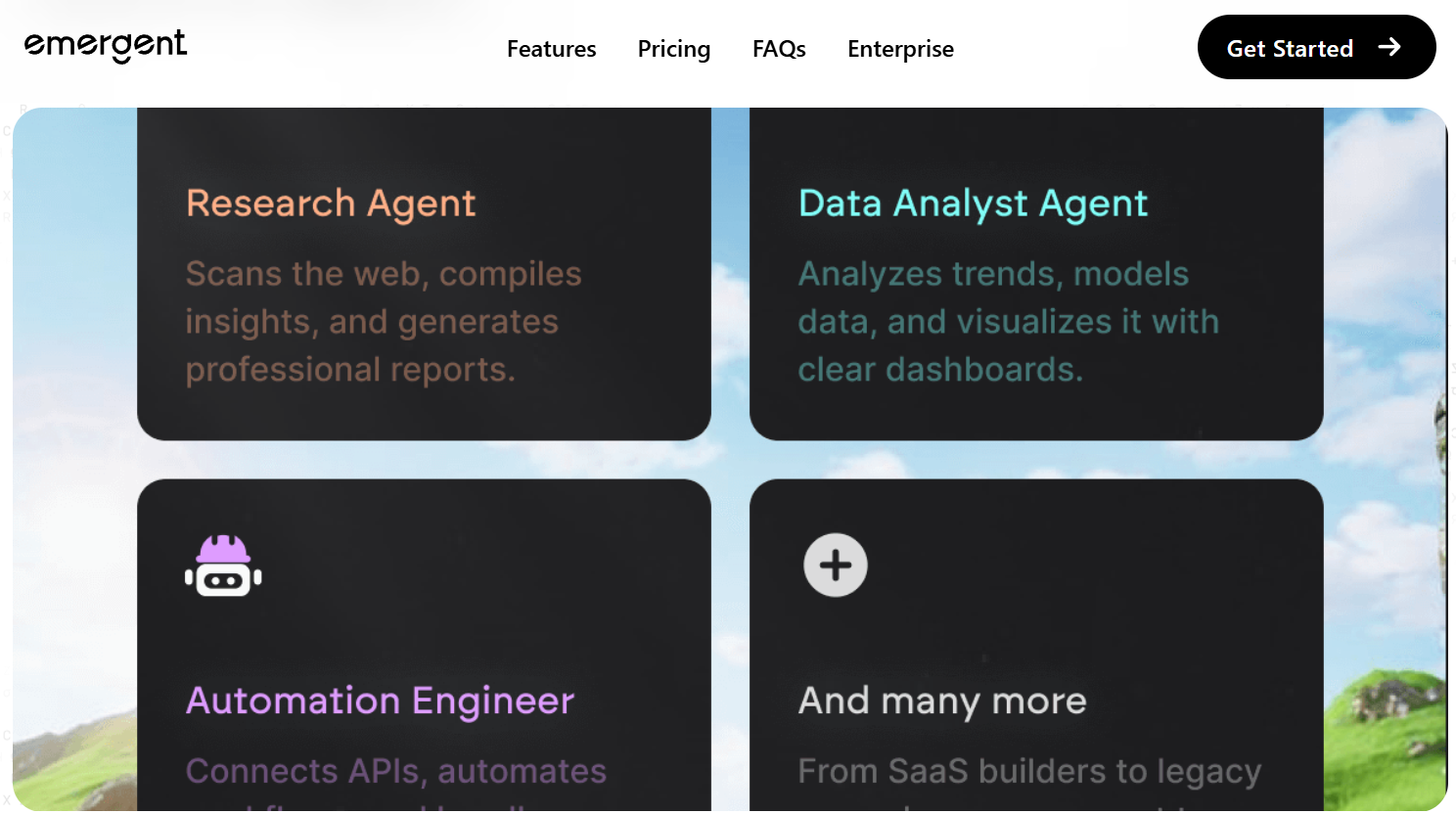
A genuine multi-agent build system, not one model doing everything: Most AI app builders send your prompt to a single large model and hope it holds the whole application in its head. Emergent splits the work: a planning agent chooses the architecture and breaks the build into steps; coding agents handle front end, back end and database logic; an integration agent wires up third-party services; and a testing agent checks the result before you see it. You also pick which agent tier runs the build — fast prototype agents for experiments, heavier agents for production — a real lever over quality and cost.
Full-stack output, not just a front end: This is the differentiator users mention most when comparing Emergent to tools they abandoned. Plenty of builders produce a beautiful interface with nothing behind it; Emergent scaffolds the database, authentication, API layer and payment flow in the same build, so you get something closer to a working product than a clickable mock-up.
You own and can export the code: Emergent isn’t a closed ecosystem that holds your project hostage. The generated code is real, ownable code you can push to GitHub, download, hand to a developer, or self-host elsewhere. That single property changes the risk profile enormously: even if you outgrow the platform, you leave with an asset rather than a subscription you can never cancel.
Mobile app generation, not just responsive web: Emergent’s mobile agent generates Expo and React Native projects, and the company reported more than 10,000 mobile apps built during early access alone. You can describe an app on your phone — including by voice — and get a real mobile codebase back, making this one of the few builders treating mobile as a first-class output rather than a responsive afterthought.
An integration catalogue that covers actual business software: Emergent lists well over a hundred integrations spanning AI models (OpenAI, Claude, Gemini, ElevenLabs), databases and storage (Supabase, Airtable, Notion), payments (Stripe, PayPal, Razorpay, Square), commerce (Shopify, WooCommerce), CRM and marketing (Salesforce, HubSpot, Pipedrive, Mailchimp), communication (Twilio, Slack, Zoom, SendGrid), accounting and ERP (QuickBooks, NetSuite, Sage), and design (Figma, Canva, Framer). For a small business owner, that means the internal tool you build can talk to the systems you already run on.
Deployment and hosting are part of the product: You don’t finish a build and then start a second project called “figure out hosting.” Emergent deploys to managed production infrastructure with SSL, custom domains, environment variables and secrets, and uptime monitoring, metered at a flat 50 credits per month per deployed app — a predictable line item rather than a surprise cloud bill.
Key Features and Technology
Emergent’s feature set is best understood in layers: the agents that do the work, the output they produce, the services they connect to, and the infrastructure that runs it.
The Agent Layer — Neo, Agent Tiers, and Ultra Thinking
The conversational surface is an agent the interface calls Neo. You describe what you want; Neo asks clarifying questions — which payment provider, what the pricing logic should be, how a feature behaves in edge cases — then hands the refined brief to the build system. Underneath sits a selectable ladder of agents, from lightweight prototype agents optimised for speed to heavier E-series agents built for stability, plus dedicated mobile agents. Pro subscribers unlock a 1M-token context window, an “Ultra Thinking” mode for complex builds, system prompt editing, and custom agents for repeatable workflows. There’s also a build-credit budget control capping how many credits a single run can consume — worth using from day one.
The Output Layer — Real, Portable Full-Stack Code
What Emergent produces is a conventional codebase, not a proprietary artefact. Web builds land on React and Next.js with Tailwind, with Node.js or FastAPI handling server-side logic and a real database behind it; mobile builds come out as Expo and React Native projects. GitHub integration on paid plans syncs the repository, giving you version history, a normal developer handoff path, and direct file editing. Rounding this out: rollback to an earlier state, forking to branch a project, voice mode for hands-free building, and MCP support — Emergent can both consume MCP servers and act as one.
The Integration Layer — the Universal Key and 100+ Services
Emergent’s Universal Key handles one-click LLM integration, so an app calling an AI model doesn’t require managing API keys and billing across three providers before you can test anything. Beyond that sits the integration catalogue proper, spanning AI, database, design, project management, communication, marketing, customer support, e-commerce, FinTech and ERP. The practical implication: “build me a dashboard that pulls deals from HubSpot, invoices from QuickBooks and posts a daily summary to Slack” is a reasonable request rather than a fantasy — though the more integrations you chain, the more credits it takes.
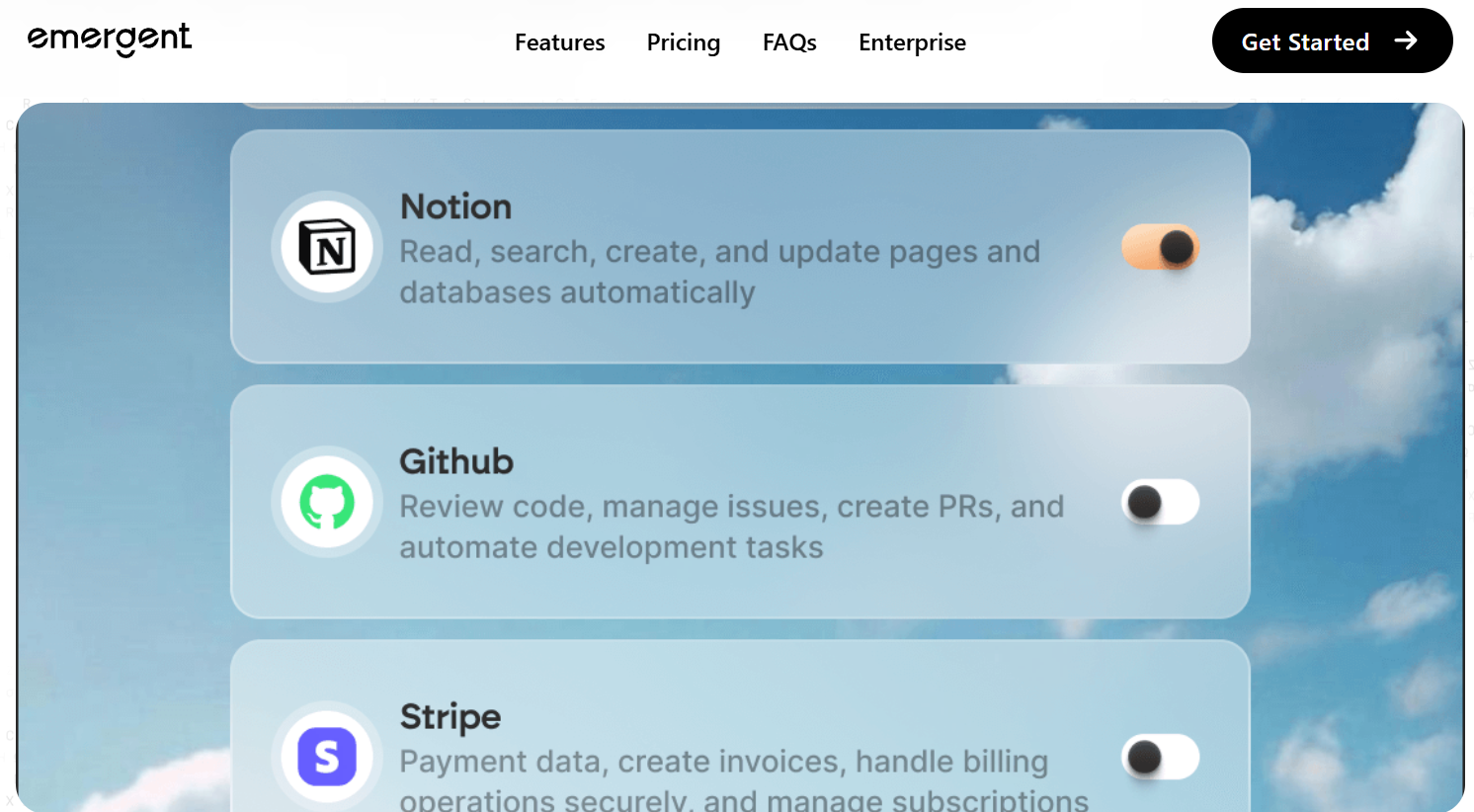
The Infrastructure Layer — Deployment, Domains, and Safety Nets
Deployment runs on managed production infrastructure including SSL, custom domains, environment variable and secret handling, and uptime monitoring, billed at 50 credits per month per deployed app. A pre-deployment health check catches problems before you push live, with different deployment types for previews versus real traffic. One detail worth knowing before cancelling: Emergent’s documentation states deployed apps stay live after cancellation as long as the account retains at least 50 credits — exactly the sort of thing to confirm in writing before hosting a client’s production system.
Pricing, Plans, and Credit Structure
Emergent is a subscription product with a usage layer on top, and the second part matters far more. Every plan includes a monthly credit allowance spent on app generation, code changes, testing and debugging, integrations and deployment. Subscription credits reset each cycle and don’t carry over; top-up credits never expire and are used only after your monthly allowance is gone. Emergent’s documentation notes a default of 5 credits per run, adjustable to a per-task ceiling of 1,000. Prices below are approximate and were checked against the official pricing page — confirm live figures before purchasing, because this company ships changes fast.
| Plan | Approx. Price | Monthly Credits | What You Get / Best For |
|---|---|---|---|
| Free | $0 | 10 | Core platform features, access to advanced models, one-click LLM integration. Enough to evaluate the interface and output quality — not enough to finish an app. |
| Standard | ~$20/mo, or ~$17/mo billed annually | 100 | Web & mobile builds, private project hosting, GitHub integration, fork tasks, custom domains, top-up credits. The realistic entry point for solo builders. |
| Pro | ~$200/mo, or ~$167/mo billed annually | 750 | Everything in Standard plus 1M context window, Ultra Thinking, system prompt editing, custom AI agents, higher-performance compute, priority support. |
| Business | Custom quote | Custom | Everything in Pro plus RBAC, SSO, shared team workspaces, real-time co-editing. For teams that need collaboration rather than single-seat building. |
| Enterprise | Custom quote | Custom | User-level credit limits, audit logs, self-hosted database support, VPC deployment, priority SLA, credit usage analytics. |
| Top-up credits | From ~$1 intro pack; ~$20 / 100, ~$50 / 250, ~$100 / 500, ~$500 / 3,000 | One-time | Never expire, stack across plans, used after monthly credits. Larger bundles carry a bonus. Roughly $0.17–$0.20 per credit. |
Two structural details deserve emphasis. First, the gap between the $20 Standard tier and the $200 Pro tier has nothing in between, so builders who consistently exhaust 100 credits face an uncomfortable jump. Second, deployment consumes 50 credits per month per live app — half of Standard’s allowance — so two deployed apps on Standard spend the whole month’s credits on hosting before you write a single prompt. Plan around that, or budget for top-ups.
How Emergent Compares to Alternatives
The AI app-builder market got crowded fast. Here’s how Emergent sits against the three most commonly considered alternatives and the traditional route of hiring a developer.
| Platform | Approx. Entry Paid Price | Model | Code Export | Best For |
|---|---|---|---|---|
| Emergent | ~$20/mo (free tier available) | Multi-agent, credit-based | Yes — full ownership, GitHub sync | Complex full-stack web + mobile builds where backend depth matters |
| Lovable | ~$25/mo | Single-agent, credit-based with rollover | Yes — GitHub sync, Supabase backend | Polished React web apps and design-led SaaS MVPs; no native mobile output |
| Bolt.new | ~$25/mo | Token-based, in-browser | Yes | Fast prototypes and framework flexibility for technically confident builders |
| Base44 | ~$16–20/mo | Message + integration credits | Limited — closed, all-in-one backend | Non-technical users who never want to see infrastructure; accepts lock-in |
| Hiring a developer | $5,000–$200,000+ per project | Time and materials | Yes | Regulated, high-traffic or architecturally complex products that need accountable engineering |
vs. Lovable: Lovable is the design-forward option — better-looking first drafts, and credits that roll over, removing one of Emergent’s most-criticised behaviours. Emergent goes deeper on the back end and is the only one of the two with a real native mobile path. For a polished web SaaS front end on a Supabase backend, Lovable is the smoother ride; for a full-stack product with meaningful server-side logic, or anything mobile, Emergent is more capable.
vs. Base44: Base44, now owned by Wix, is the friendliest starting point for someone who never wants to see a database or a deploy step — and the cheapest entry price here. The trade is lock-in: exporting a real codebase isn’t the point. Emergent asks more of you and costs more when things go wrong, but you keep the code — decisive for anything you might one day hand to a developer.
vs. hiring a developer: The honest comparison isn’t “Emergent replaces engineers.” It’s that Emergent collapses the cost of finding out whether an idea is worth engineering at all — a validated MVP for a few hundred dollars instead of a five-figure agency engagement is a genuinely different business decision. The pattern many teams land on is hybrid: shape version one in Emergent, then have a developer review security, permissions, payments and production readiness before real users arrive.
Pros and Cons
What Builders Love
Output quality that even critics concede: The striking pattern across reviews is that people who complain bitterly about billing still praise what the platform produced. Apps come out with fewer broken connections between front end and back end than single-model rivals deliver, and non-technical builders report shipping things they could not have built otherwise.
True full-stack scope in one place: Database, authentication, API layer, payments, hosting and deployment all handled in the same conversation — several tools and several weeks of setup collapsed into one workflow.
Code ownership plus first-class mobile: GitHub sync, downloadable code and self-hosting mean you’re never trapped, and Expo/React Native generation puts Emergent ahead of most web-only rivals.
Enterprise-grade compliance posture: SOC 2 Type II and ISO 27001 certification, SSO, RBAC, audit logs and VPC deployment are rare this early in a company’s life and open doors most competitors can’t.
Limitations Worth Knowing
Credit burn is the dominant complaint, and it’s a real one: Iterative debugging consumes credits even when the agent is correcting its own regressions. Multiple reviewers describe spending hundreds of credits reporting the same bug repeatedly, and the perception — fair or not — that you pay again every time the AI fails is corrosive to trust. Budget caps and tight prompts help; they don’t remove the risk.
Monthly credits expire and refunds on spent credits are rare: Unused subscription credits vanish at cycle end, and users report refund requests declined by reference to terms and conditions once credits are consumed — including where the spend produced nothing working. Top-up credits do persist, which is why buying them can beat over-subscribing.
A polarised public reputation: Emergent’s Trustpilot score sits in the low-to-mid 2s out of 5, with reviews clustering at the extremes rather than the middle. Read a sample of both before committing — the pattern tells you more than the average does.
Support responsiveness is inconsistent: Slow replies and templated responses on billing disputes appear repeatedly in negative reviews, and priority support is Pro-only — a fair commercial choice that leaves lower-tier users exposed.
The gap between tiers is steep: Going from $20 to $200 with nothing between forces a hard choice on anyone who reliably needs slightly more than 100 credits. Top-ups soften it, at a worse per-credit rate than Pro.
Store submission is still on you: Emergent generates mobile code but does not handle App Store or Play Store builds, signing, or review submission. Plan for that last mile separately.
Fast-moving platform, shifting specifics: Plans, agent tiers and packaging have changed repeatedly — third-party articles citing a “Team” plan or different credit allowances are often out of date within weeks. Verify against the official pricing page, and back up to GitHub rather than trusting the platform as your only copy.
Who Should Use Emergent
Solo founders validating an idea: If the alternative is not building at all, Emergent is transformative. Shape the MVP, put it in front of ten real users, and learn whether the idea holds — for a couple of months on Standard rather than a five-figure budget. Start Free, move to Standard monthly, cap credits on every run.
Small business owners who need internal tools: Booking systems, quote calculators, inventory dashboards, client portals — the unglamorous software that quietly runs a business and is never worth an agency quote. With QuickBooks, HubSpot, Shopify and Slack integrations, Standard usually covers one or two per quarter.
Product managers and operations leads: Turning a requirements document into a working prototype changes stakeholder conversations completely. Do this repeatedly across teams and Pro’s custom agents and larger context window earn their price.
Agencies and freelancers delivering client work: Emergent compresses delivery timelines dramatically, but client work raises the stakes on the credit model — an overrun comes out of your margin. Price with a credit buffer, run Pro for performance and priority support, and confirm deployment and cancellation terms in writing before hosting anything client-facing.
Developers who want to skip boilerplate: If you can read and fix code, you’re the ideal Emergent user — you’ll spot when the agent has gone wrong before it burns twenty credits chasing its own tail, and drop into the repo to fix it. Standard plus GitHub sync covers most of this.
Who should think twice: Anyone in a heavily regulated domain, handling sensitive personal data at scale, or shipping something where a subtle security flaw is unacceptable. Prototype with it by all means, but budget for a professional security and architecture review before real users touch it — and if your budget is genuinely fixed, a credit-metered platform is a poor fit.
Getting Started: Step by Step
- Open a free account. Sign up with Google, Apple, email or phone. The free plan gives 10 credits a month — enough to see the interface, run a couple of prompts, and judge output quality on your own idea rather than a curated demo.
- Write a proper brief before you prompt. The highest-leverage thing you can do: vague prompts make agents iterate, and iteration costs credits. Specify the core screens, the data to store, who logs in, what they can do, and which integrations matter. Many experienced users draft the brief in a separate AI chat first, then feed Emergent one step at a time.
- Choose your agent and set a credit budget. Pick a lightweight prototype agent for experiments and a heavier one for anything you intend to keep. Set the build-credit cap before sending — your safety valve against a runaway loop.
- Answer the clarifying questions properly. Neo asks about models, pricing logic, edge cases and integrations. Answering precisely saves far more credits than it costs — every ambiguity resolved up front is a rebuild avoided later.
- Connect GitHub early. On Standard and above, sync the repository as soon as something works. You get version history, a route to manual edits, and — critically — a backup independent of the platform.
- Wire up integrations one at a time. Add Stripe, Supabase, HubSpot or whatever you need individually, verifying each before the next — chaining several in one prompt is how builds fail expensively.
- Run the health check, then deploy. Catch problems before going live, then deploy — remembering each live app costs 50 credits monthly. Attach your custom domain, confirm SSL and environment variables, and walk the full user journey yourself before inviting anyone in.
Tips for Getting Maximum Value
Treat credits like cash and the whole experience improves. Cap the budget on every run without exception — an uncapped agent stuck in a loop is the origin story behind most angry reviews. Break work into small, specific prompts rather than one heroic “build my entire SaaS” instruction, confirming each piece works before moving on, because a bug found ten steps later costs far more to unwind. Prefer monthly billing until you’ve proven a repeatable workflow; several of the harshest reviews come from people who committed to a year up front. When you need capacity, weigh top-ups against upgrading — top-ups never expire, so they suit uneven usage, while Pro’s per-credit rate wins if you’re buying two or more monthly. Push to GitHub constantly and keep a local copy of anything important. Shut down abandoned deployments rather than letting them drain 50 credits a month each. And if you can read code even a little, lean into it — spotting a wrong turn early and fixing it manually is the biggest cost saving available here.
Future Outlook and Final Assessment
The tailwinds are strong. Market estimates vary widely by methodology, but the direction is consistent: analysts place vibe coding in the region of $5–7 billion in 2026 with substantial multi-year growth ahead, while Gartner has forecast that a majority of new code will be AI-generated by the end of 2026 and that a significant share of new enterprise production software will come from prompt-based development by 2028. Surveys show most professional developers now using AI coding tools daily. A platform that goes from prompt to deployed full-stack app — with real code you own at the end — is aimed squarely at where that market is heading.
Emergent’s leadership has been unusually candid about the risks. Mukund Jha has publicly named the quality of AI-generated software as the biggest threat to the whole vibe-coding category, and analysts warn that prompt-to-app development without governance will drive defect rates sharply higher. That candour suggests a company aware the durable win is reliability, not demo-day magic. Meanwhile, dependency on frontier models from providers like Anthropic and OpenAI is both Emergent’s engine and its strategic exposure — capabilities improve for free, but so do every competitor’s, and the cost structure isn’t fully in the company’s hands.
The honest caveats stand: credits burn faster than newcomers expect, monthly credits expire, refunds on consumed credits are unlikely, support can be slow at lower tiers, and the public review picture is genuinely divided. None of that is hidden, which is why it should shape how you buy rather than whether you try. Enter with a small commitment, a clear brief and a credit cap, and Emergent is one of the most capable ways available in 2026 to turn an idea into working software. Enter with an annual subscription, a vague prompt and no budget discipline, and you’ll likely join the one-star cluster.
Conclusion
Emergent is one of the most capable products in the AI app-building category — a multi-agent system handling architecture, code, testing and deployment, producing real full-stack web and mobile applications, handing you code you actually own, and connecting to more than a hundred business tools you already use. It’s also a platform whose credit model demands respect: spend carelessly and it punishes you, spend deliberately and it does work that would otherwise cost months or tens of thousands of dollars. For founders validating ideas, owners who need internal tools, product managers turning documents into prototypes, and agencies compressing delivery timelines, the recommendation is the same — start free, brief it properly, cap every run, back everything up to GitHub, and scale your spend only once the tool has proven itself on your work. Used that way, Emergent takes the hardest step in shipping software — actually building the thing — and, true to what we do here at AI Solutes, helps make everything easy.
Turn your idea into a working app this week — start free and see what Emergent builds.
Explore more honest reviews, tutorials and tool comparisons to find the right tech for the way you work and live — at AI Solutes, where we make everything easy.
👉 Open Free Account: https://ai-solutes.com/emergent
👉 Our YouTube Channel: youtube.com/@ai-solutes
👉 Our Facebook Fanpage: Facebook
👉 Our X (Twitter): @AISolutes
- Essay-Grader.AI
- KreadoAI
- Unlock Next-Gen AI Chatbots in 2025: The Ultimate Guide to Talkie AI Character Customization, Multilingual Conversations and Secure Digital Interaction
- Could Alohi Streamline Document Workflows? Exploring the Alohi Digital Signature Platform
- Unlock Puma’s 2026 Brand Strategy: Transformation, Innovations, and McLaren Racing Partnership Revealed