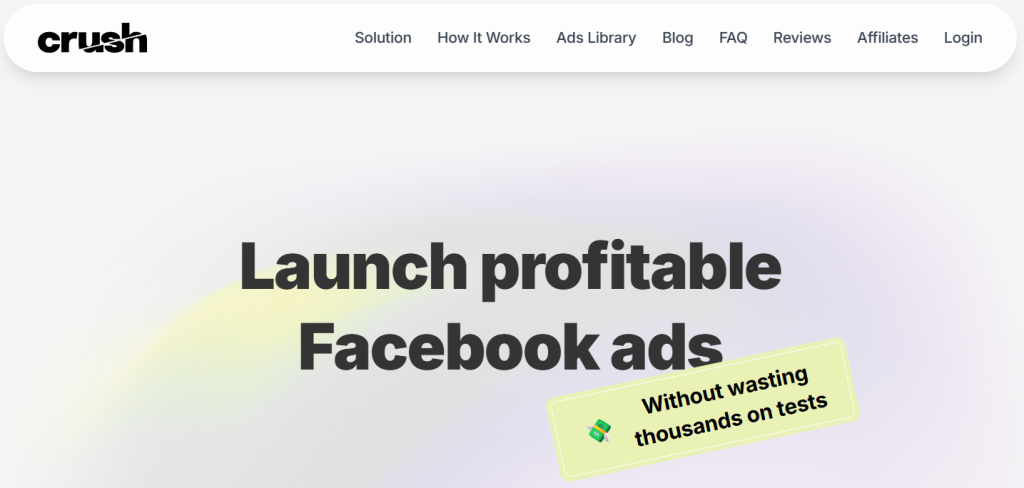
Most small businesses running Facebook ads are stuck between two bad options. Do it yourself — learn Ads Manager, design creatives, write copy, build test structures, then check your phone at 11pm to see whether today's budget went anywhere useful. Or hire an agency, which typically costs $2,000 to $10,000 a month, or 10–20% of your ad spend, before a single dollar reaches Meta. Crush (trycrush.ai) is built as a third option: an AI media buyer that connects to your Meta ad account and runs the whole loop itself — generating creatives and copy, launching structured tests, cutting losers, scaling winners, and reallocating budget around the clock. It's priced at a flat $79.95 per month, its models are trained on a claimed $100 million-plus in ad spend and 50,000+ winning creatives, and it ships with a genuinely free, no-signup library of 1.6 million+ real Facebook ads you can search before you pay anything.
That's an appealing pitch in a year when Meta is on track to pass Google as the world's largest digital advertising business and social ad spend is heading past $260 billion. It's also a pitch that asks you to hand a young company autonomous, spend-level control of your ad account. This 2026 review walks through what Crush actually automates, who's behind it, the full cost picture including the ad budget most reviews leave out, how it compares to Madgicx, Revealbot and AdCreative.ai, the real limitations users have reported, and exactly who should — and shouldn't — plug it in.
Crush AI Review 2026: The $80/Month AI Media Buyer Built to Replace Your Facebook Ads Agency
Overview and Background
Crush is a Lithuania-based AI advertising platform trading as trycrush.ai. It was founded by Rokas, an ex-IBM professional with an ecommerce and performance marketing background who serves as CEO, alongside co-founder Albertas — a leadership team small enough that both still reply to reviews personally and offer to walk new users through setup themselves. That's either reassuring or alarming depending on your temperament, and it's the most important thing to understand about the company's stage.
The origin story is familiar in performance marketing: a media buyer who had managed a very large volume of spend decided the repetitive parts of the job — testing hooks, killing underperformers, shifting budget toward what converts — were mechanical enough to encode. What emerged is positioned not as a reporting dashboard but as an autonomous operator. Crush doesn't tell you which ad set to pause; it pauses it. That distinction is the entire value proposition, and it's what users on Reddit and Trustpilot single out most: it does the media buying rather than producing another list of recommendations.
The platform is Meta-first by design, covering Facebook and Instagram placements, with multi-currency support so the optimisation logic works whichever market you bill in. Company materials cite training on more than $100 million in ad spend and over 50,000 top-performing creatives, and claim an average 3x return on ad spend — a marketing claim rather than an audited benchmark, since no independent verification exists. Public sentiment is positive but thin: Trustpilot sits around 4.4 out of 5 with roughly 86% five-star ratings, though the review count has only grown from about 22 in early 2026 to under a hundred more recently. The company replies to 100% of negative reviews, a genuinely good signal.
Why Crush Stands Out in 2026
It executes rather than advises: The Meta ads tooling market is full of products that surface insights and hand you a to-do list — Madgicx tells you which creative is fatiguing, Revealbot fires rules you wrote yourself. Crush takes the actions: it launches campaigns, builds tests, pauses what fails and pushes budget into what works, without waiting for you to log in and click.
Flat pricing that doesn't punish growth: Almost every serious competitor in this category prices on a percentage of your ad spend or in spend-banded tiers, so your software bill rises the moment your campaigns start working. Crush charges one flat monthly fee regardless of how much you spend through it. For a business scaling from $2,000 to $20,000 a month in ad budget, that difference compounds quickly.
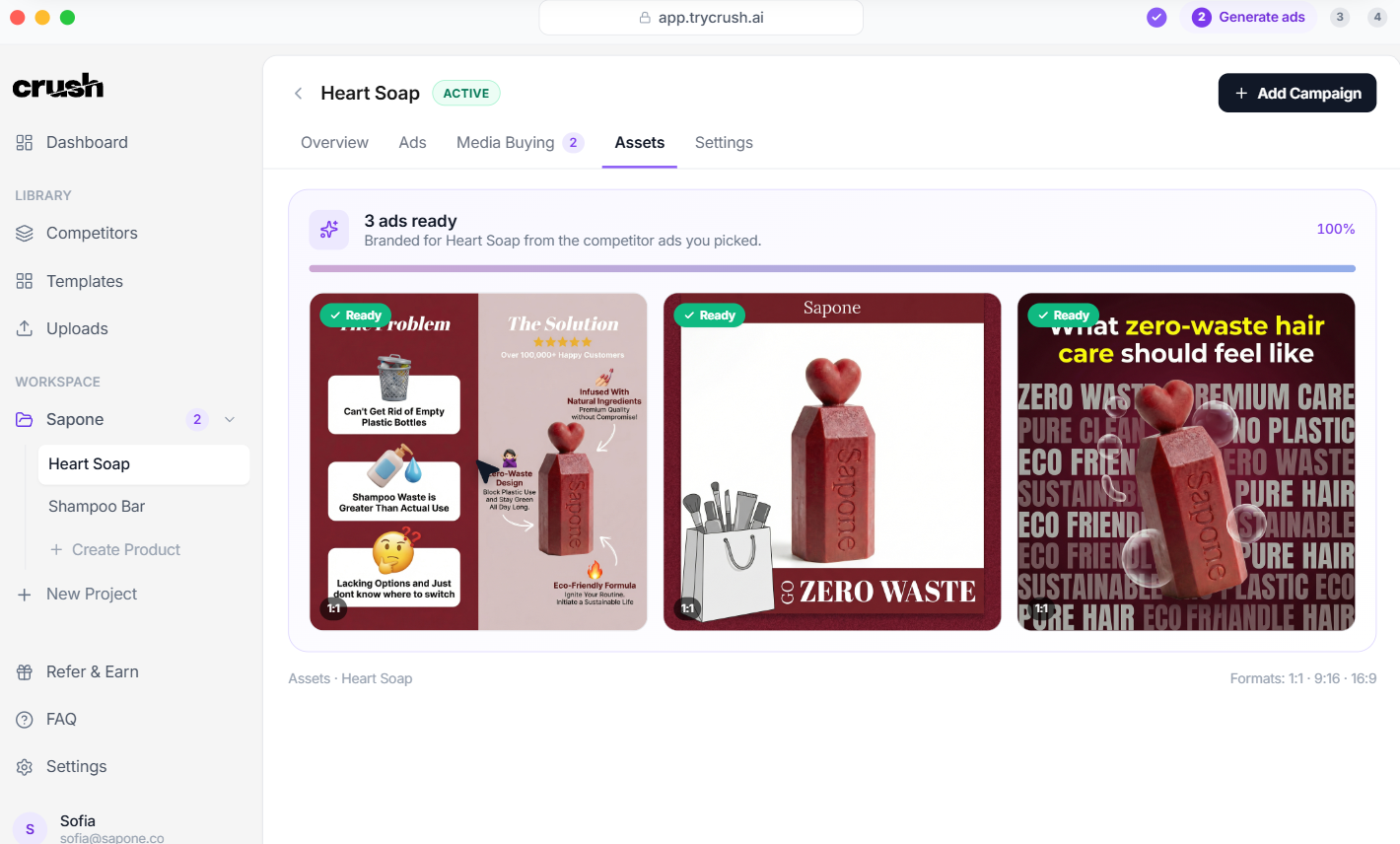
Creative and copy generation are included, not an add-on: Most media-buying tools assume you already have ads to run. Crush generates the visuals and writes the copy — in any language — as part of the same subscription, which removes the usual requirement to bolt a separate creative tool like AdCreative.ai onto your stack. Several reviewers say the generated visuals were good enough that they reused them for organic social posts.
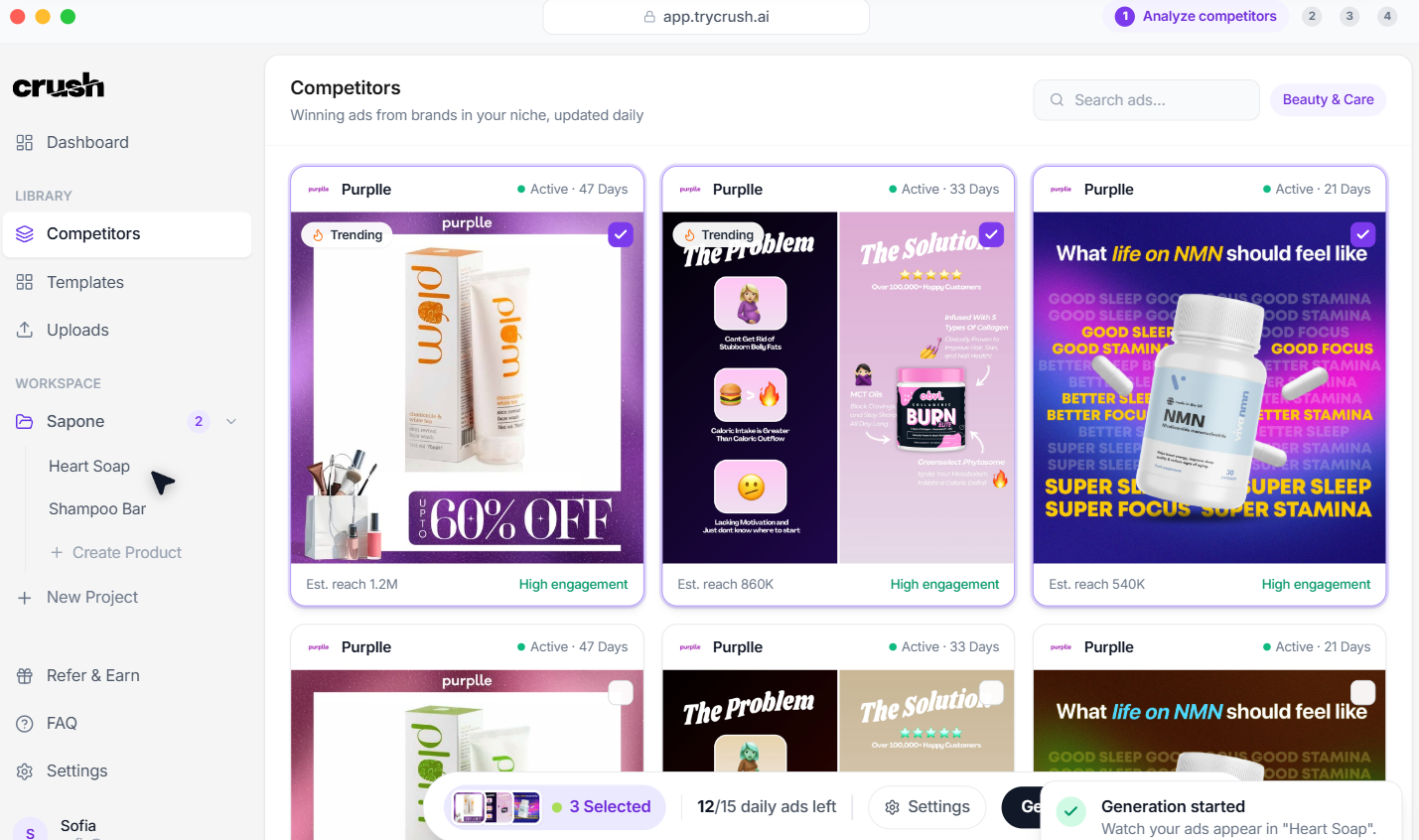
A free, no-signup competitor ad library: Crush publishes a searchable library of over 1.6 million real Facebook ads with no account required at all. You can research what's running in your category before you spend a cent, and the same engine feeds the platform's competitor analysis — scanning ads by keyword or domain and using their structures, hooks and copy patterns as raw material rather than copying them outright.
Testing velocity a human buyer can't match: The system automatically tests upwards of 50 audience combinations and deploys creative variations in volume, letting the market decide which hook wins rather than betting the budget on one person's instinct. Creative fatigue is the quiet killer of Meta performance, and high-frequency variation is a legitimate structural answer to it.
Setup measured in minutes, not weeks: Onboarding is a five-minute quiz about your product, goals and unit economics, followed by a two-click connection to your Facebook Ads account and Pixel. The company targets a setup-to-live-campaign timeline of under an hour — a genuine contrast with agency onboarding, which routinely takes two to four weeks before a single ad runs.
Key Features and Technology
Crush bundles four jobs that would normally be four separate line items — research, creative, media buying and analysis — into one subscription. Here's how each works.
The Ad Engine — Competitor Research and Creative Generation
The research layer scrapes live Facebook ads by keyword or competitor domain, then analyses layout, copy length, hook style and format. Rather than duplicating a competitor's ad — both a copyright problem and a bad strategy — it extracts the structural patterns and regenerates them against your brand and offer. From there the creative engine produces visuals without a designer and the copywriting engine drafts variations in any language, removing the localisation bottleneck for anyone selling into multiple markets. The same 1.6 million-ad library sits in front of the paywall as a free research tool.
The Media Buyer — Targeting, Testing and Budget Control
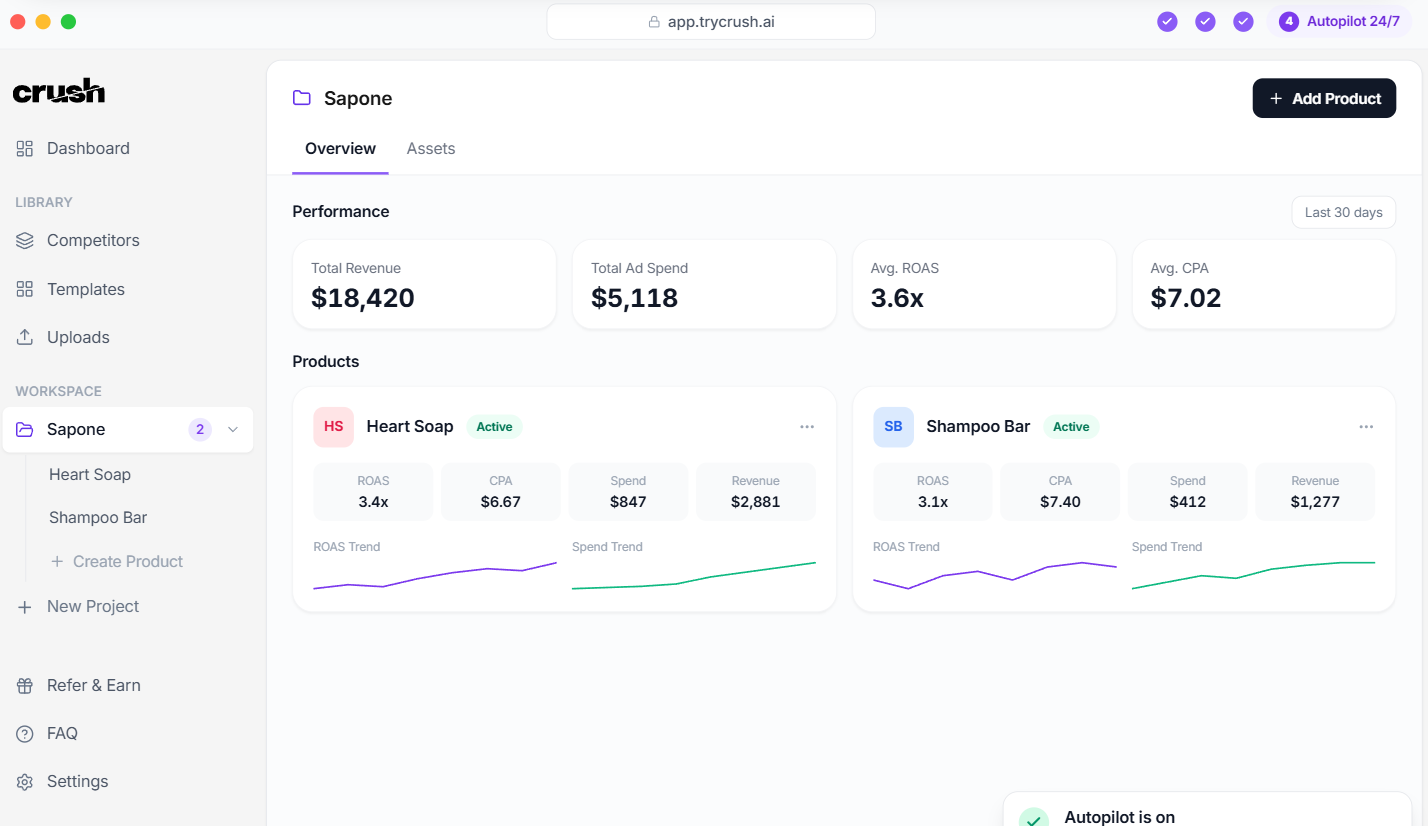
This is the core of the product. Crush builds structured A/B tests directly inside your Meta ad account, tests dozens of audience combinations to find profitable segments, and runs 24/7 budget optimisation across any currency — scaling winners and killing losers in near real time with automated kill switches on ads that miss your required return threshold. Notably, its targeting philosophy leans toward plain broad targeting, letting Meta's own algorithm find conversion paths, rather than the elaborate interest-stacking and cost-cap structures many manual buyers still favour. That's a defensible position in 2026 and matches where platform best practice has moved, but it's a philosophy, not a universal law — and it's worth knowing it's the approach you're buying into.
The Analysis Layer — Beyond Ad Metrics
The feature users mention with most surprise is that Crush doesn't confine its feedback to ad performance. It flags problems further down the funnel — mispositioned pricing, weak offers, website issues suppressing conversion — the kind of diagnostic a good agency strategist provides and most software does not. Several reviewers credit it with showing them their landing page, not their ads, was the bottleneck — which also quietly underlines the platform's biggest dependency.
Onboarding, Integration and Support Model
Getting started runs through a short quiz covering your product, pricing and target cost per acquisition, then a two-click Meta and Pixel connection, then activation with automated notifications when a winner emerges. This is also where the friction lives: multiple users report that Meta's own permissions, Pixel verification and business-account requirements are the hardest part of the process — something the co-founder has publicly acknowledged, alongside a commitment to hands-on setup help and a new hire to improve support response times. At this company size, support is founder-adjacent: personal and attentive when it lands, thin if several people need help at once.
Pricing, Plans, and What It Really Costs
Crush keeps pricing unusually simple: one plan, one flat monthly fee, no spend-based tiers, no credits. The current price is $79.95 per month, down from the $99 quoted in earlier 2026 coverage — a reminder this is a fast-moving young company and you should confirm the live figure before committing. There is no permanent free plan and no free trial of the media buyer; the risk reversal is a 14-day money-back guarantee. The number that matters more is the ad budget: Crush recommends a minimum of roughly $200 a month in actual spend for the optimisation to have enough signal, and most businesses will want more.
| Item | Approx. Cost | What's Included / Notes |
|---|---|---|
| Free ad library | $0 | 1.6M+ searchable live Facebook ads. No account, no email, no card. Genuinely free research tool. |
| Crush subscription | ~$79.95/month (previously ~$99) | Full platform: AI media buyer, creative and copy generation, competitor analysis, 24/7 optimisation, funnel diagnostics. One flat rate, no spend tiers. |
| Recommended ad spend | $200+/month minimum | Paid directly to Meta, not to Crush. Below this the system lacks the conversion signal to optimise meaningfully. |
| Realistic month one | ~$280–$580 all in | Subscription plus a $200–$500 test budget. Budget for a learning period before judging results. |
| Risk reversal | 14-day money-back window | No free trial. Refund is claimed within 14 days; you keep your ads and data. Ad spend already paid to Meta is not refundable by anyone. |
Set against the alternatives, the arithmetic is stark. A retainer agency running the same account would cost $2,000–$10,000 a month, and spend-tiered platforms like Madgicx or Revealbot climb into the hundreds as your budget grows. At a flat $79.95, Crush is priced below almost everything that claims to do comparable work — which is exactly why the risk sits in execution and company maturity rather than in cost.
How Crush Compares to Alternatives
Crush sits in an unusual spot: cheaper than the automation platforms, broader than the creative tools, and vastly cheaper than a human. Here's the landscape.
| Option | Approx. Cost | Pricing Model | Executes Campaigns? | Best For |
|---|---|---|---|---|
| Crush | ~$79.95/mo | Flat, spend-independent | Yes — creative, launch and optimisation | Small brands and solo operators with no media buyer and modest Meta spend |
| Madgicx | ~$49–$99 entry, $499+ at high spend | Tiered by monthly ad spend | Partly — automation plus recommendations | Ecommerce brands at $5K+/month who have someone to act on the insights |
| Revealbot | ~$99–$999+/mo | Tiered by ad spend; 14-day trial | Yes — but only the rules you write | Experienced buyers who want granular, rule-based control |
| AdCreative.ai | From ~$39/mo | Credit-based tiers | No — creative generation only | Teams whose bottleneck is creative volume, not media buying |
| Agency or freelance buyer | $2,000–$10,000/mo or 10–20% of spend | Retainer or percentage | Yes — with human judgement | Complex offers, large budgets, and brands needing strategic accountability |
vs. Madgicx: Madgicx is the established name here, with a far larger customer base, a deeper creative analytics layer and years of iteration behind it — but its pricing climbs with your ad spend, and its own public review scores are notably worse than Crush's despite the maturity gap. Madgicx also assumes an operator: it surfaces insight brilliantly and expects someone to act. Crush is the better fit if you have nobody to act; Madgicx is the better fit if you have a buyer who wants better instruments.
vs. Revealbot: Revealbot is rule-based rather than agentic — it executes reliably, but only the logic you define, which means it rewards expertise and punishes its absence. It's the professional's tool and it's priced accordingly. If you already know exactly which rules you want enforced, Revealbot is more predictable and more mature. If you don't know what rules you'd write, Crush is answering a question Revealbot doesn't ask.
vs. hiring an agency: The honest comparison isn't quality — a genuinely good media buyer will still beat an $80 subscription on a complex account. It's access. At $2,000–$10,000 a month, agency management is simply unavailable to a business spending $2,000 a month on ads, because the fee exceeds the budget. Crush isn't competing with a great agency; it's competing with the nothing that most small advertisers currently have. Where it fails is where agencies also fail: if the offer, price or landing page is broken, no amount of media buying rescues it.
Pros and Cons
What Advertisers Love
It genuinely does the work: The most consistent theme in positive reviews is relief — users describe getting hours back each week and no longer living inside Ads Manager. Several report the platform being the first tool that handled execution rather than producing another dashboard to interpret.
Creative output that exceeds expectations: Multiple reviewers say the generated visuals outperformed what freelance designers were delivering at several times the cost, with some reusing the assets across their wider brand channels. One supplement brand owner reported cost per acquisition falling substantially within weeks.
Flat pricing with no spend penalty: Your bill doesn't rise when your campaigns succeed. In a category where nearly every competitor takes a bigger cut as you scale, this is a real structural advantage for growing accounts.
Founder-level attention: The leadership team responds to every negative review, offers personal setup calls, and has publicly owned mistakes including a refund that went wrong. That accountability is rare and worth weighing.
Diagnostics beyond the ad account: Feedback on pricing, offer strength and website conversion issues is unusual in this price bracket and is frequently the insight that actually changes results.
Limitations Worth Knowing
A very young company with a thin track record: The domain is under a year old and the public review sample is under a hundred entries. A 4.4 average from that base tells you far less than the same score from thousands. There is no long-term evidence of how the platform performs across market cycles or account types.
No free trial, and a refund that has slipped: You pay before you can evaluate the media buyer, and the 14-day guarantee is the only safety net. One customer publicly documented waiting nearly a month for a refund and escalating to their card network before the co-founder intervened and processed it. It was resolved openly and honestly — but it happened.
Meta setup is the hardest part and it isn't automated: Pixel configuration, business account verification and permissions repeatedly trip new users up, and the company has acknowledged this is where onboarding fails. If you've never navigated Meta Business Manager, expect friction before you reach the easy part.
Support has been slow at times: Delayed responses appear in negative reviews, and the company has said it hired specifically to fix this. With a team this small, capacity remains a genuine risk during growth spurts.
Single-channel and philosophy-locked: Crush is Meta-centric, so there's no Google, TikTok or LinkedIn coverage in one place, and its broad-targeting approach is baked in. If your account genuinely needs interest stacking, cost caps or unusual structures, you're buying someone else's playbook.
Performance claims are unverified: The 3x average return figure and the $100 million training-spend number come from the company, not from independent audit. Treat them as positioning, and judge the tool on your own account instead.
It cannot fix a broken offer: Users and the company itself agree on this: without a converting landing page and a compelling offer, better media buying just finds the leak faster. Reviewers who succeeded had their fundamentals in place first.
Who Should Use Crush
Small ecommerce brands spending $500–$10,000 a month: This is the sweet spot. You're spending enough for optimisation to matter but nowhere near enough to justify agency fees, and you probably don't have a dedicated buyer. Start with the free ad library, then one month of the subscription against a controlled test budget.
Solo founders and local businesses with no marketing hire: If Facebook ads are currently a source of dread rather than revenue, an autonomous system that just runs is worth more than a better dashboard. Get your landing page right first — that single step determines whether this works for you.
Businesses selling into multiple languages or currencies: Copy generation in any language plus multi-currency optimisation removes two expensive bottlenecks at once. If you're running the same offer across several markets, this is where the flat fee compounds hardest in your favour.
Freelancers and small agencies serving low-budget clients: Clients who can't afford real management are usually unprofitable to service manually. Crush can make that tier viable — but test it on your own account before you put a client's budget behind a platform this young, and be transparent about what's running the campaigns.
Who should think twice: Anyone spending above roughly $50,000 a month, running complex multi-channel funnels, or operating in a regulated category where ad compliance carries legal weight — the maturity and control you need aren't here yet. Equally, if you have no offer-market fit, no converting page, or an ad budget under $200 a month, fix those first; automation will only reach the same conclusion faster and more expensively.
Getting Started: Step by Step
- Search the free ad library first. No signup required. Look up your competitors and your category, and confirm the coverage is meaningful for your niche. If the library is thin where you sell, that tells you something before you pay.
- Get your Meta house in order. Before subscribing, make sure your Business Manager, ad account and Pixel exist and are verified, with conversion events firing correctly. This is the step that derails most new users, and doing it in advance turns a painful onboarding into a smooth one.
- Fix the landing page before the ads. Every honest account of this platform — including the company's own — says traffic can't rescue a page that doesn't convert. Check load speed, mobile layout, the offer itself and the checkout flow first.
- Subscribe and complete the onboarding quiz. The five-minute questionnaire covers your product, pricing and target cost per acquisition. Answer it precisely: these numbers become the targets the system optimises against, so vague inputs produce vague optimisation.
- Connect Meta and set a deliberate test budget. Two clicks links your ad account and Pixel. Start at $200–$500 in spend — enough signal to learn from, small enough that a bad month doesn't hurt.
- Diary day 10. Put a reminder in your calendar four days before the 14-day refund window closes, so the decision is yours rather than the calendar's. Keep your receipt and any support correspondence.
- Let it run, then judge on your own numbers. Meta's learning phase alone takes several days, so resist intervening early. After a full cycle, compare cost per acquisition and return against your own pre-Crush baseline — not against the vendor's advertised averages.
Tips for Getting Maximum Value
Treat the subscription as the cheapest line in your budget and the ad spend as the real decision — that reframing prevents most disappointment here. Record your baseline before you connect anything: current cost per acquisition, return on ad spend and conversion rate, because without it you have no way to prove whether the platform helped. Feed the onboarding quiz accurate unit economics rather than aspirational ones, since a target cost per acquisition you can't actually afford will produce campaigns that look successful and lose money. Use the funnel diagnostics seriously; when Crush flags a pricing or website problem, that feedback is often worth more than the media buying itself. Don't stack this alongside another automation tool on the same account — competing systems making simultaneous budget changes is a well-documented way to waste money. Keep your own Meta access and never let a third party become the sole admin of your business assets. And if setup stalls, take the founders up on the offer of a personal walkthrough rather than quietly giving up inside the refund window; at this company's size, that help is real and it's the fastest route past the only genuinely hard part of the process.
Future Outlook and Final Assessment
The market backdrop is strongly in Crush's favour. Global social advertising spend is heading past $260 billion in 2026, Meta is forecast to overtake Google as the largest digital advertising business for the first time, and the overwhelming majority of that money is spent by businesses too small to employ a media buyer. Agency economics have not changed to meet them: a $2,000-a-month retainer is still the entry price for professional management, which mathematically excludes most advertisers. Software that credibly executes rather than advises is aimed directly at that gap.
There is a genuine counter-signal worth noting, though. Industry benchmark data shows Meta's own end-to-end automation, Advantage+ Shopping, fell from a peak of around 38% of US retail Meta spend to roughly 20% within a year — advertisers who rushed into full automation are selectively taking manual control back. That doesn't invalidate the category, but it does temper the “set it and forget it” promise: the market is learning that automation works best with a human keeping watch, not instead of one. The most durable version of Crush is probably one where the AI handles velocity and the owner still owns strategy.
The honest assessment: Crush is a well-conceived product at an aggressive price, backed by warm early feedback and unusually accountable founders, sold by a company that is still very young and still occasionally rough at the edges. The upside is real and the downside is bounded — one month's subscription plus whatever test budget you choose. What you should not do is skip the free research tool, commit a large budget in week one, or let the 14-day window lapse while you wait for results.
Conclusion
Crush is trying to do something most tools in this category avoid: take responsibility for the outcome rather than the reporting. It generates the creative, writes the copy, launches the tests, kills what fails and scales what works — for a flat fee that costs less than a few hours of an agency's time. For small ecommerce brands, solo founders and multi-market sellers who currently have nobody running their Facebook ads properly, that's a meaningful proposition, and the early customer feedback is warmer than the company's age would predict. Go in with clear eyes: this is a young team, the guarantee is a refund rather than a trial, and no automation fixes a weak offer. But get your fundamentals right, start small, and hold it to your own numbers, and Crush turns the most technical and time-consuming part of paid social into something that runs itself — which is exactly the kind of leverage we look for here at AI Solutes, where we make everything easy.
Stop guessing at Facebook ads — let an AI media buyer run them for you.
Explore more honest reviews, tutorials and tool comparisons to find the right tech for the way you work and live — at AI Solutes, where we make everything easy.
👉 Get Started: https://ai-solutes.com/trycrushai
👉 Our YouTube Channel: youtube.com/@ai-solutes
👉 Our Facebook Fanpage: Facebook
👉 Our X (Twitter): @AISolutes
- Can Nomad eSIM Empower Frequent Flyers? Assessing the Nomad Multi-Country Architecture
- Master Redbubble in 2026: Sell Faster With Fees Breakdown, Trend Niches, and Listing SEO That Boosts Earnings
- Should Devs AI Optimize Workflow? Analyzing the Devs AI Development Platform
- TopView.ai Review 2026: The AI Marketing Video Agent That Turns a Product Link Into Scroll-Stopping Ads in Minutes
- PresentationsAI