Landing in a new country and immediately hunting for a SIM card kiosk, or worse, discovering a $200 roaming charge on your next phone bill, is one of travel’s most avoidable headaches. NomadeSIM (branded simply as “Nomad”) is one of the eSIM providers built to erase that problem entirely: install a digital SIM before you fly, and your phone is online the moment you land, with no physical card, no local shop, and no surprise fees. Since launching in 2020 under LotusFlare, Inc., Nomad has grown to an estimated 3 million users across more than 200 destinations, with plans starting at just $4.50 and app ratings of 4.8 on the App Store and 4.7 on Google Play. With hotspot tethering included on every plan, a loyalty rewards program, and local, regional, and long-term global options, Nomad has positioned itself as one of the more complete answers to the question every modern traveler eventually asks: why am I still paying for roaming?
For digital nomads, frequent flyers, backpackers, and anyone who simply doesn’t want to think about connectivity on arrival, the appeal is immediate. This 2026 review walks through Nomad’s full plan lineup, real pricing across popular destinations, the app experience, honest limitations flagged by real users, head-to-head comparisons with Airalo and Holafly, and exactly who should (and shouldn’t) rely on NomadeSIM for their next trip.
NomadeSIM Review 2026: The Travel eSIM That Keeps You Online in 200+ Destinations Without Roaming Fees
Overview and Background
Nomad is a prepaid travel eSIM marketplace operated by LotusFlare, Inc., a telecom software company that launched the product in 2020 to give travelers an alternative to expensive roaming and the hassle of buying a physical SIM in every new country. Rather than owning cell towers itself, Nomad connects your eSIM-compatible device to established local carrier networks in each destination — the same infrastructure used by physical SIM cards — so you get real local data speeds, not a watered-down virtual connection.
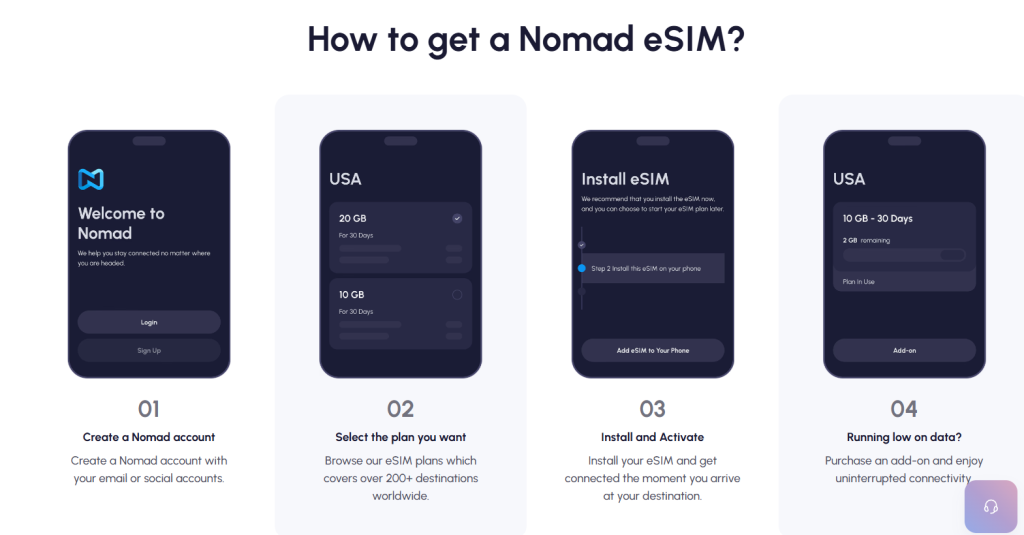
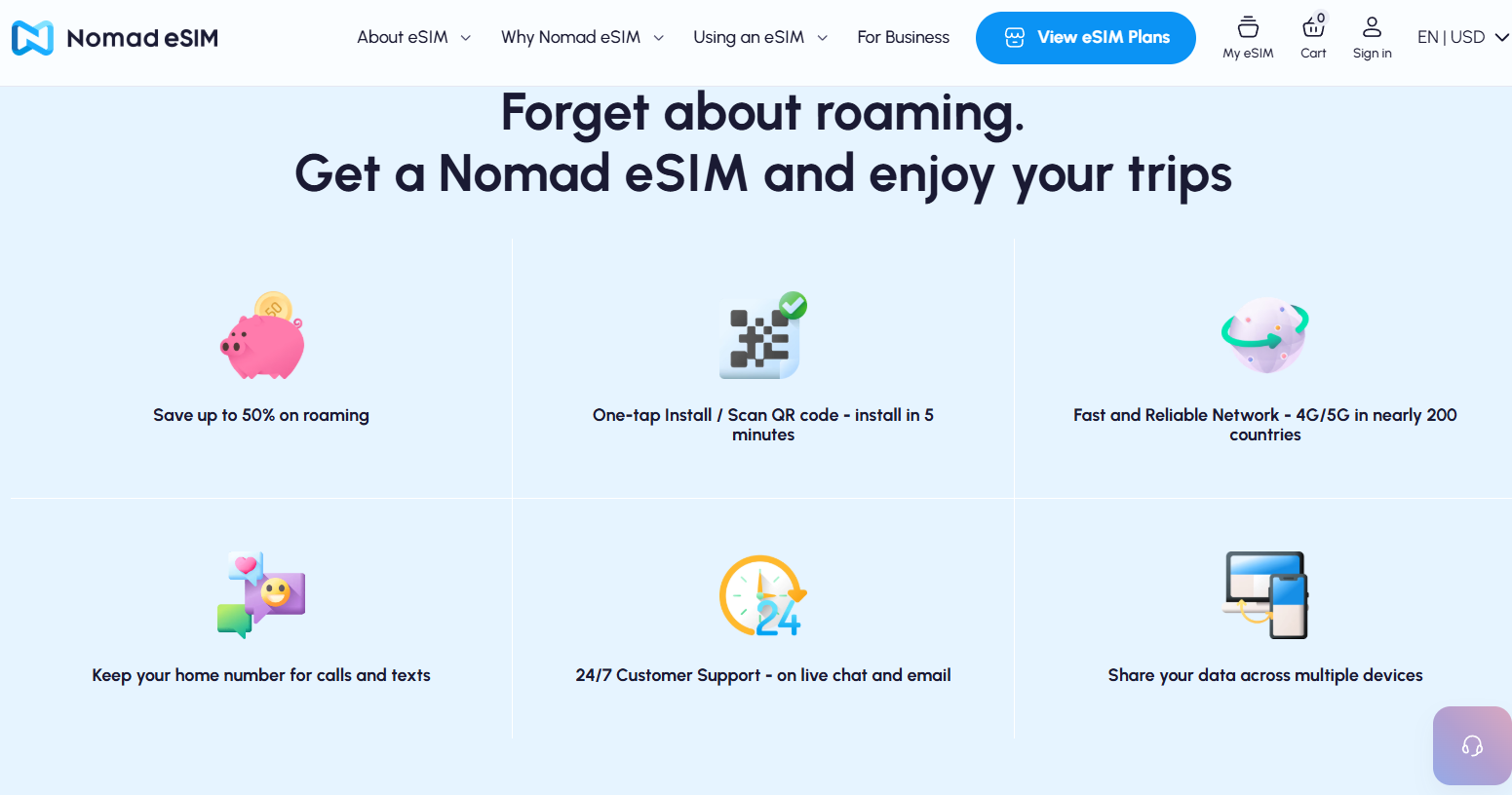
The platform covers more than 200 destinations across six continents, and in many countries it partners with multiple local carriers simultaneously, so your phone can automatically switch to whichever network has the strongest signal in your exact location. You install the eSIM as a QR code scan or one-tap download through the Nomad app, and it runs in dual-SIM mode alongside your physical SIM — meaning your home number stays active for calls, texts, and two-factor authentication while Nomad handles your data.
Nomad’s app has built a strong reputation for usability, holding a 4.8-star rating on the Apple App Store across more than 10,000 reviews and 4.7 on Google Play. Beyond simple plan purchases, the app lets you track data usage in real time, receive low-data and expiration alerts, and buy add-ons to extend an existing plan without reinstalling a new eSIM profile.
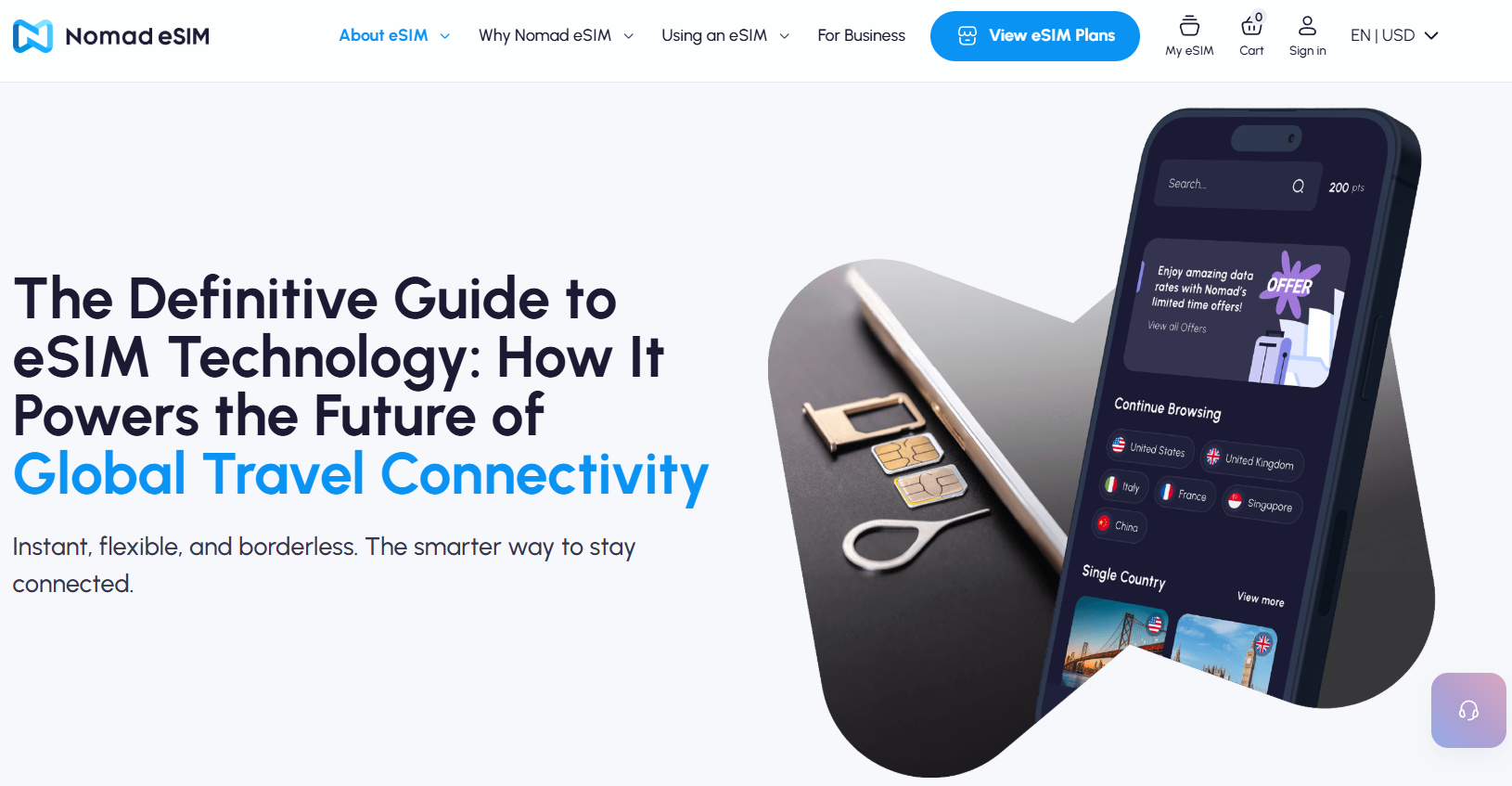
Why NomadeSIM Stands Out in 2026
Hotspot tethering included on every single plan: Unlike Holafly, which caps hotspot usage at 500MB regardless of plan size, Nomad allows unlimited hotspot tethering across its entire lineup. That means you can share your connection with a laptop or tablet without a separate data cap eating into your trip — a genuine differentiator for remote workers and travelers sharing one connection across a group.
Named local carrier partnerships, not vague coverage claims: Nomad discloses which local carrier powers each destination’s plan rather than hiding behind generic “local partner” language, and in many countries it offers multiple carrier options so you can manually switch if one network underperforms.
A genuinely broad plan structure: Between local (single-country), regional (Europe, APAC, SEA-Oceania, the Balkans, and more), Global (123 destinations), and Global-EX long-term plans (up to 365 days across 54 to 82 destinations), Nomad covers everything from a single weekend trip to a full year of continuous travel under one ecosystem.
A loyalty program that actually rewards repeat travelers: Where most eSIM providers treat every purchase as a one-off transaction, Nomad’s rewards program lets you earn points on every plan you buy, redeemable for discounts, bonus data, or extended validity on future trips — a meaningful perk if you travel more than once or twice a year.
A risk-free way to test the service: New users get a free 1GB trial eSIM valid for three days with no credit card required — a genuinely rare offer in a category where most providers expect payment upfront before you can judge real-world coverage in your destination.
Strong, consistent app store ratings: A 4.8 on the App Store and 4.7 on Google Play, backed by tens of thousands of reviews, is a solid signal that the day-to-day purchase-and-connect experience holds up for the average traveler, not just in marketing copy.
Key Features and Technology
Nomad’s feature set is built around three practical pillars: flexible plan types, an app that makes managing multiple eSIMs painless, and a handful of quality-of-life tools that separate it from bare-bones competitors.
Local, Regional, Global, and Global-EX Plans
Local plans cover a single country and generally deliver the best value if you know roughly how much data you’ll use there. Regional plans bundle a group of countries — useful for a multi-stop trip through, say, Southeast Asia or the Balkans — without needing a new eSIM at every border. The Global plan spans 123 destinations under one profile, ideal for round-the-world itineraries, while Global-EX is built for digital nomads and long-term expats, offering validity of up to 365 days across 54 to 82 countries depending on the specific plan.
The Nomad App
You can browse and purchase plans from the website, but day-to-day management — usage tracking, expiration alerts, add-on purchases, and manual network switching — happens in the app. Installation is a one-tap process or a QR code scan, and the interface has been consistently praised as one of the cleaner experiences in the eSIM category, letting you manage several destinations’ worth of eSIMs from a single dashboard.
Add-Ons and Top-Ups
Running low on data mid-trip doesn’t mean starting over. Nomad lets you purchase an add-on and keep using the same installed eSIM profile, avoiding the hassle of downloading and reinstalling a fresh profile in an unfamiliar country. Note that unused data does not roll over between billing periods, so add-ons are meant to extend a trip, not bank data for later.
Unlimited Plans and Fair Use
Where offered, Nomad’s “unlimited” plans come with a daily fair-use threshold — commonly around 2GB of full-speed data per day — after which speeds throttle to roughly 1Mbps until the next daily reset. That’s still enough for maps, messaging, and browsing, but it’s worth knowing before assuming “unlimited” means unrestricted 5G streaming all day.
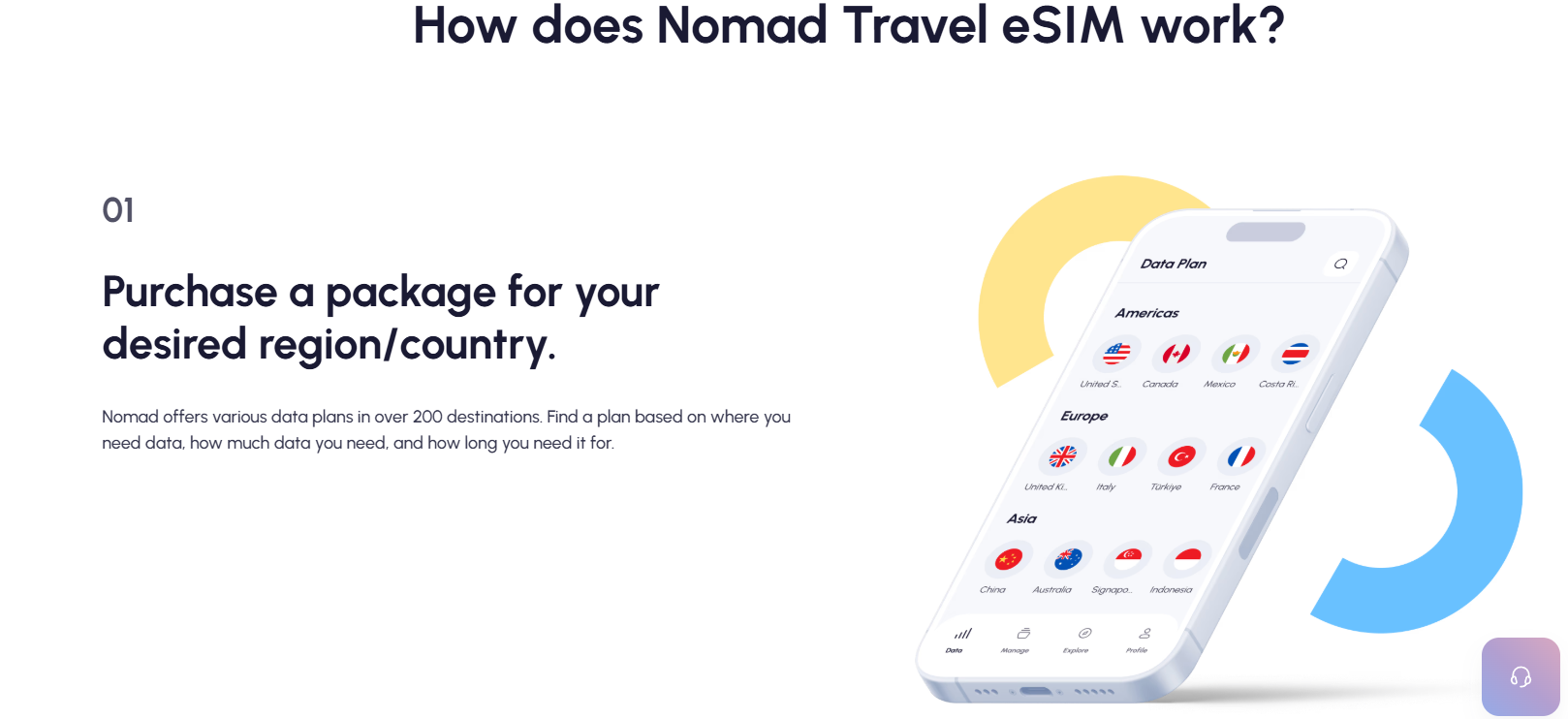
Pricing, Plans, and Package Structure
Nomad is a one-time prepaid purchase per plan rather than a recurring subscription, so there’s no auto-renewal to worry about unless you specifically opt into it. Pricing depends on three factors: destination, data allowance, and plan duration, and it varies significantly by country since Nomad is paying local carriers different wholesale rates in each market.
| Plan Type | Example Pricing | Coverage | Best For |
|---|---|---|---|
| Local (single country) | From $4.50 (1GB/7 days, UK); most countries fall between $3–$10/GB | 200+ countries | Single-destination trips |
| Regional | Varies by region and data size | Europe, APAC, SEA-Oceania, Balkans, and more | Multi-country trips within one region |
| Global | ≈ $59 for 10GB/30 days | 123 destinations | Round-the-world itineraries |
| Global-EX | Varies by duration and data size | 54–82 destinations, up to 365 days | Digital nomads and long-term expats |
As a rule of thumb, if you’re visiting only one or two countries and know roughly how much data you’ll use, local eSIMs purchased per destination will almost always beat regional or global pricing on a per-GB basis. Regional and global plans earn their premium through convenience — one profile, no reinstalling at every border — which is worth paying for on fast-moving, multi-country trips but not for a single-destination vacation.
How NomadeSIM Compares to Alternatives
| Provider | Entry Price | Hotspot | Standout Feature |
|---|---|---|---|
| Nomad (NomadeSIM) | $4.50 | Unlimited on all plans | Named local carriers + loyalty rewards program |
| Airalo | $4.00 | Supported, fair-use capped on unlimited plans | Widest brand recognition, Airmoney cashback |
| Holafly | ≈ $19 (short unlimited plans) | Capped at 500MB regardless of plan | True unlimited data in 160+ countries |
vs. Airalo: Airalo is the more recognizable name and matches Nomad closely on entry-level pricing, with its own loyalty perk (Airmoney cashback) and a slightly larger 20-million-user base. Nomad pulls ahead at the 5GB and 10GB tiers, where independent comparisons find it offers the best per-GB value of the major providers, and its unlimited hotspot tethering on every plan beats Airalo’s fair-use-capped approach on unlimited tiers.
vs. Holafly: If truly unlimited high-speed data with no daily throttle is your top priority, Holafly’s unlimited global plan is purpose-built for that use case, but it caps hotspot at just 500MB — a serious limitation for anyone tethering a laptop. Nomad is the better fit if you want flexible, fixed-data plans sized to your actual usage plus real hotspot capacity, rather than paying a premium for unlimited data you may not fully need.
vs. buying a local physical SIM: In some countries — Colombia and parts of Latin America are commonly cited examples — a local physical SIM purchased on the ground can offer significantly more data for a lower price than any eSIM provider, Nomad included. The trade-off is convenience: you’re navigating a foreign-language shop, potentially waiting in line, and sacrificing dual-SIM flexibility. For short trips or unfamiliar destinations, Nomad’s instant setup is usually worth the premium; for extended stays in budget-friendly countries, it’s worth comparing local SIM prices first.
Pros and Cons
What Travelers Love
Fast, reliable connections in major cities: Real-world speed tests report strong 4G and 5G performance in urban areas, with download speeds in the 40-90 Mbps range on tested destinations like London and Vietnam.
Effortless setup and management: The app’s consistently high ratings reflect a genuinely smooth purchase-to-connection experience, with one-tap installation and clear usage tracking.
No hidden connection fees: Unlike some physical SIM purchases that tack on activation or SIM-card fees, the advertised Nomad plan price is what you pay — no surprises at checkout.
Genuinely useful loyalty program: Frequent travelers who accumulate points across multiple trips can meaningfully reduce the cost of future plans, something most competitors don’t offer in any real form.
Limitations Worth Knowing
Not always the cheapest option: Nomad usually sits in the middle of the market rather than at the bottom. In some countries, a local physical SIM can offer several times more data for a fraction of the price — the trade-off is convenience versus raw value.
Indoor and rural signal can be inconsistent: Like every eSIM provider, Nomad depends entirely on local carrier infrastructure. Reviewers note weaker performance in subways, basements, and restaurants, and one recent review flagged elevated risk for travelers heading to Japan specifically, which is worth double-checking closer to your trip.
Fixed start dates on some plans: Certain Nomad plans begin counting down from the moment of purchase rather than from first network connection, which can waste data if your departure date slips. Always check the activation policy for your specific plan before buying.
Live support can be slow to reach: While the in-app chatbot responds instantly, getting connected to a human agent has taken as long as 10-plus minutes in independent testing, which can be stressful if you’re troubleshooting a connection issue on arrival.
Data doesn’t roll over, and “unlimited” has a daily ceiling: Unused gigabytes expire at the end of the plan period, and unlimited plans throttle to roughly 1Mbps after a daily fast-data allowance (commonly around 2GB) is used up.
Who Should Use NomadeSIM
Occasional international travelers: If you take one or two trips a year and want to skip roaming fees without researching a new local carrier every time, a single-country local plan is an easy, low-effort win.
Multi-country trip planners: Travelers hopping between several countries in one region — a Balkans tour, a Southeast Asia loop — will get the most value from a Regional plan, avoiding the hassle of reinstalling an eSIM at every border.
Digital nomads and long-term expats: The Global-EX plans, covering up to 365 days across dozens of destinations, are built specifically for people living out of a suitcase for months at a time and who value the loyalty program’s compounding savings.
Remote workers who need to tether: Anyone who regularly connects a laptop through their phone’s hotspot benefits directly from Nomad’s uncapped tethering, a real advantage over unlimited-focused competitors that cap hotspot usage sharply.
Budget backpackers visiting 10+ countries in a month: If you’re prioritizing rock-bottom prices over convenience and reliability, comparing local physical SIM prices at each stop — or a more aggressively priced eSIM competitor — may serve your budget better than Nomad’s mid-market positioning.
Getting Started: Step by Step
- Confirm your device is eSIM-compatible. Most iPhones from the XS onward, recent Google Pixels, and many Android flagships support eSIM — check your device settings or manufacturer’s site to be sure, and make sure your phone is network-unlocked.
- Try the free trial first. Claim the 1GB, 3-day free trial with no credit card required to confirm coverage quality in your specific destination before paying for a full plan.
- Choose local, regional, or global based on your itinerary. One country only, buy local. Multiple countries in one region, buy regional. Round-the-world or long-term, buy Global or Global-EX.
- Buy 1–2 weeks before departure. Purchasing early doesn’t waste your data allowance as long as your plan activates on first network connection rather than on purchase — confirm which type you’re buying.
- Install via QR code or the app. On iOS, go to Settings > Cellular > Add Cellular Plan and scan the QR code; on Android, follow the equivalent “Add Data Plan” flow. The whole process takes a few minutes.
- Turn on data roaming for the Nomad line. After installation, make sure Data Roaming is enabled specifically for your Nomad eSIM, or it won’t connect once you land.
- Monitor usage in the app and buy add-ons as needed. Set up low-data alerts so you’re never caught without a top-up option mid-trip.
Tips for Getting Maximum Value
Before buying a regional or global plan, do a quick per-country cost comparison — if you’re only visiting two or three destinations and know your rough data needs, buying individual local eSIMs is very often cheaper than paying the convenience premium for broader coverage you won’t fully use. Sign up for Nomad’s referral program if you’re traveling with friends or family; both parties get $5 off plans priced at $5 or more, which can offset the cost of your first purchase entirely. Keep an eye on your accumulated loyalty points if you travel more than once or twice a year, since they compound into real savings over time rather than expiring after a single trip. If you’re heading somewhere with reported coverage issues, burn your free 1GB trial there first rather than committing blind to a paid plan. And always double-check whether your destination is a named country in the plan’s coverage list — Nomad specifies that overseas territories belonging to certain countries may not be included, which is an easy detail to miss when booking a trip.
Future Outlook and Final Assessment
The tailwinds favor Nomad and the travel eSIM category broadly. eSIM-compatible devices are now the default across new smartphones, international travel volumes keep climbing post-pandemic, and travelers are increasingly unwilling to accept legacy roaming pricing when instant digital alternatives exist. Nomad’s growth to an estimated 3 million users in five years, its expanding carrier partnerships, and its investment in the loyalty program all suggest a provider building for repeat customers rather than one-off tourist purchases — a smart bet in a category that’s becoming more competitive every year.
The honest caveats remain worth restating: Nomad isn’t the rock-bottom cheapest option in every market, indoor and rural coverage still depends entirely on local infrastructure Nomad doesn’t control, and a handful of recent reviews flag destination-specific risk worth checking before you travel. Within those boundaries, NomadeSIM delivers a reliable, well-reviewed, genuinely convenient way to stay connected across 200-plus destinations, with unlimited hotspot tethering and a loyalty program that reward the travelers who use it most.
Conclusion
NomadeSIM has built exactly what most travelers actually want from an eSIM provider: a polished app, broad and honestly disclosed coverage, uncapped hotspot tethering, and a loyalty program that treats you like a returning customer instead of a one-time transaction. It isn’t always the cheapest name on the market, and coverage quality still hinges on the same local carrier limitations every eSIM provider shares, but for travelers who value reliability and convenience over chasing the absolute lowest price per gigabyte, it’s a strong default choice. Confirm your device compatibility, pick the plan type that actually matches your itinerary, and Nomad makes staying connected on the road feel like a solved problem — making everything easy, wherever your next flight lands.
Ready to land connected on your next trip?
Explore more honest reviews, tutorials and tool comparisons to find the right tech for the way you work and live — at AI Solutes, where we make everything easy.
👉 Open Free Account: https://ai-solutes.com/nomad.esim
👉 Our YouTube Channel: youtube.com/@ai-solutes
👉 Our Facebook Fanpage: Facebook
👉 Our X (Twitter): @AISolutes
- Unlock Powerful AI Voice with ElevenLabs: 2025 Plans, API Features, Multilingual Tech & Ethical Music Licensing
- Master Chatbase in 2026: Build Multichannel AI Chatbots to Boost Support and Sales
- Transform Global Content Creation with Akool AI: Cloud Integration, Multilingual Video, and Next-Gen Avatars
- Coohom
- Does Pitch Revolutionize Presentation Design? Reviewing the Pitch Smart Slide Templates Technology