You spend real money on Google Ads, local SEO and social campaigns — and then the phone rings, the conversation happens off-screen, and you have no idea which ad actually earned that lead. For service businesses, that blind spot is where marketing budgets quietly bleed out. CallRail was built to close it. It is a call tracking and lead engagement platform that connects every inbound phone call, text and form submission back to the exact marketing source that produced it, then layers AI on top to transcribe, summarize and even answer those calls for you. Founded in 2011 in Atlanta and now used by more than 200,000 businesses worldwide, CallRail crossed $100 million in annual recurring revenue in 2025 and starts at roughly $45–$50 per month — an accessible entry point into a category where enterprise rivals routinely charge thousands.
For marketers, agencies, small business owners and the freelancers who run their growth, the appeal is immediate: stop guessing which channel makes the phone ring and start proving it. This 2026 review walks through CallRail’s entire platform — call tracking and dynamic number insertion, the AI conversation intelligence suite, the new Voice Assist AI agent, full pricing with the overage traps spelled out, head-to-head comparisons with the main alternatives, the honest limitations, and exactly who should (and shouldn’t) sign up.
CallRail Review 2026: The Call Tracking & AI Lead Engagement Platform That Finally Tells You Which Marketing Made the Phone Ring
Overview and Background
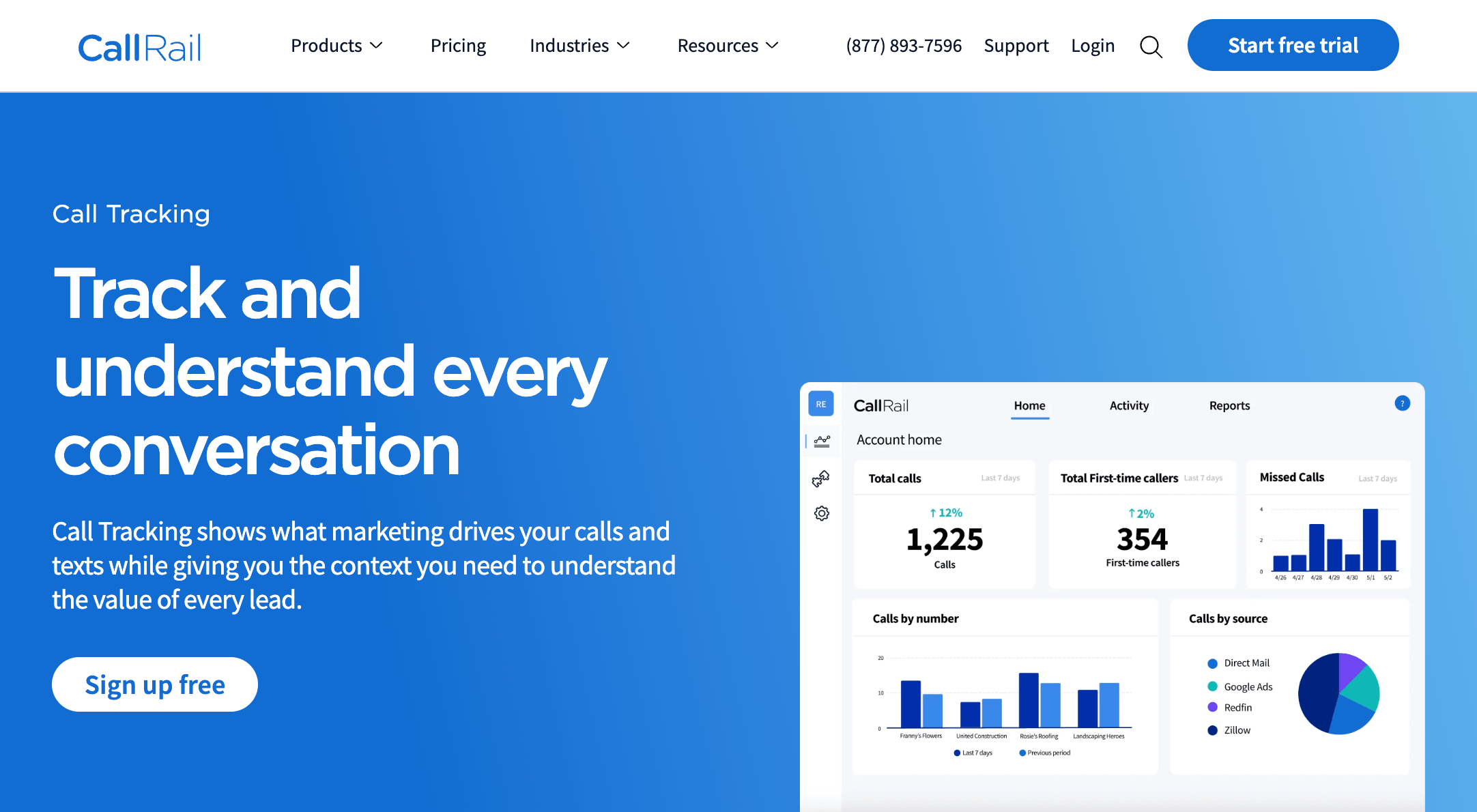
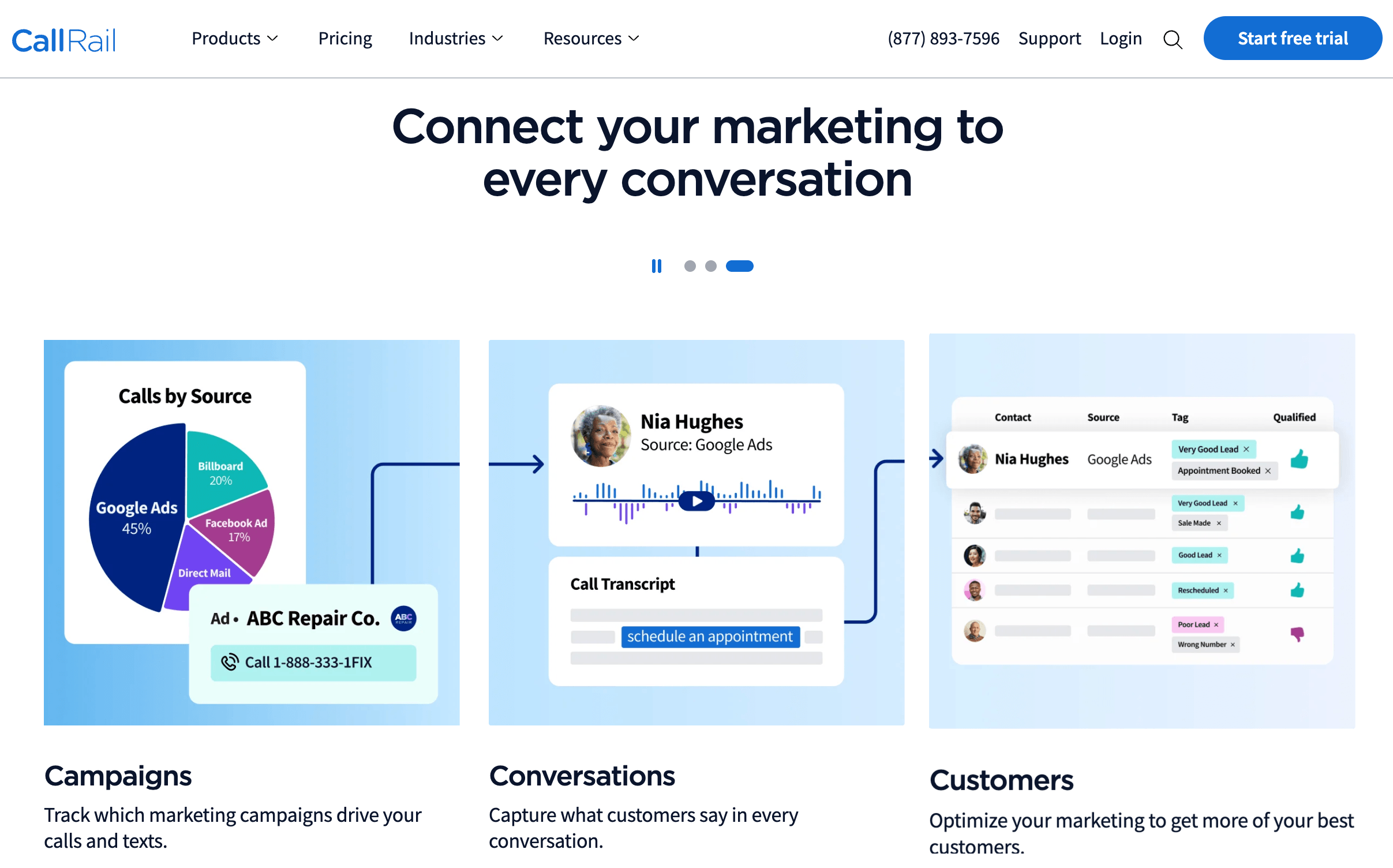
CallRail is a cloud-based call tracking, marketing attribution and lead engagement platform. In plain terms, it assigns unique phone numbers to your different marketing channels and campaigns, then records which number a caller dialed — so you can trace every inbound call back to the ad, keyword, landing page or offline campaign that generated it. That same attribution logic now extends to text messages and web form submissions, giving marketers the kind of closed-loop reporting for phone leads that they have long taken for granted for online clicks.
The company was founded in 2011 in Atlanta by Georgia Tech graduates Andy Powell and Kevin Mann, who started with a simple call-tracking tool and grew it into a full lead intelligence suite spanning calls, texts, forms and AI conversation analysis. The core insight has stayed constant for more than a decade: for a huge range of businesses — law firms, dentists, HVAC and home services, real estate, healthcare, automotive — the telephone is still the channel where deals actually close, and a click-obsessed analytics stack simply can’t see it. CallRail exists to make that invisible channel measurable.
Today CallRail serves well over 200,000 businesses worldwide (recent company figures put the number around 225,000), employs roughly 350 people out of its downtown Atlanta headquarters, and reached the $100 million ARR milestone in 2025. It integrates natively with more than 700 tools — Google Ads, Google Analytics 4, HubSpot, Salesforce, Facebook Ads, Microsoft Advertising, Slack, WordPress and many more — and powers its AI features through a partnership with AssemblyAI, a leading speech-to-text provider. On the trust side, CallRail carries SOC 2 Type II and HIPAA attestations and was the first in its category to achieve ISO 42001 certification for responsible AI governance, which matters for the healthcare and legal clients that lean on it.
Why CallRail Stands Out in 2026
Best-in-class marketing attribution: This is CallRail’s home turf. With Dynamic Number Insertion (DNI), the phone number displayed on your website swaps automatically based on where each visitor came from — Google Ads, organic search, Facebook, even a specific keyword. When the call connects, CallRail already knows the source, so you can finally see which campaigns drive real conversations rather than just clicks. For phone-heavy businesses, that single capability often pays for the whole subscription the first time it kills a losing campaign.
Genuinely fast, no-developer setup: One of the most consistent themes across user reviews is how quickly CallRail goes live. Most businesses are tracking calls within an hour, without needing an engineer — you grab tracking numbers, drop a small snippet on your site (or use the native WordPress plugin), and the data starts flowing. That low friction is a big reason agencies adopt it across dozens of client accounts.
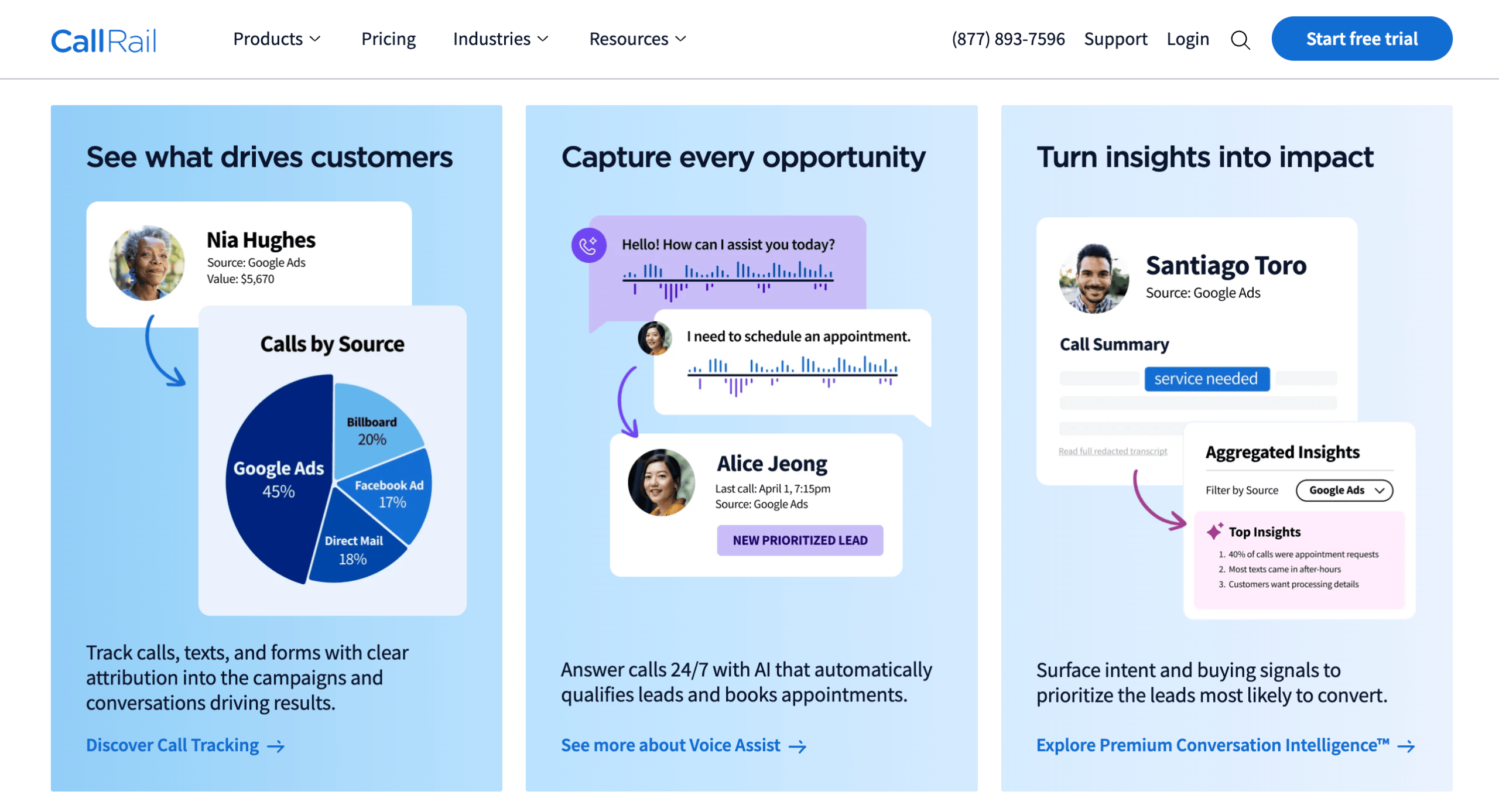
AI conversation intelligence that earns its keep: CallRail automatically transcribes calls, surfaces the keywords you care about (“quote,” “emergency,” “cancel”), summarizes conversations, scores lead quality and analyzes sentiment. Its Premium Conversation Intelligence tier adds call summaries, conversation trend reports and automatic conversion tagging — the kind of work that used to require a human QA team listening to recordings all day. Reviewers repeatedly single out the AI accuracy as one of CallRail’s strongest cards.
Voice Assist — a 24/7 AI receptionist: Launched in 2025, Voice Assist is CallRail’s AI voice agent that answers, qualifies and books appointments around the clock — no human pickup required. With 2026 integrations into Calendly and Google Calendar, it can check availability and confirm a booking live during the call. CallRail’s own data shows about 28% of business calls go unanswered and that more than 70% of customers choose whoever responds first, so an always-on front line directly targets lost revenue; early users reported a 44% increase in answered calls.
Convert Assist for faster follow-up: Beyond tracking and answering, CallRail’s Convert Assist uses generative AI to auto-generate next-step action plans for each lead, draft ready-to-send follow-up emails, and provide real-time call coaching to front-line staff. It is aimed squarely at the speed-to-lead problem that quietly costs small businesses deals every week.
700+ integrations and a real API: CallRail pushes call and lead data straight into Google Ads, GA4, CRMs and marketing platforms, so phone conversions show up alongside online ones and you can optimize bidding on the leads that actually convert. A documented API, webhooks and Zapier support cover almost anything not handled natively, which makes CallRail a flexible hub rather than a data silo.
Enterprise-grade trust for regulated industries: SOC 2 Type II, HIPAA and the industry-first ISO 42001 certification mean CallRail can be deployed responsibly by healthcare practices, law firms and other compliance-sensitive businesses — a genuine differentiator as AI features handle more sensitive customer conversations.
Key Features and Technology
CallRail’s catalog is best understood as a stack of bundleable products, each of which adds a layer of capability on top of the core call-tracking engine. Here is how the platform breaks down.
Call Tracking & Attribution — the Foundation
The base product assigns unique local or toll-free tracking numbers to your campaigns and uses Dynamic Number Insertion to attribute every call to its source. You get call recording, call routing, whisper messages (a private note played to your staff before the caller connects), automation rules, and number pools that keep attribution accurate even during high-traffic campaigns. Each call is logged with full metadata — caller ID, duration, geographic location and the marketing touchpoint that produced it — so your Call Log doubles as a campaign performance report.
Conversation Intelligence & Premium Conversation Intelligence
This is the AI layer. Standard Conversation Intelligence transcribes calls with near-human accuracy, lets you spot key terms and jump to highlighted moments on the recording’s waveform, and auto-scores leads based on conversation patterns. Premium Conversation Intelligence steps up to AI call summaries, sentiment analysis, automatic conversion tagging and conversation trend reporting — so you can understand what buyers are actually asking for at scale, not one recording at a time. Transcription is English-language and quality-dependent, and the higher tiers include progressively more transcription minutes.
Voice Assist & Convert Assist — the AI Agents
Voice Assist is the 24/7 AI voice agent that picks up calls you’d otherwise miss, qualifies the caller, and books appointments directly into Calendly or Google Calendar. Convert Assist works the other side of the funnel: it drafts personalized follow-up messages, builds action plans from a lead’s full call history, and coaches agents in real time. Together they push CallRail beyond passive measurement into active lead capture and conversion.
Form Tracking & Lead Center
Form Tracking applies CallRail’s multi-touch attribution to web form submissions, with a drag-and-drop form builder and source data attached to every submission. Lead Center is a unified inbox that pulls calls, texts and chats into a single view, so a small team can respond to leads from any channel in one place and on mobile. The result is a consolidated picture of total lead volume and source distribution across phone and web.
Pricing, Plans, and Package Structure
CallRail is a subscription product with a hybrid pricing model: a recurring monthly base fee plus usage-based charges for anything over your plan’s included minutes, numbers and SMS. There is no permanent free plan, but every account starts with a 14-day free trial (no credit card required). Plan names have shifted over time — you’ll see both the older “Call Tracking / Call Tracking + Conversation Intelligence / Call Tracking + Form Tracking / Call Tracking Complete” labels and the newer “Lead Tracking / Lead Tracking Complete / Lead Conversion / Lead Conversion Complete” naming — and prices vary a little across CallRail’s own pages and third-party trackers. Annual billing typically saves around 10–12%. The figures below are approximate ranges; always confirm the live price on CallRail’s pricing page before committing.
| Plan | Approx. Price | What You Get | Best For |
|---|---|---|---|
| Lead Tracking (Call Tracking) | ~$45–50/mo | 5 local numbers, 250 minutes, 25 SMS; call & text tracking, recording, routing, automation, basic AI insights | Small businesses proving which marketing drives calls |
| + Conversation Intelligence | ~$90–100/mo | Everything in base, plus full call transcription, keyword spotting (~7,500 transcription minutes) | Teams reviewing calls for training, QA or compliance |
| Lead Tracking Complete (+ Form Tracking) | ~$95–105/mo | Adds form tracking, drag-and-drop form builder, ~1,000 submissions, unified call + form attribution | Multi-channel marketers tracking calls AND web forms |
| Lead Conversion (Call Tracking Complete) | ~$150–175/mo | Adds Premium Conversation Intelligence: AI summaries, sentiment, auto-tagging, conversation trend reports | Marketing directors wanting the full lead picture |
| Lead Conversion Complete | ~$195–215/mo | Everything bundled: call + form tracking + Premium Conversation Intelligence in one plan | Agencies and mid-market teams needing the full suite |
| Voice Assist (add-on) | ~$95/mo + base plan | 24/7 AI voice agent; ~50 answered calls included, then ~$1/call; requires Call Tracking (~$50) | Businesses losing leads to missed and after-hours calls |
The real cost story is usage. Beyond the 250 included minutes, expect roughly $0.05 per extra local minute and $0.08 per toll-free minute, about $3/month per additional tracking number, and — once Conversation Intelligence is on — transcription minutes billed separately from call minutes. A busy local service business can easily consume thousands of minutes a month, which is how a $45 plan turns into a $150–$200 bill.
How CallRail Compares to Alternatives
| Factor | CallRail | CallTrackingMetrics | Invoca | DIY / No tracking |
|---|---|---|---|---|
| Best for | SMBs & marketing agencies | Mid-market & contact centers | Enterprise & regulated brands | No real attribution |
| Ease of setup | Very easy, no developer | Steeper learning curve | Implementation-heavy | N/A |
| AI conversation intel. | Strong (CI + Premium CI, Voice Assist) | Yes, plus call routing tools | Yes, enterprise-grade | None |
| Built-in call routing / softphone | Basic | Strong (queues, whisper, barge) | Limited | Whatever your phone offers |
| Global reach | US, CA, UK, AU focus | Broader international | Global, enterprise | N/A |
| Entry price | ~$45–50/mo | ~$79/mo | Custom / high | $0 (but no data) |
vs. CallTrackingMetrics: CTM is the closest head-to-head rival and the better pick if you need operational call-center muscle — skill-based routing, queue management, a built-in softphone and agent monitoring (whisper, barge, listen) — alongside attribution. CallRail counters with a simpler, more marketing-friendly experience that gets agencies and SMBs to value faster. If ease of use and clean reporting matter most, CallRail wins; if you’re running a contact center, CTM’s operational depth is worth the steeper learning curve.
vs. Invoca: Invoca is the enterprise-grade conversation-intelligence platform built for Fortune 500 brands and heavily regulated industries, with deeper analytics and broader global reach — and pricing to match. For most small businesses and agencies, it is overkill. CallRail offers the practical 80% of what those teams need at a fraction of the cost and complexity.
vs. DIY / no tracking: The real competitor for many readers is doing nothing — relying on “where did you hear about us?” and gut feel. That approach is free and almost always wrong. Without call attribution you can’t tell a profitable Google Ads campaign from a money pit, and you’ll keep funding both. CallRail’s entire value proposition is replacing guesswork with evidence; for any business spending real money on paid search or local SEO, that trade is usually a bargain. Budget-focused alternatives worth a look include WhatConverts, Nimbata (pay-per-answered-call) and Convirza.
Pros and Cons
What Marketers and Owners Love
Accurate, channel-level attribution: The headline benefit — knowing exactly which ad, keyword or campaign produced each call — is the reason most customers stay. It turns marketing spend from a leap of faith into a measurable decision.
Easy to use and fast to launch: Reviewers consistently praise the intuitive interface and quick setup. Call recordings, transcripts and reports are easy to find and share, which lowers the barrier for non-technical teams.
Top-tier AI features: Transcription accuracy, keyword highlights, summaries and sentiment analysis get strong marks, and the AssemblyAI partnership shows in the quality. The AI genuinely saves teams from note-taking and manual call review.
Voice Assist captures missed leads: Even with its rough edges, the 24/7 AI agent demonstrably reduces missed calls and books appointments after hours — a direct revenue win for businesses where the phone is the money channel.
700+ integrations and solid compliance: Deep connections to Google Ads, GA4, HubSpot and Salesforce, plus SOC 2, HIPAA and ISO 42001, make CallRail a trustworthy, well-connected hub rather than an isolated tool.
Limitations Worth Knowing
Overages and creeping cost: The single most common complaint. The base price is just the entry point; tight minute, number and transcription caps mean real bills routinely run well above the advertised rate, and some users report no warning before they blew through their limits. Prices have also trended upward over time.
Advanced features are gated: Transcription, form tracking and Premium Conversation Intelligence each live on higher tiers, so getting the full picture means paying meaningfully more than the entry plan suggests.
Limited global coverage: CallRail focuses on the US, Canada, UK and Australia. If you need broad international tracking numbers, this is a real constraint and rivals with wider reach may suit you better.
Integration friction and a thinner mobile app: Some users hit syncing issues with platforms like Google Ads and Zoho — missing conversions, duplicates or matching problems — and the mobile app lacks parity with the desktop experience, occasionally feeling clunky.
Voice Assist still maturing, and support can lag: The AI voice agent sometimes repeats questions or sounds noticeably robotic, and a subset of reviewers cite slow or unhelpful customer support. Both are improving, but set expectations accordingly.
Who Should Use CallRail
Local and service businesses: Law firms, dentists, HVAC and plumbing companies, home services and healthcare practices live and die by inbound calls. If the phone is where you close, CallRail’s attribution alone justifies the spend. Start on the entry Lead Tracking plan and add Voice Assist if missed and after-hours calls are costing you leads.
Marketing agencies: Multi-account management, white-label options, fast setup and clean client-ready reporting make CallRail an agency favorite. A Lead Conversion or Lead Conversion Complete plan gives you the form tracking and Premium Conversation Intelligence clients increasingly expect.
Data-driven marketers and small business owners: Anyone running paid search or local SEO who needs to prove ROI and optimize bidding on real conversions — not just clicks — will get fast value. The Conversation Intelligence add-on is the upgrade that pays off here, surfacing what buyers actually ask for.
Who should look elsewhere: Solo operators or very low call-volume businesses may find the cost hard to justify, and teams needing full contact-center routing, a built-in softphone or broad international coverage should evaluate CallTrackingMetrics or an enterprise platform like Invoca instead. If predictable, pay-per-answered-call billing is a priority, Nimbata is worth a look.
Getting Started: Step by Step
- Start the 14-day free trial. Sign up on CallRail’s site — no credit card required — so you can test the full feature set before paying anything.
- Create your tracking numbers. Provision local or toll-free numbers and assign one to each marketing source you want to measure (Google Ads, organic, Facebook, direct mail, and so on).
- Install Dynamic Number Insertion. Add CallRail’s small JavaScript snippet to your website (or use the native WordPress plugin) so the displayed number swaps automatically by visitor source.
- Connect your integrations. Link Google Ads, GA4, your CRM and any marketing tools so call and lead data flows into the dashboards your team already uses.
- Turn on call recording and AI features. Enable recording and Conversation Intelligence on the numbers where you want transcripts, keyword highlights and summaries — keeping local consent rules in mind.
- Set up routing, automations and (optionally) Voice Assist. Configure call routing, whisper messages and automation rules; if missed calls are a problem, switch on Voice Assist and connect Calendly or Google Calendar for live booking.
- Review reports and optimize. Use the Call Log, Leads Report and attribution data to identify winning channels, cut wasted spend, and double down on the campaigns that actually drive conversations.
Tips for Getting Maximum Value
The make-or-break move with CallRail is matching your plan to your real usage, not the sticker price — so before you commit, estimate your monthly call minutes and tracking numbers honestly, then request usage-limit notifications so you’re never blindsided by overages. Opt for annual billing to shave roughly 10–12% off, and if you need both Premium Conversation Intelligence and form tracking, a bundled Complete plan is almost always cheaper than stacking individual add-ons on a lower tier. Don’t pay for transcription minutes you won’t use: enable Conversation Intelligence only on the numbers where call review genuinely matters, since transcription is billed separately from call minutes and quietly doubles per-minute costs on every recorded call. Take full advantage of the 14-day free trial to pressure-test integrations with your actual Google Ads and CRM setup, because that’s where syncing quirks tend to surface. And because CallRail frequently runs promotions, mention that you’re evaluating competitors and always confirm the live price and any active discount before signing — a five-minute check can meaningfully lower your first-year cost.
Future Outlook and Final Assessment
The tailwinds behind CallRail are strong. As privacy changes erode cookie-based tracking and AI makes conversation analysis cheap and instant, the ability to attribute and understand phone leads is becoming more valuable, not less. CallRail’s 2025–2026 push — Voice Assist, the Calendly and Google Calendar booking integrations, Convert Assist, and an industry-first ISO 42001 certification — shows a company moving decisively from passive measurement into active, AI-driven lead capture and conversion. Reaching $100M ARR and 200,000+ customers gives it the scale and product depth to keep iterating.
The honest caveats remain. Pricing is the recurring sore spot: the friendly entry rate hides usage-based overages that can multiply your bill, advanced AI sits behind higher tiers, global coverage is limited to a handful of English-speaking markets, and the Voice Assist agent still has maturing to do. None of these are dealbreakers for the businesses CallRail is built for, but all of them argue for going in with eyes open and a realistic budget.
Conclusion
CallRail has spent more than a decade solving one stubborn problem better than almost anyone: telling you which marketing actually made the phone ring. In 2026 it does far more than that — transcribing and summarizing conversations, scoring leads, answering calls 24/7, and drafting your follow-ups — while keeping the fast setup and marketing-friendly reporting that made it popular in the first place. It is not the cheapest option once usage is metered, and it is not the right fit for solo operators or businesses needing global, contact-center-grade calling. But for the law firms, home-service companies, healthcare practices, agencies and data-driven marketers who treat the phone as their primary revenue channel, CallRail turns a frustrating blind spot into clear, defensible insight — and takes a genuine swing at making lead tracking and conversion feel effortless. For professionals and digital-native teams who want their tools to do exactly that, it’s the kind of platform that helps you make everything easy.
Ready to find out which marketing actually drives your calls? Start tracking with CallRail today.
Explore more honest reviews, tutorials and tool comparisons to find the right tech for the way you work and live — at AI Solutes, where we make everything easy.
👉 Open Free Account: https://www.callrail.com/
👉 Our YouTube Channel: youtube.com/@ai-solutes
👉 Our Facebook Fanpage: Facebook
👉 Our X (Twitter): @AISolutes