If you run a Shopify or WooCommerce store, you’ve probably heard the same advice a hundred times: email marketing still returns more per dollar than almost any other channel, and abandoned-cart automation alone can recover sales you’re currently losing every single day. The gap is usually the tool — most email platforms either aren’t built for ecommerce at all, or they bolt SMS on as an expensive afterthought. Omnisend was built to close exactly that gap. Founded in 2014 and purpose-built for online retailers, Omnisend now serves more than 150,000 ecommerce brands worldwide, bundles email, SMS, and web push into one dashboard and one price, and has built a reputation — backed by a 4.8/5 rating on the Shopify App Store — as one of the most affordable, ecommerce-native alternatives to Klaviyo. With a free plan that’s genuinely usable, paid plans starting around $16 a month, and 27+ pre-built automation flows tailored specifically to online stores, Omnisend has become a default recommendation for small and mid-sized ecommerce brands.
For Shopify and WooCommerce merchants, agencies managing multiple ecommerce clients, and DTC brands trying to squeeze more revenue out of an existing customer list, Omnisend is worth serious consideration. This 2026 review walks through what Omnisend actually does, its automation and AI capabilities, full current pricing, how it stacks up against Klaviyo, Mailchimp, and Shopify Email, the honest limitations reviewers keep flagging, and exactly who should — and shouldn’t — build their retention stack on it.
Omnisend Review 2026: The Email, SMS & Push Platform Built Specifically for Ecommerce
Overview and Background
Omnisend is an email, SMS, and web push marketing automation platform built exclusively for ecommerce, rather than trying to be a general-purpose marketing tool that also happens to work for online stores. Since launching in 2014, the company has grown steadily on the back of that focus, and now reports more than 150,000 brands using the platform, with native, real-time integrations into Shopify, WooCommerce, BigCommerce, Wix, and Magento that sync product catalogs, order history, and customer behavior directly into every automation and campaign.
The core pitch is simple: instead of paying for separate email, SMS, and push-notification tools that don’t talk to each other, Omnisend bundles all three channels into a single automation builder and a single price. Every plan — including the free one — ships with the full feature set rather than gating capabilities behind higher tiers, which is a deliberate contrast to how competitors like Klaviyo structure their pricing. Independent testers report an average ROI of roughly $68 for every dollar spent by paying US merchants, and the platform holds strong ratings across review sites: 4.8/5 on the Shopify App Store and 4.5/5 on G2.
Why Omnisend Stands Out in 2026
Built for ecommerce, not adapted to it: every core feature — the Product Picker, cart-recovery flows, order follow-ups, back-in-stock alerts — is designed around store data from the ground up, rather than being a general email tool with an ecommerce plugin bolted on.
One platform for email, SMS, and push: you build a single automation workflow that can trigger an email, a text message, and a browser push notification from the same trigger, instead of stitching together three separate tools and three separate bills.
27+ pre-built automation flows out of the box: welcome series, abandoned cart, browse abandonment, post-purchase, win-back, and more come as ready-to-launch templates, meaning most stores can have their first automated revenue flow live within 15–30 minutes of connecting their store.
The Customer Lifecycle Map: Omnisend uses your store’s actual purchase data to segment customers into engagement stages — at-risk, needs nurturing, loyalists, brand champions — and recommends specific retention tactics for each stage, turning a data dashboard into an actual action plan.
No feature gating between tiers: unlike Klaviyo, which restricts advanced features to higher-priced plans, Omnisend’s Free, Standard, and Pro plans all include the same core feature set — what changes between tiers is sending volume and contact limits, not capability.
Meaningfully cheaper than the category leader: multiple independent comparisons put Omnisend at roughly 35% cheaper than Klaviyo at equivalent contact tiers, which is a real factor for brands whose subscriber list grows every month and whose email-tool bill grows right along with it.
Support that’s actually responsive: Omnisend offers 24/7/365 live chat on every plan, including Free, with average response times reported under three minutes — a notable improvement reviewers highlight compared to the platform’s own earlier reputation and to competitors that reserve fast support for enterprise customers.
Key Features and Technology
Omnisend’s feature set clusters around three pillars: deep ecommerce integration, a unified automation engine across channels, and AI-assisted content tools that cut down manual design and copywriting work.
Store Integration and the Product Picker
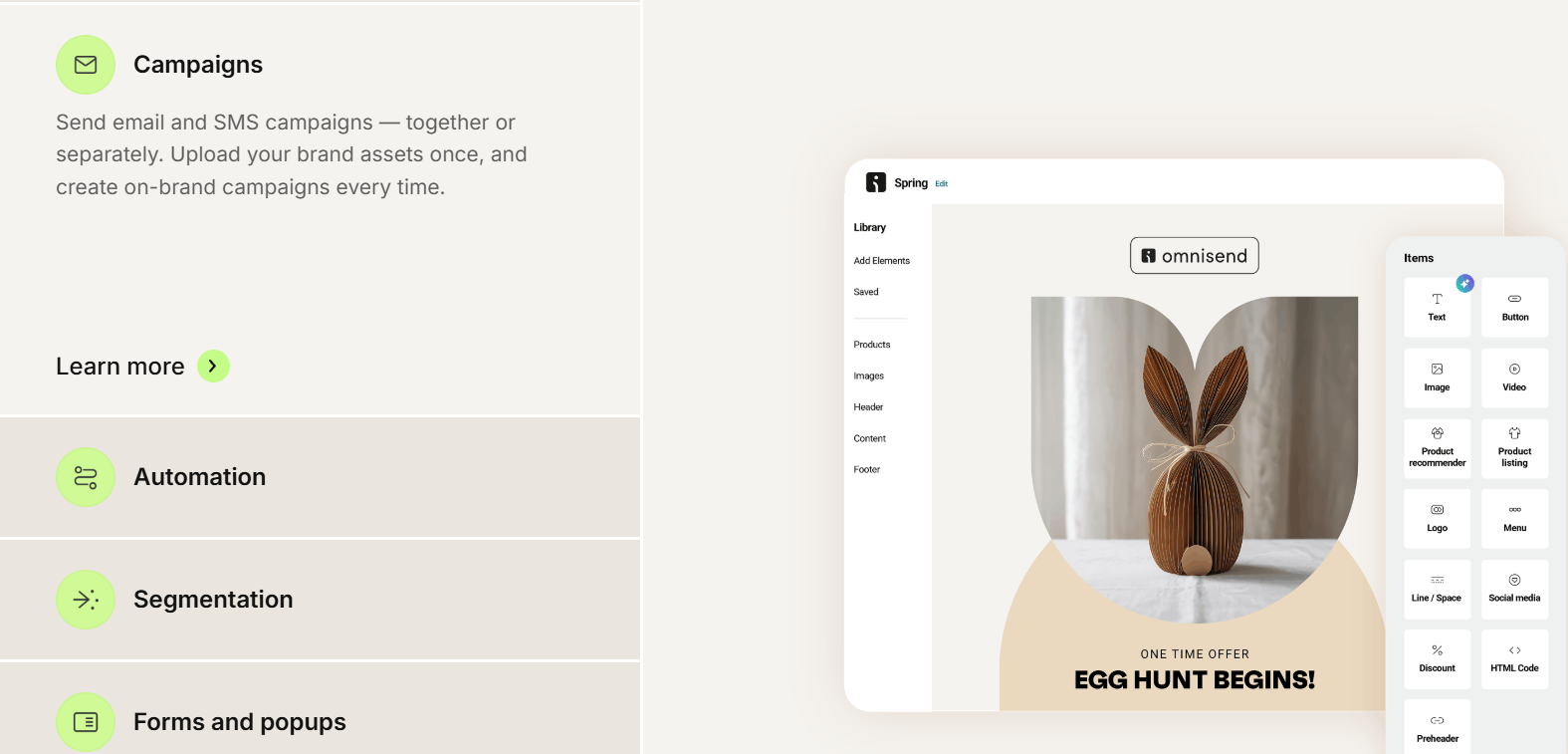
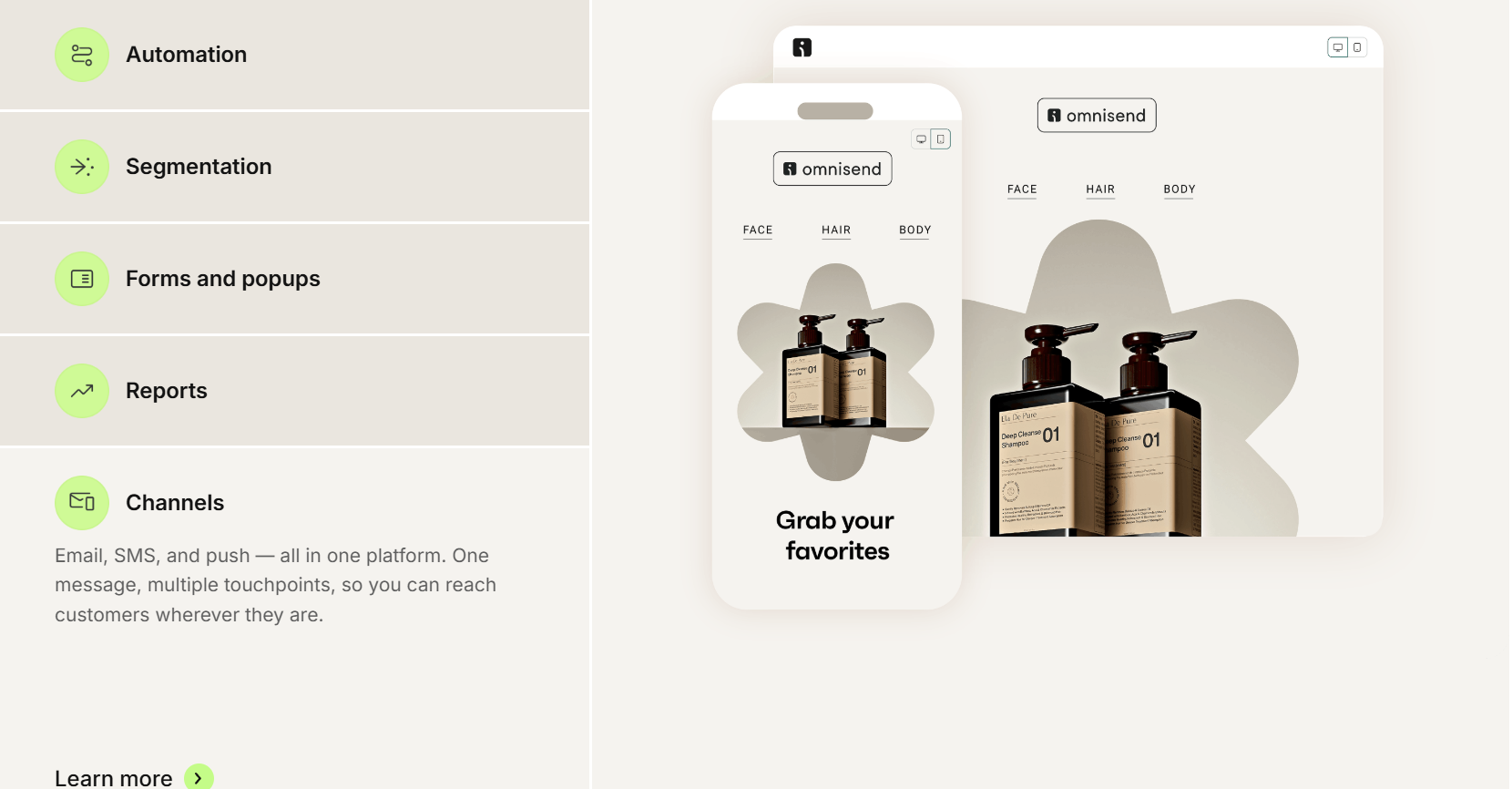
Connecting Shopify, WooCommerce, or BigCommerce syncs your product catalog, store styling, and customer list into Omnisend automatically. The Product Picker lets you browse your live inventory from inside the email editor and drop in product images, titles, prices, and links in a few clicks, so campaigns always reflect current stock and pricing instead of stale, manually updated product blocks.
Automation Workflows Across Email, SMS, and Push
The drag-and-drop automation builder lets you turn behavioral triggers — added to cart, purchased a specific product, browsed a category, hasn’t ordered in 60 days — into multi-step sequences that can mix email, SMS, and web push in a single workflow, with conditional branching and A/B testing built in. Omnisend ships 27+ pre-built flow templates covering the full ecommerce lifecycle, and while lead-scoring or CRM-style automations aren’t part of the toolkit (this is a store-focused platform, not a general marketing suite), you can trigger workflows off customer lifecycle stage, which covers most retention use cases stores actually need.
Segmentation, Forms, and Health Check
Segmentation runs on real-time behavioral and purchase data, and those segments sync directly into Google and Meta ad audiences, which removes a manual export step a lot of competing tools still require. Signup forms, popups, and the well-known “wheel of fortune” gamified opt-in widget round out list-growth tools, and the built-in Health Check feature benchmarks your last 30 days of campaign, workflow, cart-abandonment, and sign-up performance against industry peers, flagging where your program is underperforming.
AI Features: Brand Assets and Campaign Booster
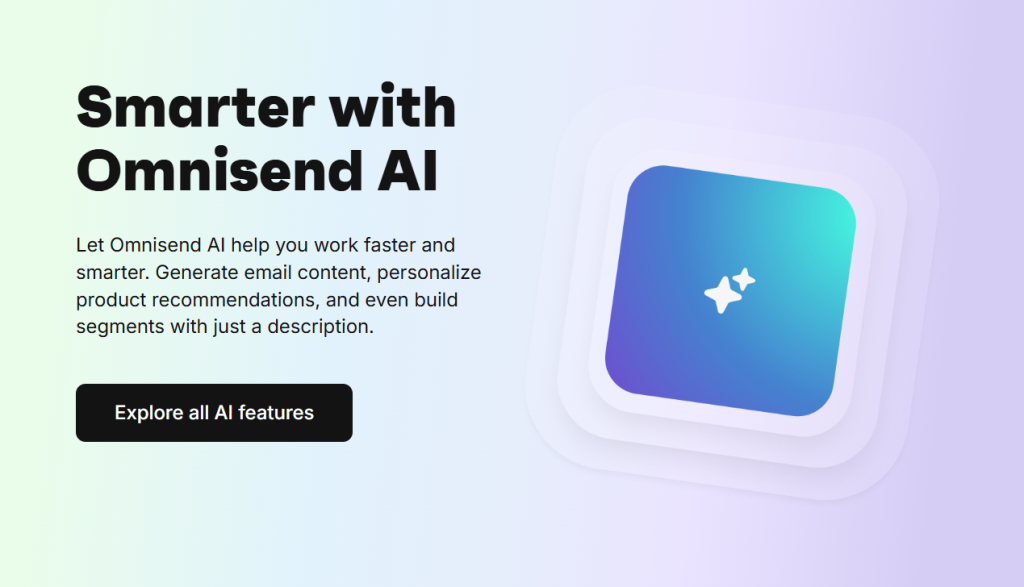
Omnisend’s Brand Assets AI feature pulls fonts, logos, and colors directly from your connected store and applies them automatically across templates, automations, and forms, cutting down the manual design work of keeping every touchpoint on-brand. Campaign Booster and the platform’s AI-powered help widget round out the AI layer, assisting with subject-line and content suggestions and answering setup questions inside the app rather than routing every question to a support ticket.
Pricing, Plans, and Package Structure
Omnisend prices around contact count rather than seats, and bundles email and web push into the plan price while billing SMS separately (except on Pro, where SMS credits equal to your subscription cost are included). Figures below are approximate ranges based on entry-level contact tiers — Omnisend’s pricing scales up with list size, so confirm your exact tier’s cost on the live pricing page before committing.
| Plan | Approx. Price | Limits | Best For |
|---|---|---|---|
| Free | $0 | 250 contacts, 500 emails/mo, 60 SMS, 500 web push | Brand-new stores validating email as a channel |
| Standard | From ~$16/mo (500 contacts) | Sends scale to ~12x contact count/mo; SMS billed separately | Email-first stores not yet running SMS at volume |
| Pro | From ~$59/mo (up to 2,500 contacts) | Unlimited email sends; bundled SMS credits equal to plan cost | Omnichannel brands running email and SMS together |
| Enterprise | Custom quote | Custom limits, dedicated Customer Success Manager | High-volume brands with dedicated marketing teams |
How Omnisend Compares to Alternatives
| Tool | Focus | Starting Price | Best Fit |
|---|---|---|---|
| Omnisend | Ecommerce email + SMS + push, all-in-one | Free / ~$16/mo | Small–mid ecommerce brands wanting value and simplicity |
| Klaviyo | Advanced ecommerce email + data platform | Free / scales fast with contacts | Larger brands wanting deeper analytics, willing to pay more |
| Mailchimp | General-purpose email marketing | Free / paid tiers | Non-ecommerce brands, content-focused newsletters |
| Shopify Email | Native, basic Shopify-only email | Free tier / low-cost sends | Very early Shopify stores not ready for a dedicated tool |
vs. Klaviyo: Klaviyo is the category’s more feature-dense platform, with deeper analytics, predictive metrics, and a larger integration ecosystem — but it gates many advanced features behind higher-priced tiers and typically costs more at equivalent contact volumes, with independent comparisons putting Omnisend roughly 35% cheaper for a similar list size. Brands migrating from Klaviyo to Omnisend cite cost as the main driver, and several report comparable automation results after the switch; brands that specifically need Klaviyo’s deeper predictive analytics or its more extensive app ecosystem may find the trade-off isn’t worth it.
vs. Mailchimp: Mailchimp is a general-purpose email platform that works across industries but treats ecommerce as one use case among many, and its free-tier automation was significantly scaled back in 2025 — a change that pushed a wave of ecommerce users toward more store-specific tools. Omnisend’s ecommerce-native automations, product syncing, and bundled SMS give it a clear edge for stores specifically, while Mailchimp remains a reasonable choice for brands that need broader content-marketing features beyond transactional and lifecycle email.
vs. Shopify Email: Shopify’s native email tool is a fine starting point for a brand-new store sending its first few campaigns, but it lacks the multi-step automation builder, SMS integration, and behavioral segmentation that actually drive the retention revenue ecommerce brands rely on. Most stores outgrow Shopify Email within their first few months and move to a dedicated platform like Omnisend once they need real abandoned-cart and win-back automation.
Pros and Cons
What Merchants Love
Genuinely fast setup: connecting a store and launching a first automation typically takes 15–30 minutes, and users consistently describe the interface and email builder as intuitive even for non-technical store owners.
Strong value at the price point: reviewers on Capterra and G2 repeatedly cite Omnisend as delivering a lot of capability for the cost, especially since billing is based on active subscribers rather than total list size.
Support that actually responds fast: 24/7 live chat with sub-three-minute average response times shows up as a recurring positive across Trustpilot, Capterra, and TrustRadius reviews, including on the free plan.
Segmentation that plugs into ad platforms: syncing Omnisend segments directly into Google and Meta ad audiences removes a manual export step that a lot of competing tools still require.
Limitations Worth Knowing
Support experiences aren’t universally positive: alongside the strong average, some Trustpilot reviewers report frustrating experiences with account suspensions or campaign pauses triggered by automatic spam-protection systems, with limited recourse to get a clear explanation quickly.
SMS pricing is a separate, easy-to-underestimate cost: outside the Pro plan’s bundled credits, SMS is billed per message and varies by country, and brands that lean heavily on text messaging can see that line item add up faster than expected.
No lead-scoring or CRM-style automation: this is a deliberate trade-off given Omnisend’s ecommerce focus, but B2B or service-based businesses looking for CRM-adjacent lead nurturing won’t find it here.
Push notifications default too aggressively: the opt-in prompt fires immediately on page load out of the box, which several reviewers find intrusive until the trigger timing is manually adjusted.
Reporting and template complaints persist: some reviewers want deeper analytics and more modern template options than the current library offers, particularly agencies managing multiple client accounts side by side.
Who Should Use Omnisend
New Shopify or WooCommerce stores: the Free plan is genuinely capable enough to launch a welcome series and abandoned-cart flow at zero cost — start here and let real revenue data justify the upgrade to Standard.
Growing ecommerce brands running email and SMS together: Pro’s bundled SMS credits make the combined channel math favorable for stores actively using text alongside email, not just email alone.
Agencies managing multiple ecommerce clients: the flat, feature-complete pricing across tiers and fast onboarding make it straightforward to stand up a new client account quickly without relearning a different feature set per plan.
Brands migrating off Klaviyo for cost reasons: if Klaviyo’s pricing has outgrown your list-size budget but you still want ecommerce-native automation, Omnisend is the most directly comparable, lower-cost landing spot.
Who should look elsewhere: B2B companies or service businesses needing CRM-style lead scoring, and enterprise brands that need the deepest predictive analytics and largest third-party app ecosystem, may still be better served by Klaviyo or a dedicated CRM platform.
Getting Started: Step by Step
- Create a free Omnisend account at omnisend.com and connect your Shopify, WooCommerce, or BigCommerce store — this syncs your product catalog and customer list automatically.
- Configure sender information and domain authentication so your campaigns land in the inbox instead of the spam folder from day one.
- Launch your first automation using a pre-built template — welcome series or abandoned cart are the highest-leverage starting points for most stores.
- Adjust the web push opt-in trigger in settings so the permission prompt doesn’t fire immediately on page load.
- Design your first campaign using the drag-and-drop builder and the Product Picker to pull in live inventory and pricing.
- Set up basic segmentation and sync your top segments into Google and Meta ad audiences for consistent retargeting.
- Review the Health Check dashboard after your first 30 days and upgrade to Standard or Pro once contact volume or SMS needs outgrow the free tier.
Tips for Getting Maximum Value
Don’t skip domain authentication before your first send — deliverability problems traced back to unauthenticated sending domains are one of the most common early mistakes new users make, and they’re avoidable in under ten minutes during setup. Treat the free plan as a real test, not a placeholder: run your welcome series and abandoned-cart flow long enough to see actual revenue attribution before deciding whether Standard is worth the upgrade. If SMS is part of your plan, run the numbers on Pro’s bundled credits against Standard’s pay-as-you-go SMS pricing at your expected message volume — the crossover point where Pro becomes cheaper happens earlier than most merchants assume. Use the Customer Lifecycle Map early rather than after your list has grown large and messy; it’s far easier to build targeted win-back and loyalty flows when you can still see individual segments clearly. And if you hit a support issue involving a paused campaign or spam-complaint trigger, ask directly for the specific reason and message ID rather than accepting a generic response — reviewers who escalated clearly tended to get faster resolutions than those who didn’t.
Future Outlook and Final Assessment
Email marketing remains one of the highest-ROI channels in ecommerce — averaging around $36 back for every $1 spent industry-wide, and climbing to roughly $45:1 in retail specifically — and Omnisend’s continued investment in AI features like Brand Assets and its help widget suggests the company is betting on reducing manual setup time as its next competitive edge, rather than chasing feature parity with Klaviyo’s more analytics-heavy roadmap. That focus keeps Omnisend firmly positioned as the practical, budget-conscious choice rather than the most powerful one. The honest gaps — occasional support friction around automated account protections, template variety, and reporting depth for agencies managing many accounts — are real, but they’re modest relative to the platform’s core strength: getting ecommerce-specific automation live fast, at a price that scales sensibly with a growing store.
Conclusion
Omnisend earns its place as one of the most practical, ecommerce-native marketing platforms available in 2026 — genuine automation depth, unified email/SMS/push in one bill, responsive support, and a free tier generous enough to actually validate the channel before you spend anything. It won’t replace a full CRM for B2B lead management, and support experiences around automated account protections aren’t universally smooth, but for the core job — turning store behavior into automated, revenue-driving campaigns — it delivers real value at a fair price. Whichever platform you choose, the goal we chase with every review on this site stays the same: helping you make everything easy.
Ready to turn your store’s data into automated revenue?
Explore more honest reviews, tutorials and tool comparisons to find the right tech for the way you work and live — at AI Solutes, where we make everything easy.
👉 Open Free Account: https://ai-solutes.com/omnisend
👉 Our YouTube Channel: youtube.com/@ai-solutes
👉 Our Facebook Fanpage: Facebook
👉 Our X (Twitter): @AISolutes
- Discover Oakstone Publishing CME in 2026: Practical Reviews, Board Prep, and Modern Online Learning
- Mentimeter
- Discover Why Hostinger Dominates Web Hosting in 2025: AI-Powered Features, Pricing, and Migration Guide
- Beautiful.AI
- Does Spocket Enhance Daily Travel? Analyzing the Spocket Smart E-Mobility Solution