If you’ve ever tried to spin up an H100 on AWS and watched the quote take a phone call and a week of back-and-forth, you already understand why RunPod exists. RunPod is a GPU cloud built specifically for AI workloads — rent an NVIDIA GPU by the second, run your training job or inference API, and shut it down without a sales contract in sight. Founded in 2022, RunPod has grown to serve over 300,000 developers, crossed roughly $120M in annual recurring revenue in January 2026, and offers 30-plus GPU models across on-demand pods, serverless endpoints, and multi-node clusters — with entry-level cards from around $0.24 an hour and flagship B200s in the single digits per hour.
For indie developers, ML researchers, and AI startups who need real GPU horsepower without a long-term enterprise commitment, that pricing and flexibility is a genuine unlock. This 2026 review walks through what RunPod actually offers, how Pods and Serverless differ, the full pricing picture across GPU tiers, how it compares to Vast.ai, Lambda Labs, and the big clouds, the honest reliability concerns real users report, and exactly who should (and shouldn’t) build on it.
RunPod Review 2026: The Developer-First GPU Cloud That Prices AI Compute by the Second
Overview and Background
RunPod is a GPU cloud platform purpose-built for AI training and inference, founded in 2022 by Zhen Wang. Rather than treating GPUs as one product line among hundreds — the way AWS, Google Cloud, and Azure do — RunPod’s entire platform is designed around a single job: getting developers from an idea to a running model as fast as possible, without procurement friction or long commitments. It has scaled quickly on that focus, reportedly reaching $120M in annual recurring revenue by January 2026 and serving 300,000-plus developers across 30-plus global regions.
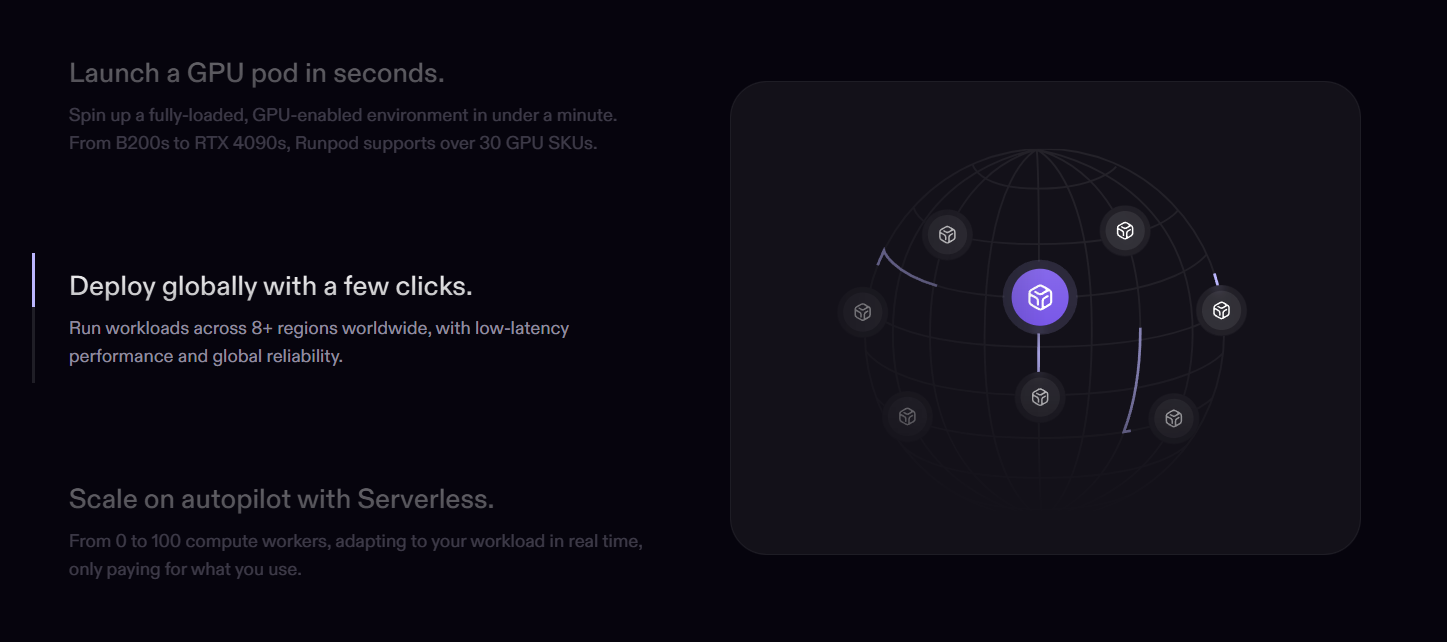
The platform splits into three core compute models. GPU Pods are dedicated, on-demand container instances you control directly — the closest analog to renting a traditional VM, except billed per second. Serverless GPU Endpoints auto-scale from zero to many workers based on request volume, ideal for inference APIs with unpredictable traffic. Instant Clusters spin up multi-node GPU clusters with private interconnect in minutes, for distributed training and large-scale simulations that a single GPU can’t handle. In 2026, RunPod added GA Slurm Clusters for production-ready HPC workloads and Bare Metal options for teams that want dedicated hardware with maximum control.
Why RunPod Stands Out in 2026
Genuinely usage-based pricing, no idle costs: Everything bills by the second (Pods) or the millisecond (Serverless). Stop your workload and billing stops — a meaningful difference from cloud GPU instances that charge for reserved capacity whether or not you’re actively computing.
Zero egress and ingress fees: Moving data in or out of RunPod costs nothing extra, which matters a lot for teams regularly pulling large model checkpoints or datasets — a cost that quietly adds up on AWS and GCP.
FlashBoot cold-start optimization: RunPod’s serverless workers are engineered for sub-2-second (and, on many endpoints, sub-200ms) cold starts, closing a gap that has historically made serverless GPU inference impractical for latency-sensitive applications.
RunPod Hub and 50-plus one-click templates: Prebuilt templates for PyTorch, vLLM, ComfyUI, and other common ML frameworks mean you can go from account creation to a running model in a couple of minutes, without hand-building a Docker image first.
A genuinely wide GPU catalog: From budget RTX cards for experimentation to H100, H200, and B200 for serious training runs, RunPod covers 30-plus GPU models — letting a solo developer and a well-funded startup both work within the same ecosystem.
Instant Clusters and Slurm for distributed workloads: Multi-node training that used to require dedicated infrastructure engineering can now be spun up in minutes with InfiniBand interconnect, with pay-as-you-go billing rather than a fixed cluster reservation.
Rapid, transparent SKU-level price drops: RunPod publishes updated GPU pricing directly on its console and pricing page as rates change, rather than burying discounts behind a sales conversation — a meaningfully different experience from the big three clouds’ GPU quote process.
Key Features and Technology
RunPod’s product line maps cleanly onto different stages of an AI workload — experimentation, training, and production inference.
GPU Pods — Dedicated, On-Demand Containers
Pods are the closest thing to a traditional cloud VM: you pick a GPU, choose Community or Secure Cloud, deploy a Docker image or a prebuilt template (PyTorch, JupyterLab, ComfyUI, Stable Diffusion, and dozens more), and get direct container control with SSH access. Billing is per second, and pods can be paused or terminated the moment a job finishes. This is the workhorse mode for fine-tuning, notebook-based experimentation, and any workload where you want to keep the environment running between steps.
Serverless GPU Endpoints — Auto-Scaling Inference
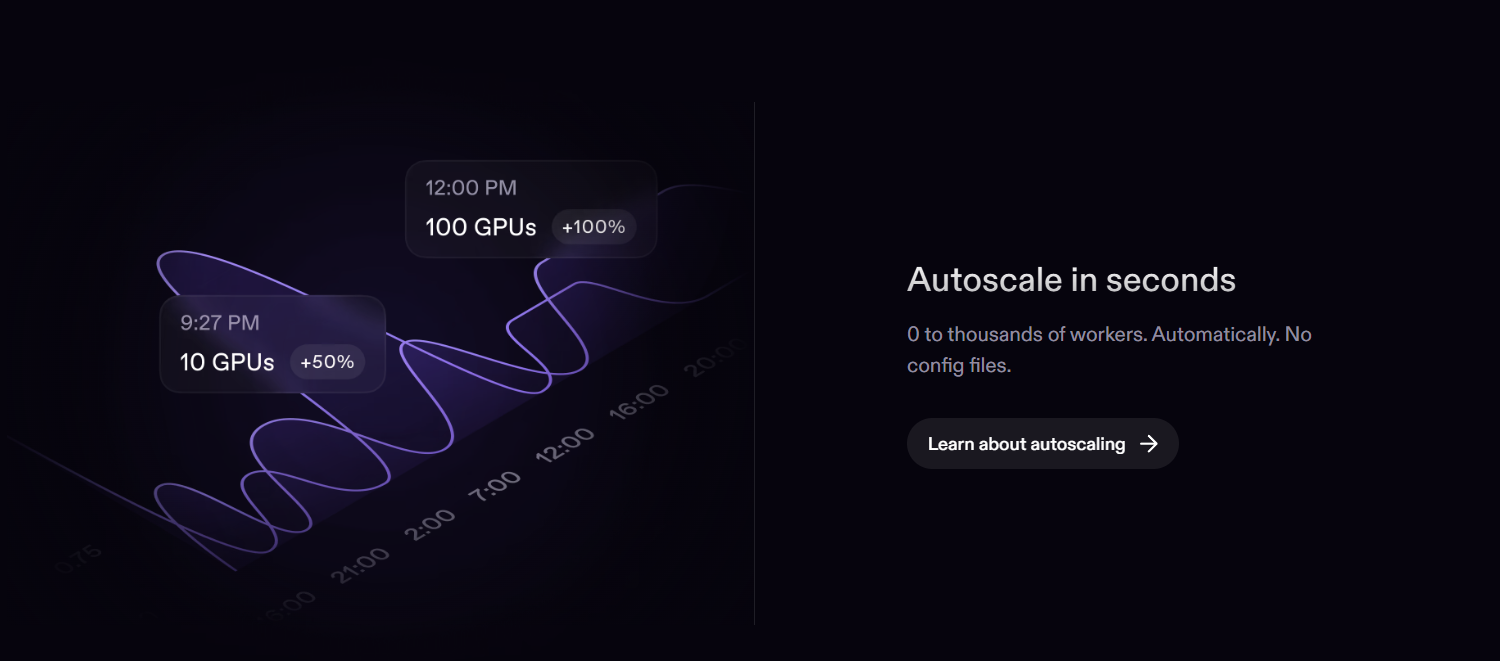
Serverless runs containerized inference behind an API and scales workers from zero up based on request volume, billing per millisecond of actual compute. You can keep a pool of always-on “active” workers pre-warmed for instant response, or rely purely on “flex” workers that spin up on demand — a trade-off between paying for standby capacity and accepting occasional cold-start latency. This is the mode most teams use for production inference APIs with variable or bursty traffic.
Instant Clusters, Slurm, and Bare Metal — Distributed and Dedicated Compute
For workloads a single GPU can’t handle, Instant Clusters provision multi-node GPU clusters with private InfiniBand interconnect in minutes rather than the days a manually provisioned HPC cluster typically takes. GA Slurm Clusters extend this to production-ready HPC scheduling for distributed training and large-scale simulation, still with pay-as-you-go billing and no idle cost. Bare Metal is the newest addition — dedicated physical GPU servers for teams that want maximum control and predictable long-term costs rather than shared infrastructure.
RunPod Hub — Templates and One-Click Deployment
The Hub is RunPod’s template marketplace: 50-plus prebuilt, one-click deployment options covering PyTorch, vLLM, ComfyUI, Stable Diffusion, JupyterLab, and other common ML frameworks. Instead of writing and debugging a custom Dockerfile before you’ve even started your actual work, you pick a template, deploy, and land in a ready-to-use environment within a couple of minutes. Community-maintained templates exist alongside RunPod’s own official images, though official templates are generally the more reliable starting point.
Pricing, Plans, and Package Structure
RunPod has no subscription tiers in the traditional sense — it’s pure usage-based pricing by GPU model, cloud tier, and compute mode, plus separate storage charges. Rates update fairly often (RunPod’s own release notes mention periodic across-the-board GPU price cuts), and figures vary somewhat between independent trackers depending on when they were last checked, so treat the numbers below as a well-sourced approximate range and confirm the live rate on RunPod’s pricing page before committing budget to a job.
| GPU / Mode | Approx. Price | What You Get | Best For |
|---|---|---|---|
| Entry GPUs (RTX 2000 / A5000 class) | ~$0.24–0.39/hr | Lower-VRAM cards on Community Cloud | Small inference workloads, experimentation, learning |
| RTX 4090 | ~$0.59–0.69/hr | 24GB VRAM, strong for image/video generation and small-model fine-tuning | Stable Diffusion, ComfyUI workflows, indie developers |
| A100 (40–80GB) | ~$1.64–2.72/hr | High-VRAM training and inference workhorse | Mid-size LLM fine-tuning, production inference |
| H100 | ~$2.39–2.89/hr | Top-tier training performance; ~20% off with a 3-month reserved commitment | Serious LLM training, large-scale fine-tuning |
| H200 / B200 / B300 | ~$4.39–7.39/hr | Latest-generation flagship compute for frontier-scale workloads | Well-funded teams training large foundation models |
| Serverless (H100 / A100 / 4090) | ~$1.10–4.55/hr equivalent | Per-millisecond billing, scale-to-zero, FlashBoot cold starts | Production inference APIs with variable traffic |
How RunPod Compares to Alternatives
| Factor | RunPod | Vast.ai | Lambda Labs | AWS / GCP |
|---|---|---|---|---|
| Pricing model | Per-second Pods + per-ms Serverless | Marketplace bidding, often slightly cheaper | Simple hourly, low-friction | Complex, often 60–80% pricier for GPUs |
| Serverless inference | Yes — FlashBoot, sub-200ms target | Limited | Limited | Yes, but heavier setup and higher cost |
| Reliability / SLA | Strong on Secure Cloud; mixed on Community | Variable, pure marketplace hosts | Generally strong, capacity can be limited | Enterprise-grade SLAs |
| Setup friction | Low — templates, self-serve signup | Low, but more manual host selection | Low | High — quotas, sales contact for GPU capacity |
| Best for | Balance of price, breadth, and self-serve speed | Absolute lowest price, tolerant of variability | Research teams wanting simplicity | Enterprises needing guaranteed capacity and compliance |
vs. Vast.ai: Vast.ai’s marketplace-bidding model is often a shade cheaper on the same GPU (data from early 2026 put an A100 PCIe at $0.52/hr on Vast.ai versus $0.60/hr on RunPod), but RunPod’s platform — Serverless, Instant Clusters, the Hub template library — is considerably more built-out for teams that want infrastructure, not just raw capacity.
vs. Lambda Labs: Lambda is research-friendly with straightforward rentals and competitive egress pricing, but GPU capacity can be more limited during high-demand periods. RunPod’s edge is breadth — doing both dedicated Pods and true auto-scaling Serverless under one platform, which Lambda doesn’t match as directly.
vs. AWS / GCP: The hyperscalers remain the right call for enterprises that need guaranteed reserved capacity, deep compliance certifications, and account-managed support at massive scale. For everyone else, RunPod’s GPU pricing runs 60–80% lower for equivalent hardware and skips the quota requests and sales calls entirely — a real advantage for teams that want to start computing today.
Pros and Cons
What Developers Love
Genuinely low prices for real GPU horsepower: Access to H100s, A100s, and top-tier NVIDIA hardware at rates 60–80% below the big clouds, with no long-term contract required.
Fast time-to-first-model: Between prebuilt templates and per-second billing, users regularly report going from signup to a running model in under two minutes.
Serverless that actually feels fast: FlashBoot’s sub-200ms cold-start target on many endpoints makes serverless GPU inference practical for latency-sensitive applications in a way older serverless GPU offerings weren’t.
No egress fees: Zero-cost data transfer out is a real, recurring saving for teams moving large model weights and datasets regularly.
Strong documentation and self-serve UX: Multiple independent reviewers and user reviews single out the console UI and documentation quality as genuinely better than typical cloud-provider defaults.
Limitations Worth Knowing
Community Cloud reliability is genuinely mixed: Verified reviews describe pods that fail to start while still billing, wasted credits, and variable hardware quality — a real risk for time-sensitive or production workloads on the cheaper tier specifically.
Secure Cloud CPU performance complaints: Multiple reviewers report outdated or lower-clock-speed CPU hardware on some Secure Cloud instances, which can bottleneck mixed CPU/GPU training pipelines even on the higher-priced tier.
GPU availability constraints during peak demand: Popular GPU types, particularly on Community Cloud, can be hard to secure when demand spikes, forcing you to wait or switch regions.
Policy and pricing changes have frustrated some long-time users: At least one documented case involved RunPod changing spot-pricing availability and access with limited notice, which a segment of its user base read as reducing product value without warning — worth factoring in if your workflow depends on a specific pricing mode staying stable.
Support quality varies by tier: Standard-tier support is reported as slower than the responsive experience Secure Cloud and higher-spend customers describe — budget-tier users should expect self-service documentation to be the primary support channel.
Who Should Use RunPod
Indie developers and researchers fine-tuning open-source models or running Stable Diffusion / ComfyUI workflows get the best value-to-cost ratio on Community Cloud with entry-level GPUs, where occasional interruptions are a fair trade for the lowest prices.
AI startups building inference APIs should look at Serverless GPU Endpoints on Secure Cloud — the combination of scale-to-zero billing and FlashBoot cold starts can meaningfully undercut AWS or GCP inference costs while still meeting production latency needs.
ML teams doing distributed training benefit most from Instant Clusters or GA Slurm Clusters, spinning up multi-node InfiniBand compute in minutes instead of waiting on a manually provisioned HPC environment.
Freelance AI engineers billing clients by the project can pass through RunPod’s per-second pricing directly, avoiding the need to eat idle-capacity costs from a reserved cloud instance between jobs.
Enterprises needing guaranteed reserved capacity, strict SLAs, or full managed services are the clearest case where RunPod is the wrong fit — the platform trades white-glove enterprise support for low prices and self-serve flexibility, and a bigger, more managed GPU cloud will serve that need better.
Getting Started: Step by Step
- Create a RunPod account and load a small amount of credit — $5–10 is enough to test a workload end to end.
- Choose your compute mode: a Pod for interactive development, Serverless for an API endpoint, or a Cluster for distributed training.
- Pick a GPU and cloud tier: start on Community Cloud for cheap experimentation, or Secure Cloud if reliability matters from day one.
- Deploy from a template in the RunPod Hub (PyTorch, vLLM, ComfyUI, and dozens more) rather than building a custom Docker image from scratch.
- Attach a network volume if you need persistent storage for model checkpoints or datasets that should survive across pod restarts.
- Run and monitor your job, using the console’s billing view to track per-second spend in real time.
- Migrate to Serverless and Secure Cloud once your workload moves from experimentation to a production-facing inference API.
Tips for Getting Maximum Value
The single biggest lever for controlling cost on RunPod is matching cloud tier to workload risk: keep cheap, interruptible experimentation on Community Cloud, and reserve Secure Cloud spend for anything customer-facing where a failed pod actually costs you money or trust. If you’re running H100s or similar flagship GPUs for an extended training run, check whether a reserved commitment applies — a 3-month commitment has been documented cutting H100 rates by roughly 20%. Watch your network-volume storage bill separately from compute; it keeps accruing even when a pod is stopped, so clean up checkpoints and datasets you no longer need. For inference workloads, benchmark both an always-on “active worker” Serverless configuration and a pure scale-to-zero “flex worker” setup against your real traffic pattern before picking one — the cost and latency trade-off is workload-specific, not universal. And because pricing updates fairly frequently across GPU SKUs, re-check the live pricing page before locking in a monthly budget estimate rather than relying on a screenshot from a few months back.
Future Outlook and Final Assessment
Demand for accessible GPU compute keeps climbing alongside the broader AI boom, and RunPod’s 2026 product direction — GA Slurm Clusters, Bare Metal, SOC 2 Type II certification on Secure Cloud, new regions like Fukushima for APAC data residency — reads as a platform actively working to close the gap with hyperscalers on reliability and compliance while keeping its price advantage intact. The honest caveats remain real, though: the reliability spread between Community and Secure Cloud is genuine and shows up repeatedly in independent user reviews, and at least one pricing-policy change has left a visible mark on trust among long-time users. Anyone budgeting for production workloads should weight those signals seriously rather than assuming lowest-tier pricing everywhere.
Conclusion
RunPod earns its place on the shortlist for anyone who needs real GPU compute without the procurement overhead of a hyperscaler. The pricing is genuinely competitive, the product surface — Pods, Serverless, Clusters, Bare Metal — covers the full range of AI workloads a growing team is likely to run, and the self-serve experience is faster than almost anything a traditional cloud provider offers. Just go in with clear eyes about the Community-versus-Secure Cloud trade-off, and route anything production-critical to the higher tier from the start. For developers and small AI teams researching cost-effective GPU infrastructure, RunPod deserves a real trial run against your own workload before you commit budget elsewhere. At AI Solutes, we make everything easy — including cutting through GPU-cloud marketing to tell you what a platform actually delivers.
Ready to spin up your first GPU without the enterprise sales call?
Explore more honest reviews, tutorials and tool comparisons to find the right tech for the way you work and live — at AI Solutes, where we make everything easy.
👉 Open Free Account: https://ai-solutes.com/runpod
👉 Our YouTube Channel: youtube.com/@ai-solutes
👉 Our Facebook Fanpage: Facebook
👉 Our X (Twitter): @AISolutes
- Synthesia
- Ditch High Bounce Rates and Protect Your Sender Reputation with ZeroBounce?
- Unlock Genius AI for Enterprise: Features, Explainable Workflows, and Transformation in 2025
- Cảnh giác web dính virut khi khôi phục xong không gỡ plugin Duplicator
- What If You Could Delegate Daily Tasks to a Dedicated AI Team? Inside Sintra AI’s Automation Suite