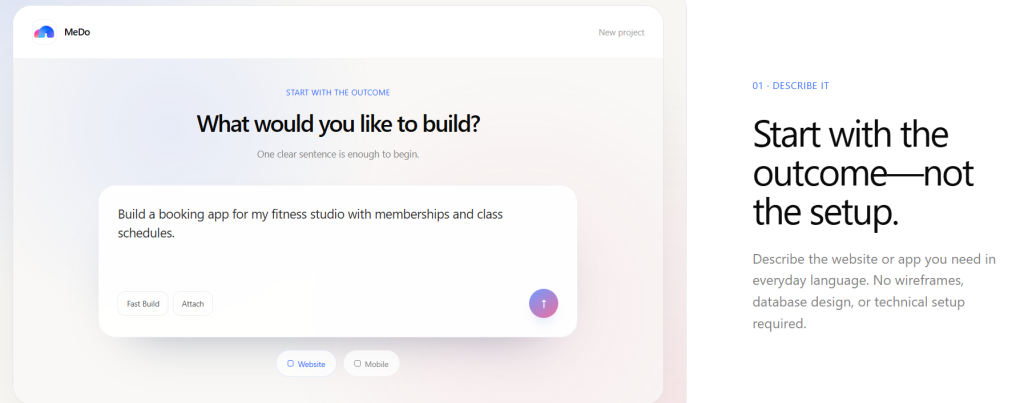
The “vibe coding” trend has already turned a text prompt into a decent-looking landing page. What most tools still struggle with is the unglamorous other half of a real app: the database, the backend logic, user authentication, and hosting that actually makes it work. MeDo — an AI-powered no-code platform backed by Baidu AI Cloud — was built specifically to close that gap, generating the full stack (frontend, backend, database, and integrations) from a single plain-language prompt, then deploying it instantly with a live URL. With a genuinely low entry price starting at $20/month for 2,000 credits, 100 free daily credits to experiment with, and code export options that avoid hard vendor lock-in, MeDo has positioned itself as one of the more budget-friendly ways for non-technical founders and small teams to ship a working prototype fast. This 2026 review covers what MeDo actually does, its full credit-based pricing, how it stacks up against Lovable and Bolt.new, the honest caveats (including a few worth taking seriously), and exactly who should try it.
For solo founders, product teams prototyping quickly, and internal tool builders who don’t want to hire a developer for a weekend MVP, the appeal is obvious. Let’s look at what you’re actually getting.
MeDo Review 2026: Baidu’s Low-Cost AI App Builder for Full-Stack Prototypes
Overview and Background
MeDo is an AI-powered no-code app builder developed and backed by Baidu AI Cloud, publicly launched in November 2025. The platform’s core promise is straightforward: describe an app idea in plain language (text, files, or voice), and MeDo’s agentic AI generates a production-ready full-stack application — user interface, backend logic, connected database, authentication, and third-party integrations — deployed directly to Baidu Cloud with a shareable link, usually within minutes rather than the days or weeks manual development would take. A visual, drag-and-drop editor lets you refine layout and logic afterward without writing code.
Because MeDo is a young product, independent third-party review coverage on sites like G2 or Capterra is still sparse, and most available commentary comes from AI-tool directories and early hands-on write-ups rather than a large base of verified long-term users. That’s a normal state for a product six months into a public launch, but it does mean buyers are relying more on documented policy and hands-on testing than a deep review history — worth factoring into how much weight you give any single glowing write-up, including this one.
Why MeDo Stands Out in 2026
Genuinely low entry price: at $20/month for 2,000 credits (roughly 133 queries), MeDo’s cheapest paid tier undercuts Lovable and Bolt.new’s $25/month entry points, and the 100 free daily credits mean meaningful experimentation is possible before spending anything.
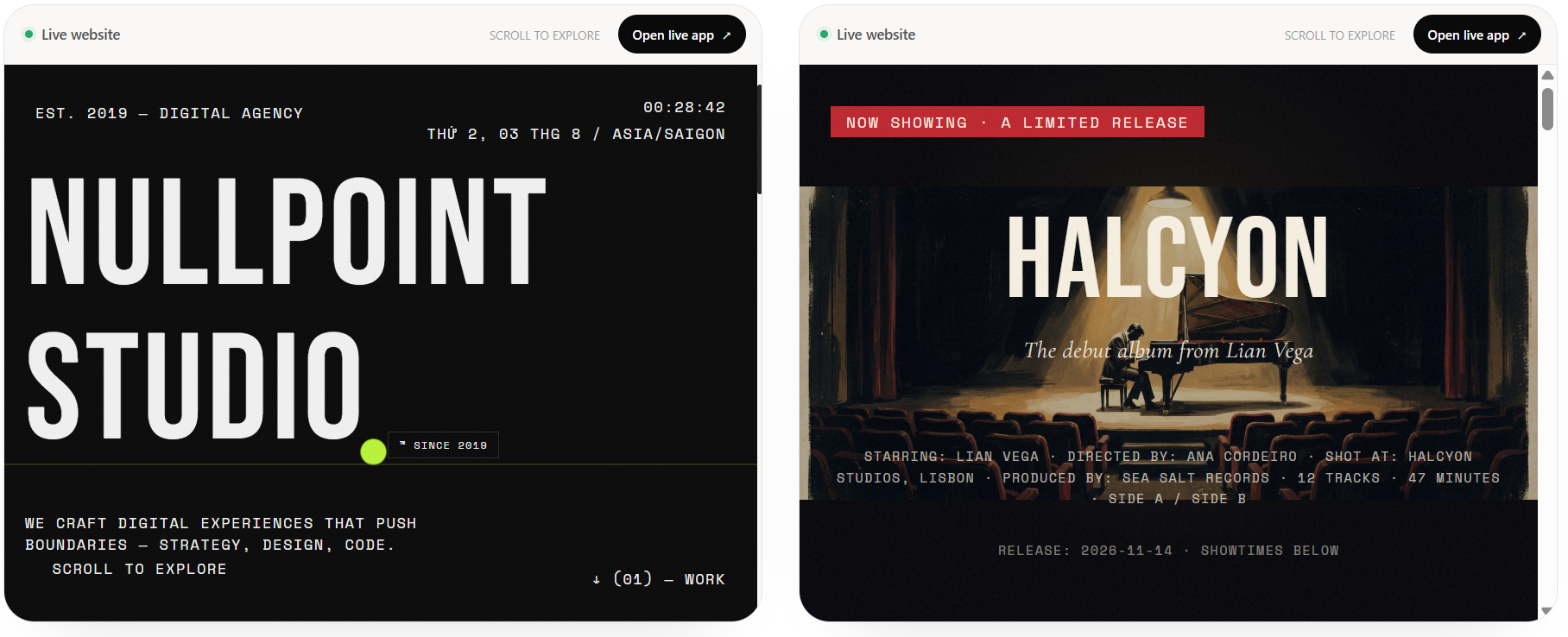
True full-stack generation, not just frontend: MeDo generates the database, backend logic, and integrations alongside the UI in one pass, rather than requiring you to separately wire up a backend service — a meaningful time-saver over frontend-only AI builders.
Credit carryover softens a slow month: unused subscription credits convert to carryover credits at the end of a billing cycle and remain valid for one additional month, which is more forgiving than platforms where unused capacity simply evaporates.
Code export reduces lock-in: the ability to download source code (70 credits) means a prototype built on MeDo isn’t permanently trapped on the platform — teams can iterate elsewhere or hand the codebase to engineers once an idea validates.
A built-in Marketplace and social credit-earning loop: publishing an app, having it copied, or getting likes all earn extra free credits, which is a genuinely useful way for active builders to offset ongoing costs — publishing alone earns 40 credits, with a 400/day cap across the community.
A real referral program: inviting a friend who successfully signs up earns 300 credits per invite (capped at 5,000/day), giving builders a straightforward way to reduce their own costs by bringing others onto the platform.
Key Features and Technology
MeDo’s platform breaks down into four practical areas: generation, editing, integrations, and publishing.
Prompt-to-App Generation
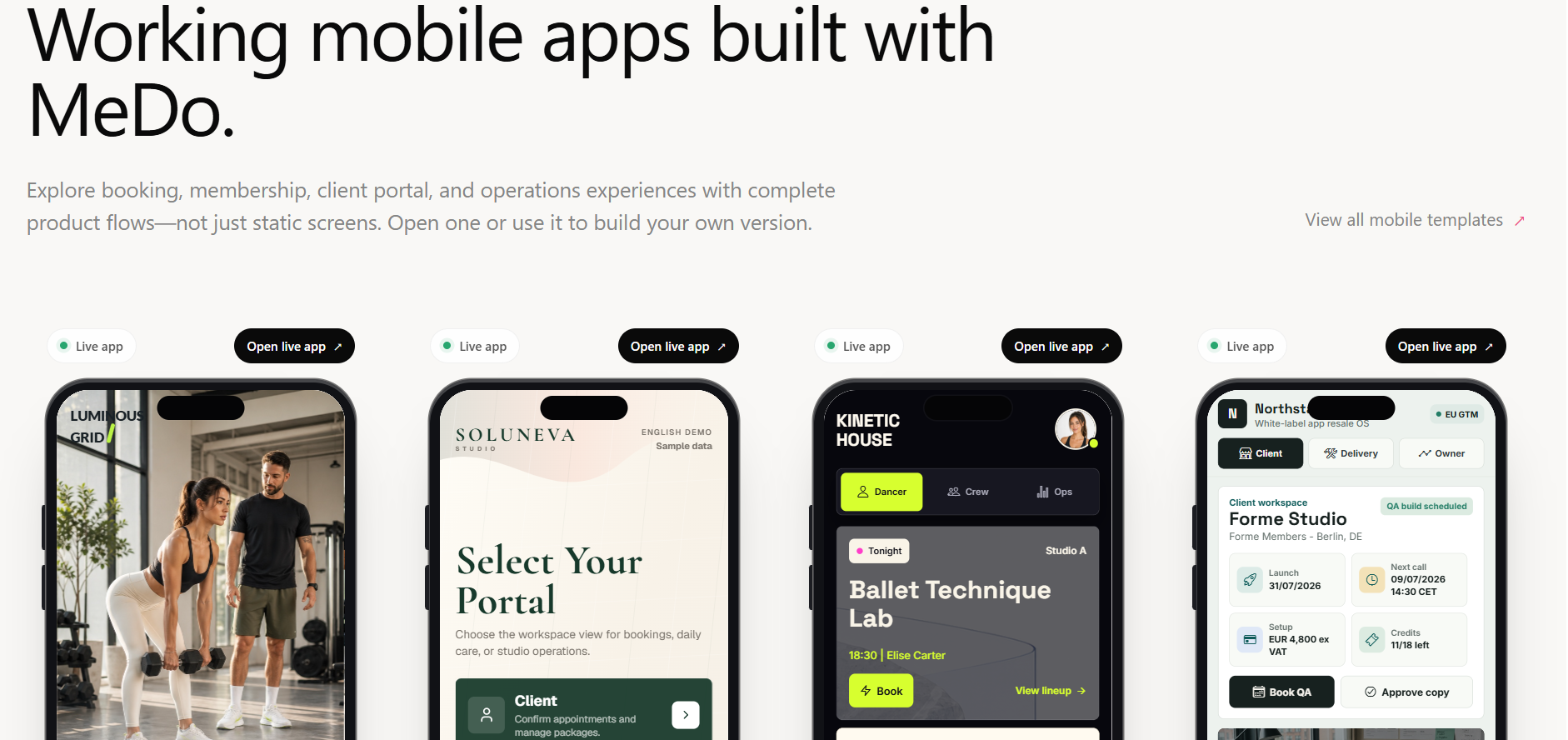
Describe an app in a single prompt — text, uploaded files, or voice — and MeDo scaffolds pages, data models, routes, and UI components automatically. The platform supports multiple app categories out of the box: education, personal pages/websites, marketing, productivity/enterprise tools, e-commerce, utilities, games, and surveys.
Visual Editing and Debugging
A drag-and-drop WYSIWYG editor lets you rearrange components, bind data fields, and adjust layout after generation without touching code. Built-in debugging and auto-fix features catch common errors, and screenshot-based editing lets you point at what you want changed visually rather than describing it purely in text.
Integrations and Skills
Stripe payment integration, custom skills/plugins, and a general task system extend generated apps beyond the basics. Each plugin generation costs 5 credits, and some skills carry a daily free-usage quota before consuming paid credits.
Publishing and Backend Management
Publishing an app to the platform costs 20 credits, and keeping the backend actively enabled costs 2 credits per app per day — a genuinely small recurring cost, but one worth factoring into your monthly credit budget if you’re running several live apps simultaneously rather than one.
Pricing, Plans, and Package Structure
MeDo runs entirely on a credit system rather than traditional feature-gated tiers — every paid plan gets the same core capabilities, and higher tiers simply provide more monthly credits at a progressively better per-credit rate. New users get 300 credits on registration plus 100 free credits daily. Key actions cost credits directly: a query (one conversation turn) costs 15 credits, publishing an app costs 20, generating a plugin costs 5, and downloading source code costs 70.
| Monthly Price | Credits/Month | Approx. Queries | Best For |
|---|---|---|---|
| $20 | 2,000 | ~133 | Solo builders, light prototyping |
| $40 | 4,000 | ~266 | Regular iteration on one project |
| $80 | 8,000 | ~533 | Active builders, multiple small apps |
| $150–$250 | 16,000–28,000 | ~1,066–1,866 | Teams shipping multiple apps, agencies |
| $400–$2,000 | 48,000–260,000 | ~3,200–17,333 | Organizations building at scale |
Upgrading mid-cycle triggers a pro-rated charge for the remaining days plus pro-rated bonus credits; downgrades take effect at the start of the next billing cycle without clawing back already-granted credits. There’s no traditional free-forever tier beyond the daily free credit allowance, and — importantly — subscription credits are explicitly non-refundable per MeDo’s official documentation, so it’s worth testing thoroughly on free credits before committing to a paid plan.
How MeDo Compares to Alternatives
| Platform | Entry Price | Backend Approach | Standout Strength |
|---|---|---|---|
| MeDo | $20/mo | Generated automatically, hosted on Baidu Cloud | Lowest entry price, credit carryover, Marketplace credit-earning |
| Lovable | $25/mo | Mature Supabase integration | Best-in-class guided experience for non-technical founders |
| Bolt.new | $20–25/mo | Bolt Cloud (database, auth, storage, hosting) | Fastest iteration loop, full browser IDE for developers |
vs. Lovable: Lovable has a longer track record, a more mature Supabase-based backend integration, and a much larger, more established review base after reaching $20M ARR in two months. MeDo’s entry price is lower and its credit-earning Marketplace is a genuine differentiator, but Lovable remains the safer choice for non-technical founders who want the most proven, polished guided experience and don’t mind paying a bit more for that maturity.
vs. Bolt.new: Bolt.new offers a genuine in-browser IDE with direct code access and a faster iteration loop, which developers who want to see and edit generated code directly will prefer. MeDo leans more no-code and visual, making it arguably more approachable for founders with zero coding background, though Bolt Cloud’s backend capabilities have closed much of the gap MeDo’s full-stack generation used to hold as a unique advantage.
Pros and Cons
What Users Like
Genuinely fast prototype generation: early hands-on write-ups consistently confirm working prototypes in minutes rather than the days or weeks manual development typically takes, matching the platform’s core claim.
Real cost advantage for experimentation: the daily free credits and low $20 entry tier make it genuinely cheap to test multiple app ideas before committing serious budget to any one of them.
Full-stack in one pass: reviewers highlight that not needing to separately wire up a backend service is a meaningful time savings over frontend-only builders, especially for founders without backend experience.
Portability through code export: the ability to download and take the generated code elsewhere is repeatedly cited as a meaningful advantage over more closed platforms.
Limitations Worth Knowing
Thin independent review history: as a product roughly six months into public launch, MeDo doesn’t yet have the large base of verified, long-term user reviews that Lovable or Bolt.new have accumulated. Early write-ups are largely positive, but the sample size is small — weigh that accordingly.
Data residency and compliance questions: because MeDo runs on Baidu AI Cloud, teams with strict data residency, GDPR, or export-control requirements should confirm specifics directly with MeDo before using it for anything beyond a public-facing prototype — this is a genuine consideration, not a dismissible detail.
Non-refundable subscription credits: MeDo’s official policy states subscription credits cannot be refunded, so an unhappy first month can’t be walked back financially the way some competitors’ trial periods allow.
Complex, large-scale systems need real engineering review: multiple independent reviewers agree that while MeDo rapidly generates a solid foundation, intricate enterprise requirements still need significant engineering time to review, extend, and harden the generated code — this is normal for the category, not unique to MeDo, but worth setting expectations around.
Who Should Use MeDo
Non-technical founders validating a business idea before hiring a developer will get real value from being able to spin up a working prototype for under $20 and test it with real users.
Product teams building internal tools — dashboards, request forms, small workflow apps — are a strong fit given MeDo’s speed advantage and the low cost of experimenting with multiple internal-tool ideas.
Budget-conscious solo builders and students comparing raw price against Lovable and Bolt.new will find MeDo’s entry tier and generous daily free credits genuinely competitive for light, iterative prototyping.
Organizations with strict data residency or compliance needs should hold off or confirm specific requirements directly with MeDo before building anything beyond a public prototype, given the Baidu AI Cloud infrastructure.
Teams needing enterprise-grade review history before adopting a new vendor may prefer to wait for MeDo’s independent review base to grow, or start with Lovable or Bolt.new where that track record already exists.
Getting Started: Step by Step
- Sign up — register to receive 300 one-time free credits plus 100 free credits per day.
- Describe your app — write, upload a file, or use voice to describe what you want to build in plain language.
- Let MeDo generate the full stack — the AI scaffolds the frontend, backend, and database in one pass.
- Refine in the visual editor — adjust layout, bind data fields, and tweak components without writing code.
- Add integrations as needed — connect Stripe or generate custom plugins/skills for specific functionality.
- Publish — deploy to a live, shareable URL on Baidu Cloud (20 credits per publish).
- Export code if you outgrow the platform — download the source (70 credits) to continue development elsewhere or hand off to engineers.
Tips for Getting Maximum Value
Use your free daily credits to thoroughly test output quality on your specific app idea before subscribing to a paid tier, since subscription credits are non-refundable once purchased. Publish finished prototypes to the Marketplace and share your build process to earn extra free credits (40 per publish), and consider referring collaborators for the 300-credit invite bonus if you’re building actively. Watch the 15-day expiry window on newly earned free credits — plan your building sessions so you’re not letting earned credits lapse unused. If your project involves regulated or sensitive user data, confirm data residency and compliance details directly with MeDo before going beyond a public prototype, given the Baidu AI Cloud backend. And if you outgrow MeDo’s generated backend for a complex production system, budget for engineering time to review and harden the exported code rather than assuming it’s production-ready as-is — this is standard practice across the whole AI app-builder category, not a MeDo-specific gap.
Future Outlook and Final Assessment
AI app builders are one of the most competitive categories in software right now, with Lovable and Bolt.new both crossing tens of millions in annual recurring revenue within months of launch — proof the underlying demand for prompt-to-app tools is real and growing. MeDo’s backing by Baidu AI Cloud gives it real infrastructure muscle behind a genuinely lower price point, and its full-stack-in-one-pass approach and credit-earning Marketplace are meaningful differentiators. The honest caveats are real too: this is a young product without the deep review history of its two biggest competitors, and the Baidu Cloud backend is a legitimate consideration for teams with data residency requirements. Neither of those makes MeDo a bad choice — they make it a choice worth testing on free credits before committing budget.
Conclusion
MeDo earns a real spot in the AI app builder conversation by doing something genuinely useful at a genuinely low price: generating a complete, working full-stack app from a single prompt for less than the cost of a few coffees a month. It isn’t without real caveats — the independent review history is still thin, subscription credits don’t come back once spent, and the Baidu Cloud infrastructure deserves a second look from any team with data residency requirements. For non-technical founders validating an idea, product teams prototyping internal tools, and budget-conscious builders comparing options against Lovable and Bolt.new, MeDo’s free daily credits make it a genuinely low-risk way to find out if it fits your workflow. That’s the whole idea behind AI Solutes, too — we dig through the pricing pages, the fine print, and the real user reviews so you don’t have to, because we believe in helping you make everything easy.
Ready to turn your next idea into a working app?
Explore more honest reviews, tutorials and tool comparisons to find the right tech for the way you work and live — at AI Solutes, where we make everything easy.
👉 Open Free Account: https://ai-solutes.com/medoai
👉 Our YouTube Channel: youtube.com/@ai-solutes
👉 Our Facebook Fanpage: Facebook