Most CRMs force your business into their data model — rigid “Contacts” and “Deals” tables that never quite match how your team actually works. Attio flips that: it’s a relational database at its core, so you build the CRM around your business instead of the other way around. Backed by more than $130 million in funding and used by fast-moving companies like Granola, Modal, and Replicate, Attio has become one of the most talked-about CRMs among startups, venture firms, and go-to-market teams that outgrew spreadsheets but found HubSpot and Salesforce too rigid or too expensive.
With a genuinely usable free plan for up to 3 seats, real-time data enrichment, and AI woven directly into records rather than bolted on as a chatbot, Attio has carved out a distinct position in a crowded CRM market. This 2026 review walks through what Attio actually does well, its full pricing structure (including the credit system that catches a lot of buyers off guard), how it stacks up against HubSpot, Salesforce, and Pipedrive, and who should — and shouldn’t — build their sales stack on it.
Attio Review 2026: The Flexible, AI-Native CRM for Modern Teams
Overview and Background
Attio is a data-driven, AI-native CRM built around a flexible relational database rather than a fixed Contacts-and-Deals schema. Instead of forcing every business into the same rigid structure, Attio lets teams define their own objects — People, Companies, Deals, or entirely custom entities like “Investors,” “Partners,” or “Properties” — and connect them however their actual workflow requires. The interface borrows heavily from Notion and modern data tools: fast, keyboard-friendly, spreadsheet-like views layered on top of a real relational database.
The platform is especially popular with startups, venture capital firms, agencies, and partnership-heavy teams whose workflows don’t map cleanly onto traditional sales pipelines. Real-time contact syncing, automatic data enrichment, and AI-generated fields are treated as core parts of the data layer rather than separate add-ons, which is the angle Attio leans on hardest in its 2026 positioning.
Why Attio Stands Out in 2026
Truly flexible data model: rather than a fixed schema, Attio lets you create custom objects and relationships that mirror your actual business — a venture firm can model deal flow and portco relationships; an agency can model clients, projects, and contractors — without hacking around rigid CRM defaults.
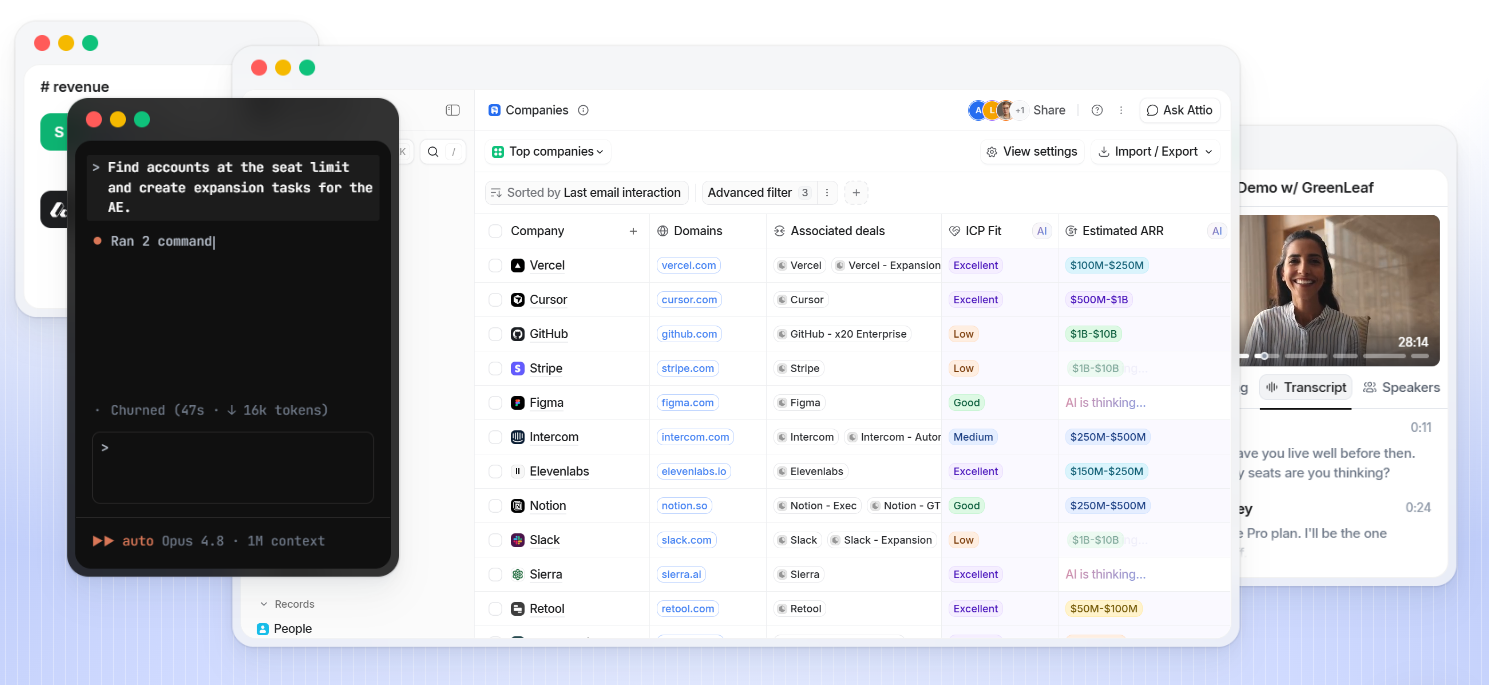
AI built into the data layer: AI attributes let you add fields to any record type that auto-fill using AI — summarizing a company, classifying a contact’s ICP tier, or running a web-research agent to find funding stage or headcount — rather than relying on a separate chat panel bolted onto a legacy interface.
Real-time enrichment and sync: contact and company records update automatically from email and calendar activity, reducing the manual data entry that traditionally eats into a sales rep’s week.
A genuinely usable free tier: unlike CRMs that disguise a 14-day trial as a “free plan,” Attio’s Free tier is permanent, supports up to 3 seats, 50,000 records, and 3 objects — enough for early-stage founders to run real operations on, not just kick the tires.
Developer-friendly ecosystem: a modern REST API, webhooks, an App SDK, and — notably in 2026 — a native MCP server let engineering teams extend Attio or connect it directly into AI agent workflows.
Workflows for orchestrating revenue motions: Attio’s automation layer (Workflows) can trigger actions on record changes, stage transitions, or time-based rules, automating lead assignment, follow-ups, and status updates without leaving the CRM.
Key Features and Technology
Attio’s feature set centers on two things: a flexible data model and high data quality, supported by automation and reporting layered on top.
Custom Objects and Data Model
Object limits scale by plan — Free caps at 3 objects, Plus at 5, Pro at 12, and Enterprise is unlimited. Each object can carry custom attributes, relationship fields to other objects, and record templates, giving teams a genuinely custom data structure rather than a workaround.
AI Attributes and Ask Attio
AI attributes are custom fields that auto-populate using AI — from the Plus plan upward — while “Ask Attio” lets you search and create records using natural language across the workspace. Each AI run consumes workspace credits, and fields update on trigger rather than continuously, which matters for planning around the credit budget.
Call Intelligence and Sequences
Available on Pro and Enterprise, Call Intelligence joins calls, records transcripts, and auto-populates CRM fields from the conversation using templates like MEDDPICC, BANT, and CHAMP. Sequences add multi-step, personalized outreach — a feature that’s notably absent from the Free and Plus tiers.
Enrichment and Email/Calendar Sync
Attio automatically enriches company records (name, description, category, employee count, ARR, funding raised) and people records (name, social profiles, location) using connected email and calendar activity. Email sending and account limits scale by tier — Free allows 200 emails/month and 1 connected account per user, while Pro and Enterprise unlock unlimited sending and multiple accounts per seat.
Reporting and Security
Reporting scales from 3 reports on Free up to 100+ on Enterprise, with funnel reports, historical attributes, and time comparisons unlocked on higher tiers. Enterprise adds single sign-on, SCIM provisioning, advanced access permissions, and payment by invoice — the compliance layer larger organizations expect.
Pricing, Plans, and Package Structure
Attio runs a per-seat, per-month model across four tiers, all billed monthly or annually (annual billing saves roughly 20% off the monthly rate). On top of seat pricing, every plan includes a shared pool of workspace credits that AI features and enrichment draw from; if you exceed the included allowance, add-on credit blocks are available starting around $70–$85/month for an extra 5,000 credits (annual pricing). Pricing below reflects Attio’s published rates as of mid-2026 — always confirm current numbers on Attio’s pricing page, since SaaS pricing shifts often.
| Plan | Monthly (per user) | Annual (per user/mo) | Seats / Records | Workspace Credits |
|---|---|---|---|---|
| Free | $0 | $0 | Up to 3 seats / 50,000 records | 250 / mo |
| Plus | $36 | $29 (save 20%) | No seat limit / 250,000 records | 1,500 / mo |
| Pro | $86 | $69 (save 20%) | No seat limit / 1,000,000 records | 10,000 / mo |
| Enterprise | Custom (annual only) | Custom | Unlimited seats / custom records | Custom |
How Attio Compares to Alternatives
| Tool | Best For | Data Model | Starting Price |
|---|---|---|---|
| Attio | Custom workflows, startups, VCs, agencies | Fully flexible / relational | Free; $29/user/mo (annual) |
| HubSpot | All-in-one marketing + sales + service | Fixed, opinionated | Free; Professional tiers scale up |
| Salesforce | Large enterprises with complex requirements | Highly customizable, complex setup | ~$25/user/mo and up |
| Pipedrive | Simple, pipeline-first sales teams | Fixed pipeline model | ~$14/user/mo and up |
vs. HubSpot: HubSpot offers a broader all-in-one suite spanning marketing, sales, and service with a mature app ecosystem, but its data model is far more opinionated and costs escalate quickly once you need its more advanced hubs — Attio trades that breadth for genuine data flexibility and a cleaner, faster interface.
vs. Salesforce: Salesforce remains the standard for large enterprises needing deep customization and a massive integration ecosystem, but that power comes with steep implementation costs and a notoriously long setup curve. Attio is dramatically faster to configure and more affordable, though it lacks Salesforce’s enterprise-grade depth for very large, complex organizations.
vs. Pipedrive: Pipedrive is simpler and cheaper for teams that just need a straightforward, pipeline-first sales tool with minimal setup. Attio requires more upfront thought around data modeling, but pays that off with far more structural flexibility once your workflows outgrow a single linear pipeline.
Pros and Cons
What Teams Love
Genuinely flexible data model: the ability to build custom objects and relationships means Attio adapts to non-standard workflows — deal flow, partnerships, recruiting pipelines — that force other CRMs into awkward workarounds.
Fast, modern interface: the Notion-style, keyboard-friendly UI is a consistent standout in independent reviews, especially compared to the dated interfaces of legacy CRMs.
A free plan that’s actually usable: 3 seats, 50,000 records, and real-time enrichment on the Free tier is more generous than most CRMs’ “free” offerings, which are usually thin trials in disguise.
AI woven into the data layer: AI attributes and Ask Attio feel native to the product rather than a bolted-on chat panel, and they genuinely reduce manual research and data entry.
Strong developer ecosystem: a modern API, webhooks, an App SDK, and a native MCP server make Attio one of the more extensible CRMs for technical teams building custom workflows or AI agent integrations.
Limitations Worth Knowing
Limited native sales execution: Attio isn’t built primarily for outbound or pipeline acceleration — email sequences and advanced outreach workflows are only available on Pro, and even then are less mature than dedicated sales engagement platforms.
Credit system adds real complexity: the shared workspace credit pool for AI features and enrichment means the effective cost of running AI-heavy workflows can exceed the headline per-seat price, and add-on credit blocks aren’t cheap.
Setup and data-modeling overhead: the same flexibility that makes Attio powerful also means teams need to invest real time designing their data model, pipelines, and workflows before the CRM pays off — it isn’t a five-minute out-of-the-box setup.
AI stays inside Attio’s boundary: AI-generated fields don’t automatically sync to external systems like a data warehouse or ERP — cross-system consistency still requires a separate integration layer.
Pricing climbs quickly with real usage: the jump from Plus to Pro (roughly $29 to $69/user/month annually) is steep, and teams that need Call Intelligence or sequences will find themselves pushed to Pro sooner than the entry pricing suggests.
Who Should Use Attio
Early-stage startup founders who need real CRM structure without committing budget yet will get strong value from the Free plan — up to 3 seats and 50,000 records is enough to run genuine early operations.
Small sales and GTM teams that have outgrown the seat cap and need private lists and enhanced email will find Plus on annual billing the natural next step, and a genuinely fair price for what it unlocks.
Scaling revenue teams running structured outbound and needing call transcription and qualification frameworks should plan for Pro from the outset — Call Intelligence and sequences are core to the plan’s value proposition.
Venture capital firms, agencies, and partnership-heavy teams whose workflows don’t fit a standard sales pipeline are Attio’s strongest natural fit, thanks to its custom-object flexibility — most will land on Plus or Pro depending on team size.
Large enterprises with compliance requirements — SSO, SCIM, advanced permissions, invoice billing — should go straight to Enterprise and talk to sales rather than trying to piece those requirements together on lower tiers.
Getting Started: Step by Step
- Sign up for the Free plan at Attio — no credit card is required to start.
- Connect your email and calendar to enable real-time contact syncing and automatic data enrichment from day one.
- Import existing data from Salesforce, HubSpot, Pipedrive, Zoho, or a CSV/Excel file using Attio’s built-in migration tools.
- Define your objects and relationships — decide whether the default People/Companies/Deals structure fits, or build custom objects around your actual workflow.
- Set up your first Workflow to automate a repetitive task, like assigning new leads or triggering a follow-up when a deal stage changes.
- Upgrade to Plus or Pro once you hit the Free plan’s seat cap or need private lists, sequences, or Call Intelligence.
Tips for Getting Maximum Value
Before committing to a paid tier, spend real time on the Free plan mapping out your objects and relationships — the data-modeling decisions you make early are the foundation everything else builds on, and getting them right up front saves painful restructuring later. Track your actual workspace credit consumption during a trial period before assuming Plus’s 1,500 monthly credits will be enough; teams that plan to lean on AI attributes or the research agent for lead enrichment often find they need Pro’s 10,000 credits sooner than expected. If your team runs outbound at any real volume, budget for Pro from day one rather than starting on Plus and upgrading later — Call Intelligence and sequences are core to justifying the jump in price, not optional extras. Finally, if cross-system data consistency matters to your stack (syncing enriched fields to a data warehouse or ERP), plan your integration layer (native connectors, Zapier, or the API) at the same time you set up Attio, rather than treating it as an afterthought.
Future Outlook and Final Assessment
AI-native CRM is one of the fastest-moving categories in SaaS right now, and Attio has positioned itself squarely at the center of it — pushing AI agents, a native MCP server, and orchestration workflows deeper into the product through 2026 rather than treating AI as a marketing checkbox. That direction plays to Attio’s core strength: a genuinely flexible data model that AI features can build on cleanly, instead of fighting a rigid legacy schema. The honest caveats remain real, though — native sales execution tools are still thinner than dedicated outbound platforms, the credit system adds a layer of cost complexity buyers need to model carefully, and the setup investment is real for teams that want the full benefit of custom objects.
Conclusion
Attio won’t be the right fit for teams that want a CRM to work out of the box with zero setup, or for organizations whose priority is mature, built-in sales sequencing over data flexibility. But for startups, venture firms, agencies, and go-to-market teams whose workflows don’t fit a rigid pipeline, its relational data model and genuinely AI-native features make it one of the most compelling modern CRMs available today. Start on the free plan, map your actual data structure before committing budget, and scale up once you know whether your team needs Plus’s collaboration features or Pro’s call intelligence and sequences. That’s exactly the kind of well-reasoned tool decision AI Solutes exists to help you make — because in the end, we want to make everything easy.
Ready to build a CRM that actually fits your business?
Explore more honest reviews, tutorials and tool comparisons to find the right tech for the way you work and live — at AI Solutes, where we make everything easy.
👉 Open Free Account: https://ai-solutes.com/attio
👉 Our YouTube Channel: youtube.com/@ai-solutes
👉 Our Facebook Fanpage: Facebook
👉 Our X (Twitter): @AISolutes
- Discover Spinnaker Watches: Ultimate Guide to Nautical-Inspired Dive Timepieces for Adventurers
- Webcam Motion Capture
- Is Descript the Ultimate Software for Seamless Studio-Quality Voice Cloning? An In-Depth Review
- Does UniPin Revolutionize Digital Tops? Reviewing the UniPin Entertainment Payment Technology
- Master Vecteezy 2026: Find Royalty-Free Vectors, Logos, and Calendar Templates Fast