Staring at a blank page at 1 a.m. with a literature review due in six hours is a rite of passage for nearly every student and researcher — and it’s exactly the problem Jenni AI was built to solve. Jenni AI is an AI writing assistant purpose-built for academic and research writing, combining a document editor, AI autocomplete, source-grounded chat, citation generation in 2,600+ styles, and a plagiarism checker into one workspace, rather than trying to be a general-purpose writing tool that happens to work for papers. Bootstrapped by co-founders David Park and Henry Mao since 2019 after several earlier pivots, Jenni AI has grown to more than 3 million users worldwide, crossed $10 million in annual recurring revenue, and built a reputation as one of the most focused academic-writing copilots on the market — with a genuinely usable free tier and a paid plan that runs as low as $12 a month on annual billing.
For students, PhD candidates, researchers, and faculty who write research papers, essays, literature reviews, and theses on a recurring basis, Jenni AI can genuinely speed up the drafting process — but it comes with a real caveat every academic user needs to understand before they submit anything. This 2026 review walks through what Jenni AI actually does, its full feature set, current pricing, how it compares to ChatGPT, QuillBot, and Paperpal, the honest citation-accuracy limitations independent testers keep finding, and exactly who should (and shouldn’t) build their research workflow around it.
Jenni AI Review 2026: The Academic Writing Assistant Built for Cited, Source-Based Research
Overview and Background
Jenni AI’s origin story is a genuine startup-persistence tale. Co-founders David Park and Henry Mao launched the company in 2019 as Altum, a B2B content-marketing agency, then pivoted it into an AI-powered SEO content tool that struggled to find traction for roughly two years. The real breakthrough came when they began experimenting with GPT-2 and GPT-3 and repositioned the product specifically around academic writing — essays, research papers, literature reviews, and theses — a narrower but far more defensible niche than general-purpose AI writing. That focus paid off: the product went viral on Twitter, adoption accelerated through the academic community, and Jenni AI has since grown to more than 3 million users and crossed the $10 million ARR mark while remaining largely bootstrapped, having raised only a modest amount of outside capital through programs like AI Grant and LAUNCH.
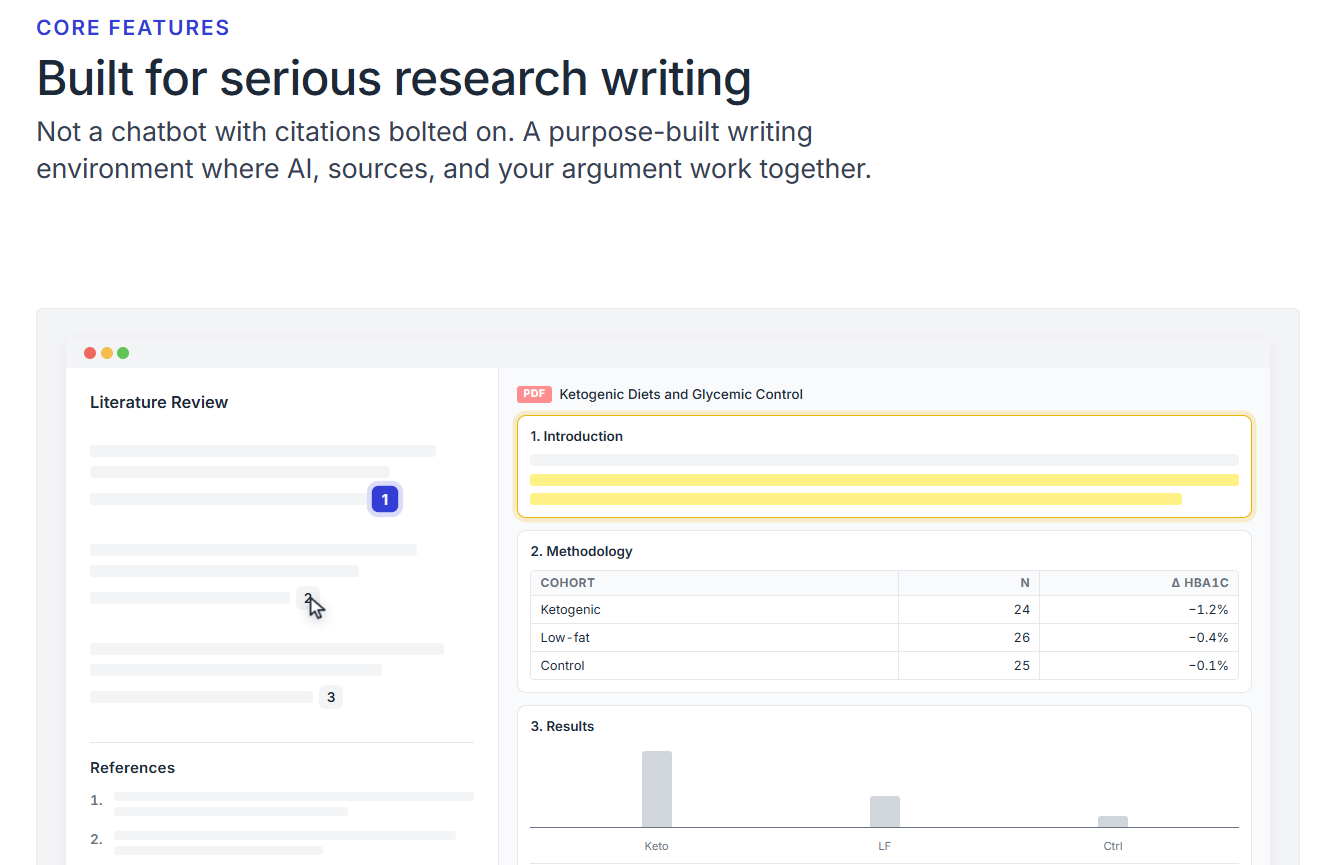
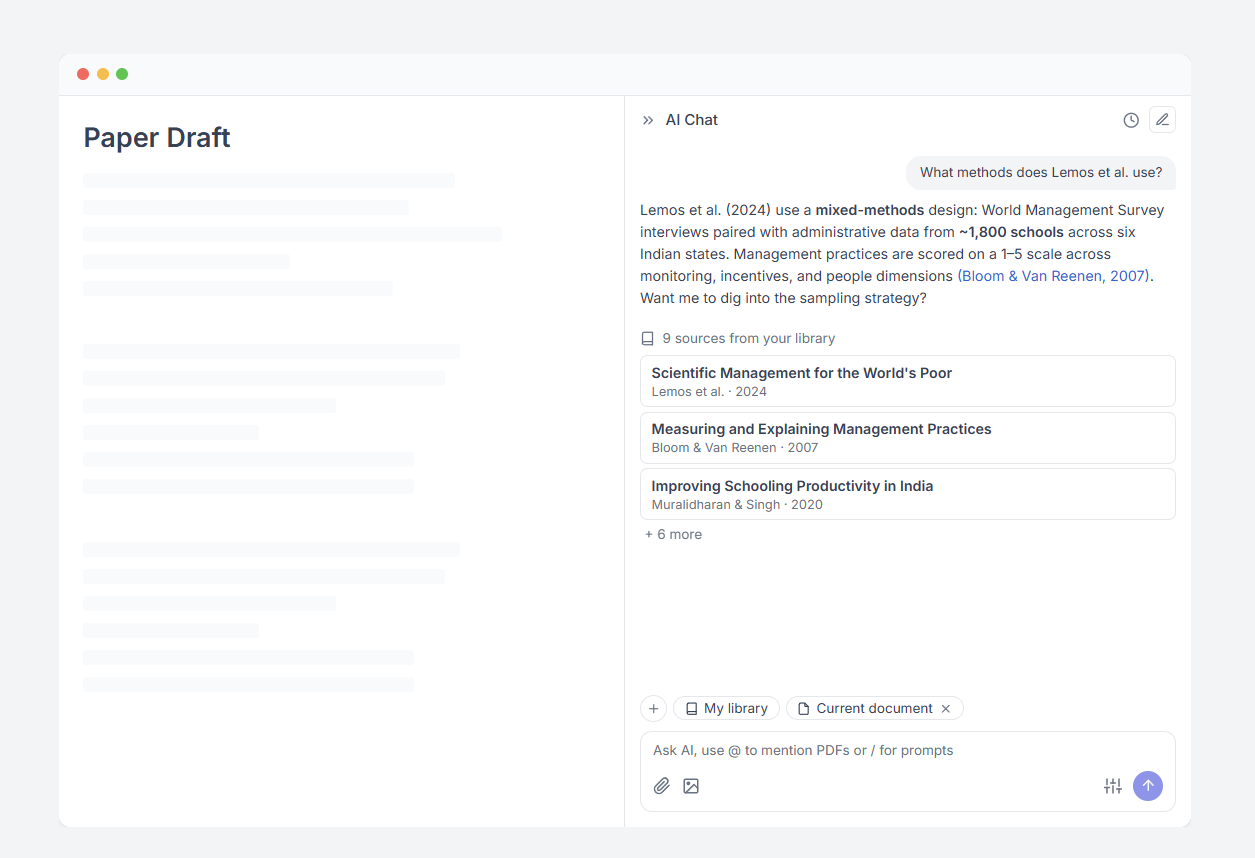
The product itself centers on a document editor built around research workflows: AI Autocomplete that continues your writing in your own tone, an AI Chat sidebar that can answer questions grounded either in the open web or in your own uploaded PDF library, and a citation system the company markets as “Smart Citations,” linked to a database of more than 250 million scholarly articles via OpenAlex to reduce fabricated sources. Jenni AI supports citation generation across more than 2,600 referencing styles, including APA, MLA, Chicago, and Harvard, and integrates with reference managers like Zotero and Mendeley.
Why Jenni AI Stands Out in 2026
Purpose-built for academic writing, not adapted to it: where ChatGPT, Claude, and Jasper serve broad writing needs, Jenni AI’s entire interface — editor, autocomplete, chat, citations — is organized specifically around research papers, essays, and thesis-level writing.
Source-grounded chat with a toggle between web and your library: the AI Chat sidebar can answer questions by pulling from its web-connected scholarly database or exclusively from PDFs you’ve personally uploaded, giving you meaningfully more control over what’s actually informing your draft than a generic chatbot.
Genuinely broad citation-style coverage: support for more than 2,600 referencing styles — well beyond the handful most writing tools offer — means Jenni AI can handle formatting requirements from almost any journal, university, or discipline without manual reformatting.
A free tier that’s a real trial, not a stripped demo: the free plan includes unlimited PDF uploads, AI autocomplete, citation tools, and export, letting you evaluate the actual workflow before paying anything — rare in a category where free tiers are often crippled to the point of uselessness.
Built-in plagiarism checking: having originality verification inside the same workspace as the writing tool saves a step most competitors force you to take externally, even though it shouldn’t be treated as a replacement for institutional plagiarism software.
Real longevity in a fast-churning category: having launched in 2019 and iterated continuously since GPT-2, Jenni AI has more product maturity than most AI writing tools that appeared after ChatGPT’s 2022 breakout, and that shows in workflow polish rather than feature novelty.
Key Features and Technology
Jenni AI’s feature set breaks into three groups: the writing and editing tools inside the document, the research and citation layer, and the review and export tools that get a draft submission-ready.
AI Autocomplete and AI Edits
AI Autocomplete continues your writing line by line as you type, matching your established tone rather than generating a wholly separate block of text — useful for breaking through writer’s block, though several reviewers note it works best as a continuation tool rather than a from-scratch generator; giving it a vague, blank-page prompt tends to produce generic, off-topic output. AI Edits let you select text and apply commands — shorten, rephrase, adjust formality, fix flow issues — which testers consistently rate as one of the more genuinely useful parts of the toolkit.
AI Chat and PDF Library
The AI Chat sidebar lets you ask research questions and toggle between pulling answers from the open web or exclusively from your uploaded PDF library, so you can keep generated content grounded in sources you’ve personally vetted. Uploading PDFs is unlimited even on the free plan, which makes the library feature one of the most accessible parts of the product regardless of budget.
Citations, Referencing, and Plagiarism Check
The citation tool searches journal and web sources and inserts in-text citations plus a formatted bibliography across 2,600+ styles, with Smart Citations linking to OpenAlex’s database of 250+ million scholarly papers specifically to reduce fabricated references. In practice, independent testing shows this reduces but does not eliminate hallucinated citations — treat the feature as a strong starting point that still requires verification, not a guarantee. The built-in plagiarism checker flags potentially unoriginal text, though reviewers note it can miss nuanced paraphrasing issues, so pairing it with your institution’s required tool (often Turnitin) before submission remains good practice.
Pricing, Plans, and Package Structure
Jenni AI runs a simple two-tier consumer structure plus custom team pricing. The Unlimited plan carries a meaningful discount for annual billing versus month-to-month, which matters for students planning to use the tool across a full academic year. As always, treat the figures below as an approximate range and confirm current pricing on jenni.ai before subscribing.
| Plan | Approx. Price | What’s Included | Best For |
|---|---|---|---|
| Free | $0 | ~200 AI words/day, unlimited PDF uploads, citations, AI editing commands | Trying the workflow, occasional short assignments |
| Unlimited | ~$12/mo billed annually (~$144/yr) or ~$20/mo billed monthly | Unlimited AI words, priority support, full citation styles, plagiarism checker | Students and researchers writing papers regularly |
| Team / Institutional | Custom quote | Seat management, single invoicing, admin dashboard, dedicated support | Research labs, university departments, writing centers |
How Jenni AI Compares to Alternatives
| Tool | Focus | Starting Price | Best Fit |
|---|---|---|---|
| Jenni AI | Academic writing, citations, PDF-grounded chat | Free / ~$12/mo | Students & researchers writing cited academic drafts |
| ChatGPT / Claude | General-purpose writing & reasoning | Free / ~$20/mo | Broad writing, brainstorming, no native citation workflow |
| QuillBot | Paraphrasing, grammar, tightening prose | Free / paid tiers | Polishing an existing draft rather than drafting from scratch |
| Paperpal | Journal-submission-focused academic editing | Free / paid tiers | Researchers preparing manuscripts for peer-reviewed journals |
vs. ChatGPT and Claude: general-purpose AI chat tools are more flexible and capable reasoners overall, but they don’t natively manage a citation library, format bibliographies in thousands of academic styles, or ground answers exclusively in your own uploaded sources the way Jenni AI’s Library mode does. Writers who need broad help across many types of content are usually better served by a general assistant; writers whose work is specifically citation-heavy academic writing get more purpose-built value from Jenni.
vs. QuillBot: QuillBot is primarily a paraphrasing and grammar tool for polishing text you’ve already written, while Jenni AI is built around active drafting with autocomplete and source-grounded chat. Many academic writers actually use both — Jenni to draft and cite, QuillBot to tighten and rephrase the resulting prose — rather than treating them as directly competing choices.
vs. Paperpal: Paperpal leans harder into the specific mechanics of journal submission — manuscript formatting, language quality checks aligned to specific publisher requirements — making it a stronger fit for researchers actively submitting to peer-reviewed journals. Jenni AI’s strength sits earlier in the process: drafting, citing, and organizing a paper or thesis chapter before it’s submission-ready.
Pros and Cons
What Students and Researchers Love
Real help breaking through writer’s block: the line-by-line autocomplete keeps the writer in the driver’s seat while still moving a stalled draft forward, which reviewers consistently rate as the standout feature.
Genuinely broad citation-style support: covering 2,600+ referencing formats means almost no discipline-specific style requirement goes unsupported.
A free plan worth actually using: unlimited PDF uploads and core editing tools at $0 let you genuinely evaluate the workflow, not just click through a demo.
Affordable relative to the category: at roughly $12/month on annual billing, Jenni AI undercuts most competing academic and general AI writing subscriptions.
Limitations Worth Knowing
Citation fabrication is a real, repeated finding: multiple independent tests have found roughly a quarter to nearly a third of auto-generated citations contain errors or reference nonexistent sources — every single one requires manual verification before submission.
Output is reliably flagged as AI-generated: AI-detection tools identify unedited Jenni text with high accuracy, which is a serious concern given how many institutions now require AI-use disclosure or prohibit it outright.
Weak on niche or highly technical subject matter: reviewers note the tool struggles with field-specific jargon and detailed technical logic, producing vague or generic arguments outside general academic topics.
Plagiarism checker isn’t a substitute for institutional tools: the built-in checker occasionally misses nuanced paraphrasing issues, so it should supplement, not replace, whatever tool your university actually requires.
Support response times vary: some reviewers report average support response times around six hours, which can matter if you’re troubleshooting close to a submission deadline.
Who Should Use Jenni AI
Undergraduate and graduate students: for essays, literature reviews, and coursework that need proper citation formatting, the Free or entry Unlimited plan is a genuine time-saver for drafting and reference management.
PhD candidates writing a thesis: the Library-grounded AI Chat and broad citation-style support make Jenni useful across a long-form project — but the citation-verification discipline matters more here than anywhere else, given the stakes of a viva or defense.
Faculty and research teams: the Team plan’s seat management and admin dashboard make it straightforward to roll the tool out across a lab or department with centralized billing.
Non-native English writers polishing academic tone: the AI Edits tone and formality controls are frequently cited as helpful for adapting a draft to expected academic register.
Who should look elsewhere: writers in highly technical or niche specialties needing deep domain accuracy, anyone submitting to institutions with strict AI-use prohibitions who can’t commit to substantial rewriting, and researchers preparing final journal manuscripts may be better served by domain experts, Paperpal, or a human editor for the final pass.
Getting Started: Step by Step
- Create a free account at jenni.ai and specify whether you’re a student, researcher, or content writer so the workspace defaults are set appropriately.
- Upload your source PDFs to build your personal library before you start drafting, since this is unlimited even on the free plan.
- Set your citation style in Content Settings to match your institution’s or target journal’s required format before you begin writing.
- Draft with AI Autocomplete in short bursts rather than long unattended stretches, reviewing and editing as you go instead of generating whole sections unattended.
- Use AI Chat in Library mode when you need answers grounded strictly in your own uploaded sources rather than the open web.
- Verify every citation manually against Google Scholar or your institutional database before finalizing — treat this as a non-negotiable step, not an optional check.
- Run the plagiarism checker and rewrite AI-flagged sections in your own voice, then export your final draft.
Tips for Getting Maximum Value
Treat Jenni AI as a collaborator that accelerates drafting, not a ghostwriter that produces submission-ready text — the writers who get the most value consistently mix their own analysis and phrasing with the AI’s suggestions rather than accepting output wholesale. Build your citation-verification habit from the very first paper you use it for, not the one right before a deadline; checking each reference against Google Scholar takes seconds per citation but catches fabrications before they become a serious academic integrity problem. If cost is a factor, commit to the annual Unlimited plan at the start of a semester rather than paying month-to-month, since the difference compounds significantly over an academic year. Use the Library-only mode in AI Chat whenever accuracy matters more than breadth — restricting answers to sources you’ve personally vetted meaningfully reduces the fabrication risk that comes with open-web grounding. And if your program has any policy on AI-assisted writing, read it before you start, since Jenni’s output is reliably detectable by tools like GPTZero and Turnitin’s AI indicator.
Future Outlook and Final Assessment
Jenni AI is riding a durable tailwind: academic writing volume isn’t shrinking, and the tool has carved out a defensible niche by staying narrowly focused on citation-heavy research writing rather than chasing the broader, more crowded general-purpose AI writing market. Its 2026 acquisition of CiteSure, an AI EdTech startup, signals continued investment in the citation and sourcing layer specifically — the area most in need of improvement given the fabrication findings above. That said, the honest gap is real and worth restating plainly: no version of Jenni AI available today eliminates the need for manual citation verification, and treating its output as submission-ready without a careful human review pass is a genuine academic risk, not a minor inconvenience.
Conclusion
Jenni AI earns its place as one of the most focused, genuinely useful AI tools for academic writers in 2026 — real help breaking through writer’s block, broad citation-style coverage, source-grounded chat, and a free tier honest enough to let you test the workflow before you pay. It is not a ghostwriter you can trust blindly, and the citation-fabrication and AI-detection risks documented by independent testers mean every serious user needs a verification habit, not just a subscription. Used the way it’s designed — as a drafting collaborator you review and rewrite, not a submission machine — Jenni AI can genuinely save hours on a research paper or thesis chapter. Whichever tool you land on for your writing workflow, the goal we chase with every review on this site stays the same: helping you make everything easy.
Ready to speed up your next research paper?
Explore more honest reviews, tutorials and tool comparisons to find the right tech for the way you work and live — at AI Solutes, where we make everything easy.
👉 Open Free Account: https://ai-solutes.com/jenni.ai
👉 Our YouTube Channel: youtube.com/@ai-solutes
👉 Our Facebook Fanpage: Facebook
👉 Our X (Twitter): @AISolutes
- Yves Rocher Hair Care & Botanical Skincare: Discover Sustainable French Luxury
- Elai
- FaceApp AI Face Editing: Features, Competitor Comparison, Revenue, Viral Trends & Demographics
- Can Pipedrive Successfully Centralize Your Customer Communication Across Email, Web Forms, and Live Chat? Testing the CRM
- Master Chatbase in 2026: Build Multichannel AI Chatbots to Boost Support and Sales