Devs.ai has emerged as one of the most strategically differentiated platforms in the rapidly expanding enterprise AI landscape — positioning itself not as another AI chatbot or developer coding assistant, but as the governed enterprise vibe-coding platform built specifically for the reality that faces IT leaders in 2026: their business users are building AI apps and agents whether IT approves or not, and the only question is whether those builds happen with guardrails or without them. What makes Devs.ai genuinely stand out in a market crowded with consumer-grade AI tools, shadow-AI risks, and vibe-coding platforms designed for individual developers: a proprietary enterprise-first architecture backed by AppDirect that lets anyone in an organization build governed AI apps, agents, and workflows on their own company data — with 50+ LLM models available through a single interface, 2,000+ integrations growing weekly, SOC 2 Type II certification, GDPR and CCPA compliance, zero-training agreements with all LLM providers ensuring corporate data is never used to train public models, and IT governance controls that give CISOs the audit trails and access management they need without becoming a bottleneck to the business teams driving AI adoption. Whether you’re a CTO trying to prevent shadow AI while enabling the rapid app-building your business teams demand, a non-technical department head who wants to build custom AI workflows on company data without waiting months for an IT project, an enterprise IT administrator who needs full auditability and role-based access over every AI interaction in the organization, or a team lead who needs AI agents that connect to real business systems rather than operating on generic public data — this comprehensive 2026 review walks you through every major feature, plan, governance capability, integration, and real-world consideration of the Devs.ai platform.
Devs.ai Review 2026: The Enterprise Vibe-Coding Platform That Lets Your Whole Organization Build AI Apps — Without Losing Control
Overview and Background
Devs.ai is an enterprise vibe-coding and AI agent platform that enables organizations to build, govern, and distribute AI-powered applications and agents — built on company-specific data, connected to business systems through 2,000+ integrations, and deployed across teams or distributed through marketplaces, all under a security and compliance framework that enterprise IT and compliance teams can actually approve. Developed as an AppDirect company, Devs.ai inherits the enterprise distribution and integration infrastructure that AppDirect has built over its decade-plus of operating B2B software marketplaces and cloud services distribution — giving the platform both the technical depth and the go-to-market reach that purely venture-funded AI startups cannot easily replicate.
The platform’s positioning addresses one of the most pressing tensions in enterprise technology in 2026: the collision between the explosive democratization of AI app-building (vibe coding has reduced the barrier to creating functional AI applications to the ability to write a clear English prompt) and the enterprise requirements around data security, governance, regulatory compliance, and operational consistency that consumer-grade vibe-coding tools were never designed to meet. By 2026, shadow AI — employees using unauthorized AI tools to process corporate data through public models — has become one of the top-three security concerns in enterprise environments, with IBM reporting that incidents related to ungoverned AI access can add over $670,000 to the average data breach cost.
Devs.ai’s answer to this tension is a governed platform that is simultaneously more accessible than traditional enterprise software development (natural language builds, no coding required) and more controlled than consumer AI tools (CISO-approvable governance, complete audit trails, zero-training data agreements). The tagline “Build it. Launch it. Sell it.” reflects the platform’s ambition: not just enabling AI app creation within an organization, but enabling teams and creators to distribute those apps — internally to their teams, or externally through the AppDirect marketplace ecosystem.
Why Devs.ai Stands Out in 2026
- Enterprise Vibe-Coding With Governance Built In: Devs.ai brings vibe-coding — building apps and agents through natural language prompts rather than traditional programming — to enterprise environments without stripping out the governance that makes enterprise deployment possible. Every build on the platform operates within configurable access controls, audit trails, and data governance policies, not as an afterthought but as the foundational architecture.
- 50+ LLM Models in a Single Interface: Rather than locking organizations into a single AI provider, Devs.ai offers access to 50+ large language models — including models from OpenAI, Anthropic, Google, Mistral, Meta, and others — through one unified interface. Creators choose the best model for each specific application based on capability, cost, latency, and data sensitivity requirements, and switch as new models emerge without rebuilding their applications.
- Zero-Training Agreements with All LLM Providers: Every LLM accessed through Devs.ai operates under zero-training agreements — guaranteeing that corporate data submitted through the platform is never used to train public foundation models. This directly addresses the primary data security concern that prevents enterprise IT teams from approving consumer AI tools for business use.
- 2,000+ Integrations — Connecting AI to Real Business Data: Devs.ai connects to over 2,000 business systems — CRMs, ERPs, HR platforms, communication tools, databases, and productivity suites — enabling AI apps and agents to operate on actual company data in real time rather than generic public knowledge. The integration library is growing weekly, with 100+ connectors available as of mid-2026.
- SOC 2 Type II, GDPR, and CCPA Certified: The compliance certifications that enterprise IT and legal teams require as baseline criteria for vendor approval — covering information security management (SOC 2 Type II), European data protection law (GDPR), and California consumer privacy law (CCPA) — are built into the platform, not available as optional add-ons on expensive enterprise tiers.
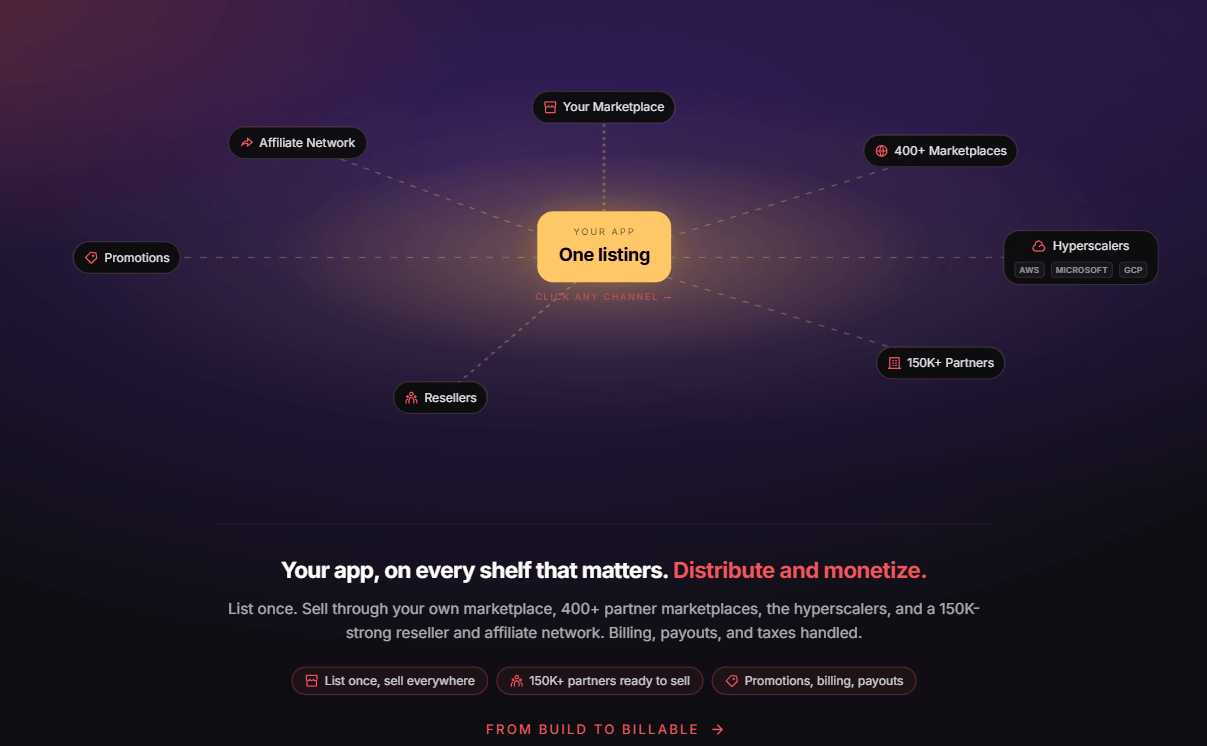
- Build, Launch, and Distribute: Devs.ai is the only enterprise vibe-coding platform that explicitly supports distribution as a core capability — teams can build an AI app internally and distribute it across the organization, or publish it to the AppDirect marketplace ecosystem where other businesses can discover and deploy it. This creates a pathway from internal tooling to commercial AI product that no competing platform currently provides.
- LLM-Agnostic by Architecture: The platform’s LLM-agnostic design ensures that enterprise AI investments don’t become hostage to a single model provider’s pricing decisions, capability limitations, or data handling changes. As the AI model landscape evolves — and it is evolving faster in 2026 than at any prior point — Devs.ai organizations can adopt new models as they become available without platform migration.
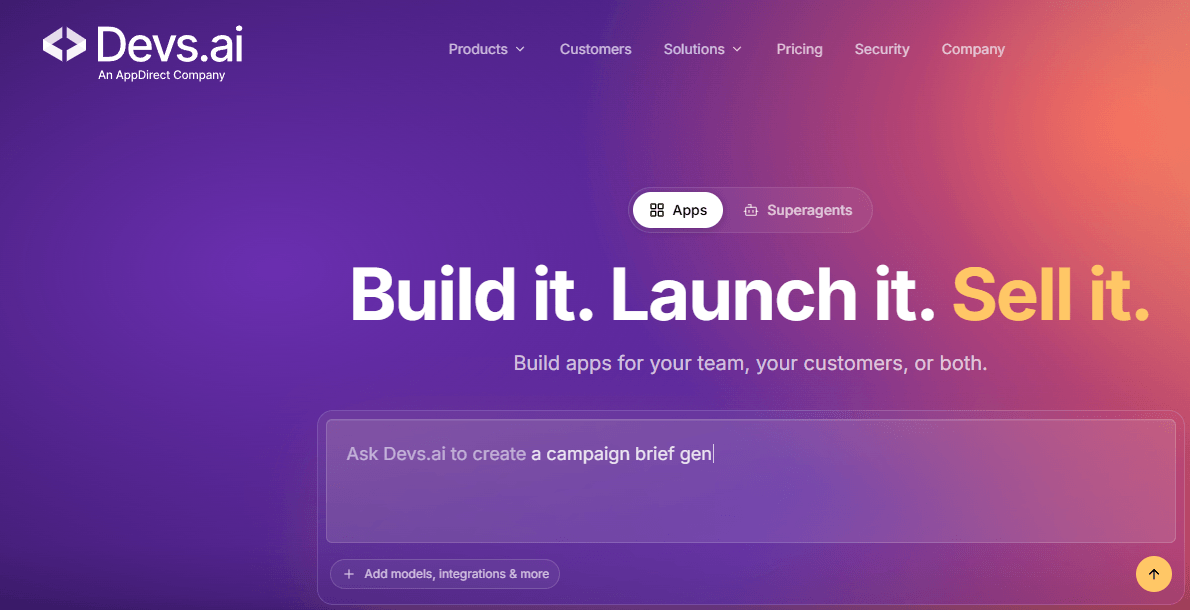
Devs.ai’s governed enterprise vibe-coding platform enables every team in an organization — technical and non-technical alike — to build AI apps and agents on company data through natural language prompts, while giving IT and compliance teams the governance controls, audit trails, and data protection agreements that consumer AI tools categorically cannot provide.
Key Features and Platform Philosophy
Devs.ai’s competitive strength in 2026 lies in the intersection of genuine enterprise security architecture and the accessibility of modern vibe-coding — delivering a platform that is simultaneously deployable by non-technical business users and approvable by enterprise IT governance teams.
Enterprise Vibe-Coding: Build Apps and Agents in Natural Language
- Natural Language App Construction: Devs.ai’s core build experience allows any user — regardless of technical background — to describe what they want an AI application to do in plain English and have the platform construct it. Product managers, marketing teams, HR professionals, and operations leads build working AI applications on their own business data without writing a line of code, requesting developer resources, or waiting for an IT project to be scoped and scheduled.
- AI Agent Creation: Beyond single-interaction applications, Devs.ai enables the creation of autonomous AI agents that can execute multi-step workflows — connecting to business systems, processing data, making decisions based on configurable rules, and completing tasks without manual intervention at each step. Agents built on Devs.ai operate on company data through the platform’s integration layer, not on generic public information.
- Governed Build Environment: Every application and agent built on Devs.ai operates within IT-configured governance parameters — data access controls that determine which systems each app can connect to, user permissions that define who can create, edit, publish, or use each application, and audit trails that log every interaction for compliance and security review. Shadow AI is structurally blocked, not just discouraged by policy.
- Creator and Consumer Roles: Devs.ai separates the platform into Creator roles (building and configuring AI apps and agents) and Consumer roles (using deployed applications) — enabling organizations to manage who has build access separately from who has use access, and to deploy broadly-accessible AI tools to large user populations without giving every employee the ability to reconfigure the underlying applications.
50+ LLM Models: One Prompt, Every Model
- Unified Multi-Model Access: Access GPT models from OpenAI, Claude from Anthropic, Gemini from Google, Llama variants from Meta, Mistral models, Grok, Perplexity, and 20+ additional LLMs through a single Devs.ai account — without requiring separate API keys, separate billing relationships, or separate data agreements with each provider. One interface, one security review, one contract.
- Model Selection by Application: Different AI applications benefit from different models — a legal document analysis agent may perform best on Claude, a code review tool on a specialized coding model, a customer communication assistant on a model optimized for tone and length. Devs.ai allows creators to select the optimal model for each application independently, and switch models as new capabilities emerge without application rebuilds.
- Automatic Library Updates: As new LLM models are released and added to the Devs.ai library, they become immediately available to all organization users without platform updates, vendor negotiations, or IT change management processes. The platform’s model library is a living resource that tracks the AI frontier rather than locking organizations into the models available at the time of contract signing.
- Cost Optimization Across Models: With 50+ models at different capability and cost tiers, organizations can route different workloads to the most cost-effective model for each task — using premium models for high-stakes outputs and more economical models for high-volume, lower-stakes processing — without the overhead of managing multiple provider accounts and billing relationships.
2,000+ Integrations: AI on Real Business Data
- Business System Connectivity: Devs.ai connects to over 2,000 business applications and data sources — Salesforce, HubSpot, Microsoft 365, Google Workspace, Slack, Jira, ServiceNow, SAP, Workday, Zendesk, and thousands more — enabling AI apps to access, analyze, and act on real organizational data rather than operating on static uploaded documents or generic public information.
- Connector Library Growing Weekly: With 100+ connectors available and the library growing weekly, the integration coverage continuously expands to meet the breadth of enterprise software stacks without requiring custom integration development for each new system connection.
- Secure Data Access Architecture: Integration connections operate within the platform’s governance framework — IT administrators configure which data sources each application can access, ensuring that an HR department’s AI agent doesn’t inadvertently access financial data, and that a customer service tool doesn’t reach engineering system data. Data access is scoped at the application level, not the user level.
- Real-Time Data Processing: AI apps and agents built on Devs.ai access connected business systems in real time — not from static snapshots or scheduled syncs. A customer service agent can pull live account status from CRM; a procurement workflow can check real-time inventory from ERP; a support tool can query the latest knowledge base entries. The AI operates with current information, not yesterday’s export.
Enterprise Governance and Security Architecture
- SOC 2 Type II Certified: Devs.ai’s information security controls have been independently audited and validated under SOC 2 Type II — confirming not just that security controls exist but that they operated effectively over a sustained audit period. SOC 2 Type II is the compliance credential most commonly required by enterprise procurement and IT security teams for cloud service approval.
- GDPR and CCPA Compliance: Full compliance with European General Data Protection Regulation and California Consumer Privacy Act requirements — covering data subject rights, cross-border transfer mechanisms, consent management, and data processing documentation. Essential for organizations operating in European markets or handling California resident data.
- Zero-Training Data Agreements: All LLM providers in the Devs.ai platform operate under contractual zero-training agreements — corporate data processed through any model in the library is never used to train or fine-tune public models. This addresses the foundational concern that prevents most enterprise security teams from approving consumer AI tools: the risk that confidential business information becomes training data for public AI systems.
- Granular Role-Based Access Controls: IT administrators define who can access the platform, what they can build, what data sources they can connect, and what they can do with deployed applications — at the organizational, team, application, and individual user level. The governance framework is designed to enable broad AI adoption within the organization while maintaining the access control standards that regulated industries and security-conscious enterprises require.
- Complete Audit Trails: Every interaction, build action, application modification, and data access event in Devs.ai generates an audit log — providing the complete record that compliance teams need for regulatory inquiries, security investigations, and internal governance reviews, without requiring IT teams to manually instrument logging across multiple disparate AI tools.
- Dedicated Azure Hosting: Data processed through Devs.ai is hosted on dedicated Azure infrastructure — not on shared multi-tenant environments where data residency and isolation cannot be guaranteed. Enterprise data remains isolated within the organization’s dedicated environment.
Distribution: From Internal Tools to Marketplace Products
- Internal Team Distribution: AI apps built on Devs.ai can be published to internal teams — making AI tools available to defined user populations within the organization through a curated internal catalog that IT controls and employees can discover and use without requiring individual technical setup.
- AppDirect Marketplace Distribution: Through Devs.ai’s connection to the AppDirect marketplace ecosystem, organizations and creators can distribute AI applications commercially — publishing apps and agents to the AppDirect marketplace where other businesses can discover, evaluate, and deploy them as part of their own AI infrastructure. This turns internal AI tooling into a potential revenue stream for technology-forward organizations.
- Partner Program: Devs.ai operates a partner program for organizations and technology consultancies that want to build, distribute, and resell AI applications through the platform — enabling a growing ecosystem of specialized AI apps built by domain experts and distributed through AppDirect’s established enterprise software marketplace infrastructure.
Devs.ai’s zero-training data agreements with all 50+ LLM providers in its library ensure that corporate data processed through the platform is never used to train public AI models — directly addressing the foundational security concern that prevents most enterprise IT teams from approving consumer AI tools for business use.
Pricing, Plans, and What Each Tier Delivers
Devs.ai operates on a tiered pricing model with plans designed to scale from individual experimentation through full enterprise deployment — with pricing that reflects the platform’s enterprise governance infrastructure and multi-model access breadth rather than competing at the commodity consumer AI tool price point.
Devs.ai 2026 Pricing Overview
| Plan | Price | Best For | Key Features |
|---|---|---|---|
| Tinkerer (Free) | $0/month | Individual exploration; first AI app builds; evaluating the platform before committing | Access to core platform; limited LLM access; basic app building; evaluate without credit card |
| Pro (Individual) | ~$30/user/month | Individuals who want the full platform without compromise; power users; freelancers | Full platform access; 50+ LLM models; unlimited app building; all integrations available; no governance controls |
| Team | Custom (per-seat) | Teams that build, deploy, and govern AI together; department-level AI deployments | All Pro features + team governance; shared app library; collaborative build; role-based access controls; audit trails |
| Enterprise | Custom (volume-negotiated) | Organizations that need AI their CISO will actually approve; regulated industries; large deployments | Full governance suite; SOC 2 Type II; GDPR/CCPA compliance; dedicated Azure hosting; zero-training agreements; dedicated account management; marketplace distribution; partner program access |
| LLM Access | All paid plans | 50+ models across all plans | OpenAI, Anthropic, Google, Meta, Mistral, and 20+ more — one interface, one billing relationship, zero-training agreements with all |
| Integrations | All paid plans | 2,000+ business systems | CRM, ERP, HR, communication, productivity tools — growing weekly; 100+ connectors actively maintained |
| Compliance Certifications | Enterprise plan | Regulated industries; enterprise IT governance requirements | SOC 2 Type II; GDPR; CCPA; dedicated hosting; complete audit trails; full RBAC governance |
Important note on value framing: Devs.ai’s pricing is most accurately compared not against individual AI tool subscriptions but against the total cost of the status quo — which for most enterprises includes multiple separate AI tool subscriptions (each with their own security risks and data agreements), developer time spent building AI integrations that business teams then use inefficiently, and the downstream cost of shadow AI incidents where employees use unapproved consumer tools to process corporate data. The consolidation value of a single governed platform accessing 50+ models with 2,000+ integrations frequently exceeds the sum of the point solutions it replaces.
Pro tip: Enterprise buyers should request a pilot program before full deployment — Devs.ai’s free Tinkerer plan and Pro tier allow individual users and small teams to validate the platform’s specific LLM and integration coverage for their priority use cases before committing to enterprise-scale deployment and contract. The evaluation period is most valuable when run against real internal business data and a real department workflow, not a sanitized demo environment.
Value vs. Alternatives
- vs. Cursor / GitHub Copilot (developer-focused vibe coding, $10–$39/user/month): Cursor and GitHub Copilot are the leading vibe-coding tools for software developers — extremely powerful for engineers writing, refactoring, and debugging code. They are designed for technical users working in code editors and are not built for non-technical business users building enterprise AI workflows. Devs.ai’s vibe-coding is designed specifically for business application creation accessible to non-developers, with enterprise governance that developer-focused tools don’t include. The platforms are complementary rather than directly competitive — engineering teams continue using their existing coding tools while business teams build AI applications on Devs.ai.
- vs. Lovable / Bolt.new (consumer vibe-coding app builders, $20–$50/month): Lovable and Bolt.new excel at consumer and startup use cases — fast, beautiful, accessible app generation for individuals and small teams. They lack enterprise governance, data protection agreements, SOC 2 certification, granular access controls, and the integration depth with enterprise business systems that Devs.ai provides. For enterprises, deploying Lovable or Bolt.new at scale creates shadow AI risk rather than resolving it. Devs.ai is the governed enterprise equivalent for organizations that need vibe-coding without compliance compromise.
- vs. Microsoft Copilot Studio (enterprise, $30–$200/user/month): Microsoft Copilot Studio is Microsoft’s enterprise AI app and agent builder, most powerful within the Microsoft 365 and Azure ecosystem. Organizations deeply committed to Microsoft infrastructure will find strong native integration. Devs.ai’s LLM-agnostic approach (50+ models vs. Microsoft’s primarily own-model-first approach) and broader multi-vendor integration library are meaningful advantages for organizations not exclusively in the Microsoft ecosystem, or those wanting model flexibility beyond what Copilot Studio offers.
- vs. Salesforce Agentforce Vibes (enterprise, Salesforce ecosystem): Agentforce Vibes is Salesforce’s enterprise vibe-coding product, powerful within the Salesforce CRM ecosystem. For organizations whose AI app needs center on Salesforce data and workflows, Agentforce is naturally strong. Devs.ai’s platform-agnostic architecture — connecting to 2,000+ systems beyond just Salesforce — makes it the more appropriate choice for organizations whose data and workflows span multiple platforms and cloud providers.
- vs. Individual LLM Subscriptions (ChatGPT, Claude, Gemini): Individual LLM subscriptions provide powerful AI chat interfaces at $20–$30/user/month, but each carries separate data handling policies, lacks enterprise governance and audit trails, and operates as an isolated tool rather than an integrated platform. For enterprises, running 100 employees on individual ChatGPT subscriptions creates 100 unmanaged data flows to a consumer AI service — a shadow AI and compliance risk that Devs.ai directly addresses by consolidating access to multiple models under governed, auditable enterprise infrastructure.
Comparisons: Devs.ai vs. Competitors in 2026
| Devs.ai 2026 | Cursor / Copilot | Lovable / Bolt.new | MS Copilot Studio | Individual LLM Subs | |
|---|---|---|---|---|---|
| Target User | Enterprise teams (technical + non-technical) | Software developers | Individuals / startups | Enterprise (Microsoft ecosystem) | Individual users |
| Enterprise Governance | Yes (full RBAC, audit trails, CISO-ready) | No / limited | No | Yes (Microsoft platform) | No |
| SOC 2 Type II | Yes | Yes (Cursor) | No | Yes | Varies by provider |
| Zero-Training Data Agreements | Yes (all 50+ LLMs) | Varies | No enterprise guarantees | Yes (Microsoft models) | Enterprise tier only |
| Multi-LLM Access (50+ models) | Yes (single interface) | No (1–3 models) | No (1–2 models) | No (Microsoft-first) | One per subscription |
| Business System Integrations | 2,000+ (growing weekly) | Dev tools only | Limited | Microsoft 365 + Power Platform | None |
| Non-Technical User Accessible | Yes (core design principle) | No (developer-focused) | Yes | Partial | Yes (chat only) |
| AI Agent Creation | Yes (governed, multi-step agents) | Yes (code agents) | Limited | Yes (Power Automate-based) | No |
| Marketplace Distribution | Yes (AppDirect ecosystem) | No | No | AppSource limited | No |
| Blocks Shadow AI | Yes (structurally by design) | No | No | Partial (Microsoft tools) | No (IS shadow AI) |
| Best For | Governed enterprise AI apps; cross-team deployment; regulated industries | Developer productivity; code generation | Fast MVP; consumer apps; startups | Microsoft-centric enterprises | Individual productivity |
Devs.ai’s edge: Among enterprise AI platforms in 2026, Devs.ai delivers the most complete combination of vibe-coding accessibility, multi-model flexibility, business system integration depth, and enterprise governance for organizations that need AI app building to be simultaneously accessible to non-technical users and approvable by enterprise security and compliance teams. Cursor and GitHub Copilot win for professional software engineers; Lovable and Bolt.new win for consumer-grade speed; Microsoft Copilot Studio wins for Microsoft-monoculture enterprises. But for organizations across industries whose business teams are building AI applications whether IT approves or not — and who need a platform that channels that energy into a governed, compliant, and auditable system rather than a shadow AI free-for-all — Devs.ai is the most purpose-built solution available.
Pros and Cons: What Enterprise Teams Report
What Enterprise Teams Value Most About Devs.ai
- Solving Shadow AI Without Slowing Business Teams: IT and security leaders consistently identify this as the platform’s foundational value — Devs.ai gives business teams a fast, capable, natural-language AI app builder that satisfies their demand for AI-powered tools, while giving IT complete governance visibility and control. The alternative — blocking AI tool access entirely while business teams work around restrictions — creates more risk, not less. Devs.ai resolves the conflict by making the governed path the easiest path.
- One Subscription Replacing Many: Organizations that previously managed separate subscriptions for ChatGPT Enterprise, Claude for Enterprise, and other individual LLM tools report significant consolidation value — one vendor relationship, one security review, one set of compliance documentation, and one audit trail covering 50+ models rather than 10 separate relationships each requiring their own security and procurement process.
- Non-Technical Teams Building Real AI Tools: Marketing, HR, operations, customer service, and finance teams report being able to build functional AI agents that connect to their actual business systems — without submitting IT tickets, waiting for developer availability, or learning technical skills. The productivity impact of HR building its own onboarding agent, or marketing building its own content workflow, without engineering involvement is a meaningful operational shift.
- Model Flexibility Without Model Lock-In: Technology teams responsible for AI strategy consistently highlight model agnosticism as a strategic advantage — as the AI model landscape continues evolving rapidly in 2026, organizations on model-specific platforms face either performance ceilings (using yesterday’s best model because switching requires platform migration) or migration costs. Devs.ai’s architecture makes model adoption a configuration choice rather than a migration project.
- CISO Approval Path That Actually Works: CISOs and IT security leaders describe Devs.ai as the first enterprise AI platform that they can approve without either blocking business capability or compromising security standards — the SOC 2 Type II certification, zero-training data agreements, granular access controls, and complete audit trails collectively address the security objections that make most AI tool approvals a multi-month compliance exercise.
- AppDirect Infrastructure Backing: Enterprise technology decision-makers value that Devs.ai is an AppDirect company — backed by an organization with an established track record in enterprise software distribution and marketplace management, not a venture-backed startup whose security and compliance infrastructure may not yet be battle-tested at enterprise scale. The institutional backing reduces the vendor risk calculation for procurement teams evaluating long-term AI infrastructure commitments.
Limitations and Caveats Worth Knowing
- Platform Is Optimized for Enterprise — Not Individual Consumer Use: Devs.ai’s governance architecture and enterprise focus make it a slightly heavier evaluation process than consumer AI tools for individuals or small teams who just want to build something quickly without compliance infrastructure. Solo users and small startups who don’t have enterprise compliance requirements will find simpler and cheaper options in Lovable, Bolt.new, or direct LLM API access. Devs.ai’s value proposition scales proportionally with organizational size and compliance need.
- Pricing Transparency Requires Sales Contact for Enterprise Tiers: Like most enterprise software platforms, Devs.ai’s Team and Enterprise plan pricing requires engaging with the sales team rather than self-service selection from a published price list. Organizations that prefer completely transparent self-service pricing before engaging a sales conversation should be prepared for this — though the Tinkerer and Pro plans offer accessible self-service entry without sales contact.
- Integration Depth Varies by Connector Maturity: While the 2,000+ integration count reflects the full scope of AppDirect’s platform connectivity, individual connector depth and real-time data sync capability can vary — some connectors offer full bidirectional data access while others provide read-only or limited field access. Organizations with complex requirements for specific business system integrations should validate connector depth for their priority systems during the evaluation period.
- AI Agent Governance Requires Configuration Investment: Building truly governed AI agents — with appropriate data access scoping, approval workflows, and output controls — requires upfront governance configuration by IT administrators. Organizations that expect governance to work out of the box with zero configuration will find that meaningful access controls require meaningful configuration investment. The platform provides the governance architecture; deploying it effectively requires planning and IT involvement.
- Newer Platform — Community and Ecosystem Still Maturing: Devs.ai is newer to the enterprise AI platform market than established alternatives like Microsoft Copilot Studio, meaning the third-party community, template libraries, and available case studies are less extensive than mature competitors. Organizations that rely heavily on community resources, templates, and peer practitioner knowledge for platform adoption should factor in the maturity gap relative to more established enterprise AI platforms.
- AppDirect Marketplace Distribution Adds Commercial Complexity: The ability to distribute AI apps through the AppDirect marketplace is a meaningful differentiator, but it introduces commercial and legal complexity that most organizations haven’t navigated for AI-generated applications — pricing models, support commitments, liability frameworks, and data handling agreements for marketplace-distributed AI products require careful consideration before publishing. Organizations focused on internal use rather than commercial AI distribution should treat the marketplace capability as a future option rather than an immediate deployment target.
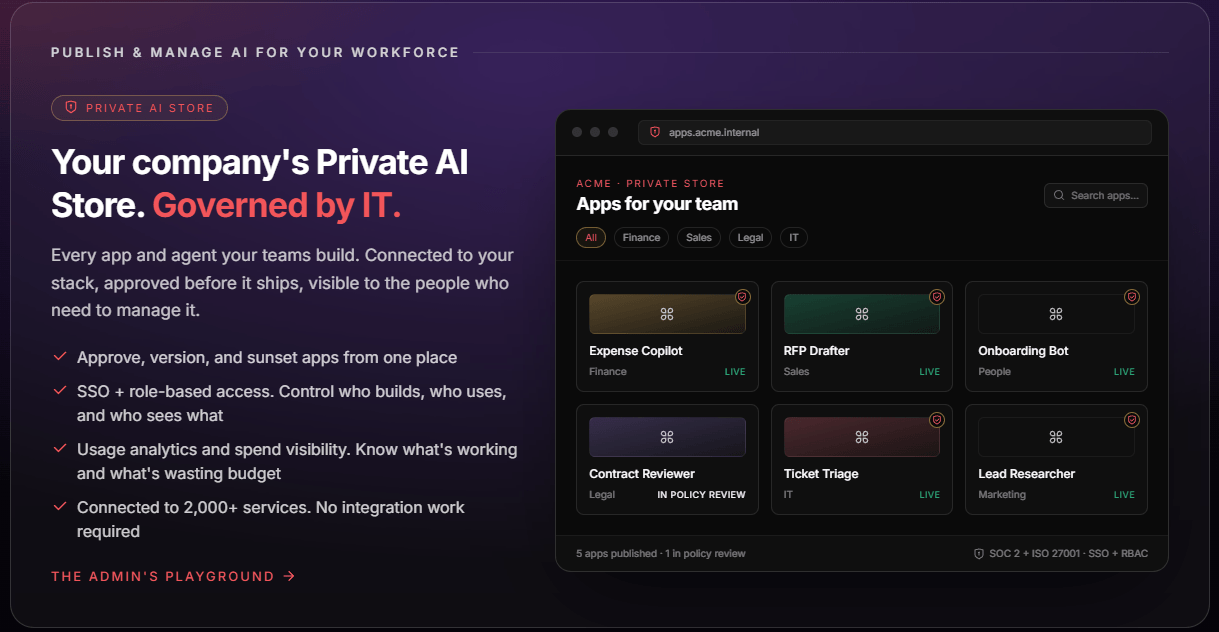
Enterprise technology leaders and IT teams consistently report the same strategic outcome after deploying Devs.ai: business teams that were previously building AI workflows on unauthorized consumer tools — creating shadow AI risk with every interaction — redirect that building energy onto the governed platform, giving IT visibility and control without becoming the bottleneck that drives teams to workarounds in the first place.
Common Use Cases and Who Should Use Devs.ai
Best Use Cases by Organization Profile
- Enterprise IT and CISOs Governing AI Adoption: Organizations where AI tool proliferation has created shadow AI risk — employees using personal ChatGPT accounts, consumer Claude, or unauthorized Gemini access to process corporate data — find Devs.ai the most direct resolution. Rather than playing whack-a-mole with blocked consumer AI URLs, providing a governed, capable alternative that satisfies what business teams actually need gives IT the visibility it requires while eliminating the incentive for workarounds.
- Business Operations Teams Building Internal AI Tools: HR teams building onboarding and policy agents, finance teams building reporting and analysis tools, marketing teams building content workflows, and customer service teams building knowledge management agents — all represent high-value use cases where non-technical users building on real company data deliver immediate operational value without consuming developer resources.
- Regulated Industries Requiring AI Compliance: Healthcare, financial services, legal, government, and other regulated industries where data sovereignty, audit trails, and regulatory compliance are prerequisites for any technology deployment find Devs.ai’s SOC 2 Type II, GDPR, and CCPA certifications, combined with zero-training data agreements, meet the compliance bar that consumer AI tools don’t approach.
- Organizations Managing Multiple LLM Relationships: Technology leaders who currently manage separate agreements with OpenAI, Anthropic, Google, and other AI providers — each with separate billing, security reviews, and data agreements — find Devs.ai’s unified 50+ model library a meaningful consolidation. One platform, one security review, one contract, full model flexibility.
- AppDirect Partners and Resellers: Organizations already in the AppDirect ecosystem — software vendors, MSPs, and technology consultancies that use AppDirect’s marketplace infrastructure — find natural synergy with Devs.ai as a platform for building, governing, and distributing AI products through established marketplace channels.
- Companies Building Internal AI Centers of Excellence: Organizations that have designated AI Centers of Excellence or AI enablement teams to govern and accelerate enterprise AI adoption find Devs.ai’s platform a governance-compatible infrastructure that enables them to deploy AI capabilities broadly without ceding control — the CoE governs the platform while business teams build within it.
- Enterprises in the Microsoft or Salesforce Ecosystem Wanting Model Flexibility: Organizations that are primarily Microsoft or Salesforce shops but want AI capability that extends beyond those platforms’ native model preferences find Devs.ai’s LLM-agnostic architecture fills the model flexibility gap — accessing Claude, Llama, Mistral, and other models through Devs.ai while maintaining their core platform investments.
Step-by-Step: Getting Started with Devs.ai
- Start with the Free Tinkerer Plan: Visit devs.ai and create an account on the Tinkerer plan — no credit card required. Explore the platform’s core build interface, try creating a simple AI app from natural language, and validate the UX before involving IT or procurement in an enterprise evaluation.
- Identify Your Priority Shadow AI Use Cases: Before requesting IT approval or escalating to an enterprise evaluation, document where employees in your organization are currently using unauthorized AI tools to process company data. These shadow AI use cases represent the highest-value migration targets for governed Devs.ai deployment — you’re not just introducing a new tool, you’re replacing risky ungoverned usage with approved governed usage.
- Validate LLM Coverage for Your Use Cases: From the Tinkerer or Pro plan, test the specific LLM models that your organization’s use cases require — verify that the models your technical teams have identified as optimal for your priority applications are available in the Devs.ai library and deliver the quality you need before committing to enterprise-scale deployment.
- Test Integration Connectivity for Priority Systems: Connect the business systems most important for your initial use cases — CRM, ERP, HR platform, or knowledge base — and build a prototype AI agent that actually accesses real system data. The integration depth test is the most important technical validation before enterprise procurement, because governance and model access are table stakes that Devs.ai delivers, but integration quality for specific systems varies.
- Engage IT and Security for Compliance Review: Download Devs.ai’s SOC 2 Type II report and compliance documentation for your security team’s review. Have IT validate the RBAC configuration capabilities against your organization’s access control standards, and review the zero-training data agreements with your legal team before recommending enterprise deployment. Devs.ai’s compliance documentation is designed to accelerate this process rather than require months of security questionnaire completion.
- Design Your Governance Framework Before Deploying Broadly: Define who in your organization can create apps, who can publish them, what data sources each department can access, and what the approval workflow is for deploying AI agents to production use — before enabling broad access. Governance architecture designed upfront prevents the remediation cost of governing an already-deployed system.
- Start with One Department, Then Scale: Deploy Devs.ai to one pilot department — HR, customer service, or marketing are often highest-value first deployments — with a clear success metric tied to a specific operational workflow. Use that deployment’s results to build the business case for organization-wide rollout rather than attempting broad simultaneous deployment before the governance framework is validated.
Tips for Getting Maximum Value
- Assign a dedicated IT administrator to configure and maintain the governance framework before giving business teams build access — the governance quality is proportional to the configuration investment, and under-configured access controls are the primary failure mode for enterprise AI platforms that promise governance but don’t enforce it.
- Use Devs.ai’s multi-model access to A/B test different LLMs on the same application workflow before selecting a production model — quality, cost, and latency vary meaningfully across models for specific use cases, and the selection decision is worth the evaluation investment rather than defaulting to the most well-known model.
- Document your organization’s internal AI app catalog after the first quarter of deployment — knowing what apps exist, who uses them, what data they access, and what business outcomes they generate creates the audit evidence and the business case data that sustains executive support for the platform investment.
- Engage the Devs.ai partner program if your organization has technology consulting or reselling capabilities — the AppDirect marketplace distribution pathway creates a commercial opportunity to monetize internally-built AI tools that most enterprise organizations haven’t factored into their AI strategy ROI calculations.
Future Outlook and Final Assessment
Devs.ai’s 2026 trajectory — expanding its connector library to 2,000+ integrations and growing weekly, deepening its enterprise governance architecture to meet the CISO approval bar that enterprise AI adoption requires, building its partner and distribution ecosystem through the AppDirect marketplace, and positioning the platform at the intersection of vibe-coding accessibility and enterprise governance — reflects a strategic vision that is well-calibrated to the most important tension in enterprise AI in 2026: the collision between the democratization of AI app building and the enterprise requirement for control over how AI uses corporate data.
The market trends are strongly favorable. Enterprise AI adoption is accelerating at 340% year-over-year. Shadow AI incidents are accelerating proportionally. The regulatory environment for AI governance is tightening across jurisdictions. And the vibe-coding wave — driven by Andrej Karpathy’s 2024 coinage and the subsequent market explosion — is expanding the universe of people who can build AI applications from professional developers to every knowledge worker in every organization. The platform positioned to govern that expansion at the enterprise level is playing for one of the most important infrastructure positions in the 2026 technology landscape.
Devs.ai’s competitive moat lies in the combination that no single competitor currently matches: vibe-coding accessibility for non-technical users, 50+ LLM model access under one governance framework, 2,000+ business system integrations, CISO-approvable compliance certification, and AppDirect’s distribution infrastructure. Individual competitors may match one or two of these dimensions; Devs.ai is the only platform that has assembled the complete combination specifically for enterprise deployment.
Conclusion
Devs.ai delivers the most enterprise-ready, governance-complete, and model-flexible vibe-coding platform available for organizations in 2026. With natural language AI app and agent building accessible to non-technical users across every department, 50+ LLM models available through a single governed interface with zero-training data agreements protecting corporate data from public model training, 2,000+ business system integrations connecting AI to real organizational data in real time, SOC 2 Type II certification, GDPR and CCPA compliance, granular role-based access controls, complete audit trails, dedicated Azure hosting, AppDirect marketplace distribution for commercial AI app deployment, a partner program for resellers and consultancies, and a free Tinkerer entry plan for risk-free evaluation — Devs.ai has positioned itself as the definitive enterprise vibe-coding platform for organizations that need AI app building to be as accessible as the consumer tools their employees are already using, with the governance architecture their CISOs actually require to approve it. The enterprise-first focus means it’s less suited for solo developers and startups who simply want to build fast without compliance overhead, and the platform’s maturity and community ecosystem are still developing relative to longer-established enterprise AI platforms. But for the CTO, CISO, and business operations leaders in regulated industries and governance-conscious enterprises who are watching their employees build AI tools on unauthorized platforms and looking for a governed alternative that resolves the tension between AI empowerment and security control — Devs.ai is the platform that finally makes those two requirements compatible rather than mutually exclusive.
Ready to give your organization the governed, multi-model AI app building platform that your business teams actually want to use — and your CISO can actually approve?
👉 Our Website: https://ai-solutes.com/
👉 Our YouTube Channel: http://www.youtube.com/@ai-solutes
👉 Our Facebook Fanpage: https://www.facebook.com/profile.php?id=61576606911341
👉 Our X (Twitter): https://x.com/AISolutes
- Unlock Genius AI for Enterprise: Features, Explainable Workflows, and Transformation in 2025
- Can a CRM Finally Adapt to Your Business? Inside Attio’s Radically Flexible Data Model
- AI Valentine by Movio
- Discover How FaceApp Revolutionizes AI Photo Editing and Global Trends in 2025
- Unlock Viral Growth in 2025 with CapCut AI Video Editing: Ultimate Guide for TikTok and Instagram Creators