For remote workers, freelancers, and growing teams, the home office eventually stops working — the Zoom calls bleed into dinner, the kitchen table isn’t built for a full workday, and client meetings need somewhere more credible than a coffee shop corner. WeWork built an entire industry around solving that problem, and even after a very public bankruptcy and restructuring, it remains one of the most recognizable names in flexible workspace. The company operates more than 600 locations across 37 countries, offers everything from a single hot desk to a fully custom private office for hundreds of employees, and emerged from Chapter 11 in June 2024 debt-free, with over $4 billion in liabilities eliminated and future lease obligations cut by roughly $12 billion. WeWork was even named to TIME’s 2026 list of Most Influential Companies for what the company itself calls a “masterful turnaround.”
For digital-native professionals, entrepreneurs, and small business owners who need a flexible, professional place to work — without signing a five-year commercial lease — WeWork’s pitch is straightforward: book a desk, a private office, or a meeting room, and get Wi-Fi, printing, coffee, and a global network of buildings you can drop into wherever you travel. This review walks through WeWork’s full range of workspace options, what membership actually costs, what real members say about it, how it stacks up against Regus and Industrious, and exactly who should — and shouldn’t — sign up.
WeWork Review 2026: Flexible Coworking and Private Offices for the Post-Bankruptcy Era
Overview and Background
WeWork is a global flexible workspace provider founded in 2010 that pioneered the modern coworking category — shared offices with a designed aesthetic, community events, and a membership model that let startups and freelancers rent space by the desk instead of by the floor. It grew explosively through the 2010s on the strength of that pitch, becoming a fixture in nearly every major business district in the world and, at its peak, one of the most highly valued private companies on the planet. After a failed 2019 IPO attempt and years of unsustainable real estate overexpansion, the company filed for Chapter 11 bankruptcy in November 2023 with $18.65 billion in liabilities against $15.06 billion in assets. It emerged from bankruptcy on June 11, 2024 as a private, debt-free company with a leaner footprint of roughly 600 locations (down from around 770), $4 billion in debt eliminated, and future lease obligations reduced by an estimated $12 billion.
Today WeWork positions itself around three core products: private offices for teams of any size, WeWork All Access for individuals who want drop-in coworking without a dedicated desk, and dedicated desks for members who want a reserved spot in a shared space. The company serves everyone from solo freelancers to large enterprises, with recent leadership emphasizing operational discipline over the rapid, unprofitable expansion that led to the original bankruptcy. Beyond individual memberships, WeWork also operates a broader real estate platform aimed at mid-size and enterprise businesses, positioning itself as an alternative to traditional commercial leasing for companies that want flexibility to expand, contract, or relocate without the multi-year lease commitments that once defined corporate office space.

Why WeWork Stands Out in 2026
A genuinely global footprint: With 45 million square feet of workspace across 120 cities and 37 countries, WeWork offers a level of geographic reach that most independent coworking operators simply can’t match — a real advantage for professionals who travel or manage distributed teams.
A financially reset company: Unlike the pre-bankruptcy WeWork burdened by above-market leases and unsustainable debt, the post-restructuring company operates debt-free with a rationalized real estate portfolio — a meaningful stability improvement for anyone worried about signing with a company that might disappear mid-lease.
Flexible tiers for every work style: From a single day pass to a fully custom, move-in-ready private office for large teams, WeWork’s product range covers freelancers, small businesses, and enterprise clients under one platform.
All-in amenities: Membership typically bundles high-speed Wi-Fi, printing, coffee, common areas, phone booths, and community events — removing the operational overhead of running a traditional office.
Design-forward, professional environments: Compared to more utilitarian corporate options, WeWork’s aesthetic and community-driven atmosphere continues to appeal to entrepreneurs, creatives, and startup teams who want their workspace to reflect their brand.
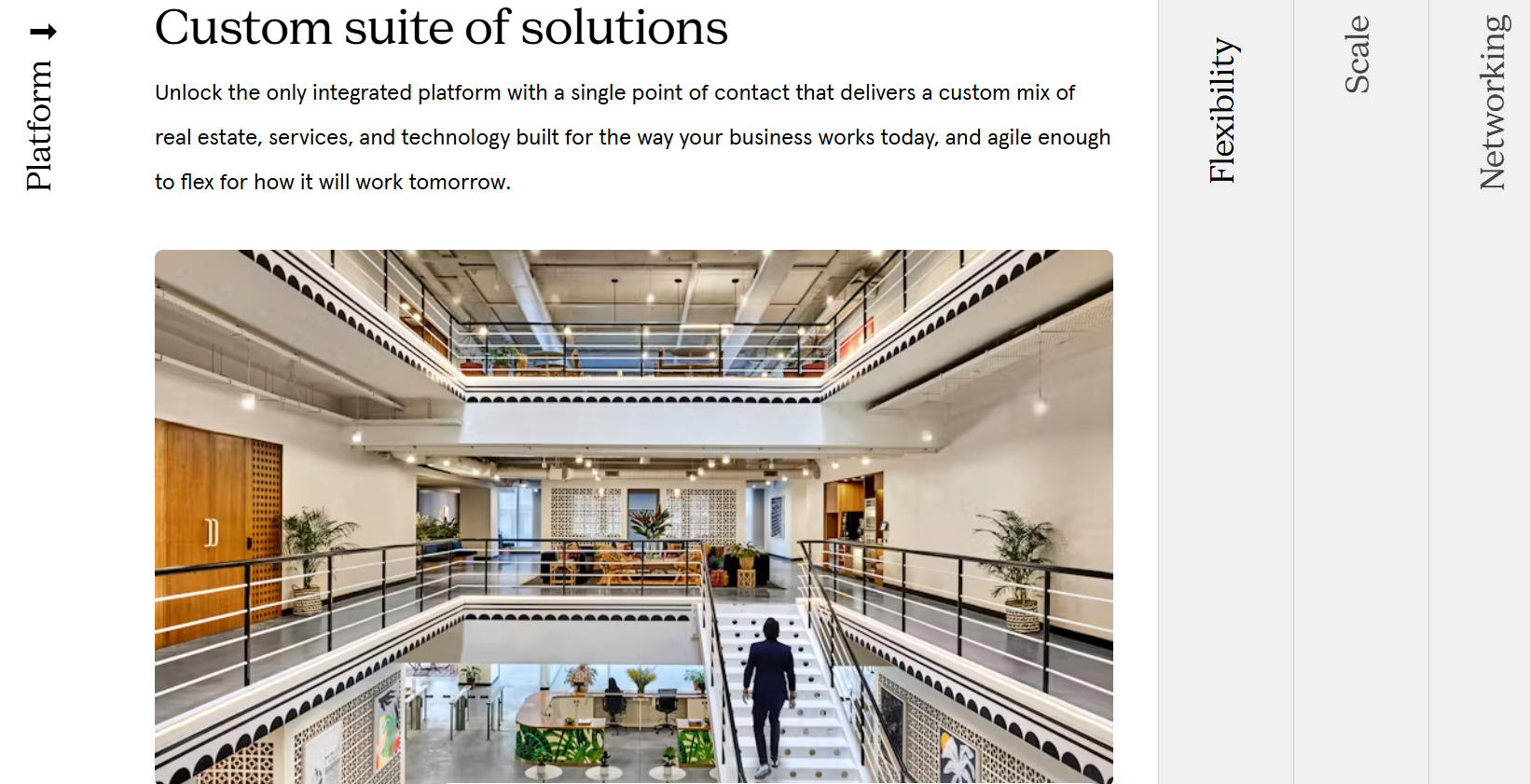
All-in-one real estate platform: For businesses that would otherwise need to coordinate space, construction, furniture, utilities, cleaning, and IT separately, WeWork consolidates all of it into a single relationship — a genuine time and vendor-management savings for growing companies.
Key Products and Services
WeWork’s offering breaks down into a few core products depending on how much space and permanence you need.
WeWork All Access
A monthly membership that unlocks drop-in access to hundreds of coworking spaces — hot desks, lounges, and phone booths — plus included credits for booking meeting rooms. This is WeWork’s most flexible and popular option for individuals who don’t need a permanent desk.
Dedicated Desk
A reserved desk in a shared office with 24/7 access, letting members leave their setup overnight for a more personal, consistent workspace than hot-desking.
Private Office
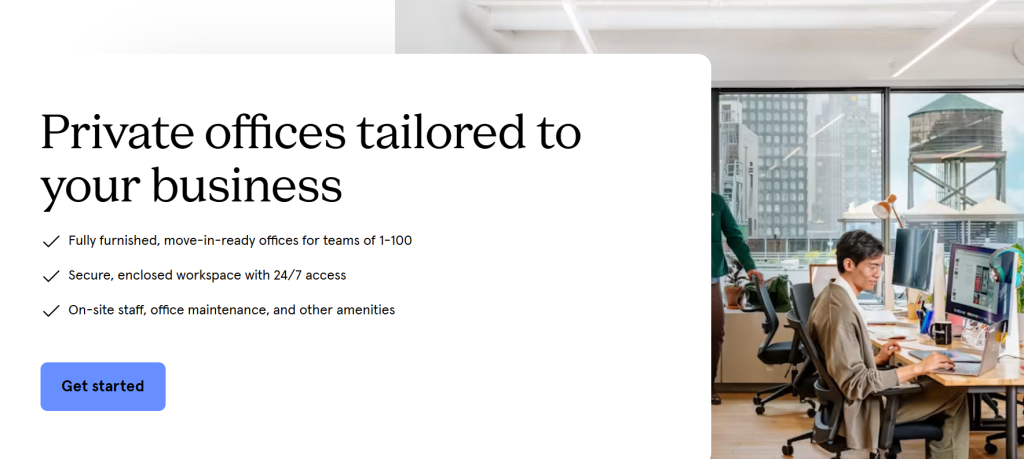
Move-in-ready, fully furnished offices for teams of any size, with Wi-Fi and printing included and an onsite team handling day-to-day office needs. Full-floor customizable offices are also available for larger organizations.
WeWork On Demand and Meeting Rooms
For occasional users, WeWork On Demand lets you book coworking space or meeting rooms without a membership at all, while dedicated meeting room and event space bookings are available to members and non-members alike for interviews, workshops, or client presentations.
Pricing, Plans, and Package Structure
WeWork does not publish a single global price list — cost varies significantly by city, building, and commitment length, and current promotions (like the up-to-20% off select private offices running through September 2026) shift regularly. Based on current market data and WeWork’s own published information, here’s a general sense of the ranges to expect. Always confirm live pricing for your specific building before committing.
| Membership Type | Approx. Price | Best For |
|---|---|---|
| Day pass | ~$29–$59/day | Occasional use without a membership |
| All Access (hot desk) | ~$279–$339/month | Freelancers and remote workers wanting flexible drop-in access |
| Dedicated desk | ~$300–$500/month | Solo professionals wanting a consistent, reserved spot |
| Private office | ~$700–$2,500+/month | Small to mid-size teams needing a dedicated, branded office |
How WeWork Compares to Alternatives
| Provider | Strength | Trade-off |
|---|---|---|
| WeWork | Design-forward spaces, strong startup/creative community | Quality varies by location; recurring billing/commitment complaints |
| Regus (IWG) | Largest global footprint (3,500+ locations), lower entry pricing | More corporate, utilitarian atmosphere; less community focus |
| Industrious | Hospitality-driven service, premium build quality | Higher price point ($419–$918/month base membership) |
| Local independent coworking | Lower cost, often stronger local community | No multi-city access; quality varies entirely by operator |
vs. Regus (IWG): Regus operates more than six times as many locations as WeWork and generally undercuts it on price, making it the stronger choice for businesses that prioritize sheer global coverage and a formal, corporate presentation over WeWork’s more social, design-led atmosphere.
vs. Industrious: Industrious has built a reputation for hospitality-driven service and consistently high build quality, which suits professionals willing to pay a premium for polish, but its base membership typically runs meaningfully higher than WeWork’s comparable tiers.
vs. local independent coworking: Independent spaces often win on price and a tighter-knit community, but they can’t match WeWork’s ability to drop into a consistent workspace in dozens of cities — a real trade-off for anyone who travels regularly for work.
Pros and Cons
What Members Love
Global mobility: Members who travel frequently consistently value being able to book a professional workspace in a new city without hunting for a local option each time.
Design and atmosphere: Well-run locations are praised for their aesthetic, energy, and sense of community — the qualities that originally made WeWork’s brand a category leader.
A functional app and access system: Several reviewers note that the WeWork app and building access (via keycard or app) work smoothly and reliably once set up.
Genuine financial stability post-restructuring: Emerging debt-free with a rationalized lease portfolio has meaningfully de-risked signing with WeWork compared to the pre-2023 company.
Limitations Worth Knowing
Trustpilot rating is low, and commitment-term disclosure is the top complaint: WeWork holds roughly a 1.9-star Trustpilot rating, and the single most recurring theme across dozens of recent reviews and BBB complaints describes checkout pages that present pricing as monthly while a 12-month commitment appears only in small-print terms — leading members to sign up believing they can cancel anytime.
Customer support and cancellation are frequently frustrating: Multiple reviewers describe difficulty reaching support, tickets closed without resolution, and no clear complaints process — a pattern that shows up across both Trustpilot and BBB filings.
Quality is inconsistent across locations: Some buildings are described as buzzing and well-staffed, while others in the same city are reported as understaffed, noisy, or poorly maintained — the brand does not guarantee a consistent experience location to location.
All Access hot-desk access can be limited at busy locations: Some reviewers of drop-in memberships report that peak-hour availability at popular buildings can mean settling for a shared communal seat rather than guaranteed desk space.
Who Should Use WeWork
Freelancers and remote workers who travel: If you regularly work from multiple cities, WeWork All Access offers a genuinely useful level of consistent, professional workspace access that a single local coworking membership can’t provide.
Startups and small teams: A private office membership removes the overhead of furnishing, maintaining, and staffing an office, letting a growing team move in and start working the same day.
Enterprise teams managing distributed real estate: WeWork’s business and enterprise solutions can replace multiple vendor relationships (space, furniture, IT, cleaning) with a single platform for companies managing offices across several cities.
Anyone considering a membership should read the fine print first: Given how consistently the commitment-term disclosure issue appears in recent reviews, prospective members — regardless of which tier they’re considering — should insist on written confirmation of the exact commitment length and cancellation terms before signing.
Businesses transitioning out of a traditional lease: Companies downsizing from a long-term office lease or scaling a distributed team can use WeWork’s private office or business solutions to bridge the gap without committing to another multi-year real estate obligation while their headcount and space needs are still in flux.

Getting Started: Step by Step
- Search locations near you using WeWork’s location finder to see which buildings and product types (hot desk, private office, meeting rooms) are available in your city.
- Book a tour of the specific building you’d actually use, since amenities and atmosphere vary meaningfully location to location.
- Compare membership tiers — day pass, All Access, dedicated desk, or private office — against how often and how consistently you’ll actually use the space.
- Read the full membership agreement before signing, paying specific attention to the commitment term, cancellation policy, and any add-on service fees.
- Ask for written confirmation of the commitment length and monthly cost from a sales representative if anything on the checkout page is unclear.
- Set up the WeWork app for building access, meeting room booking, and managing your membership day to day.
- Mark your renewal or commitment end date on your own calendar, since relying solely on WeWork’s cancellation process has been a recurring pain point for members.
Tips for Getting Maximum Value
Before signing anything, tour the actual building you’ll be using rather than judging WeWork by its brand reputation alone — member experiences vary significantly from one location to the next, and a five-minute visit will tell you more than any review. If you’re considering All Access specifically for its multi-city flexibility, confirm which nearby locations you’ll realistically use, since the value of the membership drops fast if your city only has one or two WeWork buildings. Given how frequently commitment-term confusion shows up in recent reviews, treat any “monthly” price on the signup page with healthy skepticism — scroll to the bottom of the checkout page, read every footnote, and if anything is ambiguous, get a WeWork sales representative to confirm the exact terms over email before you sign, so you have it in writing if a dispute comes up later. It’s also worth asking current members at the specific building — most locations have an active common area during business hours — how their own renewal and cancellation experience actually went, since firsthand accounts from people using the exact building you’re considering are often more reliable than either the sales pitch or an online review from a different city.
Future Outlook and Final Assessment
Flexible, hybrid-friendly workspace isn’t going away, and WeWork’s post-bankruptcy reset — a debt-free balance sheet, a rationalized real estate portfolio, and recognition on TIME’s 2026 Most Influential Companies list for its turnaround — puts the company in a genuinely stronger financial position than it held for most of the last decade. The honest caveats are real, though: a low Trustpilot rating driven substantially by unclear commitment-term disclosure, inconsistent support responsiveness, and location-to-location quality variance are patterns prospective members should go in aware of, not surprised by after signing.
Conclusion
WeWork’s story is one of the more dramatic turnarounds in recent corporate history — from a $47 billion valuation to Chapter 11 bankruptcy to a debt-free, TIME-recognized restructuring in the span of five years. The company’s global footprint, flexible product range, and design-forward spaces remain genuinely useful for professionals and businesses who need workspace without the overhead of a traditional lease. But the pattern of commitment-term disclosure complaints in recent reviews is frequent and specific enough that it deserves a clear-eyed look before you sign anything — read the fine print, tour the actual building, and get your terms confirmed in writing. Whatever workspace you land on, the goal at AI Solutes stays the same: make everything easy, starting with going in informed.
Ready to Find Your Next Workspace?
Explore more honest reviews, tutorials and tool comparisons to find the right tech for the way you work and live — at AI Solutes, where we make everything easy.
👉 Get Started: https://ai-solutes.com/wework
👉 Our YouTube Channel: youtube.com/@ai-solutes
👉 Our Facebook Fanpage: Facebook
👉 Our X (Twitter): @AISolutes
- Build Family Financial Security: Term Life Insurance, Asset Protection, Kids Investing
- Unleash Microsoft Copilot 2025: Transforming Workflow Automation and Productivity
- Hướng dẫn chèn Breadcrumbs cho website WordPress sử dụng plugin Yoast Seo
- Master Brevo 2026: Reviews, Pricing, and AI Email Automation Best Practices
- What If Pro-Level Table Tennis Training Was Built Into PongBot’s AI Engine?