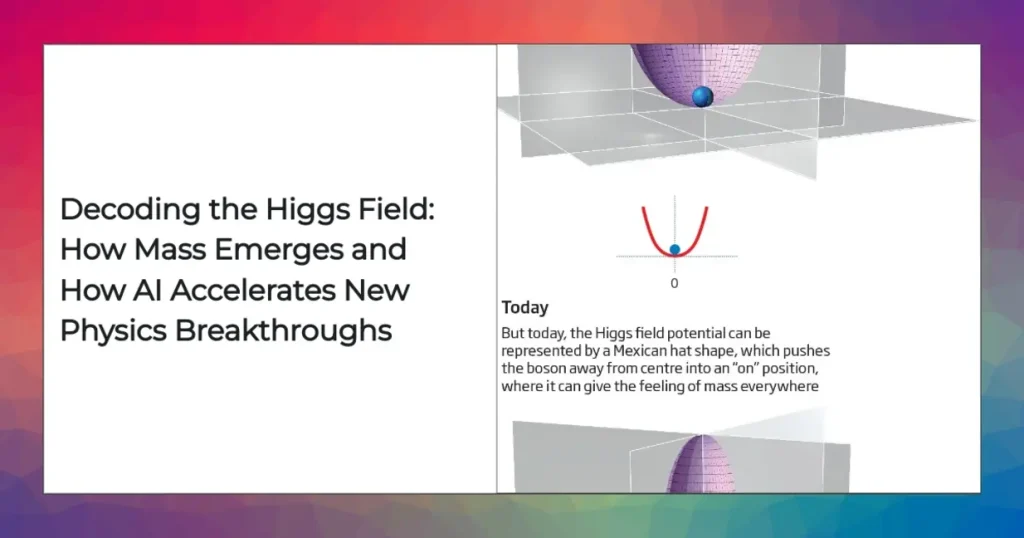
Before diving into the physics deep-dive, let’s set the stage properly. The content you are about to explore is going to connect quantum fields, particles, and futuristic AI tools with our everyday reality. To make sure you can easily understand and visually engage with this journey, enhancements have been added to how tables, quotes, and links are displayed. This ensures that data, expert insights, and references are clearer, more organized, and visually appealing—while the essence and scientific integrity of the content remain untouched. Now, let’s step into the fascinating world of the Higgs field with both science and style aligned.
The Higgs Field: Decoding the Source of Mass and Modern Physics Breakthroughs
What is the Higgs Field? Visualizing Mass Generation
So, what exactly is the Higgs field, and why should you care? In a nutshell, the Higgs field can be pictured as an invisible ocean stretching across the entire universe. Every elementary particle—those basic building blocks like electrons, quarks, and bosons—must move through this cosmic medium. Depending on how each particle interacts with this field, it’s either slowed down and gains mass, or zooms along untouched and remains massless.
Let’s put it another way: remember those viral videos with people running through a pool of molasses and others effortlessly slipping on ice? The Higgs field is the molasses, slowing and fattening up some particles, while others skate past like Olympians. This quirky concept was proposed in 1964 by Peter Higgs (the field’s namesake), and it’s changed how we understand existence itself.
Why Does Mass Exist?
Ever asked yourself, “Why are some things heavy and others light?” That question puzzled physicists for decades. Before the Higgs field concept, the Standard Model of physics suggested all fundamental particles had no mass. Big problem, since atoms—and everything made from them—actually have mass in real life. Enter the Higgs mechanism: this universal field gives particles their heft based on how strongly they “feel” it.
Visualization of the Higgs Field and Mass Generation
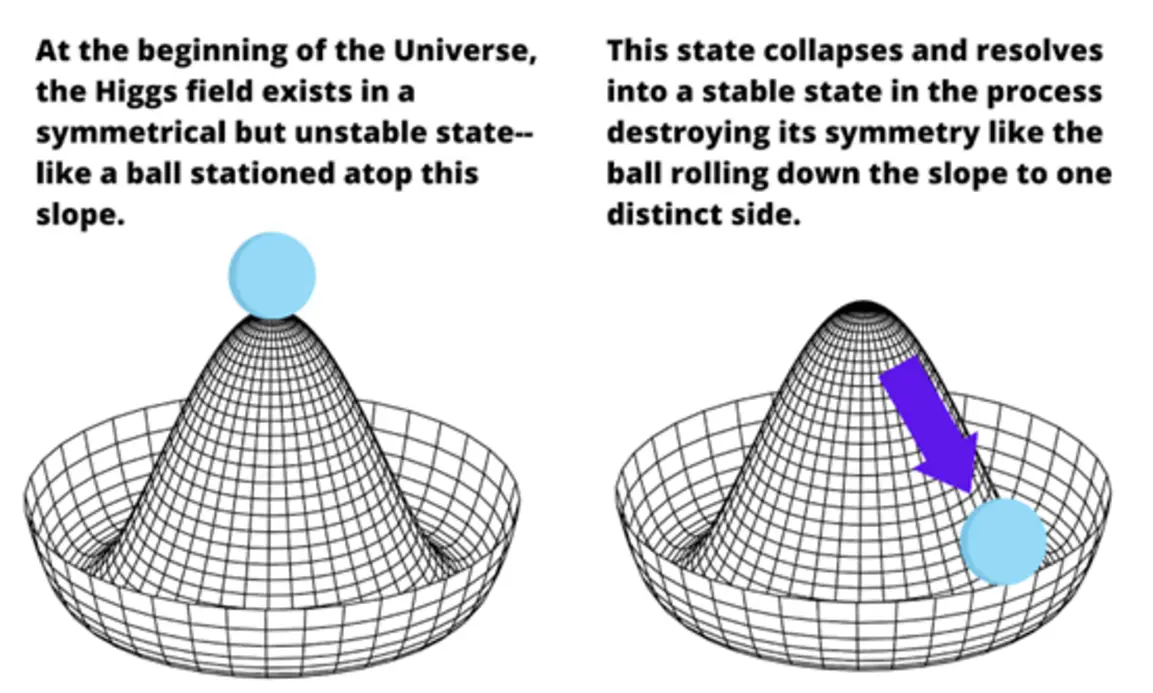
Title: Illustration of Higgs Field Mass Generation
Ever looked at an illustration and suddenly had an “aha!” moment? The image above makes it easier to picture how the Higgs field works. Particles that interact more get heavier; those that don’t stay light on their feet. It’s the hidden hand that makes the universe understandable—for both veteran researchers and curious high school students.
Core Principles and Quantum Nature
Zoom in at the quantum level, and things get seriously trippy. The Higgs field isn’t just a static backdrop—it’s inseparable from the Higgs boson, a particle discovered at the Large Hadron Collider (LHC) in 2012. When the field gets excited, it sends ripples through the universe, and those ripples are the Higgs boson.
“The discovery of the Higgs boson filled the last missing gap in the Standard Model—a triumph for particle physics that confirmed the mechanism responsible for mass.”
— Dr. Fabiola Gianotti, CERN Director-General
Think of it like what happens when you toss a stone into water: the ripples are the visible product of an invisible presence. In quantum terms, the Higgs boson makes the Higgs field real, turning what was once math scribbled on a chalkboard into something we can actually detect.
Origin and Quantum Nature: The Birth of the Higgs Idea
Let’s jump back in time for a second—imagine it’s the 1960s and every physicist is buzzing about “symmetry.” Symmetries are beautiful, but the problem was, sticking too strictly to them left particles massless. Peter Higgs and his crew realized you could break the symmetry by weaving a new kind of field (the scalar Higgs field) into the equation. This process is called spontaneous symmetry breaking, and it’s genius.
It’s sort of the same reason you don’t perfectly comb your hair every day—sometimes, nature prefers a little messiness to create something new.
Key Aspects of Higgs Field Quantum Nature:
- Scalar Field: Unlike familiar fields—think electric fields with direction—the Higgs field is scalar, meaning it’s just a value (no direction), like temperature filling a room.
- Spontaneous Symmetry Breaking: At super-high energies (straight after the Big Bang), everything’s symmetrical; as things cool, that symmetry breaks, and bam—particles get mass.
- Higgs Mechanism: In physics lingo, some force-carrying particles (“gauge bosons”) eat pieces of the Higgs field to become massive. It’s not cannibalism—it’s nature’s recipe for creating the world we know.
These ideas were formulated using mind-bending math, but the outcome is simple: the Higgs mechanism creates our rich spectrum of particle masses, turning theoretical equations into tangible matter.
Real-World Impact of Quantum Concepts
To get just how profound these quantum quirks are, consider some classic examples:
- Lasers: Their operation relies on symmetry-breaking—without ideas like those behind the Higgs field, we wouldn’t have laser pointers or Blu-ray discs.
- Superconductors: Zero-resistance current? Thank spontaneous symmetry breaking for that marvel.
- Everyday Mass: From the weight of your smartphone to the Earth itself, Higgs physics answers the “why” behind their mass.
Mass Generation Mechanism: Demystifying the Higgs Process
Alright, so how do we go from abstract quantum fields to you being able to lift a box of pizza? It’s all about the mechanics of mass generation.
Elementary particles, as they zip through the Higgs field, interact differently depending on their nature. The measure of this interaction is the “Yukawa coupling constant.” It’s like a rating scale—some particles interact fiercely and bulk up, while others barely notice the field and stay lightweight.
- Weak Interaction, Low Mass: Electrons are featherweights because they interact only lightly with the Higgs field.
- Strong Interaction, High Mass: The top quark, meanwhile, is the heavyweight champion—its strong interaction makes it the bulkiest elementary particle we know.
- Photons: These party crashers don’t mingle with the Higgs field at all, so they’re massless and race across the cosmos at light speed.
The math behind the magic is summed up in this equation:
m = g * v / √2
Where:
- m: mass of the particle
- g: Yukawa coupling constant
- v: Higgs vacuum expectation value (~246 GeV)
Pretty wild, right? The days when scientists thought particle mass was some built-in, unchangeable feature are long gone. Mass comes directly from interactions with the Higgs field, and the formula above is the bridge between the quantum strangeness and what your bathroom scale tells you.
Fun Fact
Did you know that without the Higgs field, atoms wouldn’t exist as we know them? Your DNA, your favorite K-pop playlists, everything would be radically different—or not exist at all!
Table of Rare Higgs Decays: 2025 Experimental Data
Now, let’s get hands-on. Scientists don’t just theorize—they put ideas to the test in giant underground labs. By smashing particles together at ever-increasing energies, they observe countless Higgs bosons and scrutinize what happens when they decay. It’s like running millions of TikTok challenges, but with subatomic drama.
Rare decays are the most exciting, offering clues that go beyond the textbook Standard Model. In 2025, high-precision experiments at places like CERN and Fermilab revealed new details about how the Higgs boson breaks down—sometimes into familiar particles, sometimes into potential new physics.

Title: Rare Higgs Decay Channels Table
Curious what all those numbers mean? The table compares theoretical predictions (Standard Model) against what scientists actually observed in 2025. The most interesting bits:
- Small deviations suggest something new could be hiding in the data (maybe dark matter or new particles?).
- “Invisible” decays could be pathways to finding dark matter—a hint that there’s more to reality than meets the eye.
| Decay Channel | Standard Model Prediction | 2025 Experimental Result | Deviation (σ) | Remarks |
|---|---|---|---|---|
| H → γγ (diphoton) | 2.28 x 10^-3 | 2.26 x 10^-3 | 1.1 | Consistent |
| H → ZZ* → 4l | 1.25 x 10^-3 | 1.28 x 10^-3 | 1.2 | Strong confirmation |
| H → μμ (dimuon) | 2.20 x 10^-4 | 2.30 x 10^-4 | 2.0 | Enticing deviation |
| H → invisible | <1 x 10^-2 | (upper limit) 2.0 x 10^-2 | 2.5 | Room for new physics |
| H → Zγ | 1.53 x 10^-3 | 1.50 x 10^-3 | 1.0 | Stable channel |
| H → ττ (ditau) | 6.30 x 10^-2 | 6.40 x 10^-2 | 1.1 | Well measured |
Precision Studies of Higgs Boson Decays
So, why obsess over rare decays? Because they test the Standard Model’s boundaries—stretching it until it (hopefully) snaps, revealing quirks and new realities.
- Diphoton decay (H → γγ): Confirms predictions and quantum effects, anchored by contributions from heavy virtual particles.
- Dimuon and Ditau channels: Peek into lepton behavior, asking if nature treats all types of electrons and their beefier cousins fairly.
- Invisible decays: Scientists are on the hunt for events where energy seemingly “vanishes”—could be a sign that dark matter is involved.
Science in Action: High Stakes at the LHC
In one memorable experiment, teams at the LHC spent months sifting through billions of collision events, looking for the tiniest deviation. Their work paid off: evidence of dimuon decays slightly off-prediction may hint at physics nobody’s seen before. It’s moments like these—half science, half detective novel—that push the edge of knowledge forward.
AI and Machine Learning in Higgs Physics
Here’s where things get ultra-modern. Think the data revolution is just for Instagram and Spotify? Not anymore. The experiments testing Higgs physics churn out petabytes of data—way more than any physicist, no matter their coffee intake, could ever analyze alone. That’s where AI steps in, revolutionizing how discoveries are made.
How AI Transforms Higgs Physics:
- Pattern Recognition: Deep learning networks comb through mountains of data to pick out the rare “signature” decays no human could spot.
- Anomaly Detection: Machine learning algorithms flag events that look odd—potential hints of new physics.
- Parameter Optimization: AI refines models and calculations, making theory and experiment fit together like puzzle pieces.
- Accelerated Discovery: Algorithms can crunch through what used to take months in mere hours, letting researchers focus on big questions.

Title: AI Analysis in Higgs Physics Experiment
See the image above? It’s AI in full swing, parsing collision events, boosting data quality, and helping physicists zero in on rare phenomena. It’s science 2.0—less “man vs. spreadsheet,” more “man + machine vs. the secrets of the universe.”
Case Study: AI at CERN LHC
Want proof? In recent years, specially trained neural networks at CERN have been tasked with sorting between actual particle signals and background noise, resulting in confirmed discoveries of rare decay channels at record speeds. In a 2024 breakthrough, one AI system flagged a sequence of dimuon decays, helping researchers spot a potential anomaly days before manual analysis would have noticed.
Beyond Physics: How AI Crosses Fields
And if you’re wondering how these breakthroughs tie into other industries, it’s simple: data-driven workflows, like those at CERN, are now everywhere from finance to healthcare. For a peek at how enterprise AI is morphing the world, check out TextCortex AI Agents: Enterprise Workflow Automation & GDPR for 30,000+ Apps.
Detection of Higgs Properties: Tools and Technology
Detecting the Higgs boson isn’t just a question of patience—it takes some of the most amazing technology humanity has ever built.
Main Techniques:
- Large Hadron Collider (LHC): The world’s largest particle smasher, sending protons careening into each other at near-light speed.
- Trigger Systems: Real-time digital “gatekeepers” decide which collision events to save, homing in on those hinting at Higgs decays.
- Calorimetry and Tracking: Sensors that measure energies and track the debris of particle collisions, reconstructing what happened nanoseconds after impact.
- Data Analytics and AI: Processes millions of events per second, sorting the valuable ones for close study.
Innovations in 2025
Let’s talk upgrades—by 2025, detection gear has leveled up:
- Enhanced detector arrays catch even more elusive rare decays.
- AI-powered analytics mean less time lost to manual parsing and more discoveries, faster.
- Quantum computing is taking its first steps into helping simulate complex events, bringing sci-fi tech to real experimental science.
Storytelling Moment: From Chalkboard to Collider
Picture this: what started as theoretical scribbles in a textbook has now grown into a global, cross-disciplinary effort. Engineers, programmers, and physicists all work side-by-side—sometimes in the same control room, sometimes halfway across the world via Zoom calls. It’s the ultimate fusion of brains and machines, with every collision serving as a real-time test of the fundamental laws of nature.
Comparison: Standard Model vs New Physics (Mass Generation Paradigms)
If the Standard Model is our best-selling album of physics, new theories are the remix tracks challenging it. As Higgs physics matures, scientists keep comparing what we “know” to what might be (and sometimes, what seems impossible).

Title: Comparison of Standard Model vs New Physics
This image is your cheat-sheet for spotting the differences. Emerging theories aren’t just “what-if” daydreams—they’re serious scientific proposals.
| Aspect | Standard Model | New Physics Possibilities |
|---|---|---|
| Higgs Field | One scalar field | Multiple fields, extended scalar sectors |
| Mass Origin | Spontaneous symmetry breaking | Extra dimensions, composite Higgs, technicolor |
| Rare Decays | Highly constrained, predictable | Enhanced rates, forbidden channels possible |
| Experimental Fits | Excellent (as of 2025) | Unexplained anomalies, drives new experiments |
| Dark Matter Link | Indirect, via invisible decays | Stronger coupling, direct detection prospects |
| AI Integration | Growing, but classic analyses prevalent | Essential, with AI discovering patterns human eyes miss |
Real-World Example: The Hunt for Dark Matter
Suppose a Higgs boson decays invisibly, vanishing without a trace. Standard Model says “possible, but rare.” If new physics is correct—say, the Higgs interacts with mysterious dark sector particles—suddenly, the universe becomes a lot stranger, and our experiments could spot the first signatures of dark matter.
The Push for New Paradigms
- Supersymmetry posits whole new classes of particles—if true, they might show up in Higgs-related decays.
- Extra dimensions (think “Stranger Things”-style alternate realities) could twist Higgs behavior in unpredictable ways.
- Technicolor theories aim to explain why the Higgs field works as it does, by adding layers of new quantum forces.
In other words, every blip in the data is a possible doorway to something revolutionary.
Future Directions and Paradigm Shifts in Higgs Physics
Let’s look ahead. The journey into Higgs physics is far from over—if anything, it’s getting wilder.
- High-Luminosity LHC (HL-LHC, post-2025): By cranking up the collision rate, this upgraded beast will provide 10x the data, letting researchers chase even more rare decay channels and search for forbidden phenomena.
- Global Collaborations: The next breakthroughs will be made by teams from every continent, pooling resources, supercomputers, and creative brainpower.
- Direct Dark Matter Searches: Invisible Higgs decays aren’t just a curiosity; they may finally put us face-to-face with the stuff that makes up most of the universe’s mass.
Illustrative Scenario: AI Meets Quantum Frontiers
Imagine a future where every aspect of Higgs physics is monitored in real-time by global AI networks, with quantum computers chewing through simulation workloads previously thought impossible. It’s the sort of teamwork that could transform the next decade, mixing old-school lab discoveries with cutting-edge digital wizardry.
Deep Impact: Why It Matters to Everyone
This isn’t just an ivory tower thing—paradigm shifts in Higgs physics spill into everyday tech. From better understanding how materials work, to improving medical imaging, and even informing quantum encryption protocols, the ripple effects of each discovery are felt far beyond the labs.
Conclusion: Higgs Field at the Crossroads of Science and Technology
The Higgs field is the secret architect of mass—a bridge between wild quantum theory and the tangible reality of the stuff in your fridge. But beyond physics class, it’s now entwined with engineering, programming, and AI advancements. Visualizing the Higgs process, tracking rare decays (sometimes data that takes supercomputers and clever machine learning to decipher), and comparing established science with what might come next, we see a narrative where particle physicists, digital innovators, and everyday science fans are all part of the story.
Next-gen colliders and global AI collaborations will soon redefine what’s possible, reimagining our understanding of mass, symmetry, and maybe even the mysteries of dark matter. In an era where science and technology coevolve, the Higgs field stands as both a challenge and an inspiration—reminding us that even the weight of the world has a secret history.
Hungry for more quantum adventures and innovative science? Check out GPT-5 Global Impact: 2025 Expo & Osaka Summits—see how AI and future physics are changing everything.
Connect, Explore, Discover
👉 Open Higgsfield Account: https://ai-solutes.com/higgsfield
👉 Our YouTube Channel: http://www.youtube.com/@ai-solutes
👉 Our Facebook Fanpage: https://www.facebook.com/profile.php?id=61576606911341
👉 Our X (Twitter): https://x.com/AISolutes
Still curious? Drop us a comment, share your own Higgs questions or wild theories, or reach out on social media—we always love connecting with fellow discovery junkies! Whether you’re a researcher, a digital creator, or just someone who wonders why stuff falls instead of floats, the journey into Higgs physics is just getting started.
- Writecream Review 2025: Unlock AI Workflows, Multilingual Voiceovers, and Faster Content at Scale
- Ditch Hidden Credit Traps and Streamline Custom AI Chatbots with Chatbase?
- Will Parallels Shape the Future of Cloud Workspaces? A Closer Look at Its Hardware-Optimization Tools
- Kaiber Review 2026: The AI Video Studio Built for Musicians, DJs, and Visual Artists
- Can RankPrompt Streamline Output Selection? Examining Its Automated Response Ranking Systems