The threat that empties your bank account in 2026 probably won’t look like a virus. It will look like a text from your bank, a voice on the phone that sounds exactly like your daughter, or a renewal invoice from a company you actually use. Scams drained roughly $442 billion from consumers worldwide in a single year according to the Global Anti-Scam Alliance, and the FBI logged more than 22,000 AI-specific fraud complaints in 2025 alone, totaling nearly $900 million in reported losses. That shift — from malware you catch to deception you fall for — is exactly what Malwarebytes has spent the last few years rebuilding itself around. What began in 2004 as a free scanner written by a 14-year-old who infected his family’s PC is now a full digital-life protection platform: real-time antivirus, an AI-powered scam detector, an owned-infrastructure VPN, identity monitoring, and personal data removal, running across Windows, macOS, Android, iOS and ChromeOS.
For freelancers protecting client data, small business owners without an IT department, creators whose accounts are their income, and anyone managing security for less technical family members, the question isn’t whether you need protection — it’s whether Malwarebytes is the right one to buy. This 2026 review covers the full picture: what the free version actually does, how Premium and its AI Scam Guard perform, independent lab results including the false-positive problem, complete pricing with the renewal traps, honest comparisons against Bitdefender, Norton and Microsoft Defender, and precisely who should subscribe.
Malwarebytes Review 2026: The Lightweight Security Suite Built for the Age of AI-Powered Scams
Overview and Background
Malwarebytes is an American cybersecurity company headquartered in Santa Clara, California, with an EMEA base in Cork, Ireland. It was formally founded on 21 January 2008 by Marcin Kleczynski and Bruce Harrison, though the story starts four years earlier: Kleczynski, then a teenager in the Chicago suburbs, infected his family’s computer while hunting for a game download and — unable to find a tool that could clean it — built one himself with help from strangers on a malware forum. By the time he was 18 the company was making millions. He remains CEO today.
That origin explains something important about how the company still operates. Malwarebytes built its reputation as the specialist scanner that caught what mainstream antivirus missed — the tool you ran alongside Norton when something felt wrong. It has taken only a single significant outside investment in its history and remains privately held and founder-controlled, with roughly 600 to 1,000 employees depending on which count you use. In 2023 it split its business products into a separate brand, ThreatDown, so the consumer and enterprise sides could evolve independently. And in November 2024 it acquired the Swedish VPN provider AzireVPN, giving it direct ownership of its VPN infrastructure rather than reselling someone else’s — a meaningful distinction in a category where most bundled VPNs are white-labeled.
The 2026 product is best understood as a deliberate repositioning. For years Malwarebytes was the cheap second-opinion scanner. Today it competes directly with full suites at full-suite prices, and the centerpiece of that shift is scam defense. Scam Guard — an AI chat assistant trained on the company’s threat intelligence — launched on mobile in mid-2025 and expanded to Windows and Mac in February 2026. You paste in a suspicious text, link, email or screenshot and get an assessment in seconds. According to the company’s own data, Scam Guard flagged high-risk scenarios in 15% of interactions, cases where users were on track to lose $1,000 or more.
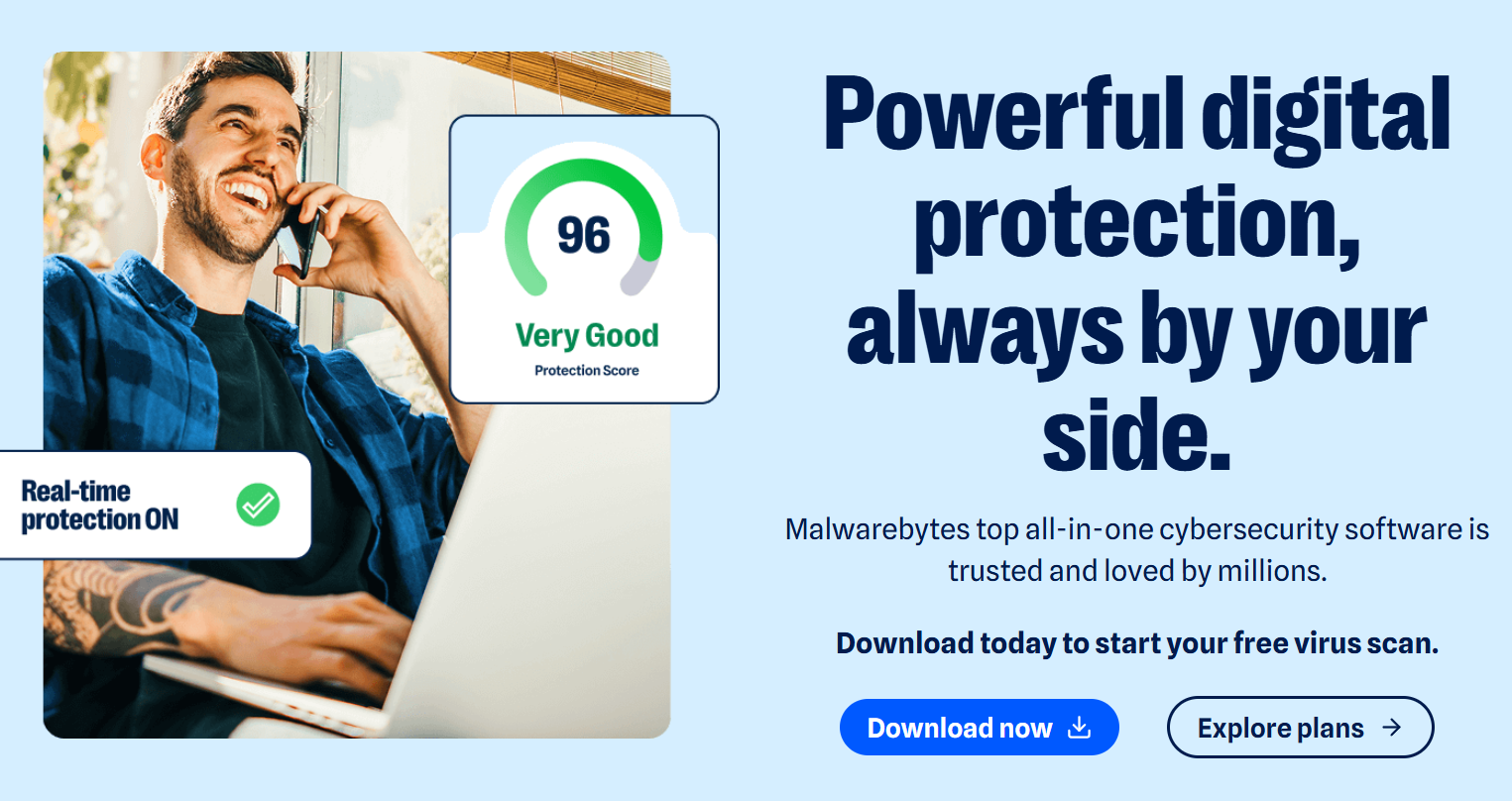
Why Malwarebytes Stands Out in 2026
Plenty of security suites will sell you more boxes on a feature checklist. Here is where Malwarebytes earns its place anyway.
Scam defense is a first-class product, not a marketing bullet: Most antivirus vendors treat phishing as a URL blocklist. Malwarebytes built an AI assistant specifically for the moment of doubt — the text that might be from your bank, the job offer that seems too good, the invoice you don’t recognize. Scam Guard is trained across romance fraud, phishing, financial scams, robocalls and shipping fraud, and it learns from new samples users submit. In a year when two-thirds of adults reportedly can’t reliably distinguish a scam from the real thing, having an expert second opinion one click away is a genuinely different value proposition.
It plugs into the AI tools you already use: This is the detail most reviews miss, and it matters enormously for anyone who lives inside AI assistants. Malwarebytes has made its threat intelligence available inside ChatGPT and as a Claude connector — meaning you can ask your assistant whether something is a scam and get a verdict backed by Malwarebytes research rather than a general-purpose guess. For professionals whose workflow already runs through these tools, that’s security meeting you where you actually work.
Genuinely excellent cleanup and remediation: This remains the company’s core competency and the reason IT technicians have kept it on a USB stick for fifteen years. When a machine is already compromised — adware, PUPs, browser hijackers, tech-support scam payloads — Malwarebytes still removes things that other engines leave behind. That reputation is earned, not marketed.
Layered protection that goes past signature matching: Premium runs four distinct real-time layers — web protection blocking malicious and scam sites before they load, malware and PUP protection, behavioral ransomware protection that watches for mass file encryption, and exploit protection shielding browsers and document readers from the injection techniques attackers use. Behavioral detection matters because it catches threats that have never been seen before.
A VPN it actually owns: Since acquiring AzireVPN, Malwarebytes controls its own VPN infrastructure and inherited Blind Operator — a design that disables both remote and local server access to make traffic interception and tampering effectively impossible. The no-log policy was independently audited in April 2026. Most bundled VPNs are an afterthought; this one is a legitimate WireGuard-based service that could stand alone.
Substantial free tools beyond the scanner: Browser Guard is a free extension for Chrome, Edge, Firefox and Safari that blocks ads, trackers and scam pages. The Digital Footprint Portal lets anyone check what personal data of theirs has surfaced in breaches. Scam Guard itself is free. Very few security companies give away this much, and after twenty years the free scanner is still free — which reflects a stated company position rather than a temporary promotion.
A 60-day money-back guarantee: Double the industry norm. Combined with a 14-day trial that requires no credit card, the risk of trying Malwarebytes is close to zero — an unusually confident stance in a category built on hard-to-cancel subscriptions.
Key Features and Technology
The 2026 lineup spans four areas: core security, scam and identity defense, privacy, and the free tools anyone can use.
Premium Security: The Core Engine
Premium Security delivers continuous real-time protection against malware, ransomware, spyware, adware and potentially unwanted programs, plus scheduled and custom scans, external drive scanning, and harmful-site blocking. The engine combines signature detection with AI-driven behavioral analysis, which is how it handles threats that have no known signature yet. It runs on Windows, macOS, Android, iOS and ChromeOS, and the desktop app has been rebuilt around a cleaner dashboard in the Malwarebytes 5 generation.
Scam Guard and Scam Number Check
Scam Guard works like a chat window: drag in a suspicious email, paste a URL, upload a screenshot of a text message, and it returns a verdict plus recommended next steps. Reviewers describe it as useful and well-executed rather than revolutionary — but usefulness at the exact moment of uncertainty is the whole point. Scam Number Check, added in June 2026, extends the same logic to unfamiliar phone numbers. On iOS the app also filters suspicious texts into your junk folder automatically.
Identity Protection and Personal Data Removal
The top Ultimate tier adds identity monitoring, credit monitoring, dark web alerts, identity theft insurance, recovery support and a Personal Data Remover that submits deletion requests to data brokers on your behalf. The Digital Footprint Scanner shows you exactly which of your credentials and personal details have appeared in known breaches — genuinely sobering the first time you run it.

How It Performs in Independent Testing
The lab picture in 2026 is strong on detection and weak on precision. SE Labs awarded Malwarebytes Premium a AAA rating in its 2026 reporting, with protection accuracy around 97% and legitimate-software accuracy around 98%. Malwarebytes earned an AV-TEST Top Product award in June 2026. AV-Comparatives real-world testing in early 2026 recorded a protection rate near 100%, blocking essentially every live threat thrown at it. The catch is false positives: in the same testing period Malwarebytes produced around twenty of them, among the highest counts of any vendor evaluated, which pulled its award level down despite excellent raw detection. In plain terms, it catches almost everything — including, occasionally, files that were never dangerous.
Pricing, Plans, and Package Structure
Malwarebytes sells annual subscriptions that auto-renew, and its pricing is unusually hard to pin down. Plan names have shifted (older reviews say “Premium” while checkout now shows Standard, Plus, Ultimate, Individual and Family), device counts differ between listings, promotional discounts of 30–50% run frequently, and regional pricing varies. The figures below are realistic approximate ranges for personal plans as of mid-2026 — orientation, not a quote.
| Plan | Approx. Price / Year | What You Get | Best For |
|---|---|---|---|
| Free | $0 — permanent | Manual on-demand scanning and removal, Browser Guard, Scam Guard, Digital Footprint check | Second-opinion cleanup alongside another antivirus — no real-time protection |
| Standard | ~$45–60 (promos lower) | Real-time antivirus, ransomware and exploit protection, web protection, scheduled scans; 1–3 devices | Anyone who just wants excellent, lightweight core protection |
| Plus | ~$60–80 (promos lower) | Everything in Standard plus the unlimited WireGuard-based VPN; typically 3 devices | The value sweet spot — replaces a separate $40–60/year VPN subscription |
| Ultimate | ~$140 intro; renewal listed far higher | Adds identity and credit monitoring, dark web alerts, data removal, identity theft insurance (1 adult) | US users who want identity protection bundled — check the renewal price first |
| ThreatDown (Business) | Quote-based, per endpoint | Four tiers (Core, Advanced, Elite, Ultimate) with endpoint protection, EDR and managed detection | Small and mid-sized businesses and MSPs — sold under the separate ThreatDown brand |
One structural warning deserves its own sentence: the gap between introductory and renewal pricing on the Ultimate tier is severe. Multiple 2026 sources document an intro price near $140 against a standard renewal rate roughly double that. Standard and Plus renewals also step up, though less dramatically. This is normal for the antivirus industry and not unique to Malwarebytes — but it is the single most common source of customer anger, and it is entirely avoidable if you diarise the date.
How Malwarebytes Compares to Alternatives
Windows security in 2026 is genuinely stronger than it was a decade ago, which changes the calculation. Here’s the honest landscape.
| Option | Approx. Cost / Year | Core Strength | Main Trade-Off |
|---|---|---|---|
| Malwarebytes | ~$45–140 intro | Best-in-class scam defense and cleanup; simple interface; owned VPN; 60-day guarantee | Above-average false positives; fewer suite extras; no phone support |
| Bitdefender Total Security | ~$60 intro / ~$110 renewal | Consistently top lab scores with notably low false alarms; 5 devices; light footprint | Basic VPN is data-capped; more settings to navigate; no equivalent scam assistant |
| Norton 360 Deluxe | ~$50 intro / ~$120 renewal | Most complete suite — VPN, password manager, cloud backup, parental controls, dark web monitoring | Heavier and busier; steep renewal increases; more upsells inside the product |
| Microsoft Defender (built in) | $0 on Windows | Free, deeply integrated, cloud-backed, genuinely competent baseline in 2026 | Windows only; no VPN, identity tools or scam assistant; thin cleanup for existing infections |
| DIY stack | ~$40–70 (VPN + tools) | Defender plus a standalone VPN and free password manager — pick best-in-class for each | Multiple subscriptions and dashboards; no unified support; nothing covers scam detection |
vs. Bitdefender: If pure detection quality with minimal false alarms is your priority, Bitdefender is the more precise instrument — it consistently posts top-tier protection scores while keeping false positives low, which is exactly where Malwarebytes currently stumbles. Malwarebytes wins on simplicity, on cleanup of existing infections, and decisively on scam defense. Choose Bitdefender for maximum technical rigor; choose Malwarebytes if the threats you actually worry about arrive as messages rather than files.
vs. Norton 360: Norton offers more for the money on a pure feature count — parental controls, cloud backup, a password manager and LifeLock identity tools that Malwarebytes doesn’t match. It’s the better choice for a household that wants one subscription covering everything. The trade-off is weight and noise: Norton is a busier product with more upselling, while Malwarebytes stays deliberately out of your way. Both run 60-day guarantees, so both are low-risk to try.
vs. Microsoft Defender: This is the comparison that should make you think hardest. Defender is free, built in, and in 2026 is a legitimately capable baseline for a careful user on Windows. If you never click unknown links, never install software from search results, and don’t need a VPN or identity monitoring, Defender plus common sense is defensible. What you’re paying Malwarebytes for is cross-platform coverage, remediation when something does get through, and the scam layer Defender simply has no answer to.
Pros and Cons
What Users Love
Removal that actually works: The most durable theme in twenty years of user feedback. When a machine is infected, Malwarebytes cleans it — often after other tools have declared the system fine. This is why technicians keep it in their toolkit regardless of what else is installed.
Simple enough for non-technical users: Install, and it works. There is no maze of policy settings or exclusion rules to configure. For anyone managing security for a parent or a small team, that simplicity is a feature worth paying for.
Scam protection with no real competitor: Browser Guard plus Scam Guard is the strongest consumer scam defense in the category, and the ChatGPT and Claude integrations extend it beyond the app entirely.
Meaningful free tier, permanently: Twenty-plus years on, the core scanner remains free, alongside Browser Guard, the Digital Footprint Portal and Scam Guard. That’s a real commitment, not a funnel gimmick.
A VPN worth using: Owned infrastructure, WireGuard, Blind Operator server hardening and an independently audited no-log policy. Bundled VPNs are usually filler; this one isn’t.
Low-risk to try and to leave: A card-free 14-day trial and a 60-day refund window are among the most generous terms in consumer security.
Limitations Worth Knowing
False positives are a real and documented problem: This is the most substantive technical criticism. In 2026 lab testing Malwarebytes blocked essentially every genuine threat but generated one of the highest false-positive counts among tested vendors, costing it award tiers it would otherwise have earned. Users report legitimate files being quarantined and support being slow to investigate. If you work with development tools, niche software or custom scripts, expect to manage an exclusion list.
Renewal pricing can roughly double: The Ultimate tier’s intro-to-renewal jump is the harshest example, and Standard and Plus step up too. Auto-renewal complaints appear consistently across Trustpilot, ComplaintsBoard and consumer review sites — often from people who genuinely didn’t realise a charge was coming.
Support has no phone line: Help runs through chat and email, and reviewers frequently describe the chatbot as unhelpful and human responses as slow or repetitive, particularly on billing and cancellation issues. To its credit the company replies to the large majority of negative public reviews within a week — but if you want to call someone, you can’t.
Fewer features than the big suites: No parental controls, no cloud backup, no firewall management. If you want one subscription covering an entire household’s needs, Norton or Bitdefender offer more per dollar.
The lightweight reputation isn’t universal: Malwarebytes is generally light, but users on older or low-resource machines report noticeable slowdowns during scheduled deep scans. Schedule scans for times you’re not working.
Plan naming is genuinely confusing: “Premium,” Standard, Plus, Ultimate, Individual, Family and the separate ThreatDown business brand overlap in ways that make comparison shopping harder than it should be. Read the feature list, not the tier name.
Who Should Use Malwarebytes
Freelancers and solo professionals handling client data: A single compromised laptop can mean a breach notification to every client you have. You need real-time protection and a VPN for public networks without becoming a part-time sysadmin. Plus covers both at a price that undercuts buying them separately.
Small business owners with no IT department: If you have a handful of machines and nobody whose job is security, the low-configuration approach is exactly right. Above roughly ten endpoints, look at ThreatDown instead — it gives you central management and EDR without enterprise complexity.
Creators and anyone whose accounts are their livelihood: Account takeover via phishing is the defining risk here, and it’s precisely what Browser Guard and Scam Guard are built to stop. Standard is the floor; add Plus if you work from cafés and co-working spaces.
Anyone protecting less technical family members: This may be the strongest use case of all. Scam Guard gives an older relative a way to check “is this real?” without phoning you at 11pm, and it works on their phone. A Family plan covering multiple devices is the sensible structure.
US users wanting identity protection in one bill: Ultimate bundles credit monitoring, dark web alerts, data broker removal and identity theft insurance. Outside the US the value is meaningfully thinner — check your region’s feature list first.
Who should skip it: Careful Windows-only users who don’t need a VPN or identity tools are genuinely well served by Microsoft Defender plus the free Malwarebytes scanner for occasional second opinions. Households wanting parental controls and cloud backup in one subscription should look at Norton. And anyone who needs phone support should choose a vendor that offers it.
Getting Started: Step by Step
- Start with the free tools — they cost nothing. Install Browser Guard in your browser and run the free scanner once. Check your exposure in the Digital Footprint Portal. This alone raises your security meaningfully before you spend a cent.
- Take the 14-day trial. No credit card is required, so there’s no auto-charge trap at the end. Install on your primary device and let real-time protection run through a normal working week.
- Run a full scan and handle any detections carefully. Given the false-positive tendency, review the quarantine list rather than deleting blindly. If a file you recognise as legitimate is flagged, restore it and add an exclusion.
- Test Scam Guard deliberately. Paste in a genuinely suspicious message from your junk folder and see how the assessment reads. This is the feature you’re really paying for — make sure you find it useful.
- Pick your tier by what you’d otherwise buy separately. Already paying for a VPN? Plus likely saves you money outright. Want identity monitoring and you’re in the US? Compare Ultimate’s renewal price against buying identity protection standalone.
- Check the renewal price before you confirm. Look for the post-first-year rate on the checkout page, not just the discounted headline number, and confirm the device count and your local currency.
- Set two reminders immediately. One at day 55 while the 60-day money-back guarantee still applies, and one about eleven months out to review the renewal before it charges. These two calendar entries prevent almost every complaint in this review.
Tips for Getting Maximum Value
Buy during a promotion — discounts of 30–50% run often enough that paying full list price is usually unnecessary, and check whether a multi-year term locks a better rate than annual renewal. Count your devices honestly before choosing a tier, since a family plan is almost always cheaper than several individual licences. If you already pay for a VPN, price Plus against your combined spend; the bundle frequently wins outright. Schedule deep scans overnight rather than mid-morning, especially on older hardware. Build an exclusion list proactively for development tools, niche utilities and anything custom you run, so a false positive never interrupts your work. Put Browser Guard on every browser you use, not just the main one — it’s free and it blocks the scam pages before they ever load. Teach the people you support to use Scam Guard rather than calling you; the habit is worth more than any single feature. And treat unexpected renewal emails with suspicion by default: check your subscription inside the app, never via a link. Above all, remember that renewal date. One calendar reminder converts the single most common complaint about this product into a non-issue.
Future Outlook and Final Assessment
The strategic bet Malwarebytes has made looks correct. Traditional malware is increasingly handled by the operating system — Microsoft Defender is a competent baseline now, and that permanently compresses the market for “just antivirus.” Meanwhile deception-based attacks are exploding: voice cloning, deepfake video calls, AI-generated phishing indistinguishable from real correspondence, and the hundreds of billions in annual global losses that follow. Building the strongest consumer scam-detection layer in the category, and pushing it into ChatGPT and Claude where people already ask questions, positions the company where the growth actually is rather than where its history is.
Structurally it’s on solid ground too. Founder-led, privately held, minimally leveraged, with an owned VPN stack and a separate business brand in ThreatDown, Malwarebytes isn’t a company likely to be gutted by an acquirer or forced into short-term monetisation. The free tier surviving twenty-plus years is reasonable evidence that stated commitments hold.
The caveats stand as written. False positives are the genuine technical weakness and cost it lab awards it would otherwise win. Renewal pricing climbs steeply and catches people out. Support has no phone line and the chat experience frustrates users at exactly the moments they’re most annoyed. And the feature set is narrower than the big suites. None of that is disqualifying — but all of it should inform which tier you buy and how you manage the subscription.
Conclusion
Malwarebytes is no longer the second-opinion scanner it was famous for being, and reviews that still describe it that way are a decade out of date. What it has become is a focused, lightweight security platform built around the threat that actually costs people money in 2026 — not the virus in a download, but the message that convinces you to hand over your credentials yourself. Its cleanup engine remains best-in-class, its scam defense has no real equivalent in the category, and its VPN is one of the few bundled ones worth using on its own merits.
It isn’t the most feature-complete suite you can buy, it flags more false positives than its best rivals, and its renewal pricing demands attention. Go in knowing all three and you’ll get excellent value from it. Start with the free tools, take the card-free trial, choose the tier that matches what you’d otherwise pay for separately, and set that one calendar reminder — because good security shouldn’t demand constant vigilance from you, it should quietly handle the hard parts and make everything easy.
Protect your devices, your identity and your inbox — start your free Malwarebytes trial today.
Explore more honest reviews, tutorials and tool comparisons to find the right tech for the way you work and live — at AI Solutes, where we make everything easy.
👉 Start Your Free Trial: https://ai-solutes.com/malwarebytes
👉 Our YouTube Channel: youtube.com/@ai-solutes
👉 Our Facebook Fanpage: Facebook
👉 Our X (Twitter): @AISolutes
- Vadoo AI
- Does QuickBooks Enhance Banking Reconciliation? Analyzing Their Secure Financial Institution Syncing Features
- What If You Never Paid Monthly Software Subscriptions Again? Inside AppSumo’s Lifetime Deals
- Master Weebly in 2026: Explore Features, Pricing, Pros, Cons, and SEO Strategies
- Should Devs AI Optimize Workflow? Analyzing the Devs AI Development Platform