If you run any kind of B2B outreach, you already know the quiet chaos of a modern sales stack: a lead database in one tab, an email sequencer in another, a LinkedIn automation tool in a third, a warm-up service somewhere in the background, and a spreadsheet trying to hold it all together. Every handoff between those tools is a place where data breaks, personalization gets lost, and deals slip through the cracks. lemlist was built to collapse that entire mess into a single workflow. It is an AI-powered sales engagement platform that finds leads, enriches them, personalizes the messaging, and runs coordinated campaigns across email, LinkedIn, cold calls, WhatsApp and SMS — all from one place. Founded in France in 2018 and now home to a 600M+ B2B contact database, a built-in warm-up engine called lemwarm, SOC 2 certification, and a loyal user base that has pushed it to roughly 4.6 out of 5 stars across 600+ G2 reviews, lemlist has become one of the clearest answers to the question every outbound team eventually asks: why am I paying for five tools to do the job of one?
For SDR teams, growth marketers, agencies, freelancers, and solo founders who live or die by reply rates, the appeal is immediate — but so are the trade-offs, and this review does not skip them. This 2026 review walks through lemlist’s entire platform: the lead database and enrichment engine, the signature image and video personalization, the multichannel sequence builder, the lemwarm deliverability layer, the new AI agents, full and current pricing (including the February 2026 price changes), honest head-to-head comparisons with Instantly and Smartlead, the real limitations worth knowing, and exactly who should — and shouldn’t — put it at the center of their outbound motion.
lemlist Review 2026: The AI Outbound Platform That Bundles Data, Personalization and Deliverability Into One Workflow
Overview and Background
lemlist is a multichannel sales engagement platform built for B2B lead generation and outbound. It combines cold email automation, LinkedIn outreach, cold calling, WhatsApp and SMS into a single sequence builder, and wraps that in three things most competitors sell separately: a large B2B lead database with email and phone finders, an AI personalization layer, and a deliverability engine. The company was founded in France in 2018 by Guillaume Moubeche and his co-founders, and it grew quickly as a bootstrapped, community-driven brand rather than a venture-funded machine — a backstory that still shapes its friendly, creator-forward positioning today.
The origin insight is worth understanding because it explains why lemlist feels different from a plain email blaster. The product made its name on personalized images and videos — the ability to drop a prospect’s name, company logo, or LinkedIn headshot directly into an image inside a cold email, so the message looks handmade rather than mass-sent. That single idea, novel in 2018, turned lemlist into the personalization brand in a category otherwise obsessed with raw volume. Over the years it expanded outward from that core into full multichannel sequences, a 600M+ contact database, and, most recently, AI agents that research prospects and detect buying signals automatically.
Today lemlist positions itself squarely as an “all-in-one” outbound platform for sales and growth teams who would rather run one system than stitch together a Frankenstein stack. It integrates natively with HubSpot, Salesforce, Pipedrive, Clay and Zapier, exposes an API and MCP access for teams that want to wire it into their own tooling, and bundles lemwarm — its automated warm-up and deliverability booster — into every paid seat. It is SOC 2 certified, and there is no permanent free plan, though a genuine 14-day free trial of the full multichannel experience is available without a credit card.

Why lemlist Stands Out in 2026
Personalization that actually looks personal: This is still lemlist’s signature edge. Beyond basic merge tags, you can generate custom images with a prospect’s name on a whiteboard, their logo on a mockup, or their website in a screenshot — plus personalized video thumbnails linking to tailored Loom-style clips, and dynamic landing pages that greet each prospect by name. Multiple reviewers report that campaigns using image personalization tend to open at meaningfully higher rates than text-only sends, which matters more than ever as generic “personalized” email floods every inbox.
Genuinely multichannel from one sequence: Where most cold email tools only send email, lemlist lets you build a single sequence that mixes email, LinkedIn steps (profile visits, connection requests, messages, voice notes), phone calls, WhatsApp and SMS — with conditional logic between them. A prospect who ignores an email can automatically receive a LinkedIn visit three days later; a positive reply auto-removes them from further steps. For teams that truly run more than one channel, that orchestration in one place is the whole point.
A 600M+ lead database baked in: Rather than forcing you to buy a separate Apollo or ZoomInfo subscription, lemlist ships with its own B2B database and waterfall enrichment that pulls verified emails and phone numbers from multiple data providers at once, improving match rates versus single-source tools. You can build a list against your ICP with smart filters, enrich a CSV you already have, or feed leads in from your CRM — all inside the same platform you send from.
lemwarm and deliverability included on every seat: Deliverability tooling that competitors treat as a paid add-on comes standard here. lemwarm gradually warms your sending domains to build sender reputation, and a deliverability hub flags risky spam-trigger words and DNS gaps before you launch. Users routinely report that running warm-up for a couple of weeks before heavy sending keeps them out of the spam folder and lifts open rates substantially.
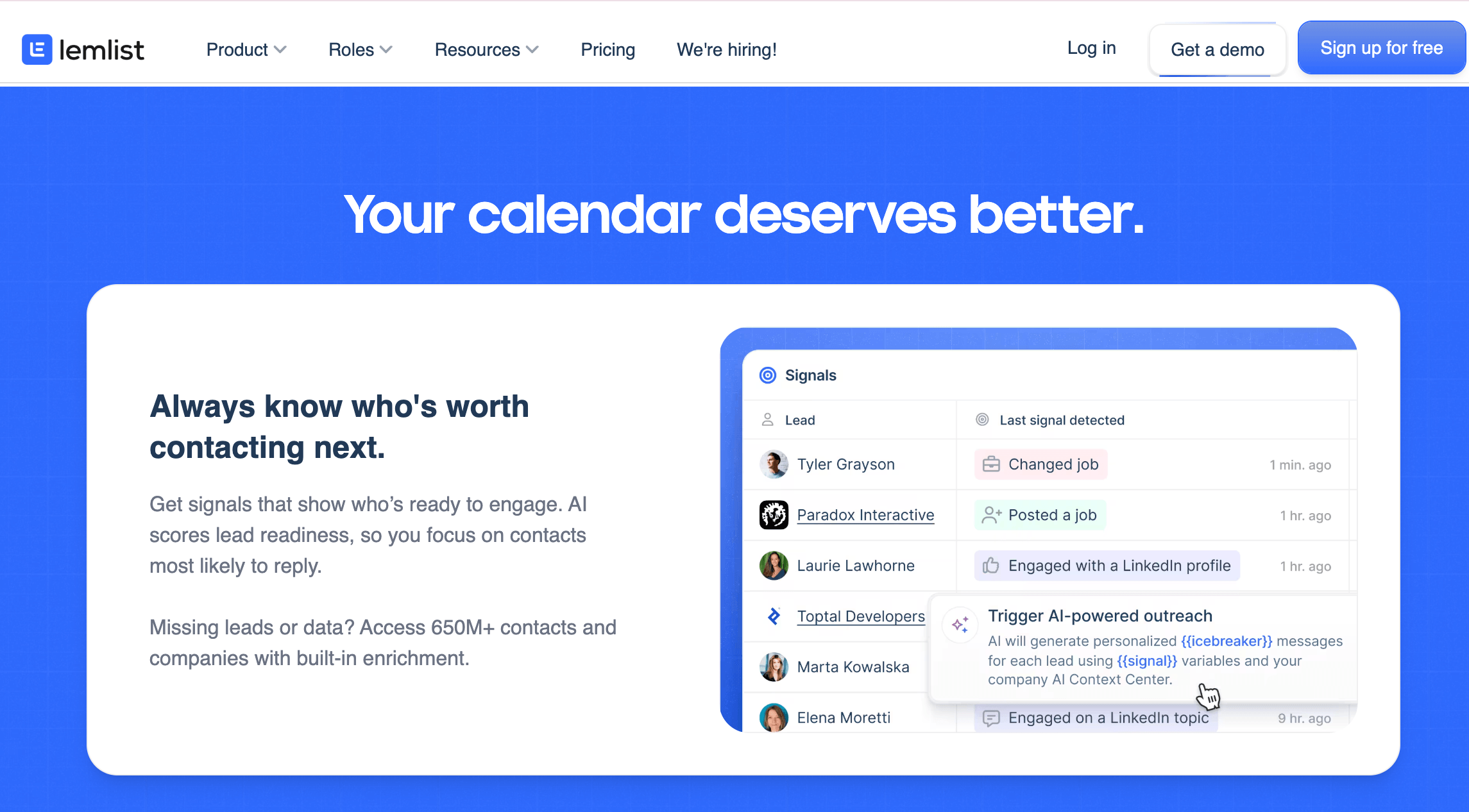
Real AI agents, not just an “AI” sticker: This is where lemlist intersects with the broader AI-tools landscape. Its intent-signal agents watch for high-intent events — hiring, funding, job changes — and automatically drop matching prospects into campaigns with messaging tuned to that exact moment. Data-enrichment agents pull structured context from LinkedIn, company sites, CRM records and even sales-call recordings, turning scattered data into usable icebreakers. It is automation aimed at the two things that actually move reply rates: timing and relevance.
A polished, friendly interface with a unified inbox: lemlist has always been one of the more approachable tools in a category full of intimidating dashboards. The visual sequence builder is easy to reason about, and a centralized multichannel inbox collates every email and LinkedIn reply in one place, so you rarely tab-hop between platforms while managing live conversations.
Enterprise-grade trust signals: SOC 2 certification, native CRM sync with HubSpot, Salesforce and Pipedrive, plus API and MCP access mean lemlist slots into a serious revenue stack without becoming a data island. For teams that need their outreach tool to be auditable and connected rather than a rogue side app, that matters.
Key Features and Technology

lemlist’s strength is how cleanly its pieces fit into one outbound loop — find, enrich, personalize, send, warm, and manage replies. Here is how the platform breaks down.
Lead Database and Waterfall Enrichment
At the top of the funnel, lemlist’s 600M+ contact database lets you prospect without leaving the app. Smart filters help you assemble a list that matches your ideal customer profile, while the waterfall enrichment engine queries several data providers simultaneously to find and verify emails and phone numbers — a design that generally beats single-source enrichment on match rate and accuracy. You can also enrich lists you bring in from a CSV or your CRM, and pull leads straight from LinkedIn, Gmail or your CRM using the Chrome extension.
AI Personalization and Liquid Syntax
This is the heart of the product. lemlist generates unique AI icebreakers per prospect, inserts personalized images (names, logos, screenshots, mockups), and supports personalized video thumbnails and tailored landing pages. For power users, Liquid syntax unlocks conditional content — different follow-ups depending on whether a lead opened, clicked, or replied — so a single campaign can branch into many personalized paths without you building each one by hand.
Multichannel Sequence Builder
The sequence builder is where the channels come together. You can chain email, LinkedIn (visits, invites, messages, voice notes), phone-call steps, WhatsApp and SMS into one cadence, with behavior-based conditions deciding what happens next for each prospect. Replies are handled in a centralized multichannel inbox, and positive responders are automatically pulled out of the automation so nobody gets a robotic follow-up after they’ve already said yes.
lemwarm and the Deliverability Hub
Every paid seat includes lemwarm, which automatically warms your mailboxes to build and protect sender reputation, plus a deliverability hub that monitors health and warns you about spam-trigger words and DNS misconfigurations before a campaign goes out. In a year where Gmail and Outlook keep tightening spam filters, having warm-up and monitoring bundled in — rather than bolted on for extra money — is a real practical advantage.
AI Agents, Intent Signals and Integrations
lemlist’s newer AI agents monitor buying signals and auto-enroll high-intent prospects into campaigns with message timing tuned to the trigger event, while enrichment agents assemble context from across the web and your CRM. Native integrations with HubSpot, Salesforce, Pipedrive, Clay and Zapier, plus API and MCP access and an Aircall integration for calling, let lemlist act as a connected hub rather than a silo.
Pricing, Plans, and Package Structure
lemlist charges a recurring subscription per user, per month, with annual billing running roughly 20% cheaper than monthly. Following a February 2026 price adjustment, most new customers land on either Email Pro (email-only) or the flagship Multichannel Expert plan; the old $39 Email Starter tier now survives mainly as a grandfathered rate for existing accounts. On top of the seat price, remember the credit system for enrichment and AI actions, plus a few add-ons: additional sending mailboxes beyond your plan’s included allotment cost about $9/mailbox/month (Email Pro includes 3 senders, Multichannel Expert includes 5), and WhatsApp is an optional add-on around $20/user/month. The ranges below are guidance drawn from 2026 pricing reports and will shift with promotions and the monthly-versus-annual toggle.
| Plan | Approx. Price (per user/mo) | What You Get | Best For |
|---|---|---|---|
| Email Starter (legacy) | ~$39 (grandfathered) | Unlimited email campaigns, lemwarm, basic personalization, 1 sending email | Existing customers still on the old entry tier |
| Email Pro | ~$63 annual / ~$79 monthly | Email outreach, lemwarm, custom image/video personalization, CRM integrations, A/B testing, 3 senders | New customers who only need email outreach |
| Multichannel Expert (flagship) | ~$87 annual / ~$109 monthly | Everything in Email Pro, plus LinkedIn steps, cold calling, multichannel inbox, 5 senders, advanced conditions | Teams running email + LinkedIn + calls together |
| Outreach Scale / Enterprise | ~$159 or custom (5-seat min.) | Everything in Multichannel, plus dedicated IP, higher credit allowances, premium support/SLAs | Agencies and larger teams needing scale and support |
| Add-ons | +$9/mailbox · +$20 WhatsApp · credits | Extra sending addresses, WhatsApp channel, top-up credits for data/AI | Teams scaling volume, channels, or enrichment |
How lemlist Compares to Alternatives
| Factor | lemlist | Instantly | Smartlead | DIY Multi-Tool Stack |
|---|---|---|---|---|
| Pricing model | Per seat (~$63–159) | Flat, from ~$37/mo | Flat, from ~$32–39/mo | Several subscriptions stacked |
| Personalization | Best-in-class (images, video, pages) | Basic; no native dynamic images | Basic merge tags | Varies by tools chosen |
| Channels | Email + LinkedIn + calls + WhatsApp/SMS | Email-focused | Email-focused | Multichannel, but disjointed |
| Lead database | Built-in 600M+ contacts | Add-on; quality inconsistent | None on lower tiers | Separate data subscription |
| Mailboxes / volume at scale | Costly (per-sender fees) | Unlimited mailboxes; great value | Unlimited; best mailbox rotation | Depends on sender chosen |
| Best fit | High-touch, personalized multichannel | High-volume email at low cost | Technical users, agencies | Teams who want best-of-breed each |
vs. Instantly: Instantly is the volume-and-deliverability workhorse — unlimited mailboxes, an aggressive warm-up network, and a flat price that starts far below lemlist. For pure text-based cold email at scale, it is cheaper and simpler. lemlist wins decisively on personalization depth, native multichannel, and its built-in database. Choose Instantly when volume and cost-per-email dominate; choose lemlist when reply quality and channel mixing matter more than raw send count.
vs. Smartlead: Smartlead is the technical power-user’s pick, with best-in-class mailbox rotation and granular infrastructure control at a flat rate that scales beautifully for agencies managing many clients. It is not a personalization or multichannel platform. lemlist is the friendlier, more visual, more channel-complete tool; Smartlead is the deliverability engine you’d reach for when you’re running hundreds of mailboxes and want fine-grained control.
vs. the DIY stack: The alternative to any all-in-one is stitching together a data tool, an email sender, a LinkedIn automation app and a warm-up service. That best-of-breed approach can beat lemlist on each individual capability — but you pay for every subscription, and you own all the integration glue and the data breakage between tools. lemlist’s pitch is consolidation: one bill, one workflow, one inbox. Whether that trade is worth it comes down to how much your team values a single system over maximum per-tool power.
Pros and Cons
What Users Love
Everything in one place: The most consistent praise is that prospecting, enrichment, email, LinkedIn, calling and deliverability all live in a single platform, cutting out the tab-juggling and integration headaches of a multi-tool stack.
Personalization that lifts replies: Users repeatedly credit the dynamic images, videos and landing pages with making cold outreach feel one-to-one — and with measurably higher open and reply rates in the right niches.
Deliverability built in: lemwarm and the deliverability hub come bundled, and reviewers say a couple of weeks of warm-up before heavy sending keeps them landing in the inbox rather than spam.
Approachable and well-supported: The visual sequence builder, unified inbox, strong integrations and a generally responsive team make lemlist one of the easier serious outbound tools to adopt, with a 4.6/5 G2 average across 600+ reviews.
Limitations Worth Knowing
Per-seat pricing gets expensive fast: Because lemlist bills per user while Instantly and Smartlead bill flat, a team of five can pay many times more for email-only outreach. At 5+ reps, the cost gap versus flat-fee tools becomes hard to ignore.
The credit system and no rollover: Data and AI actions burn credits that expire monthly. Pause a campaign or under-use your allowance and you lose them — and heavy enrichment or phone lookups (20 credits each) can quietly inflate the real bill.
LinkedIn is a bolt-on, not native automation: The LinkedIn steps run through a Chrome extension and are widely seen as less mature and less safe than dedicated LinkedIn tools. If LinkedIn is your primary channel — not a secondary one — a purpose-built platform will likely outperform lemlist.
Punishing for high-mailbox cold email: Extra sending addresses cost about $9/mailbox/month. Teams running dozens or hundreds of mailboxes to spread volume will find lemlist far pricier than tools that include unlimited mailboxes.
It’s still a layer, not a guarantee: Like every sequencer, lemlist depends on the infrastructure you connect. It offers no monitoring of your wider domain stack for blacklisting or DNS drift, and there’s a real learning curve to using its depth well. Results still hinge on your targeting, offer and copy.
Who Should Use lemlist
SDR and growth teams running true multichannel: If your motion genuinely spans email plus LinkedIn plus calls, lemlist’s ability to orchestrate all of it from one sequence and one inbox is exactly what it was built for. Put these teams on Multichannel Expert (annual).
Agencies and freelancers doing high-touch outreach: When per-email personalization drives your reply rates more than raw volume — creative services, SaaS demos, agency prospecting — lemlist’s image, video and landing-page personalization pays for itself. Multichannel Expert, scaling to Outreach Scale as seats and volume grow.
Solo founders and small teams who want one bill: If you’d rather not assemble a data + sender + warm-up + LinkedIn stack yourself, lemlist bundles it all with a friendly UI. Start on Email Pro and upgrade to Multichannel when you add channels.
Who should look elsewhere: High-volume, text-only cold emailers running many mailboxes will save dramatically with a flat-fee tool like Instantly or Smartlead. LinkedIn-first teams should choose a native LinkedIn platform. And complete beginners with no list, offer or targeting strategy shouldn’t expect any tool — lemlist included — to manufacture results on its own.
Getting Started: Step by Step
- Start the free trial. Sign up for the 14-day trial of the Multichannel Expert plan — no credit card required — so you can test the full feature set before choosing a tier.
- Connect and warm your mailbox. Add your sending email accounts, then turn on lemwarm and let it run for one to two weeks before heavy sending to build sender reputation and protect deliverability.
- Build your lead list. Use the 600M+ database with ICP filters, import a CSV, or pull leads from LinkedIn and your CRM via the Chrome extension, then enrich to get verified emails and phone numbers.
- Design the sequence. In the visual builder, chain your steps — email, LinkedIn, calls, WhatsApp — and add behavior-based conditions so the cadence branches on opens, clicks and replies.
- Layer in personalization. Write concise, one-CTA copy, then add AI icebreakers, custom images or a personalized landing page. Keep the first touch short and specific rather than long and polished.
- Run the pre-launch deliverability check. Let the deliverability hub flag spam-trigger words and DNS gaps, fix what it surfaces, and start at a conservative daily send volume.
- Launch, monitor, and iterate. Manage replies from the unified inbox, A/B test subject lines and copy, and refine targeting based on which segments actually convert.
Tips for Getting Maximum Value
Get the most out of lemlist by matching the plan to how you actually work and by resisting the temptation to over-invest in the flashy parts. Bill annually to capture the roughly 20% discount, and right-size your seats — you only need Multichannel Expert on reps who genuinely run LinkedIn and calls, not on teammates who only send email or need read-only access. Because credits expire with no rollover, time your enrichment to your sending cadence rather than front-loading lookups, and consider enriching lists externally if your volume makes lemlist’s per-credit rate expensive. Warm every new mailbox for one to two weeks before scaling, keep first-touch emails under about 120 words with a single clear ask, and use image personalization to amplify already-good targeting — never to compensate for a weak list, since a beautifully personalized email to the wrong person still gets archived. Watch the hidden line items (extra mailboxes at ~$9 each, WhatsApp at ~$20) so your real bill doesn’t drift 30–50% above the headline seat price, and always confirm the current price and any promo code on lemlist’s official site before committing to an annual contract.
Future Outlook and Final Assessment
The tailwinds behind lemlist are real: outbound teams are consolidating fragmented stacks, buyers reward relevance and timing over volume, and lemlist’s AI agents and intent signals lean directly into that shift. As Gmail and Outlook keep tightening spam filters, bundling warm-up and deliverability monitoring into every seat looks smarter each quarter. The honest caveats, restated plainly: per-seat pricing and the no-rollover credit system make lemlist expensive as teams and volume grow; the LinkedIn automation is a Chrome-extension bolt-on rather than native and safe; high-mailbox cold emailers will find flat-fee tools far cheaper; and no platform, this one included, overcomes weak targeting, a vague offer, or a market where cold outreach simply isn’t landing. lemlist is a premium tool that rewards teams who use what makes it premium.
Conclusion
lemlist earns its reputation as the personalization-and-multichannel leader in outbound. For sales and growth teams that actually run email plus LinkedIn plus calls and care about reply quality over raw send count, it consolidates data, personalization, sending and warm-up into one polished, well-integrated platform — and few competitors match that scope in a single tool. It is not the cheapest option, and it isn’t the right fit for high-volume text-only senders or LinkedIn-first teams, but for the buyer it’s built for, it turns a scattered, five-tool outbound process into a single coherent workflow. If your goal is to spend less time wiring tools together and more time booking meetings, lemlist is exactly the kind of platform AI Solutes exists to surface — the kind that takes a genuinely hard, technical job and helps make everything easy.
Ready to turn scattered outreach into one smart, high-reply workflow? Try lemlist free for 14 days.
Explore more honest reviews, tutorials and tool comparisons to find the right tech for the way you work and live — at AI Solutes, where we make everything easy.
👉 Open Free Account: https://www.lemlist.com/
👉 Our YouTube Channel: youtube.com/@ai-solutes
👉 Our Facebook Fanpage: Facebook
👉 Our X (Twitter): @AISolutes