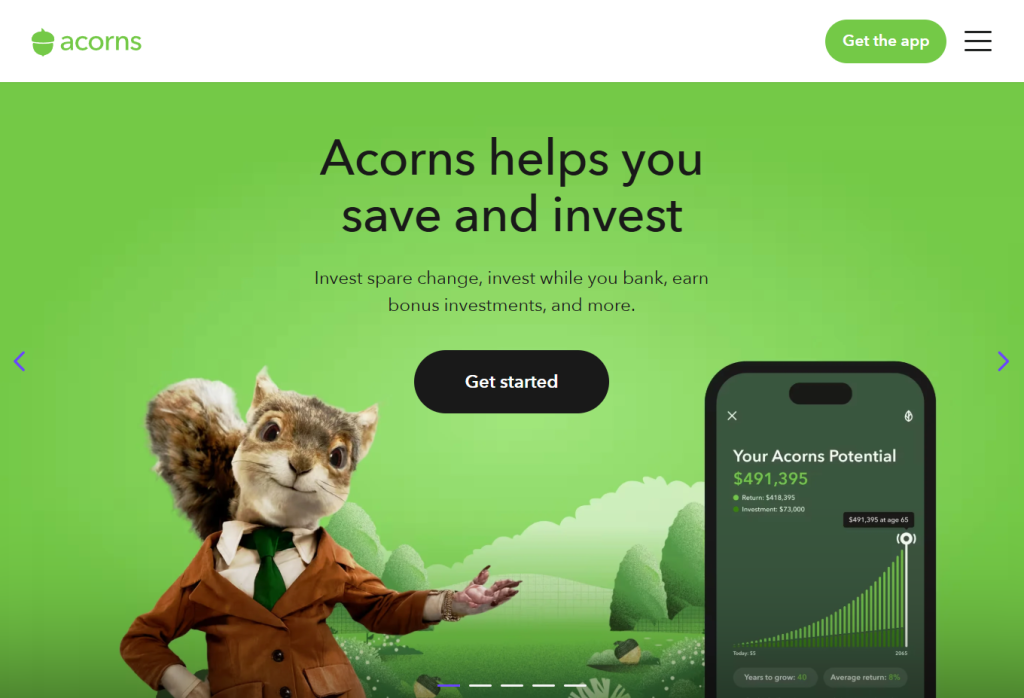
Most people who’ve never invested a dollar in their life share the same excuse: they don’t know where to start, and the amount they could realistically save each month feels too small to matter. Acorns was built around a simple behavioral trick that sidesteps both problems — round up your everyday purchases to the nearest dollar, and quietly invest the spare change into a diversified portfolio you never had to think about building. Founded in 2012 and launched publicly in 2014, Acorns has grown into one of the best-known micro-investing apps in the U.S., with millions of users and billions of dollars invested through its Round-Ups feature alone. With plans starting at $3 a month, no account minimum to open, and bundled banking, retirement, and even custodial accounts for kids, it’s designed to be the easiest possible on-ramp into investing.
But Acorns’ flat monthly fee is also its most debated feature. On a small balance, $3 a month can quietly eat a meaningful percentage of your returns — something most beginners don’t fully grasp until they run the math. This 2026 review breaks down exactly how Round-Ups and the three subscription tiers work, the real fee math at different balance levels, how Acorns compares to Betterment and Wealthfront, the honest limitations and mixed customer sentiment, and precisely who should — and shouldn’t — start their investing journey here.
Acorns Review 2026: The Micro-Investing App That Turns Spare Change Into a Portfolio
Overview and Background
Acorns was founded in 2012 and opened to the public in 2014, built around one core behavioral insight: people who won’t consciously set aside money to invest will often barely notice a few cents disappearing from each purchase. That insight became Round-Ups, the app’s signature feature — link a debit or credit card, and every purchase rounds up to the nearest dollar, with the spare change swept into a holding account and automatically invested once it reaches $5. A $7.55 coffee purchase becomes a 45-cent investment; a handful of purchases a day typically accumulate to a $5 investment within three to four days of average spending.
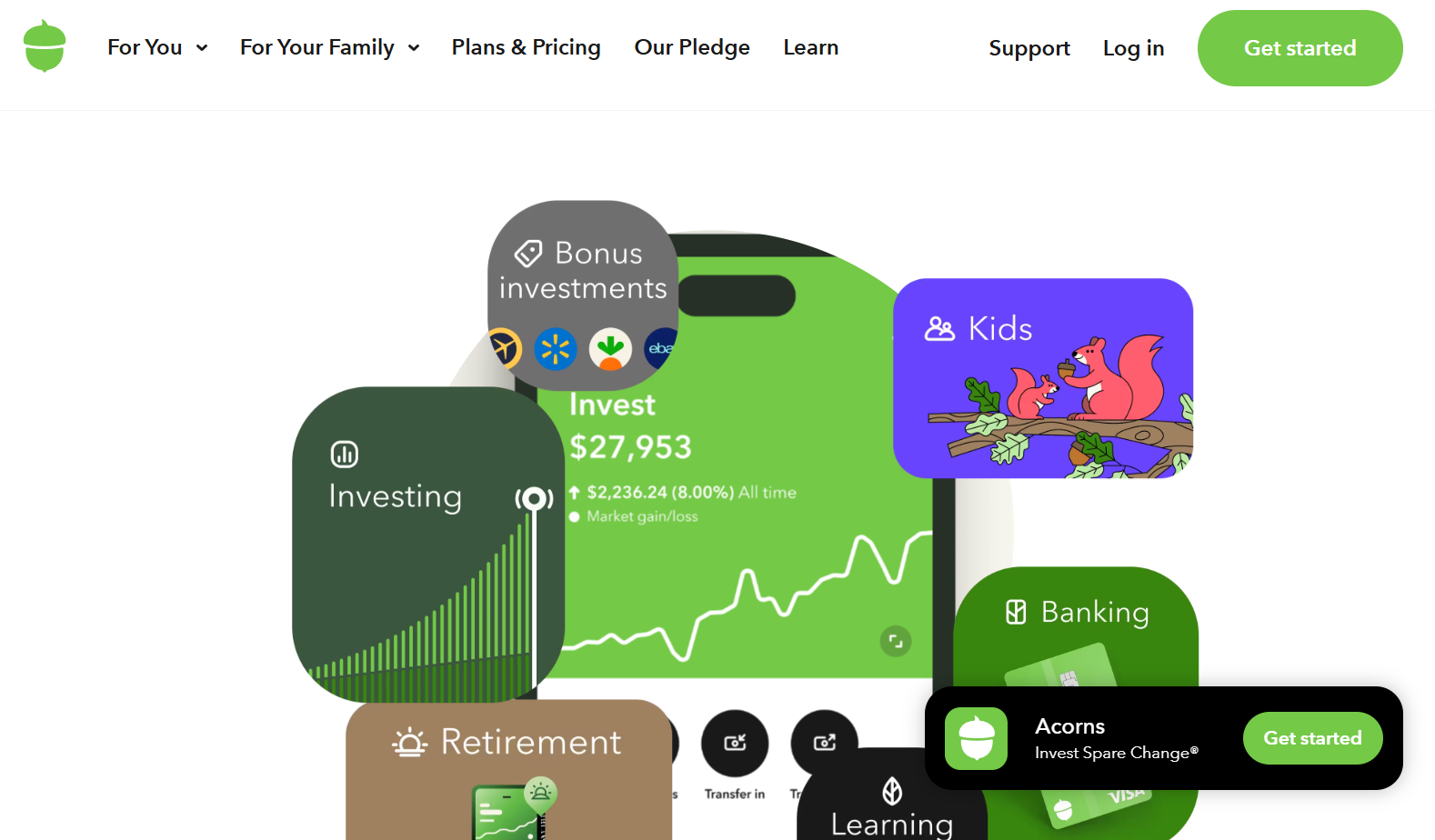
Since launch, Acorns has grown into a broader financial app rather than a single-feature novelty. Beyond Round-Ups, the platform now bundles diversified ETF investing, traditional and Roth IRA retirement accounts, a fee-free checking account with a high-yield emergency fund, custodial investment accounts for kids, and a cashback shopping program that invests a percentage of qualifying purchases directly into your portfolio. The company reports serving millions of customers who have collectively invested billions of dollars through the platform, and it was named a “Best Investing App” in The College Investor’s 2026 annual survey.
Acorns is a member of SIPC, meaning customer securities are protected up to $500,000 (with a $250,000 limit for cash) if the brokerage were to fail — standard protection for a regulated U.S. brokerage, though it’s worth noting SIPC coverage protects against firm failure, not against investment losses from normal market movement.

Why Acorns Stands Out in 2026
Genuinely frictionless behavioral saving: Round-Ups remains the best-executed version of “invest without noticing” in the category. Users consistently report never feeling the money leave their account in any meaningful way, while still accumulating $150 to $600 a year in spare-change investments purely from normal spending.
A genuine on-ramp for complete beginners: No investment decisions are required at any point — Acorns recommends a diversified portfolio from a short risk questionnaire and handles rebalancing automatically. For someone who has never opened a brokerage account, that zero-decision-required setup meaningfully lowers the psychological barrier to starting.
A genuinely valuable IRA match on the right plan: Acorns Gold’s 3% match on new IRA contributions during your first year is a real, tangible bonus — maxing out the 2026 contribution limit nets an extra $225 in free investment on top of your own contribution.
Competitive banking rates bundled in: Acorns’ Mighty Oak Checking and Emergency Fund products pay above-average interest (up to 3.35% APY on the Emergency Fund for Silver and Gold subscribers) with no overdraft fees, no minimum balance requirements, and access to more than 55,000 fee-free ATMs.
Real cashback that compounds: The Found Money program partners with more than 450 retailers — including major names like Walmart, Nike, Apple, and Expedia — depositing 1% to 10% of qualifying purchases directly into your investment account rather than as spendable cash, which keeps the reward actually working toward your future instead of your next purchase.
Key Features and Technology
Acorns’ feature set spans investing, retirement, banking, and family accounts, all accessible from the same app and subscription.
Round-Ups and Core Investing
Once linked cards trigger enough round-up activity to reach $5, Acorns invests it into a diversified ETF portfolio built from low-cost Vanguard and BlackRock funds with expense ratios ranging roughly from 0.03% to 0.25%. Portfolios span five risk levels from conservative to aggressive, chosen based on a short questionnaire, with automatic rebalancing to maintain your target allocation over time. You can override the recommended portfolio at any point, though switching may trigger a taxable event in a standard investment account. Users who want some crypto exposure can opt into a Bitcoin-linked ETF allocation of up to 5% within their diversified portfolio.
Acorns Later (Retirement)
Traditional, Roth, and SEP IRA accounts are available, with Acorns recommending the appropriate account type based on your income and tax situation (you can self-select if you already know what you want). The 2026 contribution limits are $7,500 for most people under 50 and $8,600 for those 50 and older. The Later Match — 1% for Silver subscribers, 3% for Gold — applies to contributions made during your first year with the plan.
Acorns Checking and Emergency Fund
The Mighty Oak Checking account functions as a full fee-free checking account with mobile check deposit, digital checks, and a debit card that also triggers real-time Round-Ups on every purchase. Silver and Gold subscribers unlock a linked Emergency Fund paying a meaningfully higher APY than most traditional savings accounts, giving you a dedicated, higher-yield place to build your safety net separate from your investment portfolio.
Acorns Early (Kids’ Custodial Accounts)
Included with Gold, Acorns Early is a custodial investment account plus a companion debit card and money app for kids, teens, or any young person in your life. It includes automated chore-payment tools, instant money transfers for things like field trips or lunch money, and age-appropriate financial education through short “Money Missions” quizzes and videos. Note this is a standard UGMA-style custodial account, not a 529 college savings plan, so it doesn’t carry the same tax advantages as a dedicated education savings vehicle.
Pricing, Plans, and Package Structure
Acorns uses a flat monthly subscription model rather than the percentage-of-assets fee structure used by most competing robo-advisors — a genuinely different approach that changes who the product makes financial sense for.
| Plan | Price | Includes | Best For |
|---|---|---|---|
| Bronze | $3/month | Investment account, IRA, checking account | Beginners testing the platform with a small balance |
| Silver | $6/month | Adds Emergency Fund (3.35% APY), 1% IRA match, live Q&As | Users ready to build a dedicated emergency fund |
| Gold | $12/month | Adds 3% IRA match, Acorns Early (kids), custom portfolios, tax filing partner, $10K life insurance + will | Parents and users maximizing retirement contributions |
There’s no free tier and no percentage-based option — the flat fee applies regardless of balance, aside from the platform being free for college students with a valid .edu email address. Aside from the subscription, Acorns charges no trade fees and no minimum balance fees, though a $50-per-ETF transfer-out fee applies if you move your holdings to another brokerage. To match a 0.25% equivalent fee — the flat rate most competing robo-advisors charge — you’d need roughly a $14,400 balance on Bronze, $28,800 on Silver, or $57,600 on Gold. Below those thresholds, Acorns costs you a higher effective percentage of your assets than a percentage-fee competitor would.
How Acorns Compares to Alternatives
| Platform | Fee Structure | Tax-Loss Harvesting | Best For |
|---|---|---|---|
| Acorns | Flat $3–$12/month | No | Beginners and spare-change savers, especially on larger balances |
| Betterment | 0.25% of assets/year | Yes | Balances above $14,400, tax efficiency, human advisor access |
| Stash | Flat $3–$9/month | No | Users who want to hand-pick individual stocks and ETFs |
vs. Betterment: The break-even point between the two is roughly $14,400 — below that balance, Acorns is cheaper in absolute dollars, but Betterment is cheaper as a percentage of assets and adds daily tax-loss harvesting Acorns doesn’t offer at any tier. If you’re starting with a genuinely small balance and value the Round-Ups behavior, Acorns wins on simplicity; once your balance grows substantially, Betterment’s percentage fee and tax tools generally become the better financial choice.
vs. Stash: Stash operates on a similar subscription-fee model and price range but gives you direct control to pick individual stocks and ETFs — Acorns has no equivalent self-directed option outside of the Gold tier’s limited DIY trading. If automation and zero decision-making is what you want, Acorns’ Round-Ups feature (which Stash lacks) gives it the edge on true hands-off simplicity.
vs. Wealthfront: Wealthfront’s flat 0.25% fee, daily tax-loss harvesting, and higher-yield cash account generally deliver more sophisticated tax and portfolio management, but it lacks Acorns’ Round-Ups spare-change mechanism and custodial accounts for kids. Acorns is the better starting point for someone with no existing savings discipline; Wealthfront is the stronger choice for someone who already saves consistently and wants more tax-efficient growth.
Pros and Cons
What Users Love
Round-Ups genuinely build an investing habit: Reddit and app-store reviews consistently describe never noticing the money leave their account, with the round-up mechanism successfully turning inconsistent savers into regular, if small, investors.
A genuinely clear, well-designed app: App-store ratings sit around 4.7 out of 5, and reviewers consistently praise the interface’s clarity and the frictionless onboarding flow for first-time investors.
Long-term users report solid results: Some multi-year users cite returns exceeding 20% cumulatively, reflecting genuinely well-diversified, low-cost index portfolios doing what they’re designed to do over time.
Strong in-app financial education: Users specifically credit Acorns’ educational content, especially Money Missions for kids on the Gold plan, with improving financial literacy alongside the actual investing.
Limitations Worth Knowing
Flat fees genuinely hurt small balances: This is the single most-cited complaint across every independent review. A $3-a-month fee on a $400 balance represents nearly 9% of assets annually, an unusually steep effective rate compared to percentage-based robo-advisors.
No tax-loss harvesting at any tier: Unlike Betterment and Wealthfront, Acorns offers no automated tax-loss harvesting, which can meaningfully reduce the tax efficiency of a taxable investment account as your balance grows.
Limited portfolio customization: You can’t select individual ETFs or exclude specific sectors outside the Gold tier’s limited DIY trading option, making Acorns a poor fit for anyone who wants meaningful control over their holdings.
Mixed third-party review sentiment: While official app store ratings sit around 4.7, third-party review platforms tell a more mixed story — Trustpilot scores range from roughly 2.9 to 3.8 depending on the source and sample, with recurring complaints about customer service responsiveness and unexpected fee charges after account closure.
No access to human financial advisors: Even at the Gold tier’s $12/month, there’s no option for a dedicated consultation with a certified financial planner — a real gap for anyone with a financial situation more complex than “start investing and let it grow.”
Who Should Use Acorns
Complete investing beginners: If you’ve never opened a brokerage account and the idea of picking your own stocks or ETFs feels intimidating, Acorns removes every decision except your risk tolerance, making it genuinely the easiest possible starting point.
Inconsistent savers: If you know you should be saving more but consistently fail to set money aside intentionally, Round-Ups’ invisible, automatic mechanism is specifically designed to solve exactly that problem.
Parents wanting an easy custodial account: Acorns Early on the Gold plan bundles investing, a debit card, and financial education for kids into one product, though the $12/month cost only makes sense if you’re contributing meaningfully to justify the price.
Users with growing balances above roughly $14,000: At this point, Acorns’ flat fee becomes genuinely competitive with percentage-based robo-advisors, and the bundled banking and retirement features add real value.
Not the right fit: Investors prioritizing tax efficiency should look at Wealthfront or Betterment for tax-loss harvesting, and anyone who wants to hand-pick individual investments or occasionally consult a human advisor should consider Stash, Robinhood, or a traditional advisory relationship instead.

Getting Started: Step by Step
- Download the app or visit acorns.com. Sign-up takes about five minutes and requires your email, address, and Social Security number for tax reporting purposes.
- Complete the risk questionnaire. Answer a few questions about your financial goals and time horizon to get an expert-built portfolio recommendation across one of five risk levels.
- Link your spending cards. Connect the debit and credit cards you use most so Round-Ups can start accumulating spare change automatically — investments trigger once the total reaches $5.
- Choose your plan based on real usage, not features you might use. Start with Bronze if you’re testing the platform; only upgrade to Silver or Gold once you’re confident the added features (Emergency Fund, IRA match, kids’ account) will genuinely be used.
- Set up recurring deposits alongside Round-Ups. Spare change alone won’t build meaningful wealth — add a small automatic weekly or monthly contribution to actually move the needle.
- Turn on Found Money for cashback. Browse in-app deals or shop with a linked card at partner retailers to earn bonus investments deposited directly into your account.
- Revisit your plan tier annually. As your balance grows, recheck whether your current tier still makes financial sense compared to the fee math on a percentage-based competitor.
Tips for Getting Maximum Value
If your starting balance is small, seriously consider whether Bronze alone — skipping Silver and Gold entirely until your balance grows — gets you most of the value at the lowest fee drag. Use the Round-Ups multiplier feature to accelerate contributions on days you want to save more aggressively, turning a 25-cent round-up into $2.50 with a simple setting change. If you’re on Gold and maxing out your IRA contribution in year one, the 3% match alone can be worth far more than the subscription cost, so make sure you’re actually contributing enough to capture it. Take advantage of Found Money before making planned purchases at partner retailers — check the in-app deals list first rather than shopping and hoping a partner happens to be included. And regardless of which tier you choose, set up automatic recurring deposits beyond Round-Ups, since spare change alone realistically adds $300 to $600 a year — nowhere near enough on its own to fund a comfortable retirement.
Future Outlook and Final Assessment
The category tailwinds favor Acorns broadly: financial literacy gaps remain widespread, and behavioral, low-friction saving tools continue to resonate with a generation of investors who never developed the habit of manually setting money aside. Acorns’ continued investment in bundled banking, the IRA match, and custom portfolios on Gold all suggest a company trying to become a genuine all-in-one financial hub for beginners rather than staying a single-feature novelty app — a sensible evolution as the category matures and competitors add their own automation features.
The honest caveats remain real: the flat-fee structure is a genuine mathematical disadvantage on small balances, the lack of tax-loss harvesting is a real gap versus its closest competitors, and the mixed third-party review sentiment — even alongside strong official app-store ratings — is worth weighing rather than dismissing. Within those boundaries, Acorns delivers exactly what it promises for its core audience: a genuinely frictionless way for people who’ve never invested before to start, without needing to learn stock picking or overcome the intimidation of a traditional brokerage account.
Conclusion
Acorns solved a real problem: most people who should be investing never start, either because they don’t know how or because they never feel like they have “enough” to begin with. Round-Ups quietly removes both excuses, and the platform’s expansion into retirement accounts, banking, and kids’ custodial accounts has turned it into a genuinely useful all-in-one financial starting point rather than a novelty app. The trade-off is a flat-fee structure that only makes clear financial sense once your balance grows, and a lack of the tax sophistication more advanced robo-advisors offer. Start small, pair spare change with intentional contributions, revisit your plan tier as your balance grows, and Acorns can genuinely turn “I’ll start investing someday” into a habit you’re already building — making everything easy, one round-up at a time.
Ready to turn your spare change into your future?
Explore more honest reviews, tutorials and tool comparisons to find the right tech for the way you work and live — at AI Solutes, where we make everything easy.
👉 Open Free Account: Get Started with Acorns
👉 Our YouTube Channel: youtube.com/@ai-solutes
👉 Our Facebook Fanpage: Facebook
👉 Our X (Twitter): @AISolutes
- Does Hargreaves Lansdown Simplify Stock Trading? A Closer Look at Hargreaves Lansdown’s Market Architecture
- Explore FaceApp 2025: AI Photo Editing, User Growth, Pro Features, and Global Impact
- Is Wealthfront the Ultimate Automated Brokerage? Exploring the Wealthfront Digital Wealth Ecosystem
- Master Plant Therapy Essential Oils in 2026: Benefits, Diffusers, Safety, and AI-Personalized Aromatherapy
- Stop Cat Spraying for Good in 2026: Cat Spraying No More Step-by-Step Solutions