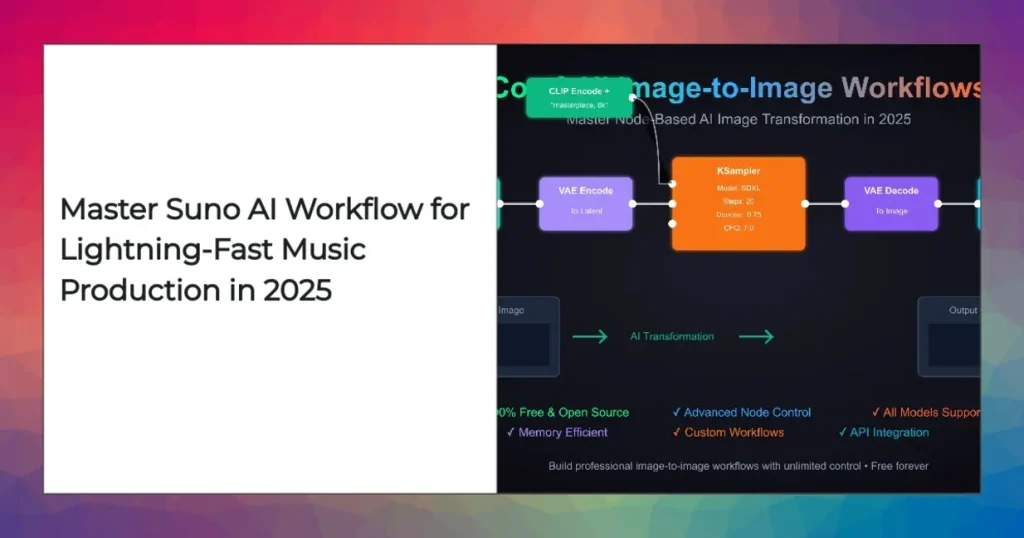
As artificial intelligence revolutionizes the music industry, platforms like Suno AI in 2025 lead a creative transformation, enabling anyone—from seasoned professionals to complete beginners—to produce polished, studio-grade tracks directly from their devices. This guide delves into the step-by-step Suno AI workflow and highlights major updates, feature comparisons, expert tips, and legal insights for today's fast-evolving creative landscape. By understanding these visual workflows, creators, educators, entrepreneurs, and researchers can unlock unprecedented flexibility and control in music production. Prepare to witness how user-friendly tools and detailed workflow diagrams are demystifying the future of song creation, making music production more transparent, scalable, and globally accessible than ever before.
The world of music is changing at lightning speed—and if you’re reading this, chances are you’re eager to know how AI platforms like Suno AI are rewriting the rules in 2025. Gone are the days when making a record meant booking an expensive studio, wrangling musicians, and spending weeks (or months!) perfecting every note. Now, with nothing more than a clever prompt and an internet connection, you can create studio-grade songs that compete with the world’s best—from your bedroom. Sounds like sci-fi? It’s not. It’s Suno AI in action.
But let’s be real: new tech can feel intimidating—especially when it’s transforming something as personal as music. Maybe you’re a songwriter curious about speeding up your workflow, an educator looking to demystify AI for students, or an entrepreneur trying to spot the next big music industry trend. Whatever your story, understanding the step-by-step workflow behind Suno AI isn’t just useful—it’ll help you unlock your full creative potential (and maybe spark a little friendly competition along the way). In this deep dive, we’ll break down Suno AI’s music creation process with a visual workflow, highlight 2025’s breakthrough updates, compare it to other top AI tools, and dish out real-world tips, legal advice, and inspiring case studies. Let’s roll up our sleeves and see just how futuristic—and approachable—music making has become.
Introduction to Suno AI’s Music Creation Workflow in 2025
It’s 2025, and the music industry has entered a bold new era—one where AI isn’t just a buzzword, but an essential part of creativity. Stealing the show is Suno AI, a platform designed to transform even the simplest musical idea into a fully polished song—sometimes in under an hour.
Imagine: You have a melody stuck in your head, a phrase you keep repeating, or maybe you’re dreaming up the next viral TikTok sound. With Suno AI, you type out your vision (as a prompt), select a vocal style or language, let the magic happen behind the scenes, and then fine-tune until it’s perfect. No advanced music theory or gear needed. But what actually happens at each step? And why is a workflow diagram so important?
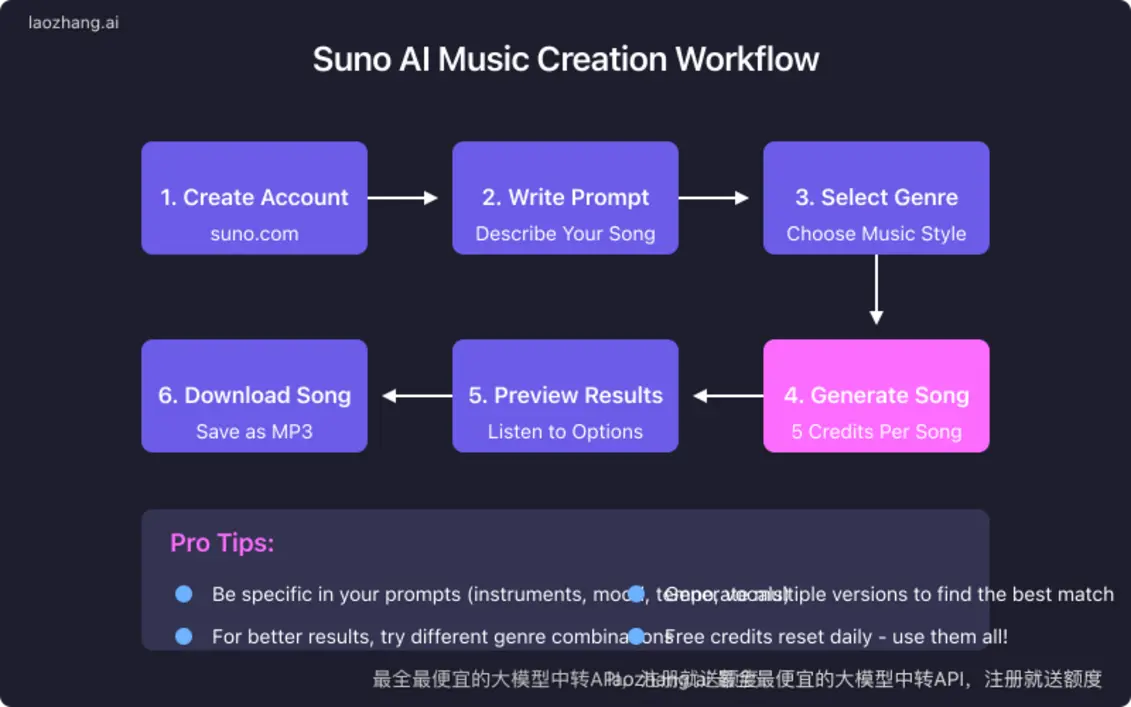
Why You Need a Workflow Diagram
Let’s be honest—AI can feel like a black box. You enter a prompt, and music comes out. But what’s happening inside? A workflow diagram tears off the lid, helping everyone (from curious students to industry executives) see how each component, decision, and prompt shapes the final result. Here’s what makes it so useful:
- Educators and students: Translate mysterious “AI magic” into tangible steps, making teaching and learning way simpler.
- Professional producers: Spot efficiency bottlenecks, experiment with new features, and personalize their process.
- Business leaders: Identify how to weave Suno AI into their ecosystems and measure the ROI of innovation.
- Researchers and creators: Analyze what sets Suno AI apart, both creatively and technologically.
Breaking Down the Suno AI Workflow
So, what does Suno AI’s creative workflow actually look like? Let’s walk through it step by step:
-
Prompt Input
This is your spark: describe the genre, mood, tempo, lyrics, or even reference famous artists (“dark retro synth like Stranger Things,” anyone?). The more you give, the smarter the AI becomes. -
Vocal Persona/Language Selection
Pick from a library of vocal personas—male, female, robotic, even child voices—in countless languages. You can even adjust accents or emotional tones right in the prompt. -
Music Generation Engine
Under the hood, Suno’s cutting-edge deep learning models orchestrate your musical vision, weaving together vocals, instrumentals, structure, and style—all in a coherent, listenable mix. -
Preview & Editing
Time for the test drive. Instantly listen, then use quick re-prompts to tweak lyrics, swap vocal personas, or even try a different genre until it’s just right. -
DAW/Third-party Integration
When you’re ready for serious touch-ups, export “stems” (the separate vocal and instrumental tracks) into your favorite Digital Audio Workstation (Ableton, Logic, FL Studio, etc.) or third-party apps for refined editing. -
Distribution & Licensing
Last but not least: decide how your song is released. Suno AI automates protection—sorting out attribution, copyright, and even distribution settings, minimizing legal headaches from the get-go.
Key Takeaway:
By visualizing this workflow, both music newbies and seasoned creators can instantly see how (and why) Suno AI makes music production so rapid, flexible, and scalable in 2025.
Suno AI V4.5 Platform Updates & Vocal Feature Enhancements
If there’s one constant in the world of AI, it’s change—and Suno AI hasn’t been sitting still. The version 4.5 release in 2025 is a serious leap forward, setting new benchmarks for how expressive, global, and lightning-fast AI-powered songwriting can be.
Let’s dig into the updates that put Suno AI front and center—for pros, hobbyists, and complete beginners alike.
Major Upgrades in Suno AI V4.5
1. Expanded Vocal Persona Library
Imagine being able to pick the exact voice you want—down to age, nationality, or even emotional tone. Suno AI’s library now includes:
- 50+ authentic vocal timbres: Male, female, and everything in between—including child, vintage crooner, or robotic pop.
- Multilingual support: English, Spanish, Mandarin, Japanese, Hindi, French, Korean…the list keeps growing.
- Real-time control of dialect and mood: Want a French lullaby with a gentle tone, or a British pop anthem brimming with angst? Just tweak the prompt.
“Suno V4.5’s multilingual, persona-driven approach is why it appeals to commercial and independent creators targeting diverse global markets.”
— Dr. Mira S., AI Music Workflow Researcher
Want proof of impact? At a 2025 international songwriting hackathon, teams used Suno AI to generate tracks in up to eight different languages, custom-tailored to audience demographics—in under 30 minutes. You simply couldn’t do that with traditional studio setups.
2. Integration with DAWs and Collaboration Platforms
- Seamless export: Instantly drop your Suno tracks into Ableton Live, FL Studio, or Logic Pro X—no clunky conversion required.
- Batch generation & API access: Great for film/game scoring or agency work—generate dozens of variations in a single workflow.
- Reversible workflow: Bring your edited track back into Suno AI for more AI-powered iterations. It’s a two-way creative street.
3. Prompt and Lyric Generation Refinements
- Prompt builder: Friendly step-by-step guides for beginners (no more staring at a blank prompt).
- Next-level AI lyricist: Generate or tweak lyrics that actually fit the mood and story you want.
- Prompt chaining: Stack prompts for evolving narratives or advanced musical “journeys” across your track.
One Suno AI user—a YouTube content creator—used prompt chaining to dynamically adapt lyrics and music based on real-time chat suggestions during a livestream. Interactive, adaptive, and expressive? Welcome to the future.
4. Genre Adaptability and Instrumentation
Suno AI now embraces:
- Orchestra-level virtual instruments: Think strings, brass, and synths with breathtaking realism.
- Hyper-real guitars, drums, and electronic beats: Not just cheesy presets—these are convincing enough for the main stage.
- Style transfer: Want your hip hop verse to fade into a jazz solo, or your pop anthem to morph into K-pop? Do it—all in one pass.
Diagram Redux:
Overlaying these enhancements on the workflow diagram, you’ll see exactly where new possibilities emerge: from the moment you craft your prompt to the point you test drive different vocal personas or genres. 2025 is all about creative acceleration and personalization.
Feature Comparison: Suno AI vs Alternatives & Workflow Integration
AI music is now a crowded field, but not all tools are created equal. Udio, Soundful, Boomy, and AIVA have carved out their niches—yet Suno AI’s workflow keeps setting the bar in 2025. For artists, brands, and tech-hungry pros, choosing the right platform isn’t just about features—it’s about the workflow that empowers you.
Suno AI vs. Major Competitors: 2025 Feature Table
| Feature | Suno AI V4.5 | Udio AI | Soundful | Boomy | AIVA |
|---|---|---|---|---|---|
| Multilingual Vocals | ✔✔ 15+ | ✔✔ 8+ | ✔ 3 | ✔ 5 | ✗ |
| Vocal Persona Range | Extensive (50+) | Moderate (10+) | Basic (5) | Basic (8) | Minimal |
| Prompt Complexity | Expert, Chainable | Intermediate | Basic | Basic | Basic |
| Genre Customization | Extensive (20+) | 12+ | 8+ | 10+ | 4 |
| DAW Integration | Deep, 2-way | Yes | Yes | Limited | Yes |
| Copyright Tools | Advanced | Intermediate | Basic | Basic | Custom (Classical) |
| Batch/APIs | Full | Partial | None | Partial | None |
| Prompt-to-Lyrics | Yes, Advanced | Yes, Basic | No | Yes | No |
| Free Tier | Limited | Yes | Yes | Yes | Free (limited output) |
How Do the Workflows Really Differ?
- Suno AI: Emphasizes transparency and iteration—see and edit every step, export stems, swap personas, and re-prompt on demand. Perfect for those obsessed with control and creative freedom.
- Udio AI: Fast, but more “black box.” Fewer options at each stage, so great for rapid ideation, but less depth for power users.
- Soundful/Boomy: Designed for true beginners. Super simple, but limited in terms of deep genre or vocal customization.
- AIVA: Best at orchestral/film scores, but lags in contemporary vocal or collaborative versatility.
Real-Life Example:
A leading ad agency in Berlin used Suno AI to prototype and test 12 song variants for a campaign—each tailored to a different European market—in a single workday. By comparison, using another platform, similar results would have taken weeks and involved multiple external vendors.
Workflow-Driven Decision Making:
If you want full creative command (and global reach), Suno AI’s robust workflow is for you. If you just want quick demo tracks for personal projects, alternatives might suffice—but expect to run into limitations when it’s time to get serious or scale.
Related Reading:
For more on workflow-centered AI, Watch more: Jasper AI 2025 Dashboard, Content Generation & SEO Workflow
Trends, Use Cases & Industry Impact: Suno AI in Professional Music
The rise of Suno AI (and its competitors) doesn’t just signal technical evolution—it’s reshaping how creators, brands, and even entire industries think about music. The divide between “DIY” and “major label” is shrinking every day. But what does this mean for you, and how are the pros already using Suno AI to carve out new opportunities?
How Are Creators and Companies Using Suno AI?
1. YouTube, TikTok, and Social Media Creators
Remember when viral hits seemed to come out of nowhere? In 2025, many of those sounds are AI-generated—and the creators behind them are using Suno AI to:
- Create personalized theme songs, intro music, or remix memes faster than trends can change.
- Rapidly iterate music for audience polls or live feedback.
- Push the boundaries of global appeal by instantly switching song language or vocal style.
Case in Point:
A TikTok musician launched a daily song challenge, letting viewers vote on prompts and vocal styles. Using Suno AI, she went from prompt to final video-ready song in under an hour, shooting her engagement metrics through the roof.
2. Brand and Ad Agencies
- Instantly prototype jingles or campaign songs targeted at specific markets (think: Spanish-language remix for Latin America, synth-pop for Japan, hip-hop for the US).
- Test different lyrics, moods, and calls-to-action across multiple demos.
- Protect creative budgets by reducing dependence on “traditional” studio time and expensive arranger contracts.
3. Indie Musicians & DIY Label Teams
No budget to book a world-class studio or hire top-tier session musicians? No problem. Indie acts now release radio-ready tracks that rival mainstream productions—without maxing credit cards or compromising on sound.
In 2024, indie artist “Leo Nakai” attributed his viral Spotify hit to Suno AI’s fast-iteration workflow—he tried dozens of vocal and genre combos before landing on the “perfect” mix.
4. Film, TV, and Game Developers
- Generate temporary “placeholder” scores for scenes in seconds—instead of waiting days or weeks for a composer’s first draft.
- Create recurring motifs, mood changes, or adaptive soundtracks (especially critical in interactive gaming).
- Experiment with genre-mashups that would be risky, expensive, or time-consuming in a live studio context.
Industry Statistics: The Bottom Line
- Suno AI experienced a jaw-dropping 250% year-over-year growth in commercially exported tracks in 2025.
- Over 30% of TikTok’s Top 1000 videos in Q1 2025 featured at least some AI-generated music.
- Global spread: More than 70 countries are represented among Suno AI’s power users, with sharp growth in regional, non-English content.
Copyright, Licensing & Legal Complexity
Technology races ahead—laws try to keep up. Here’s how Suno AI is approaching the shifting copyright landscape:
- Tiered licensing: From personal to commercial releases, plus a growing royalty-free library for creators who want to play it ultra-safe.
- Automatic metadata tagging: Copyright claims and attributions are built into every step.
- Risk factors: Even with AI, “style mimicry” and sourcing data remain gray areas; legal disputes occasionally flare up over unintentional nods to popular songs.
- Proactive solutions: Suno AI logs every version, provides opt-in transparency for commercial clients, and integrates robust support to keep users legal—and stress-free.
Legal Voice from the Field
“AI-generated music is both an opportunity and a challenge for copyright. Those using Suno and competitors should treat metadata management and source tracking as must-haves—not afterthoughts.”
— Elena Mauriello, IP Lawyer & Music Rights Advocate
Real-World Twist:
In 2025, a global gaming company averted a multimillion-dollar legal headache by leveraging Suno AI’s meticulous export logs to prove originality and proper licensing for their soundtrack. They turned what could have been a PR disaster into a showcase for AI-powered transparency.
Expert Tips, Prompt Engineering & Legal FAQ for Suno AI
Just like learning an instrument, mastering Suno AI requires both curiosity and strategy. Whether you’re chasing your next viral hit or composing for commercial clients, leveling up your prompt engineering is the secret to unlocking Suno’s full power.
Expert-Level Prompt Engineering
Ready to move from basic to next-level? Try these tactics:
-
Start Broad, Then Narrow In
Begin with the general vibe or genre. Once you hear Suno AI’s first take, add specifics: “Make it more melancholic,” “Speed up the tempo,” or “Add a lo-fi filter to the drums.” -
Use Persona Tags for Ultimate Control
Suno AI’s #tag system lets you pick or mix voices (think#female-indie,#rap-latin, or wildcards like#robotic-child). Experiment—hybrid personas sometimes spark unexpected inspiration. -
Chain Your Prompts for Storytelling
Stack prompts for evolving tunes (“Continue this as a chorus in Spanglish,” or “Now do a bridge with 90s grunge flavor”). Songs can now grow and transform as you go. -
Think Legally: No Copyrighted Samples
Always append “no copyrighted sample” to your prompt for extra peace of mind, or turn on Suno’s copyright filter tags. This could save you legal headaches down the road. -
Experiment Across Languages
Merge languages in a single track—great for global marketing or just flexing creativity. Multilingual hooks in one song? The AI’s got your back.
DAW & Third-Party Integration Tips
- Export stems and remix freely: Take Suno AI’s output apart or layer it with your own recordings in pro-level editors.
- Batch processing & automation: Power users (and agencies) can automate dozens of tracks with Suno’s API—perfect for ad campaigns, content calendars, or games.
- Metadata integrity: Always check metadata before distribution to keep copyright, licensing, and credits in sync—especially for commercial releases.
Suno AI Legal & Copyright FAQ
-
Q: Can I put Suno AI tracks on streaming platforms or sell them?
A: Absolutely. Just make sure you’re on the right license tier (commercial, not just personal use). -
Q: Will my AI-generated song be unique—or could someone else make something just like it?
A: Suno’s combo of prompt, persona, and lyric systems creates tons of variation. Still, for long-term uniqueness, add manual tweaks or custom mixes. -
Q: What about “soundalike” legal gray areas?
A: Stay clear of directly referencing copyrighted works. Use your own lyrics, and turn on Suno’s built-in plagiarism filters for an extra layer of safety.
Further Learning:
Upgrade your legal and workflow smarts—Watch more: ElevenLabs AI Voice Generator 2025 Usability, Growth & Ethics
Beyond the Basics: Real-World Scenarios & Community Inspiration
Still curious how Suno AI looks in the wild? Here are a few stories from creators pushing the limits:
-
The “30-Track Week” Challenge:
Indie singer Erin James generated a song a day for a month, mixing genres and personas. Several tracks scored sync placements in indie films, while fans loved seeing the AI-collaborative process on her socials. -
Global Nonprofit Initiative:
A language preservation group used Suno AI to record children’s folk songs in endangered languages—no native speaker singers required—revitalizing cultural heritage for a new digital generation. -
Marketing Remix Hackathons:
Brand teams now host 24-hour “AI music hack days,” prototyping dozens of ad jingles across markets, all without ever stepping into a studio.
And these are just the beginning. Communities from Reddit to Discord light up daily with fresh Suno AI collabs, prompt recipes, and remix contests. Some users even bundle Suno AI with other generative tools (lyric assistants, video editors, chord progression AIs…) to create fully automated content pipelines.
Conclusion
When you see Suno AI’s workflow diagram in action, two things become clear. First, anyone—from music rookies to charting pros—can now craft radio-ready tracks at warp speed. Second, the future of music is flexible, collaborative, and global. In 2025, Suno AI is more than just a production tool; it’s a launchpad for creators, agencies, developers, and brands to shape tomorrow’s soundscape.
From advanced prompt engineering and deep DAW integration to headache-free licensing and savvy feature comparisons, Suno AI is changing not just how songs are made—but who gets to make them. Ready to join the revolution?
👉 Our Website: https://ai-solutes.com/
👉 Our YouTube Channel: http://www.youtube.com/@ai-solutes
👉 Our Facebook Fanpage: https://www.facebook.com/profile.php?id=61576606911341
👉 Our X (Twitter): https://x.com/AISolutes
- Master Weebly in 2026: Compare Pricing, eCommerce Features, Pros and Cons, and SEO Strategies
- Master Perplexity AI for SEO Success in 2025: User Experience, Feature Comparison, and Winning Strategies
- Unlock Unmatched Enterprise Automation with Google Gemini AI: Multimodal Intelligence and Future-Proof Integration for 2025
- Slidespilot
- Supercharge Team Video Production in 2025: Veed.io’s AI-Powered Editing & Collaboration Features