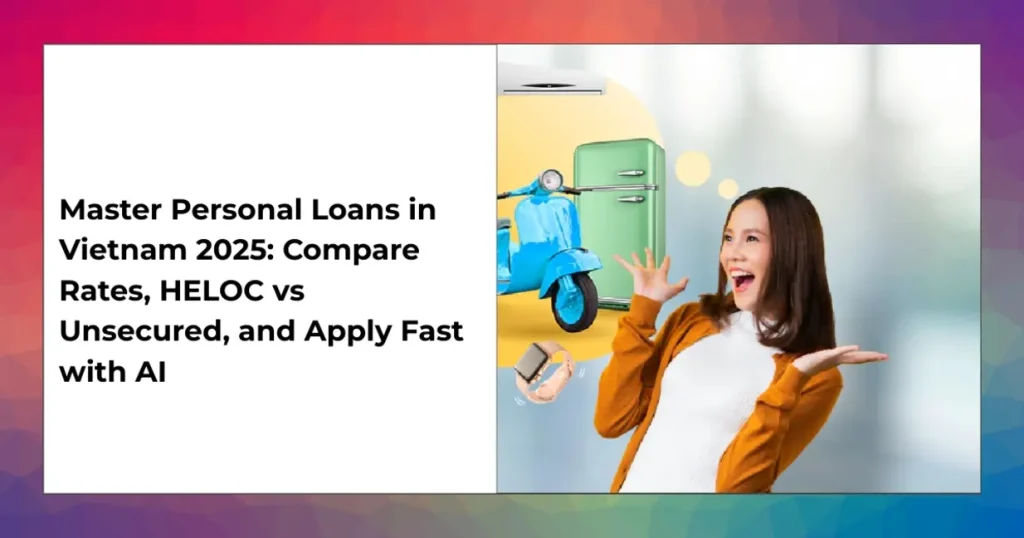
In this in-depth guide, you’ll explore everything about Vietnam’s personal loan market — from definitions and loan types to step-by-step application tips and fintech-driven innovations for 2025. The article covers both unsecured and secured options, including HELOCs and refinancing, plus real-world use cases and insights from financial experts. As you read on, you’ll also find practical comparisons, interactive visuals, and professional advice that make borrowing smarter, safer, and more efficient. Ready? Let’s dive in.
If you’ve ever found yourself scrambling for extra cash—maybe to cover a sudden expense, jumpstart a small business, or invest in your future—you’re certainly not alone. These days, with the Vietnamese economy changing faster than the latest TikTok trends, personal loans have become a go-to solution for many. And thanks to new financial tools, streamlined applications, and tech-powered approval processes, borrowing money isn’t just easier—it’s smarter. In this guide, we’ll break down every major type of personal loan available in Vietnam, show you practical comparisons and examples, and walk you through a modern, AI-powered application process. By the end, you’ll know exactly how to choose the right loan for your needs—and, just as importantly, steer clear of the traps and bad surprises that have tripped up so many others.
Tổng quan về khoản vay cá nhân: Khái niệm & thuật ngữ
Let’s start with the basics—what exactly is a personal loan, and why should you care? Personal loans in Vietnam are financial products designed specifically for individuals. They may or may not require collateral, depending on the lender and the loan type. Unlike borrowing from family (awkward), or using your credit card (expensive), these loans come in all shapes and sizes to cover everything: groceries, vacations, tuition, emergency expenses, or a cash boost to help your business thrive.
The Vietnamese loan market in 2025 is buzzing. Banks, fintechs, and financial companies are all competing fiercely, slashing interest rates, creating flexible products, and simplifying approval criteria. If you’re a young professional, a first-time borrower, or a family in need, there’s never been a better time to explore what’s out there.
Key terms to know:
- Interest rate: The percentage you pay above what you borrow. It can be fixed (never budges) or variable (goes up and down with the market).
- Loan limit: Maximum amount you can borrow. Usually scaled to your income and creditworthiness.
- Term: How long you have to repay, including both principal and interest.
- Unsecured loan: No collateral needed. Your salary or credit history does all the talking.
- HELOC (Home Equity Line of Credit): Borrowing based on your home’s equity—hugely popular abroad and now gaining ground at Vietnamese banks.
- Refinance: Swap your old loan for a new one with better rates or terms.

Market snapshot:
- Personal loans now account for 40% of all consumer finance debt in Vietnam, according to the Vietnam Banking Association (2024).
- The explosion of fintech means faster online approvals, streamlined applications, and far easier access to capital—especially for young professionals and families just starting out.
Why do interest rates and loan limits matter?
- Typical interest rates run from 12%–22% per year—much less than the dizzying 28% on credit cards.
- Loan limits are broad: anywhere from 20 million up to 500 million VND. With HELOC, you can tap up to 70% of your home’s assessed value.
Top advantages of personal loans:
- Speedy processing, no collateral for most loans (except HELOC and big amounts).
- Transparent rate comparisons—so you never overpay.
- Flexibility in terms, amounts, and payment methods.
- A world of uses: buy a car, travel, invest, pay for school… whatever you need.
Các loại khoản vay tiêu dùng phổ biến: So sánh ưu nhược điểm (infographic)
Once you dig deeper, you’ll notice a clear split in the personal loan market—different types of loans suit different people, situations, and life stages. Picking the best one for you means understanding how they compare: interest rates, loan limits, paperwork, processing speed, and those all-important pros and cons.
Bảng so sánh các loại khoản vay tiêu dùng phổ biến
| Loại khoản vay | Lãi suất (%) | Hạn mức (VNĐ) | Thời gian duyệt | Yêu cầu tài sản | Ưu điểm chính | Nhược điểm |
|---|---|---|---|---|---|---|
| Vay cá nhân không thế chấp | 12–22 | 20 triệu – 300 triệu | 1–3 ngày | Không | Thủ tục nhanh, linh hoạt | Hạn mức vừa phải |
| Vay theo giá trị nhà (HELOC) | 8–12 | Tới 70% giá trị nhà | 3–7 ngày | Có tài sản | Hạn mức lớn, lãi suất tốt | Thủ tục định giá phức tạp |
| Vay tiêu dùng ngắn hạn | 18–30 | 5 triệu – 30 triệu | 1 ngày | Không | Giải ngân siêu nhanh | Lãi suất cao, thời gian ngắn |
| Tái tài trợ ô tô/Hộ gia đình | 9–15 | 50 triệu – 1 tỷ | 3–5 ngày | Có tài sản | Có thể giảm lãi suất | Phí xử lý/định giá cao |
Detailed Comparison:
Let’s break each one down further:
-
Unsecured personal loans:
You want quick cash for something like starting a side hustle or handling unexpected shopping needs? This is your best bet. Approval only takes 1–3 days, no collateral required. Just be sure to check the real monthly repayment (sometimes fees sneak in) and watch for early repayment penalties. -
HELOC:
Got a house? HELOC lets you turn that into cash—great for home upgrades, education, or scaling a business. You’re getting lower interest rates and much bigger limits, but the application is more detail-heavy. It’s worth the paperwork for serious projects. -
Short-term consumer loans:
Emergencies happen—sickness, tuition fees, car repairs. You’ll get the money almost instantly, but the interest is high and repayment terms are short. -
Refinancing:
If an expensive old loan is draining you, refinancing offers a fresh start with lower rates. It’s perfect when switching between banks or financial companies. Just pay attention to the processing and appraisal fees.
Pro tips for picking the right loan:
- Always read every contract line and review all fees.
- Avoid short-term loans if a longer repayment is possible—longer terms mean less pressure from mounting interest.
The impact of tech and fintech
Let’s talk speed. Thanks to AI and streamlined platforms, 80% of personal loans in 2025 are expected to be approved online within two hours (Statista Vietnam, 2024). That’s almost as quick as ordering food on Grab.
Real-World Loan Scenarios
To make it all clearer, let’s peek into some real-life situations from 2024 and early 2025:
- Startup Dream: Thanh, a 27-year-old marketing graduate, needs 50 million VND to launch her Etsy store. She’s approved in one day for an unsecured personal loan after uploading her employment contract and a pay slip.
- Home Upgrade: Mr. An owns a house valued at 2 billion VND and wants 1 billion for renovations and supporting his kids’ overseas study. A HELOC gets him a low rate, high limit, and flexible disbursements.
- Emergency Expense: Nga has to pay 18 million VND for dental surgery tomorrow. She’s approved for a short-term loan at 27% interest, which she repays in three months.
Notice how each scenario matches a specific loan type—showing how personalization is no longer just a buzzword, but a reality in Vietnamese finance.
Vay theo giá trị nhà (HELOC): Giải pháp tài chính linh hoạt
If you’ve been glued to home improvement shows or considering tapping into your property’s value, let’s dive into the exciting world of HELOC—Home Equity Line of Credit. It’s not just a boring bank product; it can truly revolutionize how you fund everything from a new kitchen to your child’s university fees.
HELOC Explained: How Does It Work?
- Application & assessment: The bank estimates the value of your property, often by appraisal. You get a loan limit worth up to 70% of your home’s value.
- Flexible withdrawals: Instead of getting one lump sum, you “draw” money as needed within your loan limit. You only pay interest on what you actually use.
- Revolving credit: Unlike traditional loans, you can borrow, repay, and borrow again—all within the approved credit line.
Main advantages:
- Lower rates than unsecured loans.
- Huge loan limits—perfect for big projects: renovating, starting a business, or funding advanced education.
- Makes your home equity work for you, without selling or full collateralization.
Drawbacks:
- Requires precise property appraisal and more paperwork than regular personal loans.
- Losing your property is possible if you default.
What do experts say?
Finance expert Nguyễn Duy Hưng shares:
“HELOC opens new possibilities for Vietnamese families, helping them move beyond risky ‘hot loans’, fuel long-term investments, and support business or education needs—boosting overall quality of life.”
Quick comparison: HELOC vs. Traditional Personal Loans
- HELOC: Maximum flexibility, low rates, ideal for big needs.
- Personal loan: Lightning-fast approval, no asset needed, great for small to medium amounts.
Since late 2024, major Vietnamese banks like Techcombank, Vietcombank, and VPBank started piloting HELOC offerings modeled after Western banks—responding to rising demand for smarter capital access.
HELOC in Action: Success Stories
Let’s jump into a relatable success story. In late 2024, Minh and Lan wanted to open a cafe in Ho Chi Minh City. Instead of struggling with expensive short-term loans, they leveraged HELOC, pulling 500 million VND at 8.5% interest from their condo’s equity. “We didn’t need to sell—just optimized what we already owned. The monthly payments were manageable, and the extra funds let us invest in marketing, too,” Minh explained. Their business survived tough competition thanks to smart upfront capital.
These stories highlight something vital: Choosing the right product doesn’t just solve a short-term problem—it powers long-term growth.
Quy trình đăng ký, xét duyệt & nhận tiền: Sơ đồ minh hoạ
Are you worried that a loan application will be a bureaucratic nightmare? Not anymore. AI, automation, and user-friendly online platforms have slashed the paperwork and waiting time. Here’s a step-by-step guide—think of it as your cheat code to getting financed in 2025.
Step 1: Prepare your documents
- National ID/CCCD or passport
- Proof of income (salary statements, work contract, payroll slips)
- Proof of asset ownership (for HELOC/refinancing)
- Statement outlining loan purpose (home upgrade, car purchase, school payments…)
Step 2: Apply online
- Visit your bank or lender’s website.
- Fill out digital forms—no handwriting needed.
- Scan and upload documents.
- Choose loan type, limit, and repayment term.
Step 3: AI-powered credit check
- The system analyzes your credit score, verifies your ID, and assesses income data.
- If you’re applying for HELOC, it digitally values your home.
- All info is instantly reviewed—no slow human bottlenecks.
Step 4: Approval & verification
- Small loans: Often approved in under 2 hours.
- HELOC/refinance: May require site visits, phone confirmations, extra asset checks—usually completed in 3–7 days.
Step 5: Get your money
- Sign the contract digitally or in person.
- Receive funds by bank transfer, direct deposit, or cash.
Checklist for faster applications & lower costs:
- Gather all documents at the start.
- Use free credit checking tools (many banks offer this).
- Review all rates and hidden fees carefully.
- For HELOC, get property ownership documents sorted before you apply.
Tip:
Explore each lender’s unique process—some fintechs can approve quicker, others have lower fees. Comparison is key!
If you’re keen to speed up your online business or digital finance workflow, check out Digital Transformation 2025: AI Personalization & Omnichannel
Watch more
Điều kiện, ví dụ so sánh, FAQ & xu hướng vay cá nhân mới (infographic tổng hợp)
By 2025, loan approval criteria in Vietnam are getting a major upgrade, tailored for younger users and small-business owners—and powered by fintech automation. Let’s see what it takes to get approved and how to dodge the common pitfalls.
Standard conditions for personal loan approval in 2025:
- Age: 18–65 years old.
- Minimum income: 5 million VND/month (small loans) or 15 million/month (HELOC).
- Credit score: 650+ (based on CIC benchmarks).
- Valid residency proof.
- No bad debt history in the past 2 years.
Real-life comparison: Why the right choice matters
- Mr. Khoa needs 300 million VND for a new shop. With an 18 million monthly income and a 1-billion house, he chooses HELOC for a 700-million limit at just 9.8% interest—enough for his business and home renovations.
- Ms. Ngọc desperately needs 20 million to cover college fees. She’s approved in 2 hours for an unsecured personal loan at 17% interest.
Comparative tips and risk prevention:
- Beware “too good to be true” offers with hidden fees (processing, insurance, etc).
- Always read early repayment and bad debt penalty clauses.
- Stick with reputable banks or licensed lenders—protects your rights and data.
Frequently Asked Questions (FAQ):
-
Which is easier to get: unsecured personal loan or HELOC?
Unsecured loans are much easier—simple documents, small amounts. HELOC needs more paperwork (property, income) but offers higher limits. -
Is online approval safe?
95% of major Vietnamese banks use advanced AI and PCI DSS-certified security, with two-factor authentication. -
Are there risks in online loans if I don’t read the contract?
Absolutely. Watch for hidden fees, harsh penalties, and personal info leaks. Always verify official addresses, hotlines, and business registry info. -
What trends will shape personal lending in 2025?
AI and automation, HELOC products for younger groups, and ultra-fast loans for digital businesses or online investors.
Legal notes for safe borrowing:
- Always sign official contracts at the branch or via valid electronic signatures.
- Double-check disbursement terms and digital security.
Optimizing your loan for business? Don’t miss Money Robot Submitter Review 2025: Automated SEO AI
Watch more
Vietnam’s Lending Scene: By The Numbers
Let’s dig into some eye-opening stats that paint the bigger picture:
- Vietnamese consumer finance market grew 18% in 2024, with personal loans making up the largest segment (Vietnam Banking Association).
- Fintech lending platforms processed 5 million+ applications last year, vastly outpacing traditional banks for speed and convenience.
- Home Equity Loans in HCMC and Hanoi jumped 30% compared to 2023, thanks to wider adoption at big banks.
Taking the Next Step: Pitfalls to Avoid
Thousands have fallen into borrowing traps—often from rushing the process or ignoring the fine print. Here’s what I’d do differently:
- Slow down. Rushing means missing hidden fees.
- Check reviews. Online forums and Facebook groups are goldmines—hear from real users before signing up.
- Never pay upfront fees. Scams often involve requests for cash before processing.
Kết luận: Lựa chọn khoản vay phù hợp – nền tảng an toàn tài chính 2025
Let’s face it—money worries aren’t going anywhere soon. But with smarter, safer personal loans (including game-changers like HELOC and refinancing), young Vietnamese families and entrepreneurs have powerful new financial tools for 2025. The secret? Understand your product, compare rates, prep your documents, and use technology to speed the application. Pair that with the right lender, and you’ll finance your goals—without regrettable debt.
Here’s your 5-part cheat sheet for picking the best loan in 2025:
- Always check real interest rates and hidden fees.
- Prepare all paperwork upfront and be totally honest—credit history matters!
- Go with reputable banks or fintechs—they protect your rights.
- HELOC is a strong choice for home owners needing big, long-term capital.
- Read every contract word, verify info before signing.
And here’s a friendly nudge—if you want all the latest on AI, fintech, and digital finance, swing by the deep-dive guides on ai-solutes.com. Stay informed, stay empowered.
👉 Our Website: Watch more
👉 Our YouTube Channel: Watch more
👉 Our Facebook Fanpage: Watch more
👉 Our X (Twitter): Watch more
- Question AI.io – AI Homework helper
- Master the WhatConverts Keywords Report in 2026 to Attribute Leads and Boost Marketing ROI
- Unlock Next-Level Productivity with WPS Office 2025: The Ultimate Free AI-Powered Office Suite
- Ditch Robotic Voiceovers and Elevate Humanlike Speech Synthesis with ElevenLabs?
- Sell The Trend Review 2025: Dominate AI Dropshipping with Nexus AI