Every payroll cycle at a growing company tells the same story. HR exports time cards from one system, finance reconciles expenses in another, IT scrambles to set up a laptop for a new hire nobody told them about, and someone in the middle spends a Thursday night double-checking tax withholdings in a spreadsheet. The more people you hire, the more those seams tear. Paylocity was built to close them. It is a cloud platform that puts payroll, HR, time tracking, recruiting, benefits, spend management, and even IT access and devices on a single employee record, with an AI layer called Ignite AI now running through all of it. The numbers behind it are substantial: roughly $1.8 billion in fiscal 2026 revenue, about 44,400 client companies, a rating of around 4.4 out of 5 from more than 6,000 reviews on G2, and a 2026 slate of AI agents that flag payroll anomalies before you hit submit and answer workforce questions in plain English. For mid-sized US employers who keep asking why do we still need five systems to pay and manage one workforce?, Paylocity is one of the most complete answers on the market.
For HR leaders, payroll managers, CFOs and controllers, operations-minded founders, and the IT generalists who somehow end up owning onboarding, the appeal is immediate: fewer logins, fewer re-keyed numbers, and fewer Friday fire drills. This 2026 review walks through Paylocity’s entire platform, every major module, the new Ignite AI agents, realistic pricing estimates, head-to-head comparisons with Paycom, ADP, Rippling and Gusto, honest limitations drawn from real user feedback, and exactly who should (and shouldn’t) sign a contract.
Paylocity Review 2026: The AI-Powered HR, Payroll, Finance & IT Platform That Runs Your Whole Workforce From One Employee Record
Overview and Background
Paylocity Holding Corporation (NASDAQ: PCTY) is a provider of human capital management (HCM), finance, and IT software headquartered in Schaumburg, Illinois. Founded in 1997 and publicly listed since 2014, the company spent its first two decades as a payroll and HR specialist for small and mid-sized American businesses, then steadily widened its scope into time and labor, talent management, benefits, and employee engagement, and more recently into the office of the CFO and the IT desk. Led today by President and CEO Toby Williams, Paylocity positions itself as one unified platform for HR, Finance, and IT, with AI built into everyday workflows rather than bolted on as a separate product.
The core insight behind Paylocity is that almost every business process, from expense approvals and laptop requests to benefits enrollment and headcount planning, eventually touches an employee record. Instead of syncing that record across a dozen point tools, Paylocity keeps one version of it and builds everything else on top. Its acquisition of spend management company Airbase in late 2024, the launch of an integrated spend management suite in 2025, the 2026 purchases of AI recruiting startup Grayscale and AI-native leave management company Aidora, and a new embedded retirement offering built with Vestwell all follow that same logic.
The traction is real. Paylocity closed fiscal 2026 (the year ended June 30, 2026) with approximately $1.8 billion in revenue, up about 11% year over year, roughly 44,400 clients, revenue retention above 92%, and average revenue per client of around $37,200. Its customers range from auto dealer groups and nonprofits to the New York Jets and Philadelphia Eagles, who both picked Paylocity for HR and payroll in fall 2026. On G2, the platform’s largest user segment is the mid-market, which is exactly where its features and pricing land.
Why Paylocity Stands Out in 2026
One employee record across HR, Finance, and IT: Most HCM vendors stop at payroll and HR. Paylocity now extends the same record into corporate cards, expense reports, accounts payable, procurement, headcount planning, software access, and device management. When someone is hired, promoted, or leaves, the change flows to payroll, approvals, app permissions, and laptop returns without anyone re-entering it. That is the platform’s biggest structural advantage and the reason finance and IT leaders are increasingly part of the buying conversation.
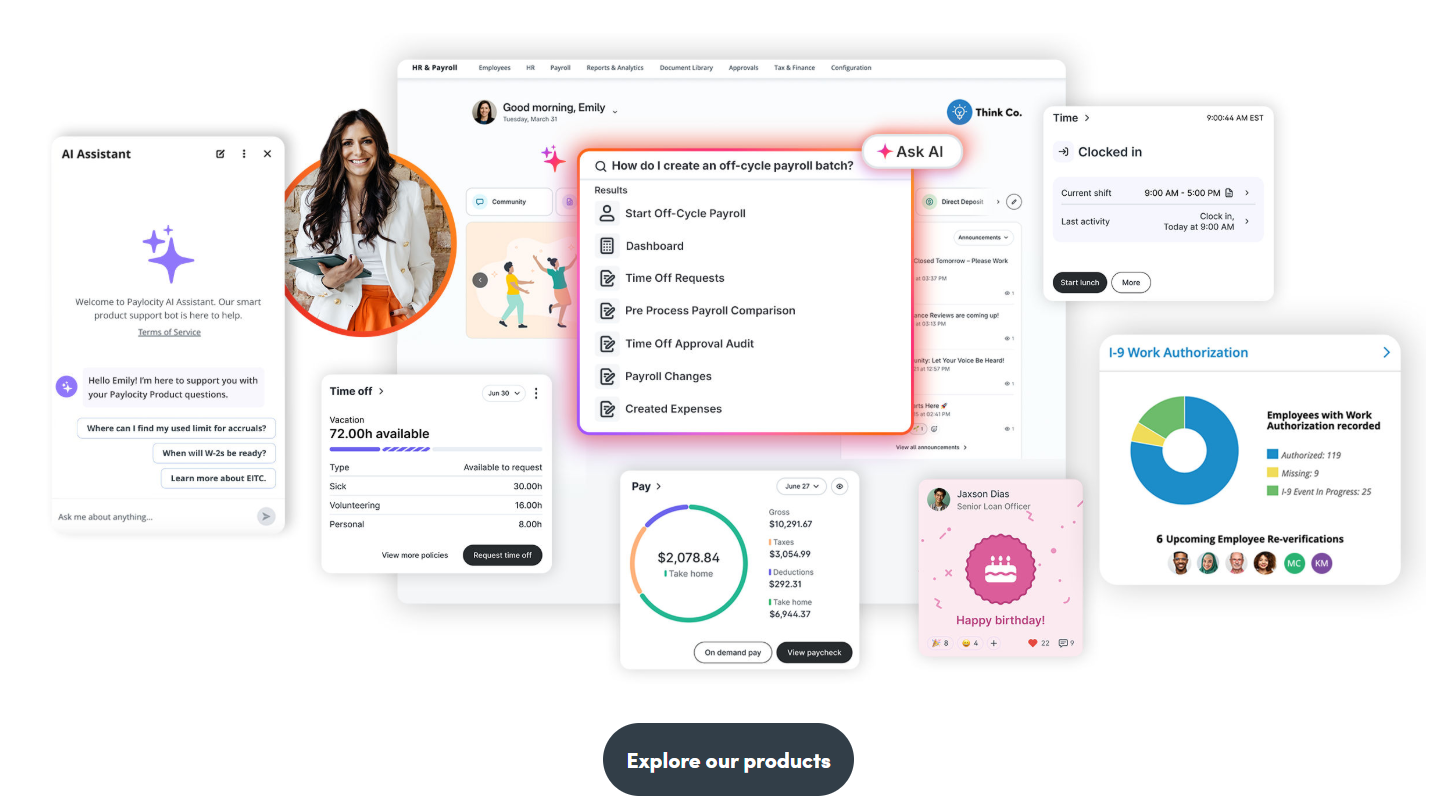
Ignite AI, with agents that do real work: Launched in July 2026, Ignite AI embeds purpose-built agents across the platform. The Payroll Analysis Agent compares each run against your own historical trends and explains anomalies before you submit. The Time Correction Agent surfaces timesheet errors and compliance issues before payroll deadlines. The Data Inspection Agent catches gaps in employee records, and the Answer & Insight Agent turns plain-English questions about overtime, turnover, or hiring funnels into answers with charts. A central Ignite AI Hub lets administrators decide which agents are switched on and measure the time they save.
An AI Assistant that moves from questions to actions: Paylocity’s AI Assistant, upgraded in September 2025, lets an employee ask how much vacation is left and request time off on the spot, or a manager check spending limits and approve an expense directly. Each answer links back to its source, and users only see data their role permits. Paylocity reported more than 1.2 million questions answered in the year before that upgrade, and management said AI interactions were nearly doubling quarter over quarter by mid-2026.
Payroll built around compliance safeguards: Beyond the new AI checks, the payroll engine runs more than 30 automated audits with alerts on every cycle, and the platform covers tax filing and payment, garnishment services, multi-state payroll and HR, and On-Demand Pay, which lets employees access part of their earned wages before payday. For businesses with hourly staff spread across several states, those built-in guardrails matter more than any headline feature.
A credible finance suite, not a side project: The spend tools come from Airbase, which Spend Matters named the top expense management solution for small and midsize enterprises in early 2025 and which Gartner recognized as a Visionary in its 2025 Magic Quadrant for accounts payable applications. Now branded Airbase by Paylocity, it brings expense management, corporate cards, AP automation, and guided procurement into the same system that already knows every employee’s department, manager, and cost center.
Employee experience people actually open: Community works like an internal social feed, peer-to-peer Recognition & Rewards lets colleagues celebrate each other, and Employee Voice handles surveys. Because it all lives in the same mobile app employees use to check pay stubs, adoption tends to be far higher than with a standalone intranet.
Room to grow, including help when you need it: The platform scales from small teams to 500+ employee organizations, connects to hundreds of HR, finance, and IT partners, ships a learning management system with 600+ pre-built courses, and in April 2026 added Elevate Solutions, a managed service layer that pairs the software with Paylocity specialists who take on routine payroll and HR operations work for lean teams.
Key Features and Technology
Paylocity is modular: you can start with one or two products and add more over time. Here is how the platform breaks down in 2026.
Payroll and Tax: The Engine Room
Payroll is where Paylocity started, and it remains the anchor of every contract. The module handles gross-to-net calculations, direct deposit, federal, state, and local tax filing and payment, year-end forms, wage garnishments, and multi-state employees in one run, with automated audits and the Payroll Analysis Agent checking each cycle for anomalies such as an unusual overtime spike or a missing deduction. For companies with staff abroad, Global Payroll provides consolidated reporting across 100+ countries through Paylocity’s partner network, which it expanded after acquiring longtime partner Blue Marble in 2021.
HR and Time & Labor: Running the Workforce Day to Day
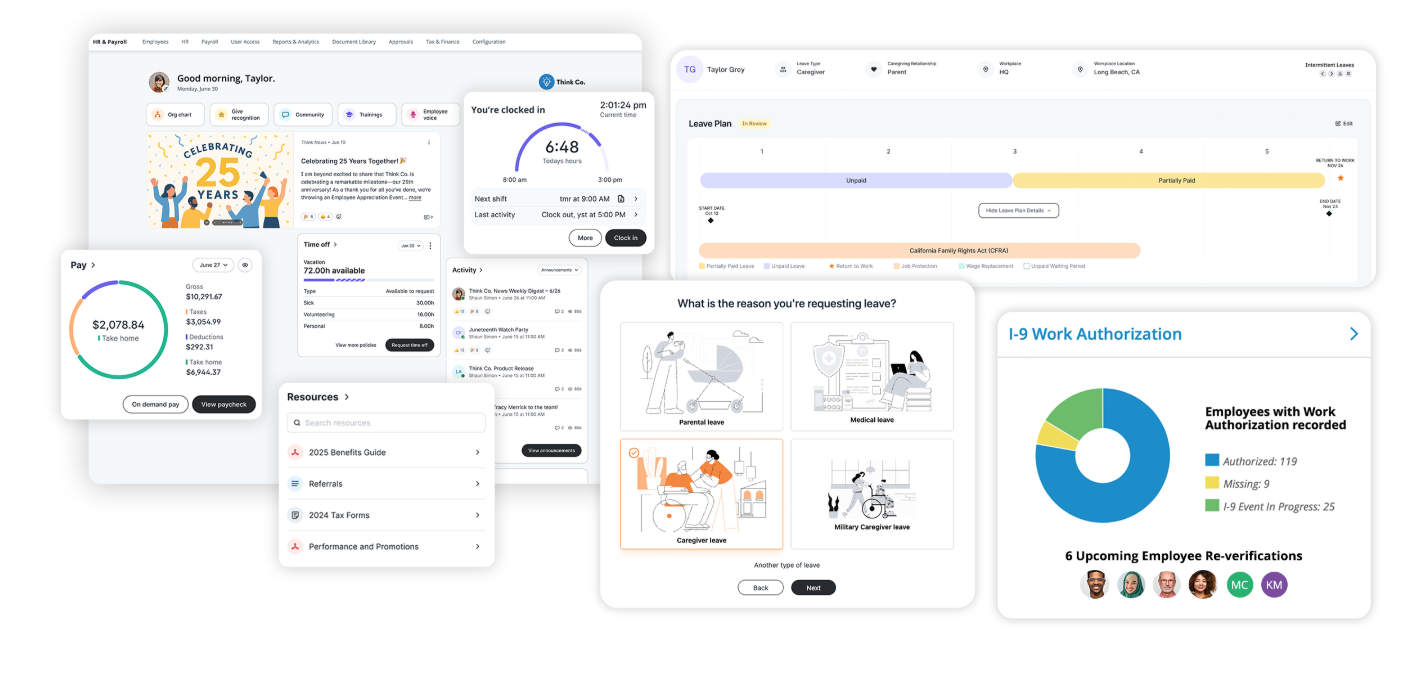
The HR layer covers the employee record itself, employee self-service, compliance tools, and absence management, with the Aidora acquisition set to bring AI-guided leave management that walks employees through eligibility and documentation by voice or text. Time & Labor includes time and attendance, scheduling, and flexible time collection options, so hourly employees can clock in from physical time clocks, the mobile app, or a browser. Because time data feeds payroll directly, the Time Correction Agent can flag missed punches before they turn into paycheck errors, and configurable approval workflows tie the pieces together.
Talent and Recruiting: AI Where Hiring Hurts Most
Paylocity’s talent suite spans recruiting, onboarding, performance, compensation, and learning, and recruiting has received the heaviest AI investment in 2026. The Candidate Fit Agent surfaces applicants who match role criteria and summarizes how they line up, while the Resume Summary Agent condenses inbound resumes. In October 2026, Paylocity added the AI-powered Recruiting Optimizer, built partly on its Grayscale acquisition: a Candidate Engagement Agent uses conversational AI over the web and SMS to answer candidate questions, run predefined screening questions, and schedule interviews, and a Talent Rediscovery Agent resurfaces past applicants who fit new openings. One auto dealer group quoted in the launch estimated its recruiters save five to eight hours per week. Recruiters still configure the rules and make every hiring decision. Paylocity also ranked first in AI Recruiting in G2’s Fall 2026 grid reports.
Benefits, Retirement, and Employee Experience
Benefits administration supports open enrollment and life events, with a guided enrollment experience that already uses agentic AI to help employees choose plans, while Flexible Benefits covers stipend-style perks. In June 2026, Paylocity launched an embedded retirement offering powered by Vestwell for 401(k) and 403(b) plans, so contributions, eligibility, and employee changes stay in sync with payroll instead of being exported to a separate recordkeeper. The engagement tools described above round out this layer and make self-service adoption easier.
Finance and IT: Beyond Traditional HCM
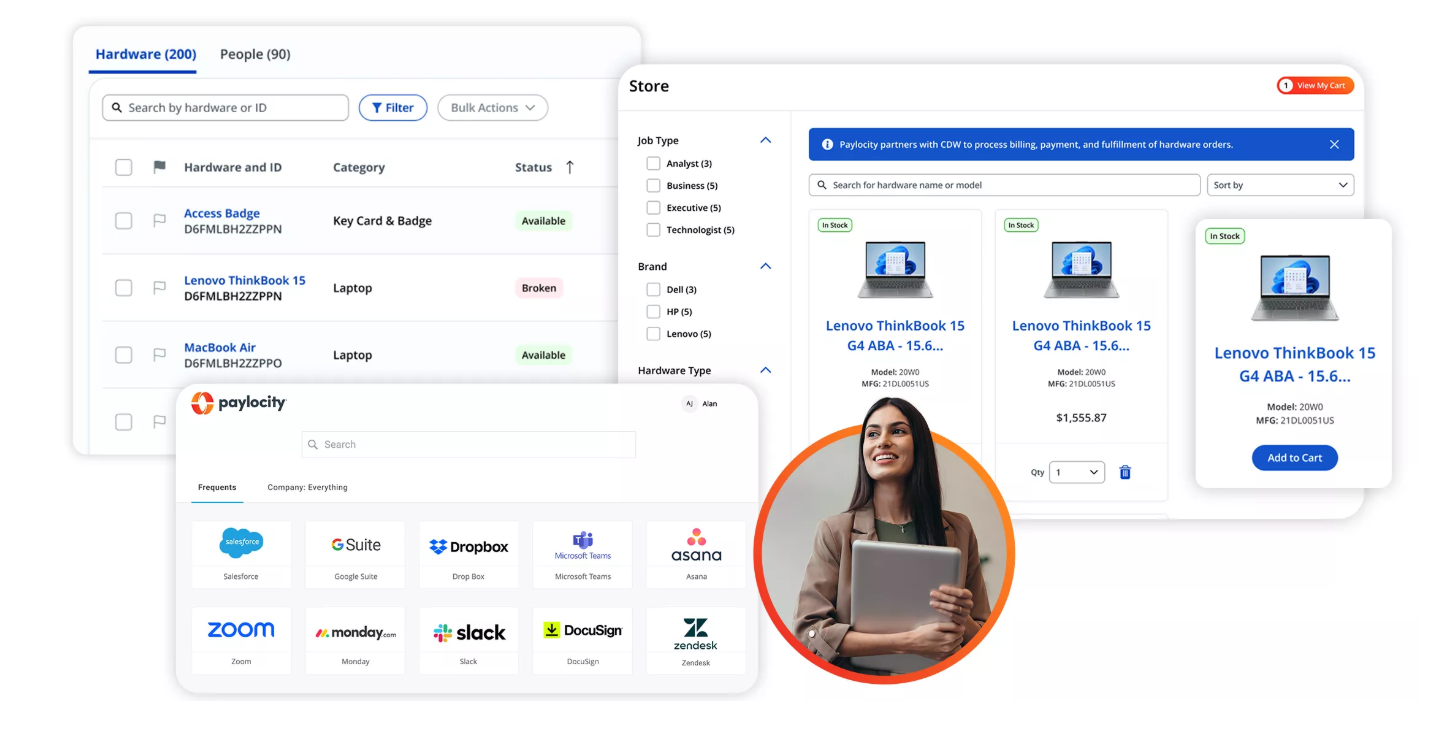
This is where Paylocity separates from most payroll-first competitors. The Finance suite, Airbase by Paylocity, includes expense management, corporate cards, AP automation, guided procurement, and headcount planning, backed by accounting automation, spend analytics, fraud detection, policy compliance, and vendor management. Because approvals follow the org chart that HR already maintains, a manager’s spending authority updates the moment their role changes. The IT side offers two products. Access Management syncs the HR record with Google Workspace and Microsoft Entra ID, handles single sign-on and multi-factor authentication, and automatically grants or removes access during onboarding, role changes, and offboarding, with a SCIM API for other identity providers. Asset Management assigns and tracks laptops, keycards, and specialty tools, ties device requests into onboarding, automates returns and refresh cycles, and includes a built-in device store powered by CDW.
Ignite AI, Analytics, and Integrations
Ignite AI is the umbrella for every AI capability on the platform: the AI Assistant, the six named agents (Answer & Insight, Payroll Analysis, Candidate Fit, Resume Summary, Data Inspection, and Time Correction), the recruiting agents, and agentic flows for benefits enrollment, expense submission, and accounts payable validation, with scheduling agents on the roadmap. Underneath sit analytics and reporting, configurable workflows, the mobile app, and an integrations marketplace that connects accounting systems, identity providers, and benefits carriers.
Pricing, Plans, and Package Structure
Paylocity does not publish prices. Every customer receives a custom quote after a demo, built from the modules chosen, headcount, contract length, and negotiated discounts. Billing is a recurring per-employee-per-month (PEPM) subscription rather than a per-paycheck fee, plus a one-time implementation charge. Paylocity’s own site groups customers into small business (1 to 99 employees), midsize (100 to 499), and enterprise (500+). The figures below are third-party estimates gathered from buyer reports and pricing research in 2026, not official rates, so treat them as a budgeting guide.
| Package / Component | Approx. Price | What You Get | Best For |
|---|---|---|---|
| Core Payroll & HR | ~$18–22 PEPM | Payroll, tax filing, HR records, employee self-service, mobile app | Teams consolidating payroll and HR first |
| Full HCM Suite | ~$26–33 PEPM | Adds time and labor, scheduling, recruiting, onboarding, performance, learning, benefits admin, engagement | Mid-market employers wanting one system |
| Implementation (one-time) | ~10–20% of annual software spend | Setup, configuration, data migration, training | Every buyer; often negotiable |
| Managed Payroll / Elevate Solutions | ~$5–15+ PEPM add-on (est.) | Paylocity specialists handle routine payroll and HR operations | Lean HR teams without deep payroll expertise |
| Finance (Airbase by Paylocity) | Quote-based | Expense management, corporate cards, AP automation, procurement, headcount planning | Finance teams replacing separate spend tools |
| IT (Access & Asset Management) | Quote-based | SSO, MFA, directory sync, automated provisioning, device tracking, CDW device store | Small IT teams tying access and devices to HR events |
| Retirement (powered by Vestwell) | Quote-based | Embedded 401(k) and 403(b) plans synced with payroll | Employers launching or consolidating a plan |
| Example: 200 employees, full HCM | ~$62K–79K per year + ~$6K–16K implementation | Roughly $68K–95K all-in for year one | Illustrative budgeting only |
How Paylocity Compares to Alternatives
| Factor | Paylocity | Paycom | ADP Workforce Now | Rippling |
|---|---|---|---|---|
| Pricing model | Custom quote, PEPM + implementation | Custom quote, per billing period + implementation | Custom quote, Select / Plus / Premium tiers | Modular, base platform plus paid add-ons |
| Estimated cost | ~$18–33 PEPM | ~$25–36 PEPM | ~$23–30 PEPM | From ~$8 per user/month base; rises with modules |
| Corporate cards & AP automation | Yes (Airbase by Paylocity) | Expense management only | Not native | Yes (Rippling Spend) |
| IT access & device management | Yes (Access & Asset Management) | No | Via partners | Yes, its signature strength |
| AI layer | Ignite AI agents + AI Assistant | IWant command-driven AI | ADP Assist | Rippling AI features |
| International payroll | 100+ countries via partner network | Primarily US-focused | Extensive, mature global payroll | Native global payroll + EOR |
| Best for | US mid-market wanting HR, Finance and IT in one | Employee-driven payroll in a single app | Larger, compliance-heavy organizations | Tech-forward, distributed companies |
vs. Paycom: Paycom is Paylocity’s closest mid-market rival and sells a similar promise of one database for HR and payroll. Its signature feature, Beti, has employees review and approve their own paychecks before payroll runs, and it scores higher on G2 for ease of use (9.5 versus 8.9 out of 10). Paylocity answers with lower estimated pricing (buyer research puts it roughly 10–20% below Paycom for comparable functionality), easier setup (8.2 versus 7.9 on G2), and a much broader scope that now includes corporate cards, AP automation, and IT. For breadth, Paylocity wins; for employee-verified payroll, demo Paycom.
vs. ADP Workforce Now: ADP brings unmatched scale, decades of compliance depth, and a far larger international payroll footprint, which makes it the safer pick for big or multinational employers. Estimated pricing lands close to Paylocity’s for similar module bundles. Where Paylocity tends to win is the modern, social employee experience, the speed of its AI rollout in 2026, and native spend management that ADP doesn’t offer. Mid-market companies that prize usability and consolidation often prefer Paylocity, while organizations with complex global or union payroll needs often stay with ADP.
vs. Rippling: Rippling is the platform most similar to Paylocity’s HR, Finance, and IT vision, and it got there first with device management and app provisioning. It earns higher G2 scores across the board (around 9.2 to 9.5 on ease of use, setup, and support) and offers native global payroll and employer-of-record services. Paylocity counters with a longer payroll track record, stronger engagement tools, a more mature recruiting suite, and pricing that some buyers find more predictable than Rippling’s add-on model. Choose Rippling for deep IT automation and global hiring; choose Paylocity for US-centric workforces with lots of hourly staff, heavy recruiting, and engagement needs.
vs. Gusto or a patchwork of point tools: For a 5- to 25-person company, Gusto’s transparent pricing (from $49 per month plus $6 per person on its Simple plan, up to $180 plus $22 per person on Premium) is far simpler and cheaper than any Paylocity quote. A patchwork of point tools and spreadsheets can also work while you are small, but duplicate data entry, sync errors, and compliance gaps multiply with every new hire and every new state. Paylocity makes the most sense once that complexity has started costing you real hours.
Pros and Cons
What HR and Finance Teams Love
Genuinely unified data: Payroll, HR, time, recruiting, benefits, spend, and IT access all draw from the same employee record. Users repeatedly highlight how much re-keying and reconciliation disappears once everything lives in one place.
Friendly for employees and managers: Reviewers on Capterra (4.3 out of 5 from nearly 2,000 reviews) and G2 (around 4.4 out of 5 from 6,000+ reviews) frequently call the interface easy to navigate. Self-service, the mobile app, and pre-day-one onboarding take a real load off HR.
AI that is embedded, not decorative: Payroll anomaly checks, timesheet corrections, data-quality scans, candidate engagement over SMS, and an assistant that can complete actions bring practical time savings to the tasks that eat HR’s week.
Strong payroll guardrails: More than 30 automated audits, multi-state support, tax filing, garnishments, and On-Demand Pay give US employers with hourly and distributed staff confidence that payroll goes out right.
Fast, steady innovation: 2026 alone brought Ignite AI, the Recruiting Optimizer, embedded retirement plans, Elevate managed services, and two AI acquisitions. Users also note frequent feature updates to the core product.
Limitations Worth Knowing
Opaque pricing and upfront costs: With no published rates, you can’t compare costs without sitting through demos. Implementation fees add a meaningful one-time expense, and buyers should watch for renewal increases once first-year discounts expire.
Inconsistent customer service: This is the most common complaint in user reviews. Customers describe frequent changes of account representative, slow email responses, and uneven product knowledge, though many report better results by phone or chat. Capterra’s customer service sub-score (4.1) trails its ease-of-use score.
Reporting has a learning curve: Standard reports work well, but users say building custom reports and certain compliance reports can be harder than expected. The new Answer & Insight Agent should help, but plan time to learn the reporting tools.
Occasional module friction: Some reviewers report that Time & Labor doesn’t always sync smoothly with HR and payroll, that payroll corrections can be cumbersome, and that some PTO accrual issues require manual fixes.
Overkill for very small teams: The platform’s breadth comes with complexity. A business with a handful of salaried employees will usually pay more and configure more than it needs compared with a simpler payroll app.
US-centric by design: International payroll runs through partners rather than Paylocity’s own engine, so companies with large workforces abroad, or no US presence at all, will find stronger options elsewhere. AI feature packaging is also not publicly documented, so confirm what your contract includes.
Who Should Use Paylocity
US mid-market companies (roughly 50 to 1,000 employees): This is Paylocity’s sweet spot. If you have outgrown a basic payroll app and are juggling separate tools for time, hiring, and benefits, the Full HCM Suite consolidates them into one system your employees will actually use.
Hourly and multi-location workforces: Restaurants, retail, healthcare, manufacturing, and auto dealer groups benefit most from scheduling, flexible time collection, the Time Correction Agent, multi-state payroll, and On-Demand Pay. Start with Core Payroll & HR plus Time & Labor.
High-volume hirers: If you fill dozens of roles every month, the Recruiting Optimizer’s SMS-based candidate engagement, automated screening and scheduling, and talent rediscovery can save recruiters hours each week. Add the recruiting module to your HCM quote.
CFOs and IT leads who want fewer vendors: If your finance team runs a separate spend tool and your IT team manually provisions accounts from HR emails, bundling Airbase by Paylocity and Access & Asset Management into the same contract can remove two vendors and a lot of manual work.
Lean HR teams that need hands-on help: If one HR generalist covers everything, pairing the core platform with Elevate Solutions puts Paylocity specialists behind your routine payroll work. Who should look elsewhere? Microbusinesses with under about ten employees (Gusto is simpler and cheaper) and companies whose workforce is mostly outside the United States (ADP or Rippling offer deeper global payroll).
Getting Started: Step by Step
- Map your current stack. List every tool you use for payroll, time, hiring, benefits, expenses, and IT access, along with your headcount by state and pay type. This tells you which Paylocity modules you actually need.
- Request a demo and pricing. Use the pricing form on Paylocity’s site or contact sales, and ask to see the specific workflows that cause you the most pain, such as payroll approvals or high-volume hiring.
- Get the quote itemized in writing. Confirm the PEPM rate at your headcount, the implementation fee, the year-two rate, renewal terms, and which Ignite AI features are included.
- Plan implementation carefully. Gather prior payroll registers, tax IDs, year-to-date earnings, benefits data, and PTO balances. Most teams run at least one parallel payroll alongside their old system to verify accuracy before going live.
- Configure, train, and launch self-service. Set up workflows and approval chains, train managers, and roll out the mobile app so employees handle pay stubs, PTO requests, and personal details themselves.
- Switch on AI gradually. Use the Ignite AI Hub to enable agents one or two at a time, starting with the Payroll Analysis and Time Correction agents, and have HR review every flag for a cycle or two.
- Expand once the core is stable. After a few clean payroll cycles, layer in recruiting, retirement, Finance, or IT modules as your needs and budget grow.
Tips for Getting Maximum Value
Get competing quotes from at least two other vendors at the same module mix and headcount, since that is your strongest lever with any quote-only provider, and insist on a written cap for renewal increases. Resist buying every module on day one; a stable payroll foundation matters more than a long feature list, and you can add Finance or IT later without re-implementing your HR data. Clean up employee records before migration, because the system is only as good as the data you load into it. Assign one internal owner to learn the reporting tools in depth, and lean on phone or chat support for urgent issues rather than email, which users say gets slower responses. Finally, measure your results: the Ignite AI Hub tracks questions answered and tasks completed, which makes it easier to prove ROI at renewal time.
Future Outlook and Final Assessment
The tailwinds favor Paylocity. Businesses are consolidating software vendors, CFOs are pushing HR, finance, and IT onto shared data, and AI agents are fast becoming the expected way to handle repetitive admin work. Paylocity is investing directly in all three trends, backed by fiscal 2027 revenue guidance of roughly $1.88 to $1.90 billion. Management has also signaled openness to per-user or usage-based pricing as AI changes how software is consumed, so expect the commercial model to evolve alongside the product.
The honest caveats remain: pricing is opaque, implementation adds real upfront cost, customer service quality varies by representative, reporting takes effort to master, and the platform is built first for US employers. Within those boundaries, Paylocity delivers one of the broadest, most modern, and most AI-forward workforce platforms available to mid-sized American businesses in 2026, and it is one of very few that can credibly replace your payroll provider, your spend tool, and part of your IT stack in a single contract.
Conclusion
Paylocity has evolved from a reliable payroll provider into a unified platform that pays your people, hires and develops them, manages their spending, and provisions their access and devices, all from one employee record and increasingly with AI agents doing the heavy lifting. It won’t suit every business: very small teams and companies without a US presence have better-fitting options, and every buyer should negotiate carefully and confirm exactly what the quote includes. But for growing American organizations that are tired of reconciling five systems every pay period, Paylocity is a strong, future-ready choice that helps HR, finance, and IT teams make everything easy, one payroll cycle at a time.
Ready to unify payroll, HR, finance, and IT on one AI-powered platform?
Explore more honest reviews, tutorials and tool comparisons to find the right tech for the way you work and live — at AI Solutes, where we make everything easy.
👉 Get Started: https://www.paylocity.com/
👉 Our YouTube Channel: youtube.com/@ai-solutes
👉 Our Facebook Fanpage: Facebook
👉 Our X (Twitter): @AISolutes
- Master WPForms in 2026: Unlock Powerful AI Forms, Payment Integrations, and Security for WordPress
- What If You Could Delegate Daily Tasks to a Dedicated AI Team? Inside Sintra AI’s Automation Suite
- BHuman AI
- Secure Global Health Insurance for Remote Teams and Digital Nomads: Compare Providers, Costs, and Worldwide Coverage
- Does Malwarebytes Eliminate Cyber Threats? Reviewing the Malwarebytes Advanced Anti-Malware Technology