If you run paid ads on Meta or TikTok, you already know the real bottleneck isn’t the ad account — it’s the creative. The platforms now reward whoever can feed them the most fresh, on-message variations, which means the hardest question in performance marketing has quietly shifted from “who do I target?” to “what ad do I make next, and why will it work?” Most teams answer that with a messy stack of tools — a spy app for inspiration, a separate analytics dashboard, a blank Google Doc for briefs, ChatGPT for copy, and a designer drowning in requests. Atria was built to collapse that whole chain into one place. It’s an AI-powered ad creative intelligence and workflow platform that researches winning ads, writes data-backed briefs, generates new creative, launches it straight to Meta, and grades the results — all driven by an AI strategist trained on more than $5 billion in real ad spend.
For DTC brand owners, in-house media buyers, creative strategists, and the agencies serving them, that’s a genuinely different proposition from a single-purpose tool. Atria is trusted by 20,000+ teams, holds a 4.9 rating on G2, is SOC 2 Type II certified, and was built by veterans of TubeScience — the agency behind scaling household DTC names. With plans starting around $129 per month and a free tier you can open without a credit card, it sits at the premium end of marketing software but aims to replace several subscriptions at once. This 2026 review walks through everything that matters: what Atria actually does, the Raya and Radar AI engines, the full feature set, real pricing and tiers, honest head-to-head comparisons, the genuine limitations, and exactly who should — and shouldn’t — buy in.
Atria Review 2026: The AI Ad Platform That Tells Performance Marketers Exactly What to Build Next
Overview and Background
Atria is an AI-powered ad creative intelligence and workflow platform built specifically for paid social — Meta (Facebook and Instagram) and TikTok. Rather than positioning itself as just another AI generator that spits out copy and images, Atria tackles the broader, harder problem: which ad concepts will win, why they’ll win, and how to systematically produce more of them. It connects directly to your ad accounts and runs the full creative lifecycle in one platform: research, brief, generate, launch, and analyze.
The company was founded in 2022 by Ray Jang, a former product leader at ByteDance and TikTok, and is built with a team that includes veterans of TubeScience — the performance-creative agency known for scaling brands like AG1, Dr. Squatch, and Fabletics. That operator pedigree matters: the people building Atria have personally spent enormous sums learning what makes social ads convert, and the product is shaped around how Meta and TikTok actually evaluate creative rather than around surface-level vanity metrics. Atria is a venture-backed startup operating out of New York, and it has grown quickly on the back of a single, clear promise — more winning ads, faster, without adding headcount.
The scale behind the tool is its headline differentiator. Atria’s core AI is trained on what the company describes as more than $5 billion in real, outcome-labeled ad spend data, paired with a vast ad library spanning tens of millions of creatives and roughly $2 billion in additional market intelligence. The platform is used by 20,000+ teams, carries a 4.9 score on G2, holds SOC 2 Type II certification for security, and runs natively inside Slack so the AI can work alongside a team where it already communicates. The timing is deliberate: Meta’s recent “Andromeda” infrastructure update made creative diversity — feeding the algorithm many distinct concepts rather than a few near-identical ones — the primary lever for performance, which is exactly the workflow Atria is designed to industrialize.
Why Atria Stands Out in 2026
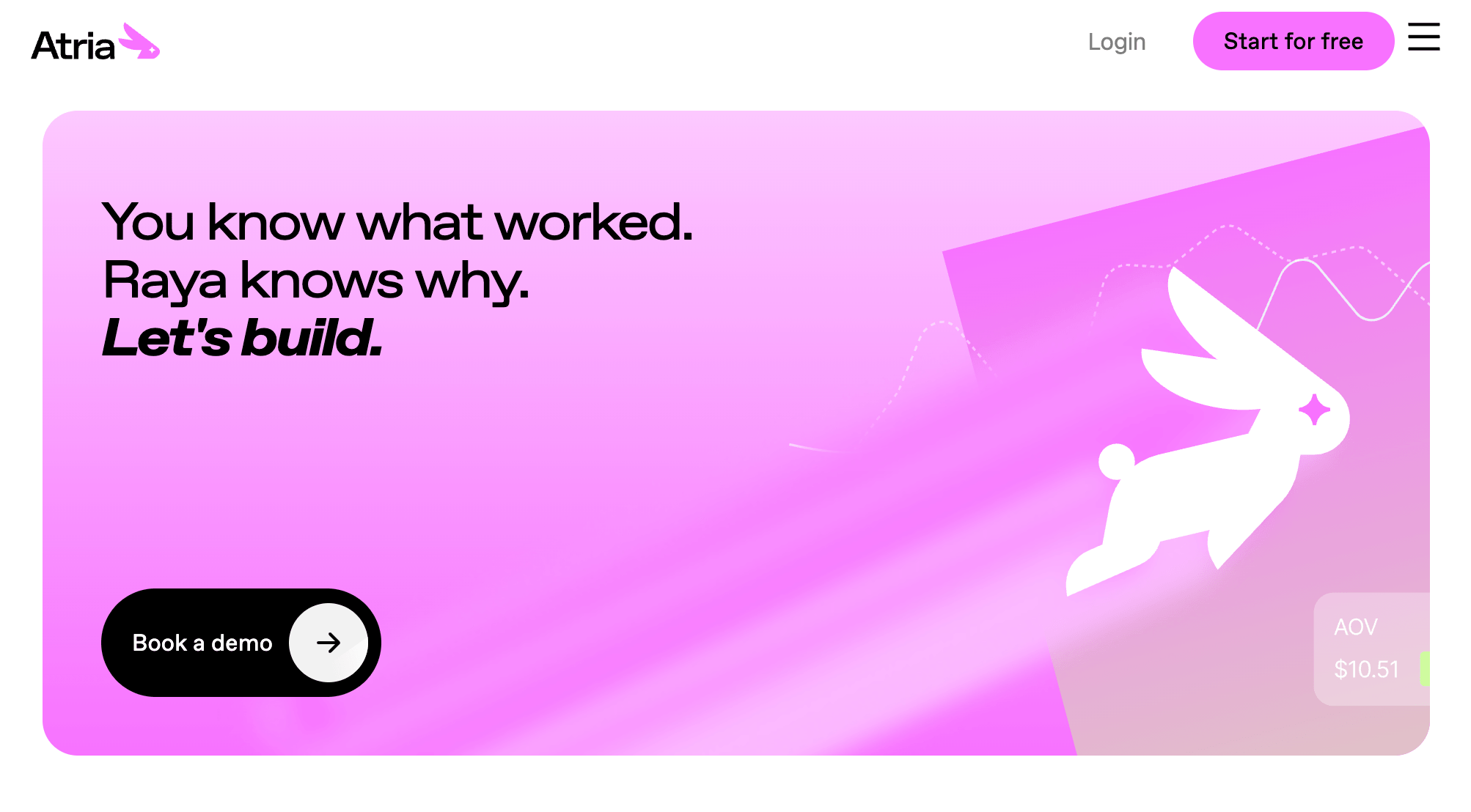
Raya — an AI strategist trained on real outcomes, not just words: The centerpiece is Raya, an AI teammate trained on $5 billion+ in real ad spend data. The distinction matters enormously. A general model like ChatGPT can write something that sounds persuasive; Raya is tuned on creatives whose actual performance is known, so it recommends personas, hooks, and messages because they have historically converted — not because they read well. Raya analyzes your brand, ads, and data, layers on competitor intelligence and market intel, and surfaces the winning formulas worth building next.
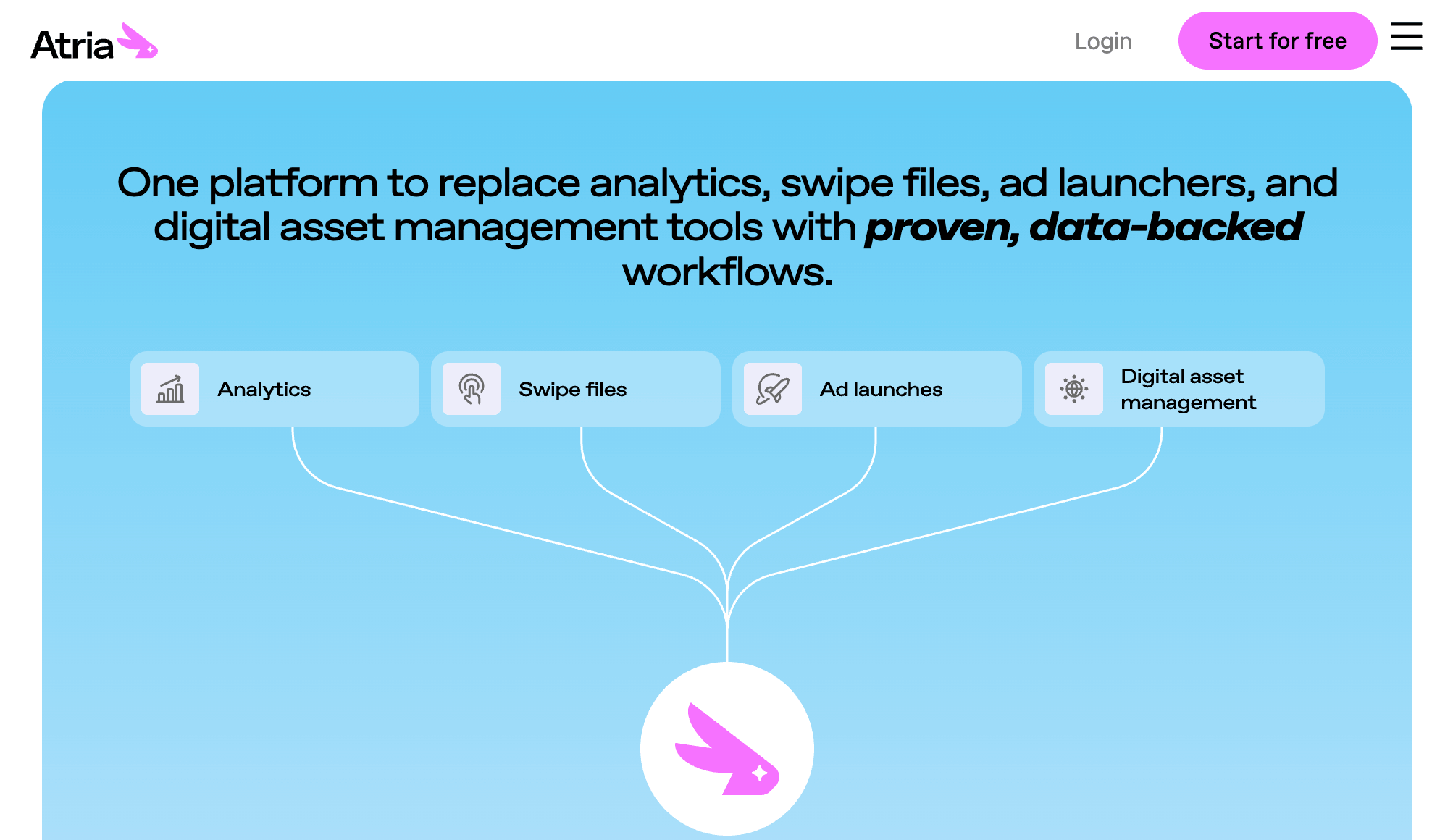
One end-to-end workflow instead of a five-tool stack: Atria’s biggest practical advantage is consolidation. The same platform handles research, brief-building, AI generation, one-click launching, and post-launch analysis — so an insight from review mining can become a tested creative without ever switching apps or losing context. For most teams this replaces separate subscriptions to an analytics tool, a swipe-file/spy tool, and a general AI writer, which is a real cost and workflow saving.
Radar — plain-English creative grading, 24/7: Radar is Atria’s always-on AI strategist that grades every ad and tells you in plain language what’s working, what’s missing, and exactly what to change — not just a wall of metrics. It proactively flags creatives that are starting to decline before they drag down your ROAS, which turns reactive firefighting into early, specific action.
Competitor and customer-review mining that becomes copy: Atria automatically extracts top hooks, personas, and landing-page angles from competitors, and mines your own customer reviews to turn what buyers love (and complain about) into ad angles and hooks. Instead of starting briefs from a blank page, you start from evidence about what already resonates in your market.
One-click bulk launching to Meta: Generating creative is only half the battle; shipping it is the other half. Atria pushes dozens of variants straight to Meta in a single bulk action — the company cites roughly 10x faster uploads than doing it manually — and can auto-scale winners and pause losers, removing one of the most tedious parts of a media buyer’s day.
Native in Slack and increasingly agentic: Raya lives where teams already work, operating inside Slack rather than forcing everyone into yet another dashboard. Atria leans into a “proactive AI” model — monitoring, tagging, and surfacing insights without being prompted — and exposes an API and MCP integration for teams that want to wire it into their own systems.
Built by operators, with optional embedded strategy: Beyond the software, Atria offers a “scale with us” service where a strategist from the team that scaled major DTC brands embeds with you for monthly audits, briefs, and scaling support. Few competitors pair a data-trained AI with hands-on human expertise from people who have actually spent at this level.
Key Features and Technology
Atria’s catalog of capabilities maps cleanly onto the five stages of a modern creative workflow. Here’s how the platform breaks down.
Raya and Radar — the AI Brains
Raya is the AI creative strategist that connects everything: it studies your brand and historical performance, blends in competitor and market data, identifies the personas, hooks, and key messages that consistently win, and then automatically builds creative briefs and new ads from those proven formulas. Radar is the analytics-side intelligence — a 24/7 engine that grades each ad, summarizes key metrics and topics, sets and tracks targets, and delivers prescriptive, plain-English fixes. Together they’re the difference between a tool that reports what happened and one that tells you what to do about it.
Research and Inspiration
Atria includes what it bills as the world’s largest ad library — tens of millions of creatives — with unlimited AI-powered search, filters by theme, format, industry and language, and the ability to sort by longest-running (a strong proxy for what’s actually working). You can follow competitor brands to get AI-tagged breakdowns of their top hooks, ad angles, personas, USPs, and emotional themes, plus weekly email digests of their newest ads. A Chrome extension and mobile Instagram saving let you capture inspiration anywhere, and AI review mining turns customer testimonials and product feedback into ready-to-use angles.
Creation and Generation
On the production side, Atria generates ad concepts, hooks, scripts, and copy benchmarked against market winners, plus AI images that are informed by performance data rather than generic prompts. A standout is AI ad cloning: you can take a top-performing image ad and have the AI generate fresh iterations on the winning structure. Creative is auto-tagged by hook, persona, USP, and format — a task the company estimates saves four-plus hours a week versus manual tagging — and assets stay organized by brand, with multi-level boards, threaded comments, and timestamped feedback for team review.
Launch, Analytics, and Asset Management
Finished creative can be bulk-uploaded to Meta in one click, with winners auto-scaled and underperformers auto-paused. Reporting goes well beyond Ads Manager basics: customizable reports with advanced segmentation and filters, comparison reports, custom attribution windows, shareable report snapshots, and — on higher tiers — custom metrics and naming-convention enforcement. Everything lives in a central asset hub with AI-powered search that can find clips by visual element, voice-over, or on-screen text, plus Google Drive import and batch actions.
Pricing, Plans, and Package Structure
Atria is a subscription product, billed monthly or annually (annual billing saves roughly 20%). Every paid tier bundles a set number of seats, a monthly AI-credit allowance, a cap on analyzable ad spend, asset storage, and a number of brand profiles. The prices below are the annual-billing rates; month-to-month is higher. There’s also a genuine free entry point — 1,000 AI credits with no credit card required — so you can test the core experience before committing.
| Plan | Approx. Price (billed annually) | Key Limits | Best For |
|---|---|---|---|
| Free | $0 (no card required) | 1,000 one-time AI credits to try the core features | Kicking the tires before you buy |
| Core | ~$129/mo | 5 seats, 4,000 credits/mo, 5 ad accounts, $500K ad-spend analysis, 50 brands (no AI insights), 3 brand profiles, 5 GB | Small teams getting started with the essentials |
| Plus | ~$479/mo | 8 seats, 10,000 credits/mo, 10 ad accounts, $1M ad-spend analysis, 100 brands + AI insights, 8 brand profiles, 1 TB | Growing teams wanting the full-featured platform |
| Business (most popular) | ~$959/mo | 15 seats, 25,000 credits/mo, unlimited ad accounts, unlimited ad-spend analysis, 200 brands + AI insights, custom metrics, guests, 5 TB | Scaled in-house teams and agencies |
| Enterprise | Custom | Custom credits, custom limits, end-to-end creative delivery, enterprise security, dedicated support | Large organizations with bespoke needs |
How Atria Compares to Alternatives
| Factor | Atria | Motion | Foreplay | DIY Stack / Agency |
|---|---|---|---|---|
| Core focus | End-to-end: research → generate → launch → analyze | Creative analytics & reporting | Ad library / swipe file & briefs | Multiple tools or outsourced service |
| AI trained on outcomes | Yes ($5B+ ad spend) | Analytics-led, limited generation | No (inspiration only) | Depends on people |
| Generate ad creative | Yes (concepts, copy, images, clones) | Limited | No | Manual / human |
| One-click bulk launch to Meta | Yes | No | No | Manual in Ads Manager |
| Platforms | Meta + TikTok | Meta + TikTok | Meta + TikTok | Whatever you assemble |
| Entry pricing | ~$129/mo (free tier to start) | Mid–high (analytics-focused) | Lower entry (library-focused) | Several fees, or % of ad spend |
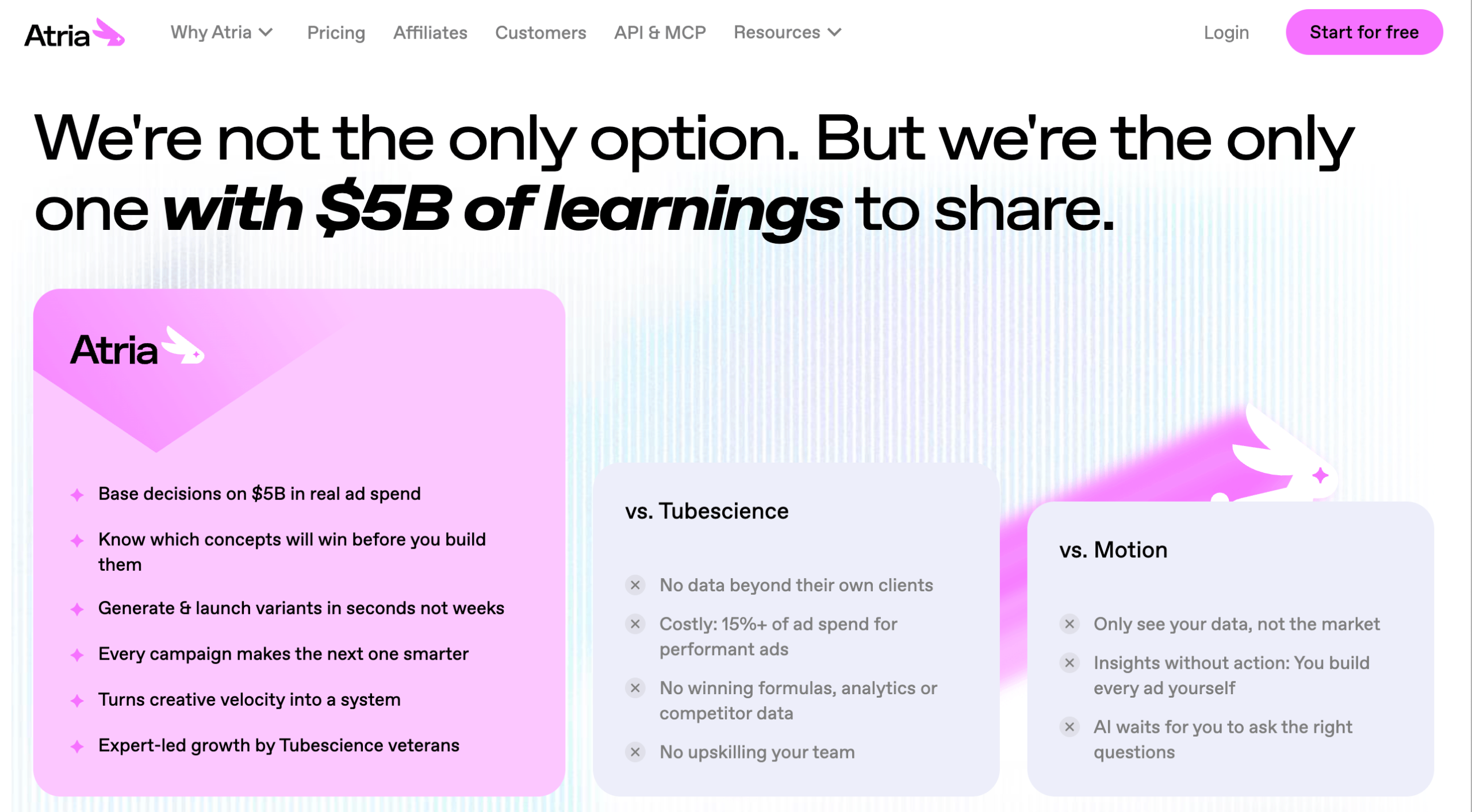
vs. Motion: Motion is a well-regarded creative-analytics and reporting tool, and it’s a frequent point of comparison — Atria users often say they barely opened Motion once they switched, because Atria turns the subjective “what should we try?” into a data-backed answer. The honest distinction is scope: Motion is excellent at showing you what your own creative did, but you still build every next ad yourself; Atria adds market-wide data, generation, and one-click launching on top of analytics. If you only want best-in-class reporting on your own account, Motion is strong; if you want the analysis to flow directly into making more ads, Atria covers more ground.
vs. Foreplay: Foreplay is a popular ad-library and swipe-file tool loved for organizing inspiration and building briefs, usually at a lower entry price. But it’s focused on the discovery end of the funnel — it doesn’t generate finished creative, grade your live ads against outcomes, or launch to Meta. Marketers frequently describe Atria as “Foreplay and Motion on AI steroids” precisely because it folds inspiration, analytics, and generation into one flow. For pure inspiration on a tight budget, Foreplay is worth a look; for an end-to-end system, Atria is the broader platform.
vs. a DIY tool stack or an agency: The realistic alternative for most teams is either stitching together a spy tool, an analytics tool, a generic AI writer, and a designer — or outsourcing performance creative to an agency that may charge a meaningful percentage of ad spend. The DIY route fragments your data across tools that don’t talk to each other; the agency route is effective but expensive and doesn’t upskill your own team. Atria’s pitch is to deliver most of that value in a single, data-connected platform at a predictable subscription, while keeping the learnings in-house. For teams committed to scaling paid social, that consolidation is the core argument.
Pros and Cons
What Marketers Love
Data-backed direction, not guesswork: The most consistent praise is that Atria makes creative decisions objective. Instead of debating which idea “feels” right, teams get recommendations grounded in $5B+ of real performance data, which removes a lot of internal friction and speeds up the path from insight to brief.
Real creative velocity: Users report meaningfully faster output — on the order of 2–3x more creative volume without adding headcount, with brands citing faster launches and quicker insight-to-brief cycles. For paid social in the post-Andromeda era, sheer volume of distinct concepts is a genuine performance lever.
One tool instead of several: Consolidating spying, analytics, generation, and launching saves both money and the daily tax of switching contexts. Teams that previously juggled three or more subscriptions often find the math works out in Atria’s favor.
Strong reporting and grading: Beyond generation, Atria earns repeated praise for analytics — customizable reports, comparison views, and Radar’s plain-English grading that tells you specifically what to fix rather than leaving you to interpret raw numbers.
Operator credibility and support: The TubeScience pedigree, the optional embedded strategist, SOC 2 Type II certification, and a 4.9 G2 rating give buyers confidence that this was built by people who have actually scaled spend — not just a generic AI wrapper.
Limitations Worth Knowing
Meta and TikTok only: Atria is purpose-built for paid social and, at the time of writing, doesn’t natively cover Google, YouTube, Pinterest, or LinkedIn ads. If a big share of your spend lives outside Facebook, Instagram, and TikTok, Atria won’t be your single source of truth.
Premium pricing for serious budgets: Entry is around $129/mo annually, and the most valuable tier (Plus) is several hundred per month. That’s well above single-purpose tools and is hard to justify for hobbyists or very small ad budgets — the ROI math only really works once you’re spending enough on ads for the analysis and velocity to pay back.
Credit and ad-spend caps to watch: The AI runs on a monthly credit allowance, and each tier caps how much ad spend it will analyze ($500K on Core, $1M on Plus). Heavy generators can burn through credits, and high-spend accounts may be pushed up a tier — so the headline price isn’t always the full picture. Model your real usage before committing.
AI output still needs a human: As with any generative tool, AI-written scripts and AI-generated images are strong starting points, not always finished assets. Expect to edit, fact-check brand details, and apply taste — Atria accelerates the work, it doesn’t fully replace a skilled marketer or designer.
Setup and a learning curve: To get the real value you have to connect ad accounts, build brand profiles, and let the AI learn your data. That onboarding is worth it, but it’s not a thirty-second install — smaller teams should budget time to set it up properly before expecting magic.
Requires connecting live ad accounts: Atria’s intelligence depends on read/write access to your Meta (and TikTok) accounts. For most teams that’s routine, but security-conscious organizations should review permissions — the SOC 2 Type II certification helps here, though it’s still a consideration worth raising internally.
Who Should Use Atria
DTC and ecommerce brands scaling on paid social: If your growth runs through Meta and TikTok and you’re constantly hungry for fresh creative, Atria is squarely built for you. Most growing brands will get the best balance from the Plus plan, which unlocks AI insights and a $1M ad-spend analysis cap.
Performance and creative agencies: Agencies managing many clients benefit most from Business, with unlimited ad accounts, unlimited ad-spend analysis, custom metrics, and guest access for sharing reports — turning creative production into a repeatable, data-backed system across accounts.
In-house media buyers and creative strategists: If your day is split between analyzing performance, briefing creative, and chasing competitors, Atria collapses that into one workflow and hands you Raya as a tireless strategist. A Core or Plus seat pays for itself in hours saved on tagging, reporting, and brief-writing alone.
Lean teams that need to punch above their weight: Startups and small marketing teams trying to produce big-brand creative volume without big-brand headcount are exactly who the “3x output without hiring” promise targets. Start free, then move to Core as your needs grow.
Who should probably skip it: Solo creators on tiny budgets, organic-only marketers, and teams whose spend is concentrated on Google, YouTube, or LinkedIn won’t get their money’s worth today. For those users, a cheaper single-purpose generator or analytics tool is the smarter starting point until paid social becomes a real channel.
Getting Started: Step by Step
- Start free, no card required. Sign up and claim your 1,000 free AI credits to explore Raya, Radar, the ad library, and generation before paying anything.
- Connect your ad accounts. Link your Meta (and TikTok) accounts so Radar can analyze real performance and Raya can ground its recommendations in your own data.
- Build your brand profile. Add your brand description, USPs, target audience, and guidelines (colors, fonts, tone) so generated creative stays on-brand.
- Follow competitors and mine reviews. Track rival brands to surface their winning hooks and angles, and run review mining on your own customer feedback to seed data-backed concepts.
- Generate, brief, and launch. Let Raya turn winning formulas into briefs and ad variants, then bulk-upload your chosen creatives straight to Meta in one click.
- Review with Radar and iterate. Use Radar’s grading and proactive alerts to double down on winners, fix or pause losers, and feed every learning back into the next round.
Tips for Getting Maximum Value
Treat the free credits as a real evaluation, not a glance — run an actual brief-to-launch cycle so you can judge Raya’s recommendations against your own instincts before subscribing. When you do pay, match the tier to your usage rather than just your team size: if you’ll lean heavily on generation or analyze more than $500K in monthly ad spend, the jump to Plus usually pays for itself, while solo or very light users may be fine on Core. Invest the upfront time in detailed brand profiles and connected accounts; the quality of Atria’s output scales directly with the quality of the data you give it. Use review mining and competitor following aggressively — they’re where the most original, conversion-ready angles come from. And because annual billing saves around 20% and credit allowances and prices shift with promotions, confirm the current terms on Atria’s official site and choose annual once you’re confident it’s a keeper. Above all, remember the AI is a force-multiplier for a skilled marketer, not a replacement — the teams that win with it pair its speed with human taste and editing.
Future Outlook and Final Assessment
The tailwinds are firmly behind a tool like Atria. Meta’s Andromeda update made creative diversity the dominant performance lever, which means the advertisers who can reliably produce many strong, distinct concepts now win — and that’s precisely the workflow Atria industrializes. As AI generation becomes commoditized, the durable advantage shifts to whoever has the best outcome-labeled data to decide what to make, and Atria’s $5B+ training set plus a continuously learning Raya is a strong moat on that front. A platform that compounds its learnings campaign after campaign is well-positioned for a market where creative velocity is the whole game.
The honest caveats remain: it’s Meta- and TikTok-only for now, it’s priced for teams with real ad budgets, the credit and ad-spend caps deserve a close read, and the AI’s output still needs a human’s judgment on top. But within those boundaries, Atria is one of the most complete and genuinely useful AI ad platforms available in 2026 — and for teams whose growth lives on paid social, the consolidation and data advantage make it an easy one to test.
Conclusion
Atria has built something rare in the crowded AI-marketing space: a single, coherent platform that meets performance teams across the entire creative lifecycle — from researching what’s working in the market, to generating on-brand variants, to launching them in a click, to grading the results and sharpening the next round. It’s grounded in real outcomes rather than generic output, built by operators who have actually scaled spend, and aimed squarely at the way modern paid social is won. Confirm it fits your channels and budget, give it good data to learn from, and Atria makes one of the most demanding jobs in marketing — producing a steady stream of winning ads — feel a whole lot more systematic and a whole lot less like guesswork. For the right team, that’s exactly the kind of leverage that makes everything easy.
Ready to turn “what ad do we make next?” into a data-backed answer?
Explore more honest reviews, tutorials and tool comparisons to find the right tech for the way you work and live — at AI Solutes, where we make everything easy.
👉 Start for Free: https://www.tryatria.com/
👉 Our YouTube Channel: youtube.com/@ai-solutes
👉 Our Facebook Fanpage: Facebook
👉 Our X (Twitter): @AISolutes
- Master Personal Loans in Vietnam 2025: Compare Rates, HELOC vs Unsecured, and Apply Fast with AI
- Will ADP Revolutionize Your Talent Acquisition? Evaluating Their Latest HR Tech
- Unlock OpenAI’s $340 Billion Impact: Real-World Business Transformations and AI Ecosystem in 2025
- Ready Player Me
- Unlock Clear, Youthful Skin with Yves Rocher Vietnam Botanical Skincare