Most people who want to buy crypto face the same uncomfortable problem: the exchanges that are easiest to use are also the ones charging the highest fees, while the lowest-fee platforms can feel intimidating to anyone who has never placed a limit order. Kraken solves both sides of that equation in a single platform. Founded in 2011 by Jesse Powell — who had witnessed firsthand the catastrophic failure of Mt. Gox — Kraken was built from day one on the conviction that security and transparency should never be afterthoughts in financial infrastructure. In over a decade of continuous operation, it has never lost customer funds to a platform hack, a record that almost no major exchange can claim. Today, Kraken serves more than 15 million clients across 190+ countries, has processed over $2 trillion in lifetime transaction volume, and earned the title of Most Popular Crypto Exchange 2026 by Forbes. It supports 500+ cryptocurrencies, commission-free trading of 11,000+ US stocks and ETFs for eligible US users, futures with up to 50x leverage, on-chain staking with up to 21% APY on select assets, and a global payments app called Krak that sends money across 160+ countries. Spot trading fees start at just 0.25% maker / 0.40% taker on Kraken Pro — among the most competitive rates of any regulated exchange in the world.
For crypto beginners who want a trustworthy first exchange, active traders who need professional tools and low fees, US investors who want crypto and stocks in one account, and institutions requiring compliant custodial infrastructure, Kraken has built something rare: an all-encompassing financial platform that grows with you from your first $50 purchase to a professional multi-asset trading operation. This 2026 review covers exactly what Kraken offers, what distinguishes it from competitors, a full breakdown of every fee structure, a direct comparison with Coinbase and Binance, honest pros and cons from real user experiences, who it suits best, and a step-by-step guide to getting started. This review is for informational purposes only and does not constitute financial or investment advice.
Kraken Review 2026: The Secure, Low-Fee, Multi-Asset Exchange Trusted by 15 Million Traders — Crypto, Stocks, Futures & More Since 2011
Overview and Background
Kraken’s origin story begins in one of crypto’s darkest chapters. In 2011, Jesse Powell was called in as a cybersecurity consultant to help the crumbling Mt. Gox exchange — at the time the world’s largest Bitcoin trading platform — deal with the fallout from a catastrophic hack that would eventually cost customers 850,000 bitcoin. Witnessing the consequences of that failure firsthand shaped every design decision Powell made when founding Kraken later that year. The exchange officially launched trading in 2013 from Cheyenne, Wyoming — a location chosen because Wyoming had become one of the most crypto-friendly regulatory environments in the United States — and has operated continuously ever since, surviving every major market cycle, regulatory wave, and industry crisis that followed.
The Kraken of 2026 is a dramatically more ambitious platform than the spot crypto exchange of 2013. Through a combination of organic development and strategic acquisitions, Kraken has evolved into a multi-asset trading and financial services platform that now encompasses spot and margin crypto trading, US stocks and ETFs (11,000+ for eligible US users), tokenized equities through its xStocks product (100 assets, with $25 billion in transaction volume by March 2026), futures with up to 50x leverage, on-chain staking, OTC trading for large block transactions, a self-custody wallet, a global payments app (Krak), and an AI-assisted trading tool. The acquisition of NinjaTrader for $1.5 billion in May 2025 — the largest deal combining traditional finance and crypto at that time — added nearly 2 million futures traders and professional-grade analytics tools to the Kraken ecosystem. In March 2026, Kraken became the first digital asset firm with a Federal Reserve master account, connecting its banking infrastructure directly to the US payments system on the same rails as traditional financial institutions.
Financially, the scale of growth is striking. Kraken’s revenue reached $1.5 billion in FY2024, up 128% year over year, with $424 million in adjusted EBITDA. Platform transaction volume hit $665 billion in 2024, and assets held for clients grew to $43 billion by mid-2025. Q3 2025 revenues reached a record $648 million, up 50% quarter over quarter. The company raised a $500 million round in September 2025 at a $15 billion valuation and has confidentially filed for an IPO — widely anticipated as one of 2026’s most significant public market events in the crypto industry. The exchange has earned regulatory licences across the US (FinCEN MSB registration, Wyoming SPDI bank charter), UK (FCA), Australia (AUSTRAC), Canada (FINTRAC), Japan (FSA), and holds a MiCA licence enabling operation across EU member states.
Why Kraken Stands Out in 2026
A 15-year security record with no customer fund losses — verified by cryptographic proof: Kraken’s security history is the foundation of its reputation. In an industry where major exchanges have collapsed, been hacked, or defrauded customers — FTX, Mt. Gox, Bitfinex, and others — Kraken has never lost customer funds to a platform breach since it was founded in 2011. This is not just a marketing claim: Kraken maintains 95%+ of customer funds in air-gapped cold storage across multiple geographic locations, publishes quarterly Proof-of-Reserves audits verified by independent third parties, and allows every user to verify their own account balance is included in the audit via a cryptographic Merkle tree. Each reserve attestation shows assets are slightly overcollateralised (101–105%), meaning Kraken holds more than it owes.
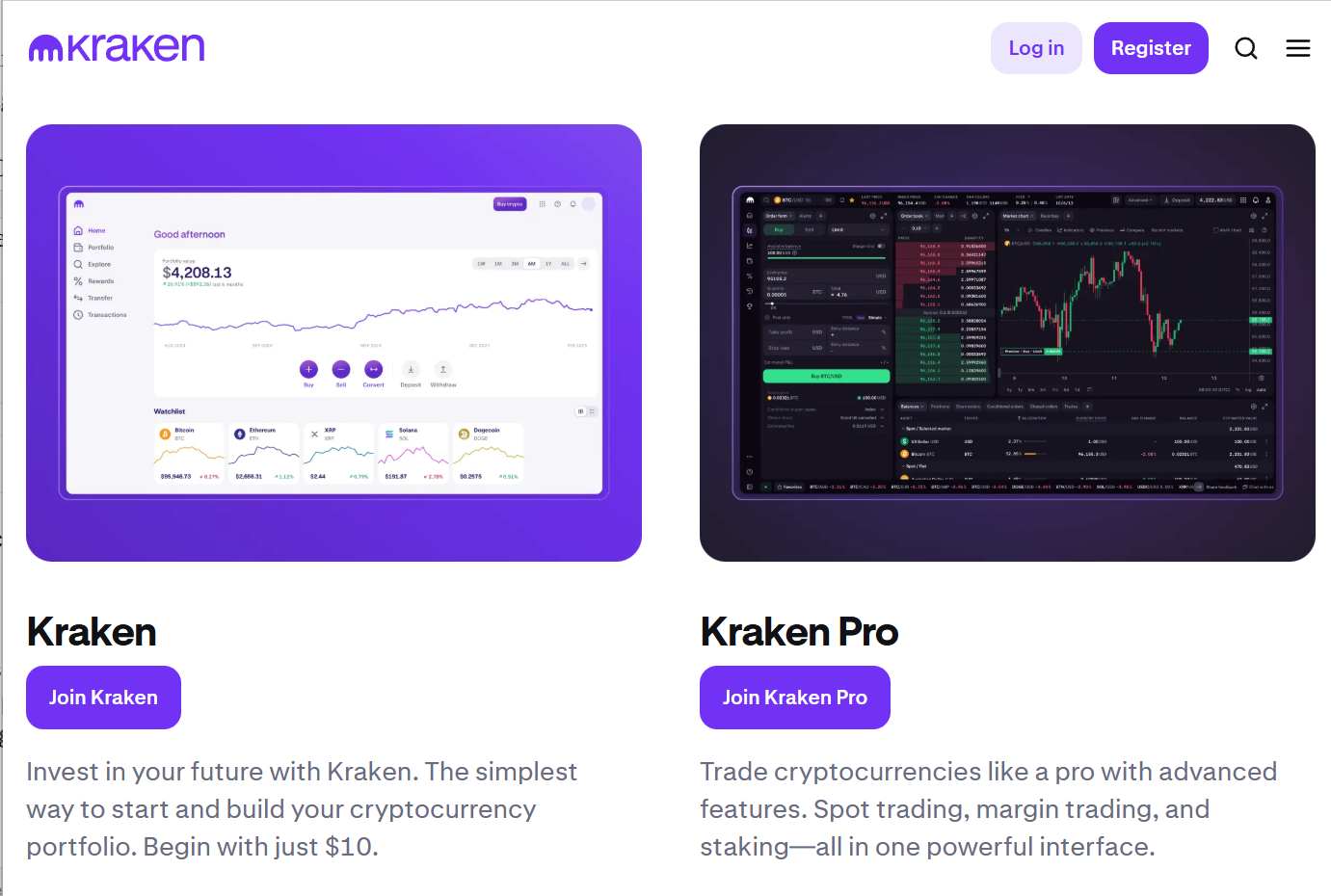
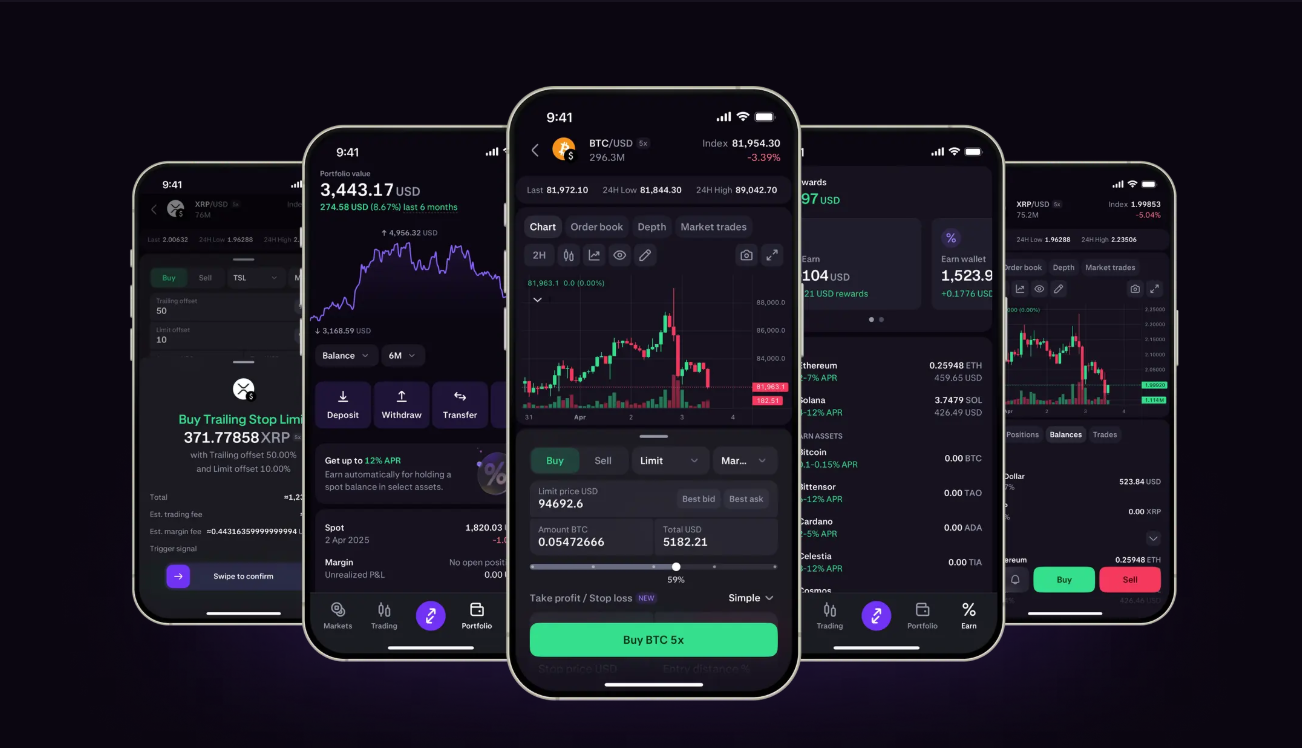
Two interfaces serving two audiences — beginner and pro, same account: Kraken runs two parallel user experiences from a single account. The standard Kraken app and web interface is built for simplicity: select a coin, enter an amount, confirm — all costs shown clearly before you proceed. Kraken Pro is the advanced trading terminal with customisable dashboards, 15+ order types, margin controls, deep order books, and detailed charting tools. Switching between them requires no separate account or transfer — your funds are shared across both interfaces. This design means you can start as a beginner using simple instant buys and migrate seamlessly to professional-grade trading as your confidence grows, without ever changing platforms.
Kraken Pro fees are among the most competitive of any regulated exchange: The cost difference between Kraken and its major competitors on Kraken Pro is substantial. Kraken Pro’s base spot fees are 0.25% maker and 0.40% taker, falling to 0.00% maker and 0.05% taker at high-volume tiers. Coinbase Advanced starts at 0.60% maker and 1.20% taker — more than double Kraken’s rates at comparable volumes. On a $10,000 maker trade, that is $25 at Kraken versus $60 at Coinbase. For active traders, this gap compounds significantly over time. Kraken Pro fees are not the absolute lowest in the market (OKX is cheaper at 0.08% maker), but they offer strong value for traders who prioritise regulatory compliance and security track record alongside competitive pricing.
Crypto and US stocks in the same account — commission-free: Since April 2025, eligible US Kraken users can trade over 11,000 US-listed stocks and ETFs commission-free through Kraken Pro, with extended trading hours (24 hours a day, Monday through Friday) and SIPC protection of up to $500,000 on brokerage assets. This makes Kraken one of the very few platforms where a trader can hold Bitcoin, Ethereum, Solana, Apple stock, and S&P 500 ETFs in a single unified account — and switch between them using the same familiar interface. For US investors who want exposure to both traditional and digital assets without maintaining separate brokerage and crypto exchange accounts, this integration is a genuine and increasingly rare convenience.
Staking rewards with some of the highest rates in the industry: Kraken’s on-chain staking program allows users to earn rewards directly from their account balances on supported proof-of-stake networks. The range of available yields is broad: Ethereum flexible staking offers approximately 1.1–1.35% APR, Polkadot bonded staking offers up to 11.8% APR, Cosmos bonded staking approaches 19% APR, and select assets offer up to 21% APY. Bitcoin staking is available via the Babylon protocol. Users can choose between flexible staking (assets remain accessible) and bonded staking (assets locked for higher rates). Kraken charges a commission from staking rewards rather than a direct fee — typically 20–30% depending on the product and asset — so the rates displayed on the platform are net of commission.
Transparent, clearly disclosed fees — no post-confirmation surprises: Both the standard Kraken app and Kraken Pro display the complete cost of a trade — spread, trading fee, and any payment processing charge — before you confirm the transaction. Independent reviewers testing the platform confirm that the stated fee matched the actual cost charged without exception. This level of pre-trade cost transparency is standard in traditional brokerage but surprisingly rare in crypto, where some exchanges embed costs in spreads that are only visible after the trade is completed. Kraken’s approach to fee disclosure builds the kind of user trust that keeps customers on the platform through market cycles.
Krak — a global money app built on crypto infrastructure: Launched in June 2025, Krak is Kraken’s consumer payments application, allowing users to send money across 160+ countries and spend across 80 million merchants worldwide using crypto or cash. It supports 300+ assets, offers APY on balances with no lockups or minimums, and operates on Kraken’s crypto rails. For professionals, digital nomads, and anyone managing money across borders, Krak represents a practical use case for the crypto infrastructure Kraken has built over 15 years — making international money transfer as fast and low-cost as sending a message.
Key Features and Technology
Kraken’s feature set spans every level of the crypto and traditional finance spectrum. Here is how each major area of the platform works in practice.
Spot Trading — Kraken and Kraken Pro
Kraken’s standard interface supports simple buy, sell, and convert transactions for 500+ cryptocurrencies with a flat ~1% trading fee (in practice approximately 0.989% in independent testing) and clearly displayed spreads. Payment options include debit card, bank transfer (ACH, wire, SEPA), Apple Pay, and Google Pay. Recurring buy orders allow dollar-cost averaging without manual intervention. Kraken Pro extends this to a full order-book trading terminal with market, limit, stop-loss, take-profit, and 15+ order types; customisable dashboards; real-time charting; full trade history; and maker-taker fees starting at 0.25% / 0.40%. The Kraken+ subscription waives trading fees on up to $10,000 in monthly buy/sell volume through the standard interface, with additional benefits including priority customer support and boosted APY on select stablecoins.
Margin Trading and Futures
Kraken offers margin trading with up to 5x leverage on eligible spot positions for qualifying users, with position opening fees of 0.01–0.02% and rollover fees of 0.01–0.02% every four hours. Futures trading is available through Kraken Pro with up to 50x leverage on major cryptocurrencies, with perpetual contracts on 300+ pairs. US-regulated spot margin at 10x has also recently launched for eligible US traders — a regulatory milestone that puts Kraken in a distinct category among US-accessible platforms. Futures fees range from -0.0006% (maker rebates available to high-volume traders) to 0.05% taker. Important: all leveraged trading carries significant risk of loss and is not appropriate for all users. Kraken provides a detailed Margin Disclosure Statement and Risk Disclosure that all users should read before engaging with leveraged products.
Stocks, ETFs, and xStocks Tokenized Equities
For eligible US clients, commission-free trading of 11,000+ NYSE and NASDAQ-listed stocks and ETFs is available through Kraken Pro, with extended market hours (24/5) and SIPC protection up to $500,000 on brokerage assets. Brokerage services are provided through Kraken Securities LLC, a FINRA/SIPC member subsidiary. For eligible non-US clients, xStocks provides exposure to 100 tokenized US equities — US stocks and ETFs settled on blockchain infrastructure — with $25 billion in transaction volume since launch in June 2025 and a Nasdaq partnership for future development. This dual approach — direct equity ownership for US users, tokenised equivalents for international users — is one of the most sophisticated equities offerings available through a crypto-native platform.
Security Infrastructure
Kraken’s security layer is the most robust in its competitive set and the most meaningful differentiator for risk-conscious users. The key components: over 95% of customer funds held in air-gapped cold storage across multiple geographically distributed locations with 24/7 surveillance; mandatory two-factor authentication with support for FIDO2 hardware security keys (YubiKey) for the strongest available protection; a Global Settings Lock that prevents account changes for a configurable time window even if login credentials are compromised; withdrawal whitelisting; Master Key protections; and quarterly Proof-of-Reserves audits independently verified to a Merkle tree level, allowing every individual user to confirm their specific balance is included in the overall reserve attestation.
Kraken Wallet, Desktop, and OTC
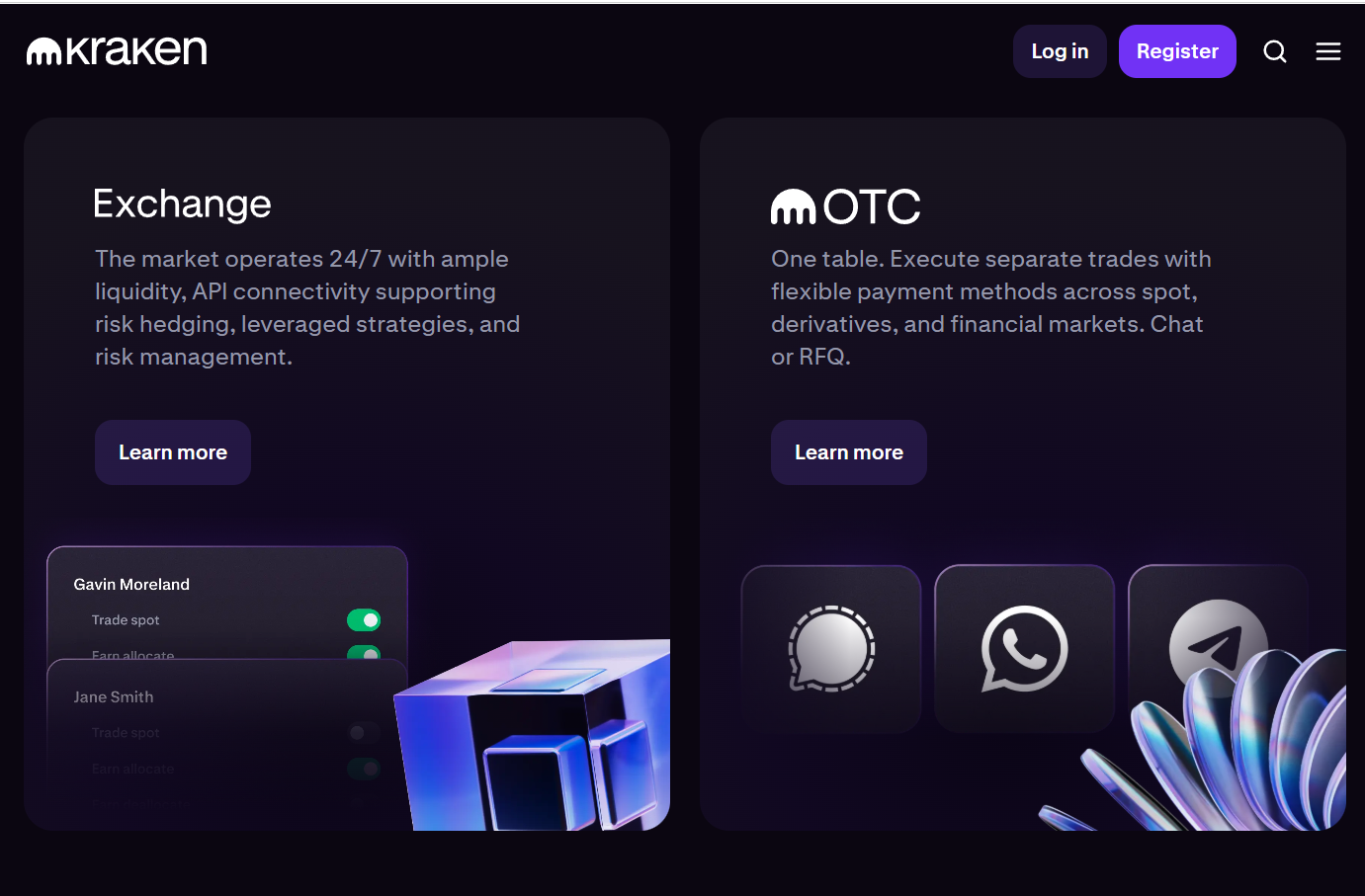
Kraken Wallet is a self-custody Web3 wallet integrating with DeFi protocols and NFT marketplaces across Ethereum, Solana, and Polygon — giving exchange users a path to non-custodial on-chain activity without leaving the Kraken ecosystem. Kraken Desktop is a downloadable low-latency trading application for Windows, macOS, and Linux (also supported on Raspberry Pi), offering customisable multi-window layouts for high-frequency and professional traders. Kraken’s OTC trading desk serves institutional and high-net-worth clients with large block transactions that require off-book execution to avoid market impact — supported by Kraken’s substantial liquidity and relationships with institutional counterparties globally.
Pricing, Plans, and Fee Structure
Kraken does not charge a flat monthly subscription for standard trading access — instead it operates on a transaction-fee model. Creating an account is free. Fees depend on the product, interface, and trading volume. The table below summarises the key cost categories; all rates reflect Kraken’s published fee schedule as of mid-2026 and should be verified on the live fee page at kraken.com before trading, as rates are subject to change.
| Product / Feature | Fee / Cost | Notes |
|---|---|---|
| Account creation | Free | KYC verification required to access most features |
| Standard app trades | ~1% fee + spread | Convenient but expensive vs Pro; all costs shown pre-trade |
| Kraken Pro spot — maker | 0.00%–0.25% | Tiered by 30-day volume; lowest tier 0.25%; falls to 0.00% at $10M+ |
| Kraken Pro spot — taker | 0.05%–0.40% | Lowest tier 0.40%; falls to 0.05% at $500M+ monthly volume |
| US stocks & ETFs | Commission-free | US eligible clients only; SIPC protection up to $500K |
| Futures trading | -0.0006% to 0.05% | Tiered by volume; maker rebates available; high risk product |
| Margin trading | 0.01–0.02% opening + rollover | Rollover every 4 hours; high risk product |
| Staking commission | ~20–30% of rewards | Commission taken from rewards; displayed rates are pre-commission |
| Crypto deposits | Free | Standard for most CEXs |
| Crypto withdrawals | Fixed per asset/network | BTC withdrawal: 0.0002 BTC (~$17); check live fee schedule |
How Kraken Compares to Alternatives
| Factor | Kraken | Coinbase | Binance | OKX |
|---|---|---|---|---|
| Operating since | 2011 — no customer fund losses | 2012 — public company (COIN) | 2017 — largest by volume globally | 2017 — strong Asian presence |
| Pro spot maker fee | 0.25% (base) | 0.60% (base) | 0.10% (base) | 0.08% (base) |
| Proof of Reserves | Yes — quarterly, user-verifiable | Public company (audited financials) | Yes — but trust concerns remain | Yes |
| US stocks & ETFs | Yes — 11,000+, commission-free | No | No | No |
| US regulatory standing | FinCEN, Wyoming SPDI charter, FINRA/SIPC, Fed master account | FinCEN, NYSDFS | Binance.US operates separately; ongoing scrutiny | Limited US availability |
| Supported crypto assets | 500+ | 250+ | 350+ | 350+ |
| Best for | Security-first, multi-asset, regulated US access | Beginners, US compliance, brand recognition | Volume, low fees, largest altcoin selection | Lowest fees, derivatives depth |
vs. Coinbase: Coinbase is the most beginner-friendly major US exchange and the only crypto-native company currently publicly traded, giving it institutional credibility and audited financials. The comparison most relevant to most users comes down to fees and features: Coinbase Advanced (the Pro equivalent) starts at 0.60% maker and 1.20% taker — more than double Kraken Pro’s base rates. Coinbase does not offer stock or ETF trading, futures with 50x leverage, or the same depth of staking options. For users prioritising regulatory trust and brand recognition, both are excellent choices. For users who care about trading cost over the long run, Kraken Pro is meaningfully cheaper.
vs. Binance: Binance is the world’s largest crypto exchange by trading volume and offers the lowest fees in the base tier (0.10% maker and taker, further reduced with BNB payment). It also lists the broadest altcoin selection — typically among the first to list new tokens. However, Binance has faced significant and ongoing regulatory challenges globally, including settlements with US authorities, restrictions in multiple countries, and a substantially different regulatory posture than Kraken. For users in jurisdictions where Binance is fully accessible and regulatory risk is a lower priority than fee minimisation and altcoin breadth, Binance is a competitive option. For users who prioritise compliance, US accessibility, and the combination of crypto and traditional assets, Kraken’s regulated offering is structurally different in meaningful ways.
vs. OKX: OKX is the most fee-competitive of Kraken’s major competitors at 0.08% maker and 0.10% taker at the base tier. It offers strong derivatives products and a broad asset selection. US users have limited access to OKX compared to Kraken, and OKX does not offer the stock and ETF trading integration that Kraken provides for eligible US clients. For US-based traders for whom regulatory compliance is a priority, Kraken’s combination of competitive-but-not-lowest fees, multi-asset access, and long-standing regulatory credentials makes it more attractive than OKX’s lower fees at the cost of regulatory clarity.
Pros and Cons
What Traders Love
Unmatched security track record since 2011: Fifteen years of operation without a customer fund loss is a credential that carries more weight than any marketing claim. For traders who experienced losses at FTX, Celsius, or other platform failures and are now acutely aware of custodial risk, Kraken’s combination of cold storage, quarterly Proof-of-Reserves with user-verifiable Merkle tree inclusion, and 95%+ cold storage allocation represents the highest transparency available at any major exchange.
Fees are fully transparent before the trade: Every cost — spread, trading fee, payment processing fee — is displayed in full before you confirm a transaction. Independent reviewers have consistently found that the stated fee matches the actual charge without exception. This pre-trade cost transparency is a standard that most exchanges fall short of and that Kraken consistently delivers.
Crypto and stocks in one account — a genuinely unique value proposition: For US investors who want exposure to both Bitcoin and Apple, or Ethereum and QQQ, Kraken’s unified account is the most straightforward available solution — no separate brokerage, no fund transfers between platforms, no reconciling two dashboards. Commission-free stock trading with 24/5 hours and SIPC protection within a crypto-native platform is a rare combination that Coinbase, Binance, and most other exchanges do not offer.
Dual interface for beginners and professionals from the same account: The progression from the simple Kraken app to Kraken Pro is seamless — same account, same funds, no transfer required. This design is genuinely thoughtful: beginners can onboard without feeling overwhelmed by an order book, and as they build confidence, the professional tools are immediately accessible without any friction of platform migration.
Regulatory depth and the Federal Reserve master account: Kraken’s regulatory portfolio is among the deepest in the industry: FinCEN registration, Wyoming SPDI bank charter (the first granted to a crypto firm), FINRA/SIPC membership via Kraken Securities, MiCA licence for EU markets, and in March 2026 the first Federal Reserve master account for a digital asset firm. For institutional clients, regulated businesses, and users who need to demonstrate regulatory compliance in their own jurisdictions, this depth of licensing is a material differentiator from many competitors.
Limitations Worth Knowing
Standard app instant buys are expensive relative to Kraken Pro: The ~1% flat fee plus spread on the standard Kraken app is transparent but not competitive with the professional fee tier. New users who do not discover Kraken Pro — or who use instant buys out of convenience — pay significantly more than necessary. The fee difference is clearly disclosed, but users who are not aware of Kraken Pro will consistently overpay for the convenience of the simpler interface.
Geographic restrictions limit access for some users: US residents in Maine and New York cannot access Kraken. Stock and ETF trading is US-only in its current form. Staking is unavailable or restricted in several US states. xStocks is non-US only. These regional restrictions are a consequence of Kraken’s compliance-first approach — regulatory licensing is the price of operating legitimately — but they are a meaningful limitation for affected users who need to seek alternatives.
Multiple apps can feel fragmented until you understand the structure: Kraken currently operates Kraken (consumer app), Kraken Pro (advanced terminal), Kraken Desktop (downloadable trading client), Kraken Wallet (self-custody), Krak (payments), and NinjaTrader (futures) as distinct products. For users coming from a single-app background, understanding how these pieces fit together and which to use for which purpose requires an orientation step that simpler platforms do not demand. Once understood, the multi-app structure makes sense — but the initial learning curve is real.
BTC withdrawal fees can be high at small withdrawal sizes: Kraken’s Bitcoin withdrawal fee of approximately 0.0002 BTC (around $17 at current prices) is a fixed cost regardless of withdrawal amount. For users withdrawing small Bitcoin amounts (under $50), this becomes a disproportionately large percentage of the withdrawal value. Users withdrawing larger amounts or using networks with lower withdrawal fees are less affected, but small Bitcoin withdrawals specifically carry unusually high percentage fees on this platform.
Customer support response times can be slow during high-volume periods: Multiple independent reviewers note that customer support response times, while generally available in multiple languages 24/7, can extend to longer-than-ideal wait times during periods of market volatility or high platform activity — precisely when users most need prompt resolution. Kraken+ subscribers receive priority support access, which partially mitigates this for regular users willing to pay for the subscription.
Staking commission structure requires attention: Kraken takes a commission of 20–30% from staking rewards depending on the product and asset, which is standard for exchange-based staking but means the APY rates displayed on the platform are gross rates before Kraken’s cut. Some competing platforms charge lower commissions. Users who staking large positions should verify the net APY after commission and compare it with alternatives, particularly for high-yield assets where the commission impact is most significant.
Who Should Use Kraken
Security-conscious users who want verified proof their assets exist: Anyone who lost funds in an exchange collapse, anyone who has read about FTX or Mt. Gox, and anyone who simply wants the highest available assurance that their assets are safe and verifiable will find Kraken’s Proof-of-Reserves audit system — the first of its kind in the industry and still among the most rigorous — to be a material reason to choose it over competitors. The ability to personally verify your account balance is included in the reserve attestation is unique and valuable.
Active traders who want professional tools and genuinely competitive fees: Traders placing regular orders across a $10,000+ monthly volume will find Kraken Pro’s 0.25% / 0.40% base rates and clear downward volume tiers to be among the most cost-effective options available on a well-regulated, long-standing exchange. For US-based active traders who cannot access Binance or OKX at full functionality, Kraken Pro represents the strongest fee-and-compliance combination in the market.
US investors who want crypto and traditional assets in one account: The unique value of Kraken’s unified account — crypto, stocks, ETFs, and futures under one login — is particularly compelling for US investors who currently maintain separate accounts with Coinbase and a traditional broker. Consolidating into a single platform where Bitcoin, Ethereum, Apple, and S&P 500 index funds are all accessible reduces administrative overhead and removes the need to fund separate accounts or reconcile multiple tax documents.
Beginners who plan to grow into professional trading: The progression from Kraken’s simple interface to Kraken Pro is frictionless — same account, no migration. For new users who are confident they will want more advanced tools as they learn, starting on a platform that supports their entire growth trajectory without requiring a platform change is a genuine long-term convenience. Kraken’s educational resources and Knowledge Base also provide structured learning materials for new users.
International users and frequent cross-border money transfers: The Krak global payments app — supporting 300+ assets across 160+ countries with no fees on transfers and APY on balances — addresses a real-world need for the growing population of professionals and digital nomads managing money across jurisdictions. Built on Kraken’s 15-year-old crypto infrastructure, Krak offers the reliability of an established financial operator with the speed and cost advantages of crypto rails.
Getting Started: Step by Step
- Create your free account. Visit kraken.com and click “Try Kraken” or “Sign Up.” Enter your email address, create a password, and verify your email. Account creation takes under two minutes.
- Complete identity verification (KYC). Kraken requires identity verification before you can deposit, trade, or withdraw. Basic verification (name, date of birth, country) unlocks basic trading; Intermediate verification (government ID, proof of address) unlocks full fiat deposit and withdrawal. Have your ID and a proof-of-address document ready. Verification can take minutes to a few hours depending on volume and documentation quality.
- Enable two-factor authentication and security features. Before depositing any funds, enable 2FA from your account security settings — Kraken supports authenticator apps and hardware security keys (YubiKey). Set up your Global Settings Lock to add an additional layer of protection against unauthorised account changes.
- Deposit funds. Navigate to Funding > Deposit. You can fund your account via bank transfer (ACH for US, SEPA for EU, SWIFT internationally), debit card, Apple Pay, or Google Pay. Bank transfers are typically the lowest-cost funding method; card payments are faster but carry a fee. Cryptocurrency deposits are also free.
- Switch to Kraken Pro for lower fees. Access Kraken Pro at pro.kraken.com or through the “Kraken Pro” button in the app. Familiarise yourself with the interface: the left panel shows your portfolio and order history; the main panel shows the chart and order book for your selected pair; the right panel is where you place orders. Your funds from the standard Kraken account are fully accessible here.
- Place your first trade. Select your trading pair (e.g. BTC/USD), choose “Limit” for a maker order at your target price (lower fee) or “Market” for immediate execution (taker fee). Enter your size, review the displayed fee, and confirm. For beginners, a small limit order at a price slightly below the current market price is a practical way to learn the interface with minimal cost.
- Explore staking, stocks, and Krak. Once comfortable with spot trading, explore the Staking section to set up rewards on supported assets, the Earn section for flexible interest products, and — if you are a US user — the Stocks section for commission-free equity trading. Download Krak from the App Store for global payments capability. Track your portfolio and P&L in Kraken Pro’s analytics view.
Tips for Getting Maximum Value
Switch to Kraken Pro as soon as possible — the single biggest lever for reducing trading costs is using limit orders on the professional interface instead of instant buys on the consumer app, cutting your trading fee by up to 75% on the same trades. Use bank transfers rather than card payments for deposits whenever possible, as bank transfers are typically the lowest-cost funding method and avoid the additional card processing charge. Enable all available security features immediately after account creation — 2FA with a hardware key, Global Settings Lock, and withdrawal whitelisting are available at no cost and dramatically raise the bar for any attacker attempting to access your account. For staking, compare both flexible and bonded options before committing: the higher APY from bonded staking comes with a lock-up period, which means your assets are inaccessible during that time — only lock assets you are confident you will not need quickly. If you are a US user, explore the stock and ETF section of Kraken Pro for commission-free equity exposure — having crypto and traditional assets in one account simplifies tax reporting and eliminates cross-platform fund transfer friction. Finally, always verify the current fee schedule, staking rates, and product availability for your jurisdiction at kraken.com before making any trading or investment decisions, as these are updated regularly and vary by location.
Future Outlook and Final Assessment
The trajectory of Kraken’s ambition is unmistakeable and accelerating. The combination of the NinjaTrader acquisition (traditional futures), xStocks (tokenized equities via Backed), a Federal Reserve master account, a Nasdaq partnership for tokenized equity infrastructure, and a confidential IPO filing collectively sketch the outline of a company building toward being the primary financial operating system for people who want a single account for crypto, stocks, derivatives, payments, and staking. No other exchange is executing this vision at the same scale with the same regulatory depth. Revenue reached $1.5 billion in 2024, grew 50% in a single quarter in mid-2025, and assets held for clients exceeded $43 billion — a platform operating at genuine institutional scale.
The honest challenges remain: the multi-app ecosystem is still maturing into a cohesive experience; stock trading is US-only; customer support speed under heavy load is an area for improvement; and the standard app’s fee structure will remain a hidden cost trap for users who do not discover Kraken Pro. Within those parameters, Kraken in 2026 is the best-positioned exchange for users who prioritise security verification, regulatory compliance, a growing multi-asset offering, and professional-grade trading tools — all from a platform with an unblemished custodial track record spanning 15 years.
Conclusion
Kraken has earned its reputation over 15 years by doing the things that matter most — and doing them consistently. Security that can be independently verified by every user. Fees that are transparent before the trade and competitive for serious traders. Regulatory credentials that open it to markets and use cases that most crypto exchanges cannot access. And a product expansion in 2025–2026 — stocks, futures, tokenized equities, payments, a Federal Reserve master account — that suggests the platform’s ambition extends well beyond being a cryptocurrency exchange. Whether you are a first-time buyer who wants a trustworthy place to make a first purchase, an active trader who needs professional tools with genuinely low fees, a US investor who wants crypto and the stock market in one account, or anyone who simply wants to verify that your assets actually exist and are protected — Kraken delivers the infrastructure that makes financial freedom genuinely accessible. That is what it means to own the power of your money, and at AI Solutes, we believe the right tools should make everything easy.
Ready to trade crypto, stocks, and more on one of the world’s most trusted exchanges — get started for free today?
Explore more honest reviews, tutorials and tool comparisons to find the right tech for the way you work and live — at AI Solutes, where we make everything easy.
👉 Open Free Account: Get Started with Kraken
👉 Our Website: https://ai-solutes.com/
👉 Our YouTube Channel: youtube.com/@ai-solutes
👉 Our Facebook Fanpage: Facebook
👉 Our X (Twitter): @AISolutes
- Ultimate Guide to International Dating Platforms 2025: Compare Niche Sites, Cupid Media, Multilingual Features, and Safety
- Master LearnWorlds 2026: AI Course Creation Review, Pricing Breakdown & Setup Tutorial
- Chatbase 2026 Review: Build No-Code AI Agents to Automate Customer Support Across Every Channel
- Discover How Ulike Sapphire Ice-cooling Technology Delivers Painless At-Home IPL Hair Removal for All Skin Types
- Galaxy – Social Media Management Tool