FullEnrich has grown from a French B2B data startup founded in 2022 into one of the most trusted names in contact enrichment — and in 2026, as single-source data providers increasingly struggle with coverage gaps, LinkedIn tightens third-party data access, and outbound sales teams demand higher match rates from their enrichment stack, it continues to set the standard for waterfall-based B2B email and phone number enrichment. What makes FullEnrich genuinely stand out in a market crowded with databases claiming 95% accuracy on 80% of contacts: a proprietary waterfall orchestration engine that queries 20+ premium B2B data vendors in sequence per lookup — including Apollo, ZoomInfo, Hunter, Dropcontact, Datagma, Findymail, RocketReach, BetterContact, Kaspr, Snov.io, Clearbit, and Prospeo — returning the first verified result found, and charging you only one credit when a match is made regardless of how many providers were queried. Whether you’re a RevOps team managing a large ICP list that single-source tools consistently under-cover, an SDR team running outbound campaigns that needs accurate mobile numbers not just work emails, an agency enriching lead lists for multiple clients without subscribing separately to a dozen data vendors, or a solo founder doing cold outreach who can’t afford to waste a third of their credits on contacts that come back empty — this comprehensive 2026 review walks you through every major feature, plan, credit structure, integration, and real-world consideration of the FullEnrich platform.
FullEnrich Review 2026: The Waterfall Enrichment Platform That Finds the Emails and Phone Numbers Other Tools Miss
Overview and Background
FullEnrich is a B2B contact enrichment platform built around waterfall methodology — an architectural approach that queries multiple third-party data providers in sequence for each contact lookup, returning the first verified match found and stopping there. Rather than maintaining its own proprietary contact database (a model every major B2B data tool has traditionally used), FullEnrich acts as an intelligent orchestration layer that aggregates and sequences 20+ premium external data vendors to maximize hit rates on emails and mobile phone numbers for B2B prospects.
Founded in 2022 and headquartered in France with a US market presence, FullEnrich was built to solve a problem that every outbound sales team eventually encounters: no single B2B data provider has complete coverage. Apollo might have 60% of your list. Hunter picks up another 15%. Dropcontact covers some of what both miss. When teams discover this, they face a difficult choice — subscribe to multiple tools individually, manually cross-reference the results, and build internal logic to sequence lookups, or accept the coverage gaps and watch their outbound pipeline shrink accordingly. FullEnrich eliminates that choice entirely by making the waterfall approach accessible without any engineering infrastructure or multi-vendor contract management.
According to Forrester research cited by FullEnrich, poor contact data quality costs B2B organizations approximately 25% of lost pipeline annually — the precise problem that multi-provider waterfall enrichment solves at scale. The platform holds a 4.8/5 rating on G2 across 172+ verified reviews — unusually strong for a B2B data tool in a category where user frustration with accuracy claims is endemic — and is trusted by fast-growing B2B companies including Aircall, Autodesk, AWS, Bombora, MongoDB, Remote, Toptal, and Gorgias.
Why FullEnrich Stands Out in 2026
- 20+ Provider Waterfall — The Core Differentiator: FullEnrich queries a cascade of 20+ B2B data vendors per contact — Apollo, ZoomInfo, Hunter, Dropcontact, Datagma, Findymail, RocketReach, BetterContact, Kaspr, Snov.io, Clearbit, Prospeo, and more — in optimal sequence, returning the first verified result. Where a single provider achieves 50–60% coverage on a typical ICP list, FullEnrich’s waterfall routinely achieves 75–95% hit rates on the same list.
- Pay Only for Successful Matches: FullEnrich charges 1 credit per successful email find, 3 credits per personal email, and 10 credits per mobile phone number — and critically, charges nothing when no match is found. Teams that previously burned credits on empty lookups from single-source tools find that FullEnrich’s pay-per-success model immediately changes the economics of enrichment at scale.
- Triple Email Verification: Every email returned by FullEnrich passes through a three-stage verification process — syntax check, domain validation, and live mailbox verification — including catch-all address detection. Verified email accuracy reduces bounce rates and protects sender reputation, two metrics that directly affect whether outbound email campaigns land in inbox or spam.
- GDPR and CCPA Compliant: FullEnrich operates fully within GDPR and CCPA compliance frameworks — a critical requirement for European go-to-market teams and any US company selling into European markets where non-compliant data sourcing creates legal exposure that single-source tools don’t always adequately address.
- Unlimited Users on All Plans: Unlike most B2B data platforms that charge per seat — adding significant cost for sales teams larger than 2–3 people — FullEnrich includes unlimited user seats on every plan tier. Credits are shared across the team, making it immediately more cost-effective than per-seat alternatives for any team with more than one SDR or researcher.
- 50 Free Credits to Start (No Card Required): New users receive 50 free credits without a credit card — enough to enrich 12–50 real contacts from their actual ICP list before making any purchasing decision. This removes the evaluation friction that prospecting tools that gate data quality behind paid trials impose.
- Credit Rollover Policy: Unused credits roll over for 3 to 12 months depending on the plan tier — preventing the end-of-month credit cliff that forces teams to either rush through enrichment to avoid losing credits or lose the value of credits purchased ahead of actual demand.
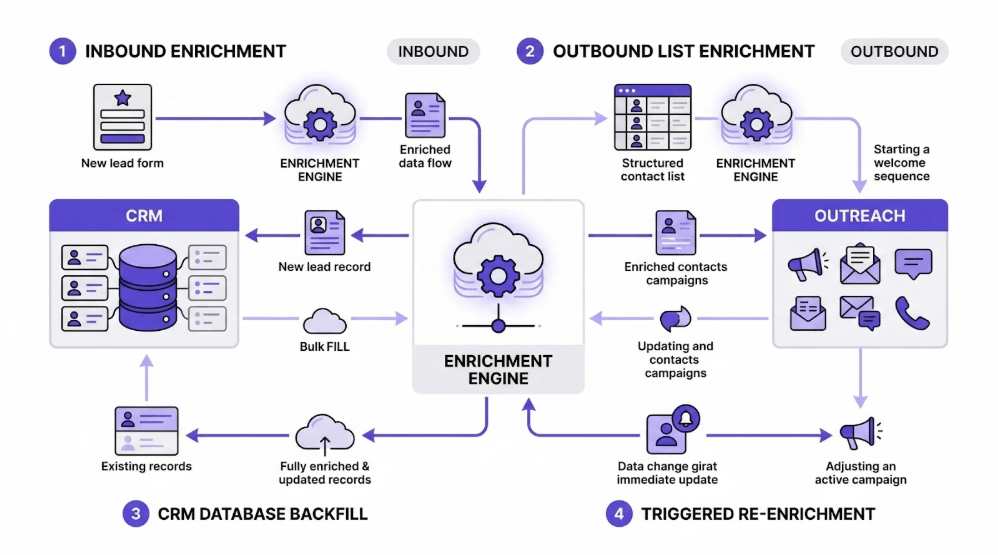
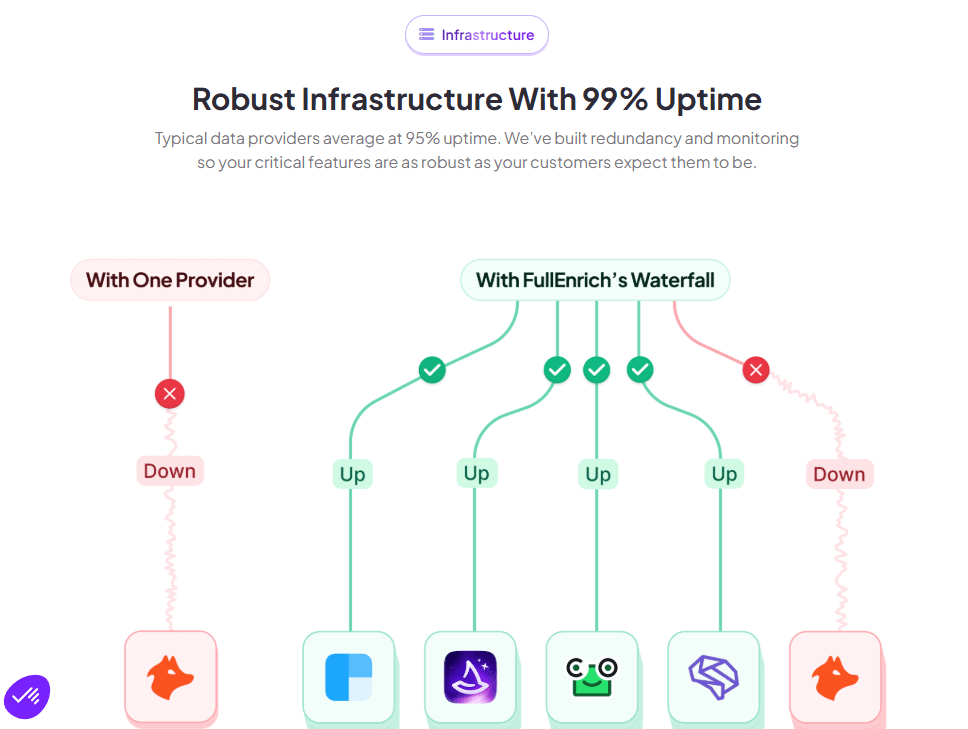
FullEnrich’s waterfall enrichment engine queries 20+ premium B2B data providers in sequence for every contact lookup — automatically finding verified emails and mobile phone numbers that any single provider would miss, and charging only when a match is actually returned.
Key Features and Enrichment Philosophy
FullEnrich’s competitive strength in 2026 lies in the depth of its multi-vendor orchestration and the practical workflow integrations that make high-coverage enrichment accessible to teams without dedicated data engineering resources.
Waterfall Enrichment: How the Core Technology Works
- Sequential Multi-Provider Querying: For each contact in your list, FullEnrich submits the lookup to Provider 1 (typically Apollo or the highest-coverage source for that segment). If a verified match is returned, the credit is charged and the lookup completes. If Provider 1 returns nothing, the request falls through to Provider 2 automatically, then Provider 3, continuing down the cascade until either a provider matches or all sources are exhausted — at which point no credit is charged.
- Provider Sequence Optimization: The waterfall order is not random — FullEnrich’s algorithm sequences providers based on historical match rates for specific segments, industries, seniority levels, and geographies. A lookup for a VP of Engineering at a US SaaS company will trigger a different provider sequence than a lookup for a Director of Marketing at a European manufacturing firm, because the coverage patterns of individual data vendors vary significantly by these dimensions.
- Custom Provider Priority (Pro and Above): On Pro and higher plans, teams can configure their own provider priority within the waterfall — prioritizing GDPR-certified vendors for European lookups, deprioritizing providers that have historically returned low-quality data for their specific ICP, or ordering the cascade to align with data quality preferences rather than purely historical hit rates.
- 80%+ Average Match Rate: Across FullEnrich’s published user data and independent third-party reviews, the platform consistently achieves 70–85% hit rates on US enterprise contact lists and 50–70% on APAC and LATAM markets — compared to 25–60% typical of single-source tools on the same input lists. The 25–30 percentage point difference in email coverage translates directly to proportionally larger outreach sequences and pipeline generation from the same prospect universe.
Email Enrichment and Verification
- Work Email Discovery: FullEnrich’s primary enrichment use case — finding a prospect’s professional work email address from their name and company. Work emails cost 1 credit per successful find, making bulk enrichment of large ICP lists economically viable even at the entry pricing tier.
- Triple Verification Pipeline: Every email returned passes through syntax validation, domain-level MX record verification, and live SMTP mailbox verification — the three-stage process that separates genuinely deliverable addresses from technically formatted but undeliverable strings that inflate bounce rates and trigger spam filters.
- Catch-All Detection: FullEnrich flags catch-all email domains — domains configured to accept any email regardless of whether the specific mailbox exists. Most enrichment tools either silently include catch-all addresses in results (inflating reported accuracy) or exclude them entirely (reducing coverage). FullEnrich flags them as a distinct category so teams can decide how to handle them based on their sender reputation tolerance.
- Personal Email Discovery: In addition to work emails, FullEnrich can surface personal email addresses for prospects — useful for outreach scenarios where work emails bounce or for reaching decision-makers who are more responsive on personal accounts. Personal emails cost 3 credits per find, reflecting the higher sourcing complexity.
Mobile Phone Enrichment
- Direct-Dial and Mobile Number Discovery: FullEnrich sources verified mobile and direct-dial phone numbers for B2B prospects — a capability that most single-source enrichment tools provide with significantly lower coverage than email. Phone enrichment costs 10 credits per successful find, reflecting the substantially higher difficulty and sourcing cost of accurate mobile data versus email discovery.
- Multi-Vendor Phone Coverage: The phone waterfall draws on a different subset of FullEnrich’s 20+ provider network — sourcing from vendors with strong phone coverage like Datagma, Kaspr, and RocketReach in sequence — achieving phone match rates of 60–80% on US contacts where single tools typically return 30–50%.
- Country and Format Standardization: Phone numbers returned by FullEnrich are standardized to E.164 international format with country code — ready for direct upload to dialers, CRMs, and sales engagement platforms without reformatting or deduplication steps.
Input Methods: LinkedIn, CSV, API, and CRM
- LinkedIn URL Enrichment: Paste a prospect’s LinkedIn profile URL directly into FullEnrich to trigger a waterfall lookup for their verified email and phone — the most common point-of-source workflow for SDRs researching prospects individually or in small batches.
- Bulk CSV Upload: Upload lists of prospects via CSV with name, company, and/or LinkedIn URL columns — FullEnrich processes the entire file through the waterfall in batch mode and returns an enriched CSV with matched contact data appended. This handles the high-volume use case for RevOps teams enriching large ICP lists, account-based marketing audiences, or event attendee databases.
- REST API Access: FullEnrich’s API enables programmatic enrichment integration — connecting directly to CRMs, data pipelines, sales engagement platforms, or custom GTM tooling to trigger waterfall lookups automatically as new records enter the system. API access is available from the Starter plan and above.
- HubSpot and Salesforce Integration: Native CRM integration enables enrichment directly within HubSpot or Salesforce — triggering waterfall lookups on contact and lead records without requiring CSV export/import cycles, with enriched data written directly back to the CRM record fields.
Clay, Make, and Automation Integrations
- Clay Integration: FullEnrich’s Clay integration is one of its most popular workflow connections — allowing Clay users to add FullEnrich’s waterfall as an enrichment step within their Clay table workflows, combining FullEnrich’s high-coverage contact data with Clay’s broader data enrichment and AI personalization capabilities.
- Make (Formerly Integromat) and Zapier: FullEnrich connects to Make and Zapier for no-code automation workflows — enabling trigger-based enrichment (enrich when a new lead is created in HubSpot, when a LinkedIn connection is made, or when a record enters a specific pipeline stage) without requiring API development work.
- CSV Export to Outbound Tools: Enriched contact data exports directly in CSV format compatible with Apollo, Outreach, Salesloft, Instantly, Lemlist, and other sales engagement platforms — completing the enrichment-to-outreach workflow without additional formatting or field mapping steps.
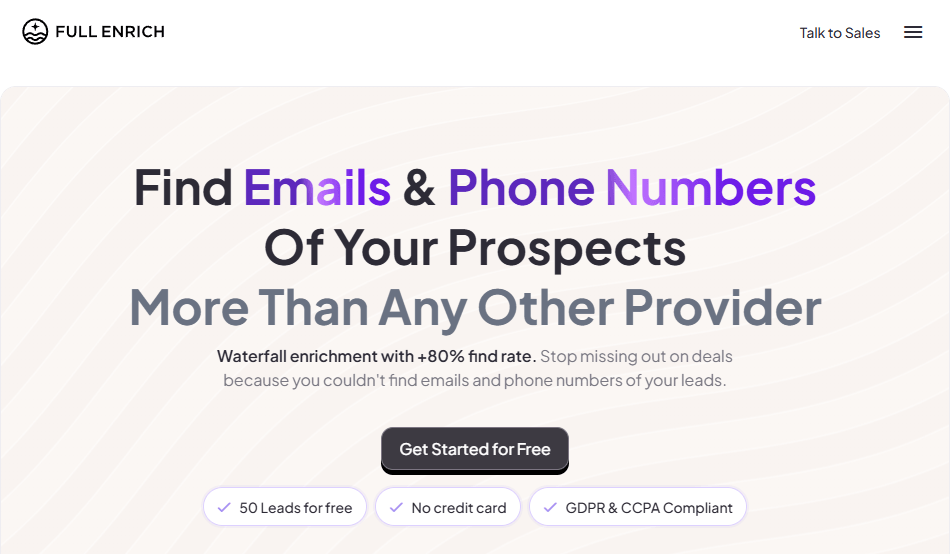
FullEnrich’s credit-based waterfall model fundamentally changes the economics of B2B contact enrichment — teams that previously subscribed to four separate data vendors to achieve adequate coverage now manage a single platform that handles all four in sequence, paying only when contact data is actually found.
Pricing, Credits, and Plan Structure
FullEnrich operates on a credit-based model — credits are consumed only when a successful match is returned, making the pricing directly tied to the value delivered rather than to the number of queries submitted or lookups attempted. Annual billing saves approximately 20% compared to monthly rates.
FullEnrich 2026 Pricing Breakdown
| Plan | Monthly Price | Credits/Month | Credit Rollover | Best For |
|---|---|---|---|---|
| Free | $0 | 50 credits (one-time) | 30 days | Evaluation — test on real ICP contacts before committing; no credit card required |
| Starter | From ~$29–$39/month | 500–750 credits/month | 3 months | Solo founders, small SDR teams, early-stage outbound; API access included |
| Pro | From ~$55–$69/month | 1,000+ credits/month | 6 months | Growing sales teams; custom provider priority; LinkedIn leads export; premium support |
| Scale / Agency | Custom (volume-based) | Custom credit packages | 12 months | High-volume enrichment; agencies; bring-your-own vendor API keys; dedicated account manager |
| Work Email Find | 1 credit per find | All plans | — | Primary enrichment use case; professional work email address |
| Personal Email Find | 3 credits per find | All plans | — | Personal/private email addresses for prospects |
| Mobile Phone Find | 10 credits per find | All plans | — | Direct-dial and mobile numbers; highest credit cost reflects sourcing difficulty |
| No-Match Policy | $0 / 0 credits | All plans | — | No credit charged when waterfall exhausts all providers without a match |
Important note on credit math: Phone number enrichment at 10 credits per find is the most credit-intensive use case — a Starter plan’s 500–750 credits would cover only 50–75 phone lookups if used entirely for phone enrichment. Teams running high-volume phone prospecting should model their credit consumption across email and phone mix carefully before choosing a plan tier, and should consider the Scale plan for campaigns where mobile numbers are a primary enrichment target. For email-only enrichment use cases, 500 credits covers 500 successful work email finds — a meaningful volume even on the entry plan.
Pro tip: Use the 50 free credits to enrich a representative sample of your actual ICP list — 12 phone lookups or 50 email lookups — before choosing a plan. The coverage you observe on your specific ICP (industry, seniority, geography) is more predictive of FullEnrich’s value for your use case than any published benchmark, because waterfall hit rates vary meaningfully by market segment.
Value vs. Alternatives
- vs. Apollo.io ($49–$99/month, single-source): Apollo is the most popular all-in-one sales platform with its own prospecting database — strong for list building and email sequencing, but limited to its own data coverage. Teams using Apollo as their only enrichment source typically achieve 50–65% email match rates. FullEnrich’s waterfall includes Apollo as one of its providers and adds 19+ more on top — giving teams Apollo’s data plus every other vendor’s data in a single credit-based lookup. For enrichment-only use cases, FullEnrich delivers materially higher coverage at comparable or lower per-credit cost.
- vs. Hunter.io ($49–$99/month, single-source): Hunter is highly accurate for domain-based email pattern guessing and is particularly strong for certain company types and industries. Its coverage is narrower than Apollo’s. FullEnrich includes Hunter as a waterfall provider — teams that find Hunter reliable get that data plus the full waterfall fallback for every contact Hunter can’t match, without paying for a Hunter subscription separately.
- vs. Clay ($149–$800+/month): Clay is the most powerful GTM data enrichment and AI personalization platform and is increasingly the standard for sophisticated outbound teams. Clay and FullEnrich are more complementary than competitive — Clay users commonly add FullEnrich as a dedicated contact enrichment step within Clay workflows to access FullEnrich’s 20+ provider waterfall as one Clay enrichment action. FullEnrich is not a Clay replacement; it’s a high-coverage enrichment module that Clay users deploy to maximize contact data yield.
- vs. Kaspr ($30–$80/month, EMEA-focused): Kaspr is the leading mobile phone enrichment tool for European markets and is particularly strong for French, German, and UK contact data. FullEnrich includes Kaspr as a waterfall provider while adding coverage from 19+ additional sources — making FullEnrich the higher-coverage option for teams with mixed US/European ICPs, while Kaspr may edge FullEnrich on European mobile-only coverage for teams with exclusively European target markets.
- vs. ZoomInfo ($15,000–$30,000+/year): ZoomInfo is the enterprise-grade B2B data platform with the most comprehensive database and the highest price point. For SMB and mid-market sales teams, ZoomInfo’s pricing is prohibitive. FullEnrich includes ZoomInfo’s data as one provider in the waterfall via its data partnerships — giving teams access to ZoomInfo coverage without the enterprise contract requirement, as part of the multi-vendor cascade at credit-based pricing.
Comparisons: FullEnrich vs. Competitors in 2026
| FullEnrich 2026 | Apollo.io | Hunter.io | Clay | Kaspr | |
|---|---|---|---|---|---|
| Enrichment Model | Waterfall (20+ providers) | Single database | Single database | Multi-waterfall (configured per workflow) | Single database (EMEA-focused) |
| Email Hit Rate (US Enterprise) | 75–95% | 50–65% | 40–60% | 80–95% (with FullEnrich step) | 50–65% (EMEA stronger) |
| Mobile Phone Coverage | 60–80% (US); 50–65% (EMEA) | 40–55% | Limited | Varies by enrichment step | 65–80% (EMEA); 40–55% (US) |
| Pay-Per-Success Model | Yes — 0 credits if no match | No (credits used regardless) | No (credits used regardless) | Depends on step configuration | No (credits used regardless) |
| Unlimited Users | Yes (all plans) | No (per-seat pricing) | No (per-seat pricing) | No (per-seat pricing) | No (per-seat pricing) |
| Triple Email Verification | Yes (incl. catch-all detection) | Basic verification | Yes (strong) | Depends on step | Basic verification |
| GDPR / CCPA Compliant | Yes (full compliance) | Partial | Yes | Depends on data source | Yes (GDPR-first) |
| HubSpot / Salesforce Integration | Yes (native) | Yes (native) | Limited | Yes (native) | Yes (native) |
| Credit Rollover | 3–12 months (plan-dependent) | No rollover | No rollover | N/A | No rollover |
| Entry Price | Free (50 credits); from ~$29/mo paid | $49/month | $49/month | $149/month | $30/month |
| Best For | Maximum email + phone coverage; pay-per-success enrichment | All-in-one prospecting + sequencing | Domain-based email finding | AI-powered GTM workflows + enrichment | EMEA phone enrichment |
FullEnrich’s edge: Among B2B contact enrichment platforms in 2026, FullEnrich delivers the highest email and phone match rates for teams whose outbound coverage requirements exceed what any single-source database can provide — through a pay-per-success waterfall that queries 20+ providers in sequence, charges nothing for misses, includes unlimited user seats, verifies every email through a three-stage pipeline, and operates in full GDPR and CCPA compliance. Apollo wins for all-in-one sales workflow integration; Clay wins for AI-powered GTM personalization complexity; Kaspr wins for EMEA mobile coverage depth. But for teams whose primary constraint is finding verified contact data at the highest possible match rate across a broad ICP — particularly in US enterprise and mixed-geography markets — FullEnrich delivers coverage that the alternatives cannot match individually.
Pros and Cons: What Sales and RevOps Teams Say
What Teams Love Most About FullEnrich
- Match Rate Improvement Over Previous Tools: The most consistently cited outcome across G2 and independent reviews — teams switching from Apollo-only or Hunter-only enrichment report finding 30–50% more valid contacts on the same prospect lists. For outbound campaigns where every incremental reachable contact directly expands the addressable pipeline, this improvement compounds meaningfully across every campaign run.
- Zero-Credit Policy on No-Match: Teams describe the no-charge-on-miss model as genuinely trust-building in a category where many tools charge credits regardless of whether data is returned. Knowing that credits are only consumed on successful matches changes how teams approach enrichment — they can submit full ICP lists without worrying about burning budget on bad data or low-coverage segments.
- Unlimited User Seats: Sales teams and agencies consistently highlight the per-seat-free model as a meaningful cost advantage — especially for agencies managing enrichment across multiple clients or for sales teams with 5–10+ SDRs all needing enrichment access. What would be a $200–$500/month line item per user on seat-based alternatives becomes a flat credit-based platform cost shared across the full team.
- Credit Rollover Policy: The 3–12 month credit rollover eliminates the “use it or lose it” pressure that forces teams to rush enrichment at end-of-month. RevOps teams that run enrichment in campaign batches rather than continuously find the rollover essential — credits purchased for a Q4 campaign sequence don’t evaporate if the campaign launches a week into the next billing period.
- Clay Workflow Compatibility: Teams using Clay as their primary GTM data platform consistently cite FullEnrich’s Clay integration as one of the highest-value enrichment steps in their workflow — adding FullEnrich’s 20+ provider waterfall as a contact enrichment action that dramatically improves contact coverage relative to any single Clay-native enrichment source.
- Verification Quality Reducing Bounce Rates: Teams that switched to FullEnrich from unverified or single-verified data sources report measurable improvements in cold email deliverability — lower bounce rates, lower spam complaint rates, and better inbox placement — as a direct consequence of the triple verification pipeline catching catch-all and undeliverable addresses before they enter outreach sequences.
Limitations and Caveats Worth Knowing
- Phone Enrichment Credit Cost Is High at Low Volumes: At 10 credits per mobile phone find, phone-heavy enrichment workflows consume credits at 10x the rate of email-only enrichment. Teams whose primary use case is building phone lists for cold calling rather than email sequences should model credit consumption carefully — a 1,000-credit monthly plan yields only 100 phone enrichments if used entirely for mobile numbers, which may not be sufficient for high-volume phone prospecting operations at the entry price tier.
- Coverage Drops Outside US and Western Europe: FullEnrich’s 70–85% hit rate applies primarily to US enterprise and Western European contacts. Coverage drops to 50–70% on APAC markets and 40–60% on LATAM and Middle Eastern contacts, reflecting the underlying coverage limitations of the data vendors in the waterfall for those regions. Teams with predominantly non-Western ICP segments should test coverage on representative samples from their actual target geographies before committing to a plan.
- Enrichment-Only Platform — No Prospecting or Sequencing: FullEnrich is a pure enrichment tool — it finds contact data for prospects you already have in a list, but does not help you build those prospect lists from scratch (unlike Apollo or ZoomInfo) or send outreach sequences (unlike Outreach or Salesloft). Teams that need an all-in-one prospecting, enrichment, and sequencing solution will need to combine FullEnrich with a list-building tool and a sales engagement platform.
- Chrome Extension Limitations: Several user reviews note that FullEnrich’s Chrome extension for LinkedIn-based enrichment has functionality constraints compared to competitor tools that offer more seamless in-browser enrichment workflows. Teams that rely heavily on one-at-a-time LinkedIn enrichment as their primary workflow may find the extension less fluid than dedicated LinkedIn scraping alternatives, though bulk CSV enrichment through the web platform is noted as efficient and well-implemented.
- Starter Plan Credits May Run Short for Fast-Growing Teams: At 500–750 credits per month on the Starter plan, fast-growing SDR teams ramping outbound volume can exhaust their monthly credit allocation mid-cycle. Teams planning to scale outbound significantly within their first 3–6 months of using FullEnrich should factor plan upgrade timing into their enrichment budget projections rather than defaulting to the lowest tier and upgrading reactively.
- No Native Outreach Sequencing: FullEnrich’s value ends at the enriched contact record — there is no built-in email sending, sequence management, or dialer functionality. This is by design (the platform focuses on doing enrichment better than anyone else rather than building a full sales workflow), but teams evaluating it as a potential all-in-one replacement for Apollo or similar platforms will need a separate outreach tool to complete the workflow.
Sales and RevOps teams across industries consistently report the same outcome after switching from single-source enrichment to FullEnrich: significantly larger pools of reachable prospects from the same ICP list, lower bounce rates from triple-verified emails, and a predictable enrichment cost structure that scales without per-seat overhead as the team grows.
Common Use Cases and Who Should Use FullEnrich
Best Use Cases by Team Profile
- RevOps Teams Managing Large ICP Enrichment Lists: Operations teams enriching hundreds to thousands of contacts per month from ICP account lists, event attendee databases, or LinkedIn Sales Navigator exports find FullEnrich’s bulk CSV workflow and high waterfall coverage essential. The ability to enrich a 2,000-contact list and achieve 85%+ email coverage versus the 55% they previously got from Apollo changes the downstream math on pipeline generation from every list-building exercise.
- SDR Teams Running High-Volume Outbound Email Campaigns: Individual SDRs and SDR teams find FullEnrich’s single-credit-per-email pricing and waterfall coverage directly improve their daily outreach productivity — more reachable contacts per hour of research, fewer bounces degrading sender reputation, and better inbox placement from verified emails translate to measurably more replies and booked meetings per campaign.
- Agencies Enriching Leads Across Multiple Clients: Lead generation agencies that enrich contact lists for multiple B2B clients benefit from FullEnrich’s unlimited user seats (no per-seat overhead for client-access accounts), the credit-based model (costs scale with actual enrichment volume rather than team headcount), and the GDPR compliance framework (critical for agencies handling European client data under data processing agreements).
- Clay Power Users Building GTM Workflows: Teams using Clay as their primary GTM data platform add FullEnrich as a dedicated contact enrichment step within Clay table workflows — accessing FullEnrich’s 20+ provider waterfall through Clay’s step interface to maximize contact data yield before moving records into personalization and sequencing steps.
- Founders Doing Cold Outreach Without a Large Budget: Solo founders and early-stage teams doing their own prospecting find FullEnrich’s free 50 credits and low-entry Starter pricing accessible — pay only for the contact data you successfully retrieve, share credits across every team member with no per-seat overhead, and avoid the subscription commitment of enterprise data platforms before proving outbound as a channel.
- Marketing Operations Teams Enriching Inbound and Event Leads: Marketing ops teams enriching inbound form submissions (where prospects provide a name and company but not always a work email), event attendee lists, or content download registrations find FullEnrich’s API integration with HubSpot and Salesforce enables real-time enrichment at the point of record creation — automatically appending verified contact data to new records without manual export/import cycles.
- Account-Based Marketing Teams Building Named Account Contact Maps: ABM teams building multi-threaded contact maps for target accounts — identifying and enriching contacts across multiple personas (economic buyer, champion, technical evaluator) within each target company — find FullEnrich’s bulk enrichment and waterfall coverage essential for building complete contact maps at the volume and coverage depth ABM motions require.
Step-by-Step: Getting Started with FullEnrich
- Claim Your 50 Free Credits: Visit fullenrich.com and create a free account — no credit card required. You receive 50 free credits valid for 30 days.
- Test on a Representative ICP Sample: Don’t use your free credits on random contacts. Select 10–15 prospects from your actual ICP — the same industry, seniority level, and geography you’ll be targeting in real campaigns — and run them through FullEnrich’s email enrichment. The match rate and email quality you observe on this sample is your most reliable signal for evaluating FullEnrich’s coverage on your specific market segment.
- Compare Results Against Your Current Tool: Run the same 10–15 contacts through whatever enrichment tool you currently use. Compare the total emails found, the number that pass triple verification, and the number of catch-alls flagged. This side-by-side comparison on your own data is the most credible evidence for an internal upgrade decision.
- Choose Your Plan Based on Monthly Enrichment Volume: Calculate your expected monthly credit consumption — estimate the number of work email enrichments (1 credit each), personal email enrichments (3 credits each), and phone enrichments (10 credits each) you’ll run per month. Choose the plan tier whose credit allocation covers your expected volume with a 20–30% buffer for campaign ramp-ups.
- Connect to HubSpot or Salesforce: In the integrations section of your FullEnrich account, connect your CRM. Configure the enrichment triggers — enrich on new contact creation, enrich when a contact enters a specific pipeline stage, or trigger manual batch enrichment from a CRM list view — based on your workflow preferences.
- Upload Your First Bulk CSV: Take an ICP list from LinkedIn Sales Navigator, Apollo, or your CRM (exported as CSV with name, company, and/or LinkedIn URL columns) and upload it to FullEnrich for batch enrichment. The waterfall processes the full list and returns an enriched CSV typically within minutes for lists under 1,000 contacts.
- Export to Your Outreach Platform: Download the enriched CSV and import into Apollo Sequences, Instantly, Lemlist, Outreach, or Salesloft for campaign setup. Map the FullEnrich email and phone fields to the corresponding fields in your outreach platform, and configure bounce rate monitoring to validate deliverability performance from your first send.
Tips for Getting Maximum Value
- Prioritize email enrichment over phone enrichment if you’re credit-conscious — at 1 credit per email versus 10 credits per phone, email enrichment delivers 10x more contacts per credit and should be the default starting point for any new ICP list before selectively adding phone enrichment for high-priority accounts or personas.
- Use FullEnrich’s catch-all flagging actively in your outreach setup — route catch-all addresses to a separate sequence with lower sending frequency and monitor bounce rates independently. High bounce rates from catch-all domains can affect your sender reputation across your entire domain even when your verified non-catch-all contacts are delivering cleanly.
- Configure the Clay integration if you’re using Clay — FullEnrich as a Clay enrichment step gives your Clay workflows access to 20+ waterfall providers through a single API call, dramatically improving contact coverage in AI-personalized sequences without requiring separate provider integrations for each data source.
- Plan enrichment batches around campaign timelines rather than enriching continuously — buying a month’s credits and enriching all at once for a campaign launch is more efficient than drip-enriching individual contacts, and the credit rollover policy means you don’t lose credits if your campaign timeline shifts by a few weeks.
Future Outlook and Final Assessment
FullEnrich’s 2026 trajectory — expanding its provider waterfall beyond 20 sources, launching an MCP (Model Context Protocol) integration for AI agent-based enrichment workflows, maintaining a 4.8/5 G2 rating that reflects genuine user satisfaction rather than review incentive programs, and continuing to build CRM and workflow integrations that reduce the friction between enrichment and outreach — positions it as the definitive pure-play contact enrichment platform for B2B sales and marketing teams that prioritize coverage quality over all-in-one feature breadth.
The broader B2B data landscape in 2026 is increasingly favorable to the waterfall model. LinkedIn’s continued tightening of third-party data access is reducing the coverage of database tools that relied on LinkedIn scraping, creating larger gaps in single-source coverage that waterfall orchestration is uniquely positioned to fill. As AI-driven GTM workflows powered by Clay and similar platforms become standard for sophisticated outbound teams, FullEnrich’s role as the high-coverage enrichment module within those workflows becomes more rather than less important — the better the contact data, the more effective every downstream AI personalization and sequencing step built on top of it.
The emergence of AI agent-compatible enrichment through MCP suggests that FullEnrich is building toward a future where enrichment happens automatically within agentic GTM workflows — an AI agent identifies a prospect, triggers a FullEnrich waterfall lookup for their contact details, and passes verified data into a personalized outreach sequence without human intervention at any step of the process.
Conclusion
FullEnrich delivers the most coverage-efficient, cost-transparent, and team-accessible B2B contact enrichment experience available in 2026. With a 20+ provider waterfall achieving 75–95% email hit rates on US enterprise contacts, a pay-per-success model that charges nothing when no match is found, triple email verification including catch-all detection, verified mobile phone numbers, unlimited user seats on every plan, 3–12 month credit rollover, full GDPR and CCPA compliance, native HubSpot and Salesforce integration, a Clay workflow integration, bulk CSV processing for large ICP lists, API access from the Starter plan, a 4.8/5 G2 rating from 172+ verified reviews, and 50 free credits with no credit card required — FullEnrich has earned its position as the leading waterfall enrichment platform for sales and RevOps teams that are serious about maximizing the contact coverage of their outbound pipeline. The high credit cost of phone enrichment and the narrower coverage on non-Western markets are real constraints for specific use cases, and teams needing all-in-one prospecting and sequencing will need companion tools. But for the vast majority of B2B outbound teams currently accepting 50–65% email match rates from a single data provider and watching the rest of their ICP go uncontacted — FullEnrich is the upgrade that fills those gaps without requiring a new vendor relationship for every database you’d otherwise subscribe to separately.
Ready to stop letting 30–40% of your ICP go uncontacted because your current enrichment tool can’t find their email — and start hitting 80%+ match rates with a waterfall that queries 20+ providers automatically?
👉 Our Website: https://ai-solutes.com/
👉 Our YouTube Channel: http://www.youtube.com/@ai-solutes
👉 Our Facebook Fanpage: https://www.facebook.com/profile.php?id=61576606911341
👉 Our X (Twitter): https://x.com/AISolutes
- Accelerate Enterprise Workflow Automation with TextCortex AI Agents: GDPR-Compliant and Integrates with 30,000 Apps
- RepliQ
- Unlock Job Offers in 2025: Master AI Jobscan and ATS Resume Optimization
- Sell The Trend Review 2025: Dominate AI Dropshipping with Nexus AI
- Unlock Smarter Automation in 2025 with n8n Visual Workflow Builder, AI Power, and Enterprise Security