Whether you’re trying to break into data science, pick up a new leadership credential, or simply prove to a hiring manager that you can keep pace with AI tools, there’s a good chance your search for “where do I actually learn this” lands you on Coursera. It’s the platform that turned university lecture halls into a subscription you can access from a laptop at midnight — and it has done it at a scale almost nothing else in online education can match. Coursera now connects more than 197 million registered learners with over 375 university and industry partners, spanning a catalog of 12,000+ courses, Specializations, Professional Certificates, and full degrees, with plans starting around $49 for a single course and topping out at a $399-a-year all-access subscription. This 2026 review walks through what Coursera actually offers, how its pricing and plans break down, the new AI-powered learning tools reshaping the platform, how it stacks up against Udemy, edX, and LinkedIn Learning, and exactly who gets the most value from a subscription.
For working professionals trying to stay employable, career-switchers building a portfolio from scratch, small business owners upskilling without hiring a trainer, and content creators or freelancers who need a credential they can put on LinkedIn, Coursera is built around a simple promise: real university and industry content, structured into something you can finish. This review walks through Coursera’s plans, its standout features, real pricing, how it compares to the alternatives, its honest limitations, and who should sign up.
Coursera Review 2026: The Online Learning Platform That Turns University-Grade Courses Into Career Credentials
Overview and Background
Coursera was founded in 2012 by two Stanford computer science professors who wanted to put real university courses online for free, and it grew from that “massive open online course” (MOOC) idea into one of the largest education technology companies in the world. The core insight hasn’t changed: instead of building its own curriculum from scratch, Coursera partners with universities (Yale, Imperial College London, the University of Michigan) and industry leaders (Google, IBM, Meta, Microsoft, and even Anthropic) to host their training content, then wraps it in a consistent platform with quizzes, graded assignments, peer review, and shareable certificates.
The scale here is hard to overstate. Coursera reported 197 million registered learners as of December 31, 2025, generated $757.5 million in revenue for the full year, and worked with more than 375 university and industry partners. Learners are spread globally, with the largest concentration in Asia Pacific, followed by North America and Latin America. In a recent year alone, 22 million new learners joined the platform — nearly 82,000 people every day — with a typical day seeing 150,000 new enrollments. That’s not a niche course library; it’s closer to critical infrastructure for how a meaningful share of the world’s professionals are reskilling right now.
Why Coursera Stands Out in 2026
Genuine university and industry pedigree: This is Coursera’s biggest structural advantage over most of its competitors. Coursera partners with 350+ top universities like Yale and Stanford, offering accredited certificates, degrees, and career-focused programs, alongside Professional Certificates built directly by Google, IBM, and Meta. A certificate from a recognizable institution carries weight in a way an anonymous marketplace course often doesn’t.
A catalog deep enough to cover an entire career path: Coursera’s catalog runs over 16,000 courses from more than 370 partners, organized into individual courses, multi-course Specializations, Professional Certificates, MasterTrack credentials, and full bachelor’s and master’s degrees. You can start with a free audit and, without ever leaving the platform, work your way up to an accredited degree.
Coursera Coach and a genuinely expanding AI toolkit: Coursera has leaned hard into generative AI on the learner-facing side. Coursera Coach, Course Builder, Dialogue, and newer Role Play simulations and Program Builder features are designed for skills-first, personalized learning, with the company reporting that 94 percent of learners say Coach improves their experience. In practice, Coach acts as an in-course AI tutor — answering questions, summarizing lectures, and offering feedback — without you needing to leave the page to ask ChatGPT.
Career-outcome data baked into the platform: 85% of learners on Coursera identify as career learners, and roughly a third say their primary goal is to develop skills and advance in their current role, while 29% are using it to switch roles entirely. Courses are increasingly mapped to specific job titles and skill gaps rather than presented as a loose list of topics.
An enterprise and Teams layer that scales with you: Coursera isn’t just a consumer subscription. Coursera for Teams serves smaller groups (roughly 5–125 users) starting around $399 per user per year, while Coursera for Business offers enterprise-grade analytics, integrations, and custom content for larger organizations, which means a freelancer who outgrows the individual plan and starts hiring can move the whole team onto the same platform.
Real accreditation, not just a certificate of attendance: Unlike most marketplace-style platforms, Coursera is accredited by organizations including the American Council on Education, and a majority of its courses and programs are accredited — which matters if you’re hoping a course will eventually count toward college credit, not just a resume line.
Key Features and Technology
Coursera’s product line is best understood as a ladder, with each rung built for a different level of commitment.
Individual Courses, Specializations, and Professional Certificates
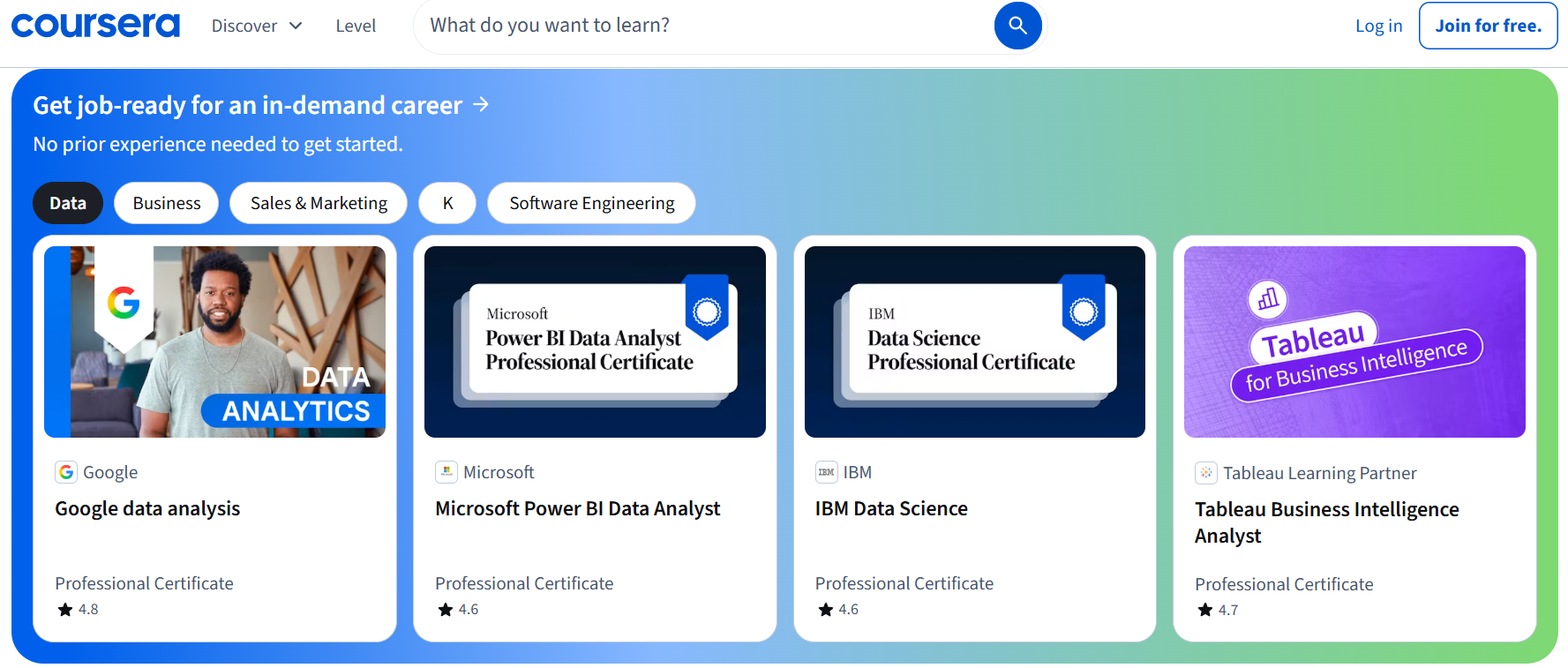
At the base level are standalone courses — typically a few weeks of video lectures, readings, and graded quizzes built by a single university or company. Specializations bundle several related courses into a longer track with a capstone project. Professional Certificates (from Google, IBM, Meta, and similar partners) go further, designed explicitly to prepare you for an entry-level job in fields like data analytics, UX design, or cybersecurity, often with no prior experience required.
Coursera Plus — The All-Access Subscription
Coursera Plus is the platform’s flagship subscription, and for most regular learners, it’s the product that actually matters. It unlocks unlimited access to most courses and Specializations for $59 per month or $399 per year (roughly $33/month on the annual plan), and comes with a 7-day free trial and a 14-day refund window if you decide it isn’t for you. One important carve-out: Coursera Plus does not unlock Professional Certificates from partners like Google, IBM, or Meta, nor MasterTrack Certificates or full Online Degrees — those are purchased and completed separately.
Degrees, MasterTrack, and Accredited Credit
At the top of the ladder, Coursera partners with universities to deliver full bachelor’s and master’s degrees online, plus MasterTrack certificates that can carry transferable academic credit toward a future degree. These are priced and structured much closer to a traditional university program than a typical online course.
AI-Powered Learning Tools
Coursera’s AI suite has expanded well beyond a simple chatbot. Coach offers in-course tutoring and feedback, Course Builder and Program Builder use generative AI to help instructors and organizations turn learning objectives into structured content, and newer Role Play simulations let learners practice scenarios like negotiations or customer conversations against an AI counterpart. On the integrity side, Coursera backs its AI tools with academic integrity features including AI-enabled proctoring and plagiarism detection, which matters if you’re earning a credential you intend to put real weight behind.
Pricing, Plans, and Package Structure
Coursera’s pricing spans free audits all the way to multi-thousand-dollar degrees, and it’s genuinely one of the more layered pricing structures in online learning. There’s no single number that captures “the cost of Coursera” — what you pay depends entirely on which product you choose.
| Plan | Approx. Price | What You Get | Best For |
|---|---|---|---|
| Free Audit | $0 | Lecture access on most individual courses, no certificate or graded feedback | Curious learners testing a subject before committing |
| Single Course / Specialization | ~$49–$79/month | Graded work and a certificate for one specific course or track | Learners who want exactly one credential and nothing more |
| Coursera Plus Monthly | $59/month | Unlimited access to most courses and Specializations, cancel anytime | Learners unsure how long they’ll stick with it |
| Coursera Plus Annual | $399/year (~$33/month) | Same unlimited access, lower effective monthly cost, 14-day refund window | Committed learners planning multiple courses over the year |
| Coursera for Teams | From ~$399/user/year | Curated content libraries for small groups (roughly 5–125 users) | Small business owners and team leads upskilling a small staff |
| MasterTrack / Degrees | ~$2,000–$50,000 | Transferable academic credit up to full accredited bachelor’s/master’s degrees | Learners pursuing a formal academic credential, with financial aid options |
How Coursera Compares to Alternatives
| Factor | Coursera | Udemy | LinkedIn Learning | edX |
|---|---|---|---|---|
| Content source | Universities + industry partners, platform-curated | Open marketplace, anyone can publish | Industry experts, open contribution model | Universities (Harvard, MIT-founded) |
| Accreditation | Yes, on most certificates/degrees | No | No, but strong LinkedIn profile integration | Yes, on most certificates/degrees |
| Catalog size | 16,000+ courses, 375+ partners | Very large, variable quality | 24,600+ courses | 4,600+ courses |
| Typical pricing model | Subscription ($399/yr) or per-course | Pay-per-course, frequent deep discounts | Subscription via LinkedIn Premium | Per-course, $50–$300 for certificate |
| Full degrees available | Yes, bachelor’s and master’s | No | No | Yes, via partner universities |
| Best for | Credentialed career growth across many subjects | Affordable, narrow practical skills | Quick skills tied to your LinkedIn profile | Academic rigor, university-style courses |
vs. Udemy: Udemy is best if you’re looking for an affordable course on virtually any topic, while Coursera is the stronger pick if you want learning taught and partnered with a recognized university or organization. Udemy courses also rarely carry weight with employers the way an accredited Coursera certificate does, since the vast majority of Udemy courses aren’t built in partnership with external universities or organizations. If price-per-course is your main filter, Udemy often wins; if the credential needs to mean something on a resume, Coursera generally does.
vs. LinkedIn Learning: LinkedIn Learning delivers a large library of industry-relevant courses with seamless integration into your LinkedIn profile, which makes it ideal for skill-building and quick career pivots, while Coursera leans on academic credibility through accredited certificates and degrees from named universities. If you want a fast badge that shows up natively on your LinkedIn profile, LinkedIn Learning is convenient; if you want something with deeper academic backing, Coursera is the stronger long-term bet.
vs. edX: edX is Coursera’s closest peer in terms of academic pedigree — both were born out of elite university partnerships and both offer accredited certificates and degrees. The practical difference is breadth and pricing structure: Coursera’s catalog of over 16,000 courses from more than 370 partners outpaces edX’s roughly 4,600 courses, and Coursera’s subscription model (Coursera Plus) gives heavy users a predictable flat cost that edX’s largely per-course pricing doesn’t match.
Pros and Cons
What Learners Love
Credentials that actually carry weight: Certificates from Google, IBM, Meta, and accredited universities are recognizable to hiring managers in a way a generic course-completion badge isn’t, which is a meaningful edge for career-focused learners.
Genuinely massive, well-organized catalog: With 16,000+ courses across thousands of subjects, almost any professional skill gap has a structured path to fill it, from a 2-hour micro-course to a multi-year degree.
Free auditing on most courses: You can preview the actual lecture content before paying anything, which removes a lot of the guesswork that comes with buying a course sight-unseen.
An AI toolkit that’s actually built into the learning flow: 94 percent of learners report an improved experience when using Coursera Coach, and tools like Role Play simulations give a more interactive alternative to passive video-watching.
A clear upgrade path from free to formal degree: You can start auditing a course for free and, without switching platforms, work your way toward an accredited Professional Certificate, MasterTrack credit, or full degree.
Limitations Worth Knowing
Pricing is genuinely confusing at first: Between per-course pricing, Specializations, Coursera Plus, Teams, and Degrees — each with their own rates and frequent promotional discounts — it takes real effort to figure out which plan is actually the cheapest option for your specific goal.
Coursera Plus doesn’t cover everything: Professional Certificates, MasterTrack Certificates, and Online Degrees are excluded from the all-access subscription, so a learner chasing one of Coursera’s most valuable credentials may end up paying on top of an existing Plus subscription.
Course quality varies by partner: Because content comes from hundreds of different universities and companies, production quality, pacing, and assessment rigor aren’t perfectly consistent across the catalog the way they would be on a single-instructor platform.
Billing and cancellation complaints surface in reviews: Independent reviews of the platform note recurring billing and cancellation friction as a theme worth watching, so it’s worth reading the cancellation terms for your specific plan before subscribing.
Degrees and MasterTrack programs are a real financial commitment: At the top end, accredited degree programs run from roughly $9,000 into the tens of thousands of dollars — a different category of decision than a $59 monthly subscription, and one that deserves the same scrutiny as any traditional degree program.
A short free trial compared to some competitors: Coursera’s standard free trial on Plus runs 7 days, noticeably shorter than the one-month trial some competing platforms offer, which leaves a tighter window to evaluate fit before being charged.
Who Should Use Coursera
Career-switchers building skills from zero: If you’re moving into data, tech, or business from an unrelated field, a Google or IBM Professional Certificate gives you both the curriculum and a recognizable credential in one purchase — start there rather than with Coursera Plus alone.
Working professionals upskilling continuously: If you’ll realistically take two or more courses or Specializations across the year, Coursera Plus Annual at $399 pays for itself quickly compared to buying access course by course.
Small business owners and team leads: Coursera for Teams lets you put a handful of employees through curated learning tracks without negotiating a full enterprise contract — a sensible middle ground for a growing freelance practice or small agency.
Marketers, creators, and freelancers chasing one specific skill: If you only need a single Specialization — say, in digital marketing or AI tools for content creation — a one-time per-course purchase is usually cheaper than a full subscription.
Learners weighing a real degree against tuition: If you’re seriously considering a master’s degree, it’s worth comparing Coursera’s online degree partners directly against the on-campus equivalent — the flexibility and lower price point are compelling, but it deserves the same diligence as any other tuition decision.
Getting Started: Step by Step
- Define your actual goal first. Decide whether you want a quick skill, a job-ready credential, or a full degree — the right plan depends entirely on this, and picking the wrong one is the most common reason people overpay.
- Audit a course for free before paying. Browse Coursera’s catalog and audit one or two relevant courses to confirm the teaching style and pacing actually work for you.
- Compare per-course pricing against Coursera Plus. If you expect to take more than two courses this year, run the math on Coursera Plus Annual before committing to individual purchases.
- Check for an active discount. Coursera frequently runs promotional pricing on Plus, so look for a live offer before paying full price.
- Use the 7-day trial deliberately. Set a reminder before the trial ends, and use the window to actually complete a module rather than just browsing the catalog.
- Lean on Coursera Coach as you go. Use the built-in AI coach for clarifying questions and feedback rather than switching to an external tool mid-lesson — it has context on the course you’re already in.
Tips for Getting Maximum Value
Always check for an active promotional discount before paying full price for Coursera Plus — the platform runs frequent sales that have ranged from 20% to 40% off, and the listed price is rarely the lowest one available. If your goal is a specific Professional Certificate from Google, IBM, or Meta, buy that directly rather than assuming Coursera Plus covers it, since those credentials sit outside the subscription. Set a calendar reminder near the end of any free trial so you don’t get billed for a plan you forgot to cancel, and if you’re not sure Coursera Plus is worth it yet, do the simple math: count how many courses or Specializations you realistically expect to finish this year, multiply by the typical $49–$79 per-course price, and compare that total to the $399 annual subscription. Finally, don’t default to the most expensive credential available — a $49 single course is sometimes a smarter first step than a multi-thousand-dollar degree if you’re still validating whether a new career direction is right for you.
Future Outlook and Final Assessment
The trends favor Coursera continuing to grow. The company introduced a platform fee on partners in 2026 that, according to early results, has pushed consumer-segment margins to a multi-year high without changing what learners pay, which suggests a path toward sustainable profitability rather than the growth-at-any-cost model many ed-tech platforms relied on in the past. Demand for AI-related skills in particular is accelerating fast on the platform, and as more employers explicitly look for verified micro-credentials rather than just a degree on a resume, Coursera’s mix of accreditation plus flexibility looks well positioned for where hiring is heading.
The honest caveats are worth repeating: the pricing structure takes real effort to untangle, Coursera Plus leaves out some of the platform’s most valuable credentials, and course quality isn’t perfectly uniform across hundreds of different partners. But within those boundaries, Coursera remains one of the most credible, comprehensive places to turn structured learning into a credential that actually means something to an employer — and its growing AI toolkit is making the experience faster and more personalized without sacrificing the academic rigor that set it apart in the first place.
Conclusion
Coursera has built something genuinely rare in online education: a platform with the academic credibility of a university, the catalog depth of a marketplace, and an AI toolkit that’s actually woven into the learning experience rather than bolted on as an afterthought. It isn’t the cheapest option for every single course, and its pricing takes a few extra minutes to understand, but for professionals who want credentials that hold up under real scrutiny, it’s hard to beat. Define your goal, pick the plan that actually matches it, and let Coursera make the path from curiosity to credential easy.
Ready to turn your next skill into a credential that counts?
Explore more honest reviews, tutorials and tool comparisons to find the right tech for the way you work and live — at AI Solutes, where we make everything easy.
👉 Open Cousera Account: Get Started with Coursera
👉 Our Website: https://ai-solutes.com/
👉 Our YouTube Channel: youtube.com/@ai-solutes
👉 Our Facebook Fanpage: Facebook
👉 Our X (Twitter): @AISolutes
- Hydrating Creams Guide: Unlock Glowing Skin with Safe, Science-Backed Routines
- Discover Top Embroidery Online Trends and AI-Powered Services Shaping Textile Arts in 2026
- Transform Skin and Hair with Pure Organic Essential Oils and Serums
- Can RankPrompt Streamline Output Selection? Examining Its Automated Response Ranking Systems
- Vitacost Login Guide: Access Your Account Fast, Fix Sign-In Issues, and Boost Security