Z.ai has emerged as one of the most consequential AI platforms in 2026 — the international brand face of Zhipu AI, a Tsinghua University spinout founded in 2019 that listed on the Hong Kong Stock Exchange in January 2026, raising approximately HKD 4.35 billion (USD ~558 million) at a market capitalization near USD 52.83 billion, and has since shipped four flagship-tier model releases in roughly four months: GLM-5 (February 11, 2026), GLM-5-Turbo (March 15), GLM-5.1 (April 7), and GLM-5.2 (June 13, 2026). What makes Z.ai genuinely stand out in a field where OpenAI, Anthropic, and Google have set the benchmark expectations for foundation model quality: a 1,000,000-token context window that holds up in real-world use (enough to load an entire mid-sized codebase or hundreds of pages of documents into a single prompt), an MIT open-source license with no regional restrictions on self-hosting or commercial deployment, GLM Coding Plan pricing starting at ~$10/month — roughly a tenth of comparable frontier model access from Anthropic or OpenAI — training completed entirely on Chinese-made Huawei chips without a single NVIDIA component (making GLM the most prominent demonstration that competitive frontier AI can be built under US export restrictions), and benchmark performance on agentic coding tasks (GLM-5.1 scoring 77.8% on SWE-bench Verified) that competes directly with Claude Opus 4.8 and GPT-5.5. Whether you’re a developer looking for production-grade agentic coding capability at a fraction of Western provider costs, a team that needs to ingest entire codebases or document repositories in a single context window, an organization in a privacy-sensitive environment that needs to self-host a frontier-grade open-weight model without vendor lock-in, or an AI researcher tracking the frontier of models built outside the Western chip supply chain — this comprehensive 2026 review walks you through every major model, capability, pricing tier, benchmark, and real-world consideration of the Z.ai platform.
Z.ai Review 2026: The Open-Weight Frontier AI Platform That Challenges the Western Model Duopoly on Price, Context, and Performance
Overview and Background
Z.ai is the international consumer and developer brand of Zhipu AI — a Beijing-based foundation model company and Tsinghua University spinout led by CEO Zhang Peng, which develops the GLM (General Language Model) family of large language models. Founded in 2019, Zhipu AI grew from an academic research collaboration into China’s most prominent foundation model company, operating both a Chinese-language consumer product (ChatGLM at chatglm.cn) and an international platform (Z.ai at z.ai) that serves developers, enterprises, and general users globally with access to the GLM model family through chat interface, API, and IDE-integrated coding tools.
The company’s 2026 trajectory has been defined by two landmark events. First, the Hong Kong Stock Exchange IPO on January 8, 2026 — raising HKD 4.35 billion at a valuation near USD 52.83 billion, validating Zhipu’s position as one of the most significant AI companies outside the Western tech ecosystem. Second, the release of GLM-5 on February 11, 2026 — a model that staked an immediate claim as the strongest open model in the world, with shares climbing 60% within three days of the announcement on the strength of its performance credentials and the political significance of its chip provenance. The GLM-5 release was followed by three more major model releases in the subsequent four months, demonstrating a release velocity that few AI labs globally — Western or otherwise — have matched in 2026.
The GLM model family’s defining characteristics distinguish it from both Western frontier models and Chinese competitors: an architecture optimized for agentic, long-horizon tasks rather than conversational generalism; a context window that scaled to 1,000,000 tokens with the GLM-5.2 release; open-weight releases under MIT license for every major model; and a pricing structure through the GLM Coding Plan that makes frontier-grade AI coding capability accessible at approximately one-tenth the cost of comparable Claude or GPT-5 access.
Why Z.ai Stands Out in 2026
- 1,000,000-Token Context Window — Real and Usable: GLM-5.2 ships with a 1-million-token context window that early testing confirms holds up in practical use rather than degrading at long contexts. This is enough to load an entire mid-sized software codebase, a full legal contract review dossier, or hundreds of pages of research documentation into a single prompt — enabling workflows that require comprehensive context retention that no comparable model has matched at this price point.
- MIT Open-Source License — Self-Host Commercially, Globally: Every major GLM model release ships under the MIT license with no regional restrictions — meaning any developer, company, or researcher can download, self-host, fine-tune, and commercially deploy the model on their own infrastructure. This is not the restricted open-weight release pattern of some competitors; MIT is the most permissive license in the open-source ecosystem.
- ~10x Cost Advantage Over Western Frontier Models: The GLM Coding Plan starts at ~$10/month (Lite), making frontier-grade agentic coding capability accessible at a fraction of Claude Max (~$200/month) or comparable OpenAI tiers. For high-volume API use, GLM-5 token pricing at ~$1.00/M input tokens also undercuts Claude and GPT-5 significantly for most workloads.
- Huawei Chip Independence — No NVIDIA Required: GLM models are trained entirely on Huawei Ascend chips without a single NVIDIA GPU — making the GLM family the most visible proof-of-concept that frontier AI development can proceed under US export chip restrictions. For enterprises and governments concerned about supply chain geopolitical risk, this is a meaningful differentiator beyond raw benchmark performance.
- Dual Thinking Modes (High and Max): GLM-5.2 introduced two selectable reasoning effort levels — High (standard extended thinking for most tasks) and Max (maximum reasoning compute for the hardest problems) — giving users control over the trade-off between response speed and reasoning depth, similar to the extended thinking modes offered by Claude and GPT-5 on their flagship tiers.
- Benchmark-Competitive Agentic Coding: GLM-5.1 scored 77.8% on SWE-bench Verified — the benchmark measuring ability to resolve real-world GitHub software engineering issues — placing it directly competitive with Claude Opus 4.8 (~80.9%) and GPT-5.5 (~80%). For the specific use case of agentic software engineering, GLM competes at the frontier while costing approximately 10x less.
- HK Stock Exchange Listed, $52.83B Market Cap: Z.ai/Zhipu AI is a publicly listed company on the Hong Kong Stock Exchange — providing a level of financial transparency, institutional accountability, and long-term investment visibility that most foundation model startups and Chinese AI companies cannot match.

Z.ai’s GLM-5.2 model combines a 1-million-token context window, MIT open-source licensing, dual thinking modes, and API pricing roughly 10x cheaper than comparable Claude or GPT-5 access — making frontier-grade agentic AI coding accessible to developers and teams that the Western model pricing structure effectively prices out.
Key Features and Model Architecture
Z.ai’s competitive strength in 2026 lies in the rapid progression of the GLM model family across the year — delivering meaningful capability improvements across context, reasoning, and coding benchmarks at a pricing structure that Western competitors have not matched.
GLM Model Family: Four Releases in Four Months
- GLM-5 (February 11, 2026 — Flagship Launch): The headline model that accompanied Zhipu AI’s transformation into Z.ai for the international market. GLM-5 launched with strong agentic coding performance and a context window enabling long-horizon task completion — immediately drawing developer adoption and generating the 10x traffic spike that temporarily destabilized the service in the days following launch. GLM-5 is the production-grade model available on Pro and Max Coding Plan tiers, priced at ~$1.00/M input tokens via API.
- GLM-5-Turbo (March 15, 2026): A speed-optimized variant of GLM-5 designed for workloads where latency matters more than maximum reasoning depth — maintaining most of GLM-5’s capability profile at meaningfully lower response latency and cost, similar to the turbo/flash model patterns established by OpenAI and Google.
- GLM-5.1 (April 7, 2026 — SWE-Bench Leader): An open-weight release under MIT license that immediately set a new benchmark high for the GLM family — 77.8% on SWE-bench Verified, placing it directly competitive with the leading Western frontier models on software engineering task performance. GLM-5.1 represents the highest-performance self-hostable model for agentic coding available at the time of its release.
- GLM-5.2 (June 13, 2026 — 1M Context + Dual Thinking): The latest and most capable GLM release at the time of this review — introducing the 1-million-token context window that holds up under real-world testing, two selectable thinking modes (High and Max reasoning effort), MIT open-source licensing, and API access at pricing that continues to undercut Western frontier models significantly. GLM-5.2 was announced 48 hours after a major Claude release — the timing a deliberate statement about competitive positioning.
- GLM Flash Models (Free Tier): GLM-4.7-Flash and GLM-4.5-Flash provide capable, lower-compute model access at zero cost for registered users — creating a genuine free tier that enables meaningful exploration of Z.ai’s capabilities without any credit card or subscription requirement.
1,000,000-Token Context: What It Actually Enables
- Full Codebase Loading: A 1M token context window enables loading complete software repositories — not just individual files or modules — into a single prompt for comprehensive analysis, refactoring, or cross-file reasoning. Developers working on large codebases who previously needed to carefully curate which files to include in context can now provide the full codebase and ask questions about any aspect of the system.
- Entire Document Repository Analysis: Legal teams reviewing contract portfolios, research teams analyzing literature, and compliance teams reviewing policy documentation can load entire document sets — hundreds of pages — and ask questions that require synthesizing information across the full corpus rather than chunk by chunk.
- Long-Horizon Task Completion: The context architecture is optimized for long-running agentic tasks — not just providing a large context window but maintaining coherent reasoning and task tracking across extended multi-step workflows that span the full context length. This is the capability that “long-horizon” in Z.ai’s positioning refers to.
- Conversation History Without Compression: In interactive sessions, the 1M token window enables extremely long conversation histories to be maintained without summary compression — preserving full context of extended working sessions in ways that smaller context windows force truncation or summarization to handle.
Agentic Coding: GLM Coding Plan and IDE Integration
- GLM Coding Plan — Purpose-Built for Developers: The GLM Coding Plan is Z.ai’s developer-specific subscription product — distinct from general consumer access — designed around the workflows of professional software engineers and AI-assisted development teams. It provides higher context limits, priority API access, and IDE integration support for coding-specific workflows at flat-rate monthly pricing.
- IDE Integration Ecosystem: GLM models integrate with VS Code, Cursor, Claude Code, Roo Code, Cline, Kilo Code, OpenCode, and the Codex ecosystem — positioning GLM as a backend model available within the tools developers already use rather than requiring adoption of a proprietary IDE.
- Full-Stack Code Generation: Z.ai’s coding capability spans the full software development stack — from system architecture through backend API development, database schema design, frontend component generation, and deployment configuration — enabling solo developers and small teams to build complete applications with AI assistance across every layer.
- Website and Application Building: The Z.ai chat interface supports direct website and application generation from natural language prompts — building functional web applications and interfaces without requiring IDE integration for simpler generation tasks.
- Long-Running Agent Tasks: GLM-5.2’s architecture is explicitly optimized for “long-horizon tasks” — multi-step agentic workflows that run for extended periods, take multiple actions, and complete complex objectives rather than responding to isolated single-turn prompts. This distinguishes Z.ai from general-purpose chatbots and positions it alongside Claude Code and GPT-5-based agent frameworks.
Multimodal Capabilities: Vision, Document, and Video
- Image Understanding (GLM-4.1V, GLM-4.5V): Dedicated vision-language models for image analysis — enabling use cases including image-to-code generation (converting UI screenshots or diagrams to code), visual Q&A (answering questions about image content), chart and table data extraction, and mathematical problem solving from photos.
- Document Analysis: Comprehensive document understanding across PDFs, contracts, reports, and structured documents — extracting specific data, answering questions about content, and synthesizing information across multi-document sets within the extended context window.
- Video Analysis and Summarization: Video content analysis including summarization, transcript generation, object identification, and content question-answering — extending Z.ai’s context capabilities to time-based media beyond text and images.
- AI Presentation Generation: Built-in presentation and slide deck generation from prompts or documents — creating pitch decks, business presentations, and marketing slide sets directly from text input or document content, with Z.ai handling layout and content organization.
Open Weights and Self-Hosting: The Vendor Lock-In Alternative
- MIT License — Maximum Commercial Freedom: MIT is the most permissive software license available — allowing any organization to use, modify, distribute, and commercially deploy GLM models without royalty payments, attribution requirements beyond the MIT notice, or restrictions on use case or industry. This stands in contrast to the restricted open-weight releases of some competitors that prohibit certain commercial uses or impose usage conditions.
- No Regional Restrictions: GLM open-weight releases carry no regional download or usage restrictions — available to developers globally without the geographic access limitations that some model releases impose.
- Self-Hosting for Privacy-Sensitive Workloads: Organizations handling sensitive data — healthcare records, legal documents, financial information, government data — can run GLM models entirely on their own infrastructure, eliminating the data transmission to third-party API servers that cloud-only model access requires. For regulated industries where data residency is a compliance requirement, self-hostable frontier models are a category solution that cloud-only providers cannot offer.
- Fine-Tuning for Domain Specialization: MIT licensing enables organizations to fine-tune GLM models on proprietary datasets for domain-specific performance improvement — legal language, medical terminology, financial analysis patterns, or any domain where specialized training improves performance over the base model.
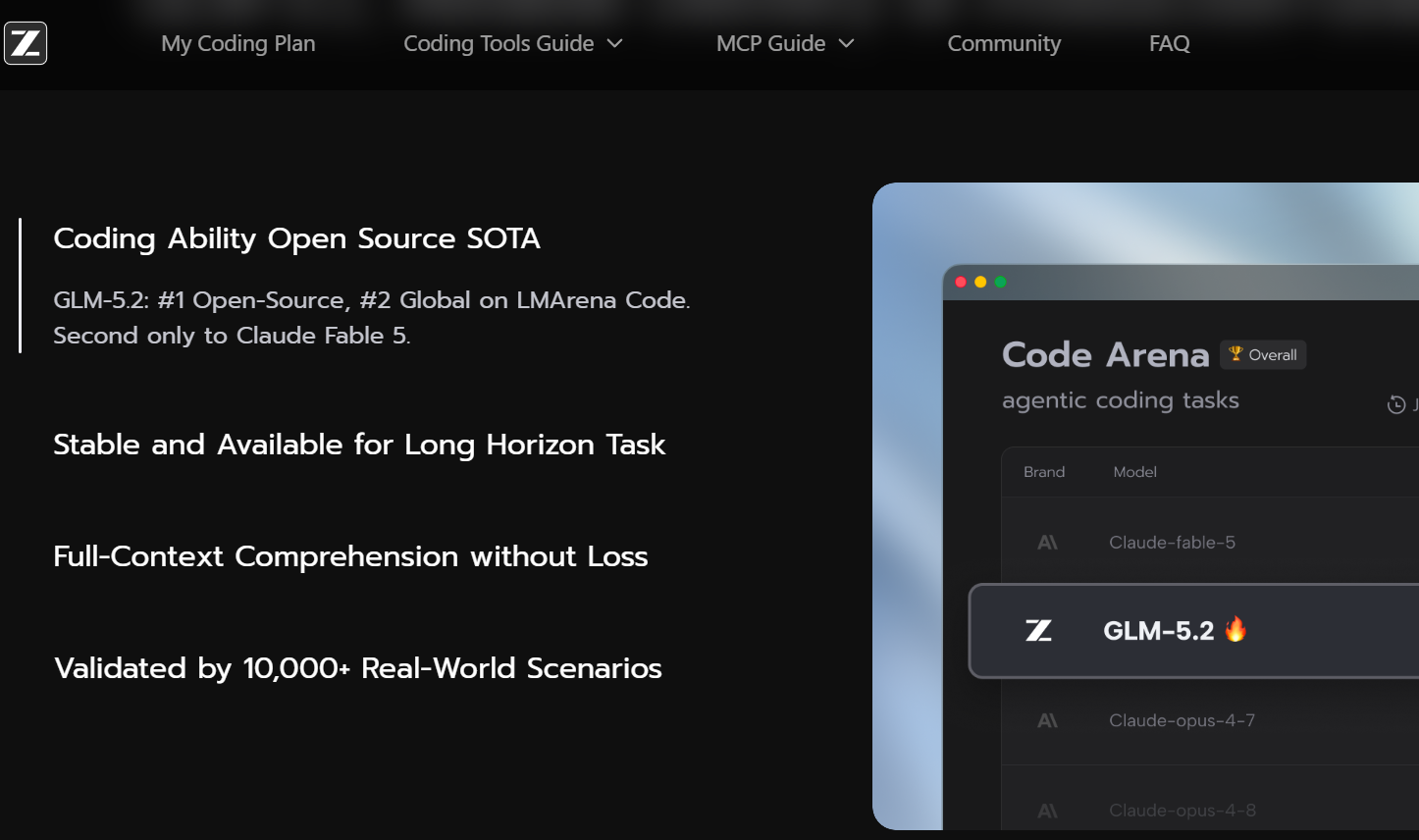
GLM-5.2’s training on Huawei Ascend chips without any NVIDIA components is more than a technical specification — it’s a geopolitical statement that competitive frontier AI can be built and deployed under US export restrictions, giving organizations in data-sovereign environments a self-hostable frontier model that doesn’t depend on Western chip supply chains or API access.
Pricing, Plans, and Access Tiers
Z.ai’s pricing structure reflects its explicit positioning as a cost-accessible frontier model — with a free flash tier that enables genuine capability evaluation, a Coding Plan subscription structure designed for developer budgets, and API per-token pricing that undercuts Western providers significantly for most production workloads.
Z.ai / GLM 2026 Pricing Overview
| Plan / Access Tier | Price | Model Access | Best For |
|---|---|---|---|
| Free (Flash Models) | $0 — registered users | GLM-4.7-Flash, GLM-4.5-Flash | Exploration, light tasks, evaluating Z.ai capabilities before subscribing |
| GLM Coding Plan — Lite | ~$10/month (billed $30/quarter) | GLM-4.7, prompt-based limits | Hobbyists, students, light experimentation with frontier-adjacent coding model |
| GLM Coding Plan — Pro | ~$30/month (billed $90/quarter) | GLM-5, higher limits, IDE integration | Active developers; full frontier GLM-5 access; production coding workflows |
| GLM Coding Plan — Max | ~$80/month (billed $240/quarter) | GLM-5, highest quotas, priority access, dedicated support | Power users, high-throughput coding teams, maximum performance configuration |
| Enterprise (Custom) | Custom pricing | Full model range, team features, SLA-backed support, higher concurrency | Teams, regulated industries, high-volume API deployments, self-hosting support |
| API — GLM-5 (per token) | ~$1.00/M input tokens | GLM-5 flagship model via API | Production API integration; pay-per-token workloads; no subscription commitment |
| API — GLM-4.7 (per token) | ~$0.60/M input tokens | GLM-4.7 (73.8% SWE-bench) via API | Cost-sensitive production workloads where GLM-4.7’s performance level is sufficient |
| Self-Hosted (MIT License) | Infrastructure cost only | GLM-5.1, GLM-5.2 open weights | Privacy-sensitive workloads; regulated industries; eliminating vendor API dependency; custom fine-tuning |
Important note on pricing context: Z.ai’s GLM Coding Plan pricing (~$10–$80/month) compares against Claude Max at ~$200/month and equivalent OpenAI tiers — the cost advantage is real and substantial for most developer workflows. However, two pricing caveats are worth noting: Zhipu raised prices approximately 30% when GLM-5 launched and an additional ~10% at GLM-5.1, meaning cost predictability has been lower than at competitors; and quarterly billing (billed every 3 months rather than monthly) affects cash flow planning for smaller teams. The API per-token pricing remains significantly cheaper than Claude or GPT-5 API access for most workloads.
Pro tip: For most professional developers, the Pro plan (~$30/month) represents the optimal entry point — it provides full GLM-5 model access and adequate limits for active development workflows at a price point where the comparison against Claude Pro or comparable tiers is immediately compelling. Start with the free Flash models to validate task compatibility, then use the Pro tier for production coding workflows before evaluating whether Max-tier quotas are needed for your specific throughput requirements.
Value vs. Alternatives
- vs. Claude Opus 4.8 / Claude Max (~$200/month): Claude Opus 4.8 scores approximately 80.9% on SWE-bench Verified against GLM-5.1’s 77.8% — a roughly 3 percentage point performance advantage on agentic coding benchmarks. Whether that gap justifies a 6–20x price differential depends entirely on the specific workload. For most general development tasks, the gap is negligible in practice; for the hardest multi-step software engineering challenges where every percentage point matters, Claude’s performance edge may justify the premium. For high-volume, cost-sensitive production deployments, GLM’s economics are difficult to ignore.
- vs. GPT-5.5 / OpenAI API (~$200+/month or premium API rates): GPT-5.5 scores approximately 80% on SWE-bench Verified — similarly competitive with Claude and similarly priced above GLM. The Microsoft ecosystem integration (GitHub Copilot, Azure OpenAI) gives GPT-5.5 deployment advantages within Microsoft-native workflows that GLM doesn’t replicate. Outside those ecosystems, GLM’s cost advantage applies.
- vs. DeepSeek API (~3–4x cheaper than GLM for non-coding chat): DeepSeek undercuts GLM on raw API cost for general chat workloads — making it the better choice for cost-sensitive non-coding conversational applications. For the agentic coding use case where GLM-5’s SWE-bench performance is the relevant metric, the comparison shifts back toward GLM. DeepSeek and GLM are closer to complements than direct substitutes: DeepSeek for general AI tasks, GLM for coding-optimized agentic work.
- vs. Qwen (Alibaba, similar cost bracket): Qwen 2.5 and subsequent Alibaba models compete directly with GLM in the open-weight Chinese AI space — similar open-source approach, similar international ambition, similar price positioning. GLM’s competitive differentiation over Qwen centers on its specific SWE-bench coding performance and the Tsinghua academic research heritage that shaped its agentic task architecture. Both are serious alternatives to Western frontier models at a fraction of the cost.
- vs. Self-Hosted Llama 4 / Mistral (infrastructure cost only): For organizations with GPU infrastructure already deployed, Meta’s Llama 4 and Mistral’s models provide capable open-weight alternatives at pure infrastructure cost with no per-token API fees. GLM competes with these through the specific strength of its coding benchmarks — GLM-5.1’s 77.8% SWE-bench score outperforms Llama 4 and most Mistral variants on coding-specific agentic tasks — and the MIT license that matches or exceeds the openness of most Llama releases.
Comparisons: Z.ai (GLM) vs. Competitors in 2026
| Z.ai / GLM-5.2 | Claude Opus 4.8 | GPT-5.5 | DeepSeek | Llama 4 / Mistral | |
|---|---|---|---|---|---|
| SWE-bench Verified | ~77.8% (GLM-5.1 baseline) | ~80.9% | ~80% | ~65–70% (approx.) | ~65–75% (varies) |
| Context Window | 1,000,000 tokens (usable) | 200,000 tokens | 128,000+ tokens | 128,000 tokens | 128,000–1M (Llama 4) |
| Open Source / Self-Host | Yes (MIT license, no restrictions) | No (closed) | No (closed) | Yes (MIT, some restrictions) | Yes (Llama Community / Apache) |
| Thinking / Reasoning Modes | Yes (High + Max levels) | Yes (Extended Thinking) | Yes (o-series reasoning) | Yes (R1 reasoning) | Limited (Mistral Pro) |
| Flagship Subscription Cost | ~$80/month (Max plan) | ~$200/month (Claude Max) | ~$200+/month (ChatGPT Pro) | ~$50–$80/month | Infrastructure cost only |
| API Cost (Flagship, per M tokens) | ~$1.00/M input | ~$15/M input | ~$10–$15/M input | ~$0.27–$0.55/M input | Infrastructure cost only |
| Chip Independence (No NVIDIA) | Yes (Huawei Ascend) | No (NVIDIA-dependent) | No (NVIDIA-dependent) | Partial | No (NVIDIA-dependent) |
| Multimodal (Vision + Video) | Yes (GLM-4.1V, GLM-4.5V) | Yes | Yes | Yes (limited) | Yes (Llama 4 Scout/Maverick) |
| Free Tier Availability | Yes (Flash models, no CC required) | Yes (Claude.ai free) | Yes (ChatGPT free) | Yes (web interface) | Yes (self-hosted) |
| Public Company / IPO | Yes (HKEX, Jan 2026, $52.83B) | No (private, Anthropic) | No (private, OpenAI) | No (private) | No (Meta = public; models ≠ IPO) |
| Best For | Cost-efficient agentic coding; 1M context; self-hosting; chip-independent AI | Highest coding benchmark; enterprise safety; best English output quality | Microsoft ecosystem; GPT-5 reasoning; OpenAI integrations | Ultra-cheap API; general non-coding tasks | Privacy-first self-hosting; zero API cost |
Z.ai’s edge: Among frontier AI platforms in 2026, Z.ai and the GLM model family deliver the most compelling combination of agentic coding performance, context window scale (1,000,000 tokens), open-source accessibility (MIT license with no restrictions), cost accessibility (~10x cheaper than Claude or GPT-5 equivalent access), and geopolitical chip independence (Huawei Ascend, no NVIDIA) for developers and organizations whose priorities include performance-per-dollar, data sovereignty, or vendor independence from Western AI providers. Claude Opus 4.8 and GPT-5.5 lead on absolute benchmark scores and English output quality; DeepSeek leads on pure API cost for non-coding chat; self-hosted Llama and Mistral lead on total cost-of-ownership for organizations with existing GPU infrastructure. But for the specific use case of agentic coding with large context requirements at a fraction of Western provider pricing — particularly for teams that want a genuinely open MIT-licensed option for self-hosting or fine-tuning — Z.ai is the most complete and compelling alternative to the Claude/GPT-5 duopoly available in 2026.
Pros and Cons: What Developers and Teams Report
What Developers and Teams Value Most About Z.ai
- Cost-to-Performance Ratio for Coding: The most consistently cited value driver — developers running agentic coding workloads report that GLM-5’s SWE-bench performance at ~$10–$80/month versus Claude Max at ~$200/month makes the GLM Coding Plan the economically obvious choice for most production coding volume. The ~3 percentage point performance gap on SWE-bench does not translate to a 6x cost differential being justified for the majority of real-world coding tasks.
- 1M Token Context for Full Codebase Analysis: Software engineers working on large repositories describe the 1-million-token context as a genuine workflow transformation — the ability to provide an entire codebase as context for debugging, refactoring, or architecture questions eliminates the careful file selection and chunking that smaller context windows require, saving significant workflow overhead on large-system tasks.
- MIT License for Self-Hosting Flexibility: Security-conscious teams, regulated industry developers, and organizations concerned about data privacy report that GLM’s MIT-licensed open weights are the primary reason they chose it over Western frontier models — the ability to run inference entirely on internal infrastructure with no data leaving organizational control is a capability that closed models fundamentally cannot provide regardless of their API data handling policies.
- Rapid Model Release Cadence: Four flagship-tier releases in four months (February through June 2026) demonstrates an R&D velocity that users view as a strong signal of continued improvement — teams that adopted GLM-5 in February have already seen two major capability upgrades (5.1 and 5.2) without changing their integration or pricing tier.
- Chip Independence Significance: For organizations tracking AI supply chain risk, the Huawei Ascend chip training is genuinely significant — GLM is the most capable demonstration in 2026 that frontier AI development can proceed without NVIDIA dependency, providing an alternative infrastructure pathway for countries and organizations operating under or concerned about Western export restrictions.
- Huawei Free Flash Tier for Evaluation: The availability of genuinely capable Flash models at zero cost for registered users removes the evaluation friction that paid-only AI platforms impose — developers can test Z.ai’s interface, integration patterns, and model behavior on real tasks before committing to any subscription.
Limitations and Caveats Worth Knowing
- No Published Benchmarks for GLM-5.2 at Launch: Zhipu shipped GLM-5.2 without published benchmark scores — a notable transparency gap compared to the detailed evaluation reports that Anthropic and OpenAI release with flagship model launches. Performance characterization for GLM-5.2 currently rests on GLM-5.1’s 77.8% SWE-bench score as a baseline and early independent hands-on testing, not official company-published evaluations. Independent benchmark results were expected within 2–3 weeks of the June 13, 2026 launch date.
- Price Increases Have Been Frequent: Zhipu raised prices approximately 30% when GLM-5 launched and an additional ~10% at GLM-5.1’s release — drawing user complaints about cost predictability. While GLM remains significantly cheaper than Western frontier models even after these increases, organizations budgeting for 12-month AI spend should factor in the demonstrated pattern of price adjustments at major model releases rather than assuming current pricing is a stable baseline.
- English Output Quality Trails Anthropic and OpenAI: Multiple independent reviewers note that Z.ai’s English-language output quality — tone, naturalness, cultural register, and subtle formatting — is meaningfully weaker than Claude or GPT-5. This gap is most pronounced in consumer-facing content generation, professional writing, and nuanced communication tasks. For Chinese-language tasks, Z.ai’s output quality is strong; for Western English outputs where style and polish matter, Claude’s advantage is real.
- Service Instability at Launch Scale: GLM-5’s launch generated a 10x traffic surge that caused several days of service instability — Zhipu issued a public apology and the situation stabilized by mid-March 2026. For enterprise buyers evaluating Z.ai for production workloads with uptime SLAs, this launch pattern is a relevant data point for infrastructure reliability assessment, though the subsequent stabilization and the Enterprise plan’s SLA-backed support address much of this concern for paying enterprise customers.
- Quarterly Billing Reduces Cash Flow Flexibility: The GLM Coding Plan’s quarterly billing structure (billed every 3 months rather than monthly) is less flexible than the monthly billing standard at most SaaS AI platforms. Teams with variable usage patterns or budget review cycles that don’t align with quarterly commitments should factor this into their procurement planning.
- International Platform Secondary to Chinese Product: The Z.ai international experience is functionally and experientially secondary to the primary Chinese-market ChatGLM product — the international interface is less polished, international customer support is less mature, and some features that Chinese-market users access are not yet available on the international platform. Organizations evaluating Z.ai as a primary enterprise AI platform should validate their specific use case on the international platform, not on Chinese-market capabilities.
Developers who have integrated GLM-5 and GLM-5.2 into production agentic coding workflows consistently report the same core finding: for the vast majority of real-world software engineering tasks, the performance gap versus Claude or GPT-5 is negligible in practice, while the cost gap — roughly 10x at comparable capability tiers — is impossible to rationalize away when running at any meaningful API volume.
Common Use Cases and Who Should Use Z.ai
Best Use Cases by User Profile
- Cost-Sensitive Developers Running High-Volume Coding Workloads: Individual developers, startups, and small engineering teams who need frontier-adjacent coding capability at API volumes where Claude or GPT-5 pricing becomes prohibitive find GLM-5’s ~$1.00/M input token pricing the decisive factor. A developer running 10M tokens per month pays ~$10 in GLM API costs versus ~$150 at Claude Opus rates — a difference that funds multiple other tools or simply funds more AI-assisted development time.
- Teams Working on Large Codebases: Engineering teams whose codebase analysis tasks require full repository context — legacy system refactoring, cross-file dependency tracing, large-scale API migration, monorepo architecture review — find GLM-5.2’s 1M token context the primary differentiator over alternative models that force manual context curation for large system work.
- Organizations Requiring Self-Hostable Frontier Models: Healthcare organizations handling patient data, financial institutions with data residency requirements, government agencies with sovereign cloud mandates, and any organization where sending data to third-party API endpoints is a compliance concern find GLM’s MIT-licensed open weights the only viable path to frontier-grade coding and reasoning capability without external data exposure.
- AI Researchers Studying Non-Western Frontier Development: Researchers, analysts, and policy professionals tracking the development of competitive AI outside the Western chip and data supply chain find GLM’s Huawei Ascend training a critical case study — the most capable confirmed instance of frontier model development proceeding under US export chip restrictions, with real benchmark evidence of performance validity.
- Multilingual Teams with Chinese-Language Components: Organizations with Chinese-language content, customer bases, or development teams find Z.ai’s Chinese-language performance — native and primary rather than an afterthought — meaningfully stronger than Claude or GPT-5’s Chinese capabilities, which are solid but secondary to their English optimization.
- Developers Building on IDE-Integrated AI Coding Pipelines: Teams using Cursor, Roo Code, Cline, Kilo Code, or OpenCode as their primary development environment can integrate GLM models as the backend model powering their IDE coding assistant — accessing GLM’s agentic coding performance within the tools they already use without switching IDEs or adjusting workflows.
- Enterprises Evaluating AI Vendor Diversification: Organizations that currently rely exclusively on Claude or OpenAI for AI capability and want to reduce single-vendor dependency for either cost, performance redundancy, or geopolitical supply chain reasons find GLM-5.2 the most capable and accessible diversification option available — open weights for complete fallback capability, MIT license for zero switching cost, and benchmark-competitive performance for production workloads.
Step-by-Step: Getting Started with Z.ai
- Register for Free Access: Visit z.ai and create an account — the free tier provides immediate access to GLM-4.7-Flash and GLM-4.5-Flash with no credit card requirement. Use these to evaluate the Z.ai interface, test basic coding and reasoning tasks, and validate the platform’s integration with your existing workflow before any subscription commitment.
- Test on Your Specific Task Type: Run your actual use case — the specific coding tasks, document analysis workflows, or reasoning problems that matter for your work — against the free Flash models first. If Flash performance is sufficient, the free tier may be all you need. If you identify performance gaps on your specific tasks, those gaps characterize what the Pro or Max Coding Plan adds for you specifically.
- Evaluate the 1M Context Window for Your Workload: If large context is your primary need — full codebase loading, large document analysis — test GLM-5.2’s context at your actual scale. Load a representative portion of your codebase or document set and test whether context retention and reasoning quality hold across the full context length. Not all 1M-token claims perform equally in practice.
- Compare API Costs vs. Current Provider: Calculate your current monthly API token consumption with Claude, OpenAI, or your existing provider, and run the equivalent volume through GLM’s pricing. The cost comparison is the most compelling entry point for most teams — the math rarely favors the status quo for coding-heavy workloads.
- Choose Your Coding Plan Tier: Select Lite (~$10/month) for light experimentation and learning, Pro (~$30/month) for active development with full GLM-5 access, or Max (~$80/month) for high-throughput production coding workflows. Note that billing is quarterly — $30, $90, or $240 charged every 3 months rather than monthly.
- Configure IDE Integration: For Cursor, Roo Code, Cline, or other supported IDEs, configure GLM as the backend model provider using your Z.ai API key. The integration patterns are consistent with standard API-based model provider configuration in most IDE coding tools.
- Evaluate Self-Hosted Deployment if Applicable: For organizations with data sovereignty requirements, download GLM-5.1 or GLM-5.2 open weights from the official repository and test self-hosted inference against your infrastructure. The MIT license covers this use case completely — no additional agreements, restrictions, or license fees beyond your own infrastructure costs.
Tips for Getting Maximum Value
- Use GLM-5.2’s “Max” thinking mode selectively for the hardest multi-step problems — routine coding tasks don’t require maximum reasoning compute, and routing simpler tasks through “High” mode preserves quota while delivering equivalent results on straightforward requests.
- For large codebase tasks, structure your context loading with the most relevant files first rather than alphabetically — GLM’s long context is capable but benefits from context organization that places the most directly relevant information near the start of the prompt for tasks where the model might not fully utilize the entire 1M window.
- Monitor Zhipu’s official announcements around major model releases for pricing changes — the pattern of 30% price increases at GLM-5 and 10% at GLM-5.1 suggests that major capability releases have come with corresponding pricing adjustments. Building budget buffer into your AI spend projections for the next major release is prudent.
- For teams evaluating GLM for production use, the Enterprise plan’s SLA-backed support and higher concurrency limits are worth the custom pricing conversation before committing to Max plan for high-throughput production workloads — the concurrency guarantees may be more operationally important than the Max plan’s higher limits for production uptime requirements.
Future Outlook and Final Assessment
Z.ai’s 2026 trajectory — four major model releases in four months, a Hong Kong IPO at USD 52.83 billion valuation, demonstrated frontier-adjacent benchmark performance on agentic coding, the 1M token context window, MIT open-source release, and the geopolitically significant proof that competitive frontier AI can be trained entirely on Huawei chips — positions Zhipu AI as one of the most consequential AI companies of 2026 regardless of where it sits in pure benchmark rankings.
The GLM model family’s rapid iteration pace suggests continued capability improvements are coming in Q3 and Q4 2026. The public company status provides both financial transparency and the long-term investment mandate needed to sustain frontier research at the pace GLM-5’s release cadence has demonstrated. And the MIT open-source licensing strategy creates an expanding ecosystem of self-hosted deployments, fine-tuned variants, and commercial applications that amplifies Zhipu’s reach beyond direct subscription customers.
The primary competitive uncertainty is whether the ~3 percentage point SWE-bench gap versus Claude Opus 4.8 will close, maintain, or widen as both labs continue rapid development. Zhipu’s chip constraint — though it has delivered competitive results — limits the raw compute that Huawei Ascend currently provides versus the largest NVIDIA cluster configurations. Whether Huawei’s next-generation Ascend chips close that compute gap will significantly determine whether GLM can not just compete at but surpass the Western frontier in absolute capability terms.
Conclusion
Z.ai and the GLM-5.2 model deliver the most cost-accessible frontier-adjacent AI coding and reasoning platform available to developers globally in 2026. With a 1-million-token context window that holds up in real-world use, an MIT open-source license with no regional restrictions for self-hosted deployment, GLM Coding Plan pricing from ~$10/month (versus ~$200/month for comparable Claude or GPT-5 access), API costs of ~$1.00/M input tokens (versus ~$15/M for Claude Opus), dual thinking modes (High and Max reasoning effort), agentic coding benchmark performance at 77.8% on SWE-bench Verified directly competitive with Claude Opus 4.8 and GPT-5.5, multimodal capabilities across vision and video, full IDE integration with Cursor, Roo Code, Cline, and the broader agentic coding ecosystem, training completed entirely on Huawei Ascend chips without NVIDIA dependency, and a Hong Kong-listed company at a $52.83 billion valuation providing the institutional backing for long-term frontier research — Z.ai has earned a serious evaluation from any developer, team, or organization whose current AI budget doesn’t match the performance return they’re getting from Western frontier models. The English output quality gap versus Claude and GPT-5 is real, the price increase pattern at major releases requires budget planning, the GLM-5.2 benchmark data gap at launch requires independent validation, and the international platform experience trails the Chinese-market product. But for developers and engineering teams running agentic coding workloads at any meaningful API volume, for organizations that need a self-hostable MIT-licensed frontier model for data sovereignty, and for any team evaluating AI vendor diversification away from the Claude-OpenAI duopoly — Z.ai is the most compelling non-Western AI platform available in 2026, and the cost math alone makes the evaluation mandatory.
Ready to access frontier-adjacent agentic AI coding capability at a fraction of Western provider costs — with a 1M-token context window, MIT open-source weights, and pricing that starts free?
👉 Open Z ai Account: https://ai-solutes.com/z.ai
👉 Our YouTube Channel: http://www.youtube.com/@ai-solutes
👉 Our Facebook Fanpage: https://www.facebook.com/profile.php?id=61576606911341
👉 Our X (Twitter): https://x.com/AISolutes
- Pain-Free, Sensitive Skin IPL: How Ulike’s Sapphire Icecooling Sets the Standard in At-home Hair Removal (2025 Guide)
- Thêm hiệu ứng ánh sáng khi hover vào ảnh bài viết trong theme Flatsome
- Unlock Massive ROI with HubSpot CRM 2025: AI-Powered SEO, Automation, and Analytics for Digital Marketers
- Does i10x AI Exponentially Boost Productivity? Reviewing the i10x AI Next-Gen Automation Technology
- Global Hosting 2025: Supercharge Growth with High-Speed, Low-Latency, Green Solutions